
bCloud AI

⚡Ecommerce

AI Search for Ecommerce: How It Works and How to Choose the Best Ecommerce Search Engine

Move beyond keywords and help customers find what they actually need. Understand intent. Improve relevance. Increase sales.

What is AI search for ecommerce?

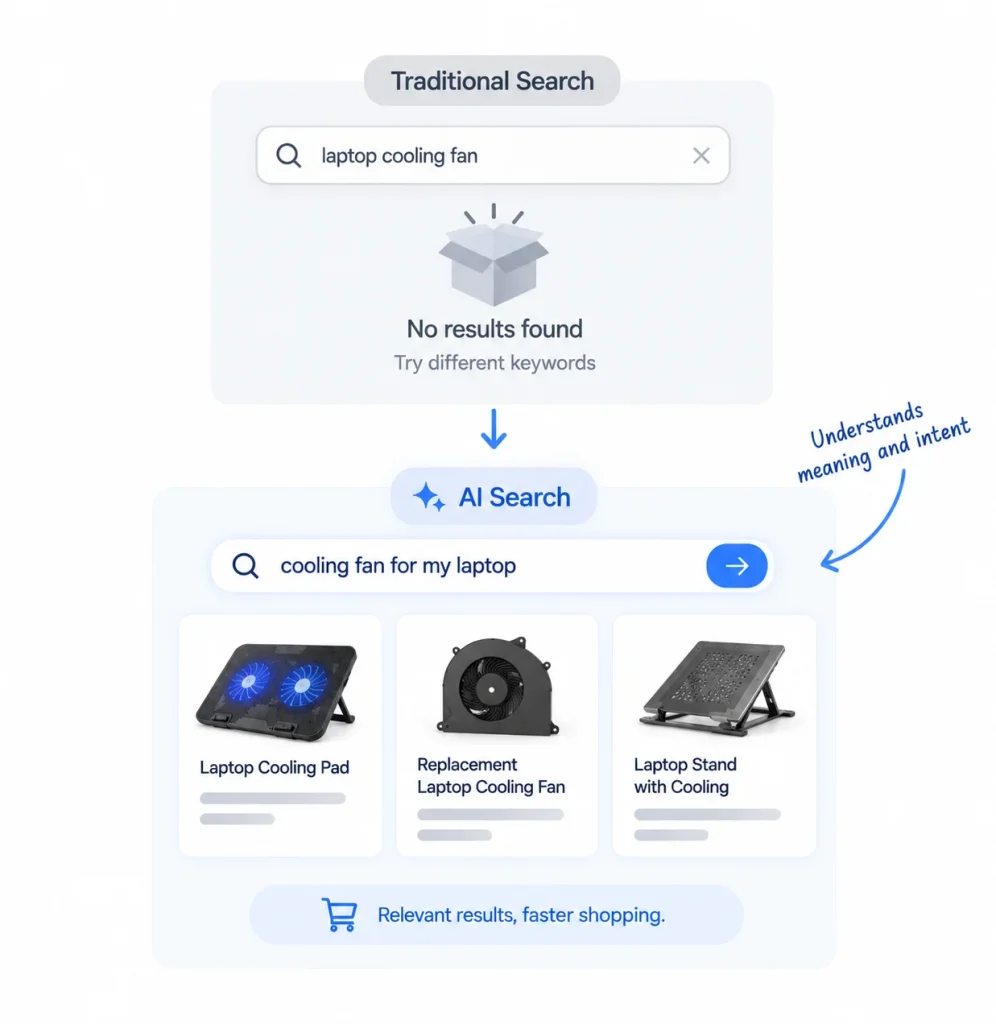
AI search for ecommerce is site-search technology that understands the meaning and intent behind a shopper’s query, instead of just matching their exact keywords against your product titles. Powered by large language models and vector search, it interprets what a customer actually means — “summer beach outfit” surfaces swimwear, sandals, and cover-ups even when none of those words appear in the query — and returns the products that genuinely fit, in milliseconds.
Traditional store search works like a filing clerk matching words letter-for-letter. AI search works like an experienced sales associate who understands concepts, context, and intent. That single difference is why AI ecommerce search has become the new standard for modern online retail.
What is AI search for ecommerce

AI search vs. traditional keyword search

The gap between old and new search shows up directly in revenue. Here’s how they compare:

Capability

Traditional keyword search

AI search for ecommerce

AI search for ecommerce
Exact words in the query vs. words in your catalog
Meaning and intent behind the query
Natural language
Breaks on full sentences
Built for “comfortable shoes for standing all day”
Typos & synonyms
Often returns zero results
“couch” finds “sofa,” “comptuer” finds laptops
Personalization
One result set for everyone
Adapts to each shopper’s behavior in real time
Zero-result searches
Common — and they send shoppers away
Rare — there’s almost always a sensible match
Business impact
Lost high-intent traffic
Higher conversions, AOV, and loyalty
If a shopper searches “comfortable ethnic wear” but your product is titled “Cotton Kurta,” basic search finds nothing. An intelligent engine understands the relationship and surfaces the right product instantly. That’s the whole point.

How AI search for ecommerce works

The technology is sophisticated, but the workflow is clear. Understanding it helps you evaluate platforms with confidence, because it tells you exactly what separates a genuine AI ecommerce search platform from a keyword box with a fresh coat of paint.
Catalog ingestion and enrichment.
The platform reads your entire catalog — titles, descriptions, attributes, images, metadata — then cleans, structures, and enriches it, adding context your raw data may be missing so every product becomes fully discoverable.
Vector embeddings.
Each product and query is converted into a mathematical representation that captures meaning. Products with similar meaning sit close together in this "vector space," which is how the system knows "automobile" and "car" belong together.
Hybrid retrieval.
The best platforms combine keyword precision (BM25) with semantic vector search, running both in parallel — the exactness of keywords and the intelligence of semantics in a single sub-200ms response.
Ranking and personalization.
Machine-learning models rank results by relevance, popularity, freshness, and individual shopper signals, retraining continuously on real clicks and purchases so results get smarter every week.
Continuous learning.
Every interaction teaches the system. Zero-result queries, conversion attribution, and revenue impact feed a loop that compounds in value over time.

The business case: why AI search matters now

Site search isn’t a minor feature — it’s where your most valuable visitors raise their hand. When it delights them, you capture revenue competitors are leaving on the table. Measured in the metrics U.S. retailers actually care about, upgrading to an intelligent ecommerce search platform typically delivers:

Rather than quoting a headline

percentage, measure your own baseline before and after against a control group. Our search relevance metrics and A/B testing guides cover the methodology, and a measured number you can defend is worth more in a board conversation than an industry average you can't.

The takeaway is simple:

every day your store runs on legacy keyword search, you're paying to acquire traffic and then failing to convert it. Better search recovers that lost revenue without spending a dollar more on ads.

Higher conversion on your highest-intent traffic.

Search users have already declared what they want, so relevance improvements land on the visitors closest to buying.

Higher average order value

as AI product discovery surfaces complementary items alongside the requested one.

Lower bounce rate

because shoppers can quickly find relevant products, explore with confidence, and continue toward purchase instead of abandoning the site.

Fewer zero-result searches.

Long-running UX research from the Baymard Institute consistently finds most sites failing the messy, human queries shoppers actually type, and industry analysis commonly puts around 31% of on-site searches returning nothing, usually from vocabulary mismatch rather than missing stock — every one is a customer with intent turned away.

How AI product discovery increases ecommerce conversion

Search is one surface of ecommerce search. AI product discovery is the whole set of paths a shopper takes to find something worth buying — search, category browse, faceted navigation, recommendations, and recovery when they hit a dead end.

Category ordering.

The highest-volume ecommerce search and discovery surface in most stores, and typically left at whatever default the platform ships. Applying the same relevance intelligence to browse ranking that you apply to search results is often the largest untapped gain available.

Zero-result recovery.

A dead end in ecommerce search wastes a visit from someone who declared intent. Alternatives, spelling corrections, and adjacent categories turn an exit into a second chance.

Per-visitor adaptation.

Session signals shape ecommerce search results within two or three interactions, which works for anonymous traffic — the majority on most stores.

Recommendations that share the ecommerce search brain.

When "similar products" and "customers also bought" run on the same understanding of your catalog as search, they get meaningfully better — and they stop contradicting each other, which shoppers notice even when they can't name it.

The compounding effect is what makes AI product discovery worth more than search alone: each surface improves the data the others learn from. Our product discovery guide covers the full surface map, and vector search personalization covers the adaptation layer.

Semantic search for ecommerce

Underneath almost everything above sits one capability: semantic search for ecommerce, which matches meaning rather than characters.
The failure it fixes is easy to see. Type “couch” into a keyword system where everything is labeled “sofa” and you get nothing — the product exists, but the words didn’t line up. Semantic search for ecommerce closes that gap by converting products and queries into vectors that capture meaning, so proximity replaces exact matching.

One caveat worth repeating, because vendors rarely volunteer it: semantic retrieval alone drifts on exact identifiers. A shopper typing a SKU gets "close enough," which in practice means wrong. That's why production ecommerce search runs hybrid — semantic understanding for descriptive queries, keyword precision for part numbers and model codes, fused into one result set.

Our what is semantic search guide covers the mechanics and what is hybrid search covers the fusion.

Conversational search for ecommerce

Conversational search for ecommerce adds something single-query ecommerce search can’t do: memory across turns.
Plenty of platforms now handle a long natural-language query in one shot — “warm waterproof jacket for winter dog walks under $150” returns sensible results. That’s excellent and it isn’t conversation. Conversation is what comes next: “in navy,” “something lighter,” “does it pack down small?” Each is meaningless alone. Understanding them requires remembering the jacket discussion already in progress.
Conversational search for ecommerce earns its cost in considered purchases — furniture, appliances, technical apparel, gifting — where shoppers genuinely narrow through several rounds. For commodity replenishment it’s overhead.
Two requirements separate working conversational search for ecommerce from a demo. Context must persist appropriately, holding constraints across turns but resetting cleanly when the shopper changes direction. And responses must stay grounded in real catalog data rather than generated from a model’s assumptions, or the system will confidently describe features a product doesn’t have. Our conversational search engine guide covers the architecture, and generative search covers composed answers more broadly.

How to choose the best ecommerce search engine

Seven auto parts search requirements, ordered by how much damage their absence causes.

01

Semantic understanding

Matches intent, not just keywords — the core capability everything else rests on

02

Conversational / natural language search

"Gift for mom who loves gardening" should return a sensible, curated set

03

Speed

Sub-200ms cached, under 400ms cold — latency directly affects conversion

04

Personalization

Results adapt to each shopper's history and behavior in real time

05

Merchandising controls

Pin bestsellers, boost high-margin items, bury out-of-stock products on demand

06

Deep analytics

Real-time dashboards for zero-results, conversion attribution, and revenue impact

07

Native integrations

Pre-built connectors for Shopify, BigCommerce, Magento, WooCommerce, plus a REST API for headless stacks

08

Enterprise security

TLS 1.3, private VPC, GDPR-compliant handling — your data stays yours

09

Reliability at scale

Proven uptime (99.99%) and the ability to handle real traffic without degrading

A note on platforms. Incumbents like Algolia and Hawksearch popularized ecommerce search, but pricing and AI depth vary widely — Algolia’s per-search model can get expensive at scale, and legacy tools often bolt AI onto a keyword core. Newer, vector-native platforms like bCloud AI are built infrastructure-first for semantic search. For a side-by-side of the current options, see our roundup of the best AI ecommerce search platforms, and our Algolia alternative and Hawksearch alternative comparisons.

AI search and AI visibility: two sides of the same coin

Here’s a shift worth paying attention to. Shoppers aren’t only searching on your store with natural language — they’re asking ChatGPT, Gemini, Perplexity, and Google’s AI Overviews for product recommendations too. The same intent-understanding that powers a great on-site search experience is what determines whether external AI engines can understand and recommend your products.
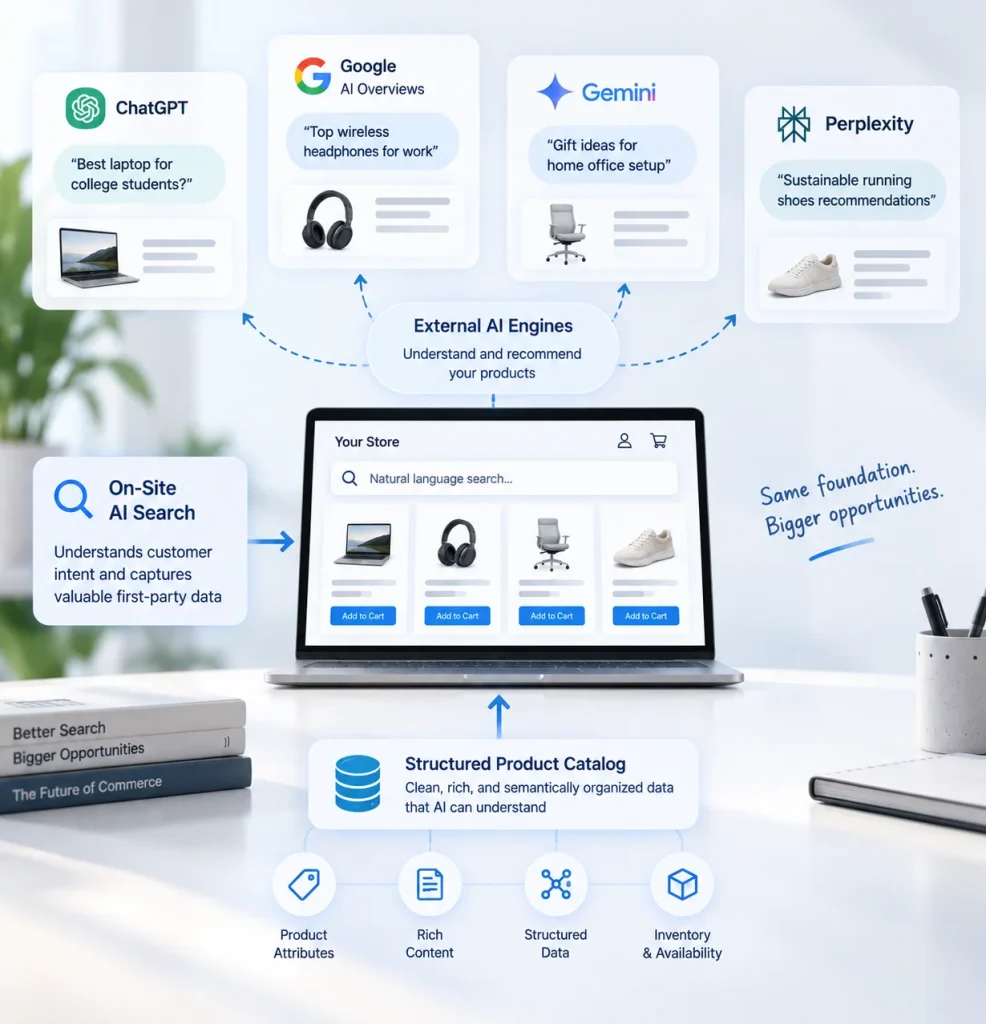
It’s not a coincidence. A clean, semantically structured catalog — the kind a real AI ecommerce search engine builds — is exactly the data AI answer engines read when deciding what to surface. And an on-site AI assistant captures first-party data on the real questions your customers ask, which is gold for the content and product attributes that earn AI recommendations. If you’re thinking about getting recommended by AI, start with our guide to AI visibility for ecommerce. The foundation for both is the same: a catalog an AI can actually understand.

What to require from a platform

Seven auto parts search requirements, ordered by how much damage their absence causes.

Demoing with clean queries only. Test typos, synonyms, and full sentences — that's where the difference lives.

Ignoring zero-result data. The searches that return nothing are a direct map of lost revenue; the right platform turns them into a feedback loop.

Treating speed as a "nice to have." Latency is a conversion lever. Sub-200ms isn't a vanity metric.

Overlooking merchandising. Relevance is table stakes; the ability to boost margin and bury out-of-stock items is what protects profit.

Forgetting the headless path. If you're on (or moving to) a React/Vue/Next.js storefront, confirm there's a real REST API, not just a plugin.

Where this is heading

Search is becoming the storefront’s brain — understanding intent on your site, feeding the AI engines that recommend you off it, and increasingly powering shopping agents that compare and act on a buyer’s behalf. The retailers who win are the ones whose catalog is easy for AI to understand and trust. Clean data, semantic understanding, and search that reads intent — that’s the foundation that pays off across every channel a shopper uses.

Ecommerce FAQs

What is AI product discovery, and how is it different from search?
AI product discovery covers every path a shopper takes to find something — search, category browse, faceted navigation, recommendations, and zero-result recovery. Search is one of those paths. Since only a minority of shoppers use the search box, improving search alone addresses a fraction of discovery; improving the whole set is where the conversion gain compounds.
It depends on your catalog. Conversational search adds memory across turns, so shoppers can refine with “in navy” or “something lighter” without restating context. That earns its cost for considered purchases like furniture, appliances, and gifting, where buyers narrow through several rounds. For commodity reordering it’s usually overhead.
AI search for ecommerce is site-search technology that understands the meaning and intent behind a shopper’s query rather than matching exact keywords. Using large language models and vector search, it returns relevant products even when the wording doesn’t match — for example, surfacing swimwear and sandals for “summer beach outfit.”
There’s no single answer — the best ecommerce search engine depends on your catalog size, tech stack, and team. The criteria that matter are consistent, though: genuine semantic understanding, natural-language and conversational search, sub-200ms speed, real-time personalization, merchandising controls, deep analytics, native integrations (Shopify, BigCommerce, Magento, WooCommerce, plus a REST API), and enterprise security. Evaluate vendors against those, and test each demo with messy, human queries. bCloud AI is built vector-first specifically for these requirements.

Keyword search matches the exact words in a query against your catalog and fails when they don’t line up. AI search interprets the meaning and intent behind the query, handles typos and synonyms automatically, understands full sentences, and personalizes results — so shoppers find the right product even when they don’t use your exact terms.

Yes. Leading AI ecommerce search platforms offer direct syncing for Shopify, BigCommerce, Magento, and WooCommerce, plus a REST API for headless React, Vue, or Next.js storefronts.
No. A well-built platform loads a lightweight asynchronous script and edge-caches responses, returning results in under 200ms cached — often faster than native store search.

Indirectly, yes. The clean, semantically structured catalog that powers strong on-site AI search is the same data external AI engines read when deciding what to recommend, and an on-site AI assistant reveals the real questions shoppers ask — both of which support your AI visibility.

See AI search for your store.

The right intelligent search platform pays for itself in recovered revenue. See how bCloud AI turns shopper intent into conversions — clean, semantic, sub-200ms search built for commerce, without spending more on ads.
Scroll to Top