
What is query understanding?
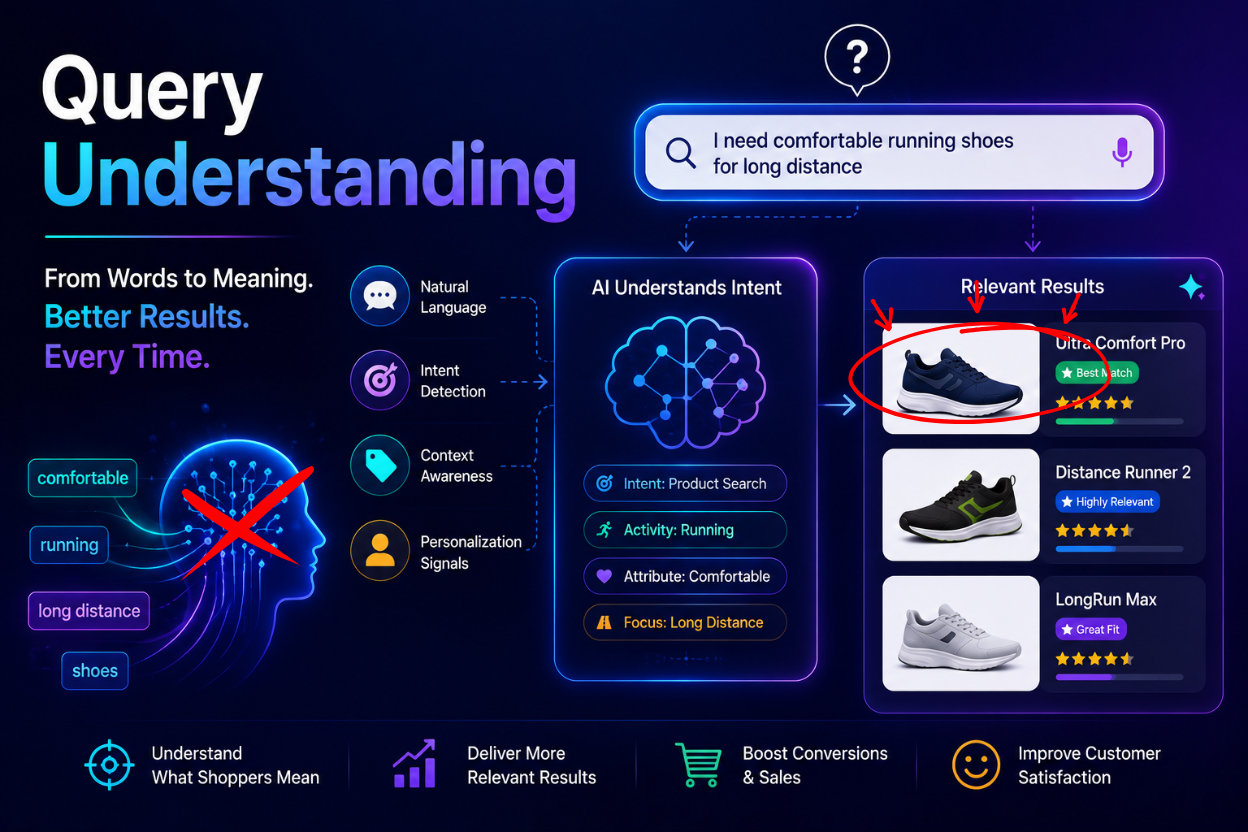
Think of query understanding as the translator between how humans type and what a search engine needs. Shoppers use synonyms, misspellings, abbreviations, natural language, and implicit constraints; query understanding turns that messy human input into a clean, structured, machine-actionable request. Our AI ecommerce search guide shows how this front-end layer feeds the rest of the search flow.
Why query understanding matters for ecommerce
Search visitors are your highest-intent shoppers, and they express that intent in ways that break naive search. Strong query understanding is what turns those raw, imperfect queries into sales. A few reasons it matters so much:
- It rescues failed searches. Typos, synonyms, and descriptive phrases are the top causes of zero results — the average store loses around 31% of searches to them, and good query understanding recovers most.
- It unlocks natural language. As shoppers increasingly search (and speak) in full sentences, query understanding is what lets “a warm jacket for a winter wedding” return sensible results instead of nothing.
- It powers filtering by intent. Extracting a price ceiling or a color from a query lets the engine apply the right filters automatically, no manual clicking required.
- It’s the foundation for AI and voice search. Every conversational or voice experience depends on query understanding to interpret what was asked. Baymard Institute’s search UX research repeatedly shows stores underperform on exactly the query types query understanding is built to handle.
How query understanding works
Query understanding is a pipeline of steps that run in milliseconds before retrieval. A raw query enters, and a series of processes clean and enrich it. First the query is normalized — lowercased, stripped of extra whitespace, tokenized into meaningful units. Spelling is corrected and the language detected. Then the harder work begins: the system classifies the intent behind the query, extracts entities and attributes (category, brand, color, size, price), expands the query with synonyms, and often rewrites it entirely into a cleaner form. The output is a structured, enriched query that retrieval can act on precisely.
The example that captures it: “blue running shoes under $150” enters as plain text, and query understanding turns it into a structured request — category = footwear, activity = running, color = blue, price_max = 150 — so the engine retrieves and filters correctly. That transformation is the essence of query understanding, and it’s why two stores running the same retrieval engine can deliver wildly different result quality.
AI Search Grader by bCloud AI
Grade your ecommerce search in 10 quick questions
31% of ecommerce searches return zero results — and most shoppers who hit a dead end leave for a competitor. How does your store's search stack up?
Answer 10 short questions and get your AI search score, plus a personalized report to fix the gaps. Free, takes about 2 minutes.
No signup needed to take the quiz.
Understanding intent…
Scoring your answers across relevance, AI, experience, and insights.
Your AI search score is ready
Tell us where to send your personalized report. You'll see your score and recommendations right away.
Your score by pillar
Personalized recommendations
Fix the gaps in weeks, not quarters
bCloud AI replaces keyword-only search with hybrid AI retrieval — sub-200ms responses, 99.99% uptime, and conversion lifts of up to 40% across 50+ implementations.
The 7 query understanding techniques that matter
Here are the seven components of query understanding that make the biggest difference for ecommerce.
1. Spell correction and typo tolerance
Shoppers misspell constantly (“comptuer,” “addidas”). Query understanding corrects or tolerates these so a typo never produces zero results. This is often the single highest-ROI piece of query understanding.
2. Query normalization and tokenization
Lowercasing, trimming, handling punctuation, and splitting the query into meaningful tokens (including multi-word terms like “running shoes”) so downstream steps work on clean input.
3. Intent classification
Determining what kind of search this is — a specific product (navigational), a broad browse (informational), or a ready-to-buy query (transactional). Routing each intent appropriately is a core query understanding job; a SKU lookup and a vibe-based browse deserve different handling.
4. Entity and attribute extraction
Pulling structured attributes from the query — category, brand, color, size, material, and constraints like price or availability. This is what lets query understanding apply filters automatically, turning “red dress under $80” into a filtered, precise search.
5. Query expansion (synonyms)
Broadening the query to include related terms so “couch” also matches “sofa” and “sneakers” matches “trainers.” Good query understanding expands recall without drifting off-intent.
6. Query rewriting
Reformulating vague, verbose, or conversational queries into a cleaner form the engine handles better. Increasingly done with LLMs, query rewriting is a powerful part of modern query understanding — turning “something nice to wear to my friend’s beach wedding” into a structured apparel search.
7. Language detection and multilingual handling
Identifying the query’s language and routing it correctly, essential for international stores. Robust query understanding handles multiple languages and even mixed-language queries.
Together, these seven steps convert raw shopper input into a precise, structured request — the quiet work that determines whether retrieval succeeds.
When query understanding tries too hard
Interpreting a query is helpful. Over-interpreting one is not.
Each technique above can misfire in the same direction, by assuming more than the shopper said. Four failures show up most often, and all four are quietly frustrating.
Correcting a real word.
Brand names often look like typos. If the system “fixes” one, the shopper gets results for something else entirely and no explanation.
Filtering on a guess.
Extracting “cheap” as a hard price cap can hide products the shopper would have bought. Consequently soft ranking beats a strict filter for vague words.
Expanding too far.
Loose synonyms widen recall until precision collapses. Therefore review your expansion list the same way you review boost rules.
Rewriting silently.
If the query was changed, say so on the results page. A short note lets the shopper undo it rather than assume your catalog is wrong.
In short, make every interpretation visible and reversible. Confidence thresholds help too, since a weak guess should nudge ranking rather than rewrite the search. Our search relevance metrics guide covers how to catch these in your data.
Query understanding in the age of LLMs
Large language models transformed query understanding. Where older systems relied on hand-built synonym lists and rules, an LLM can read a query and extract intent, constraints, and implicit requirements directly — even ones the shopper didn’t state explicitly. “Blue running shoes under $150” becomes a fully structured request without anyone maintaining a rulebook. This is why modern AI search feels so much smarter at the front door: the query understanding layer genuinely comprehends language.
That same capability powers conversational and voice search, where multi-turn context (“show me cheaper ones,” “in black”) must be understood as part of one evolving query. bCloud AI’s conversational AI layer applies exactly this LLM-driven query understanding, and it pairs with strong embedding models for retrieval so intent flows cleanly from the query into the results.
How to improve query understanding in your store
Practical steps to strengthen query understanding:
- Mine your search logs. Your zero-result and low-conversion queries are a precise map of where query understanding is failing — start there. Tie this to your search relevance metrics.
- Add or upgrade spell correction and synonyms. Often the fastest wins.
- Adopt semantic understanding. Move beyond keyword rules to a system that interprets meaning, so descriptive and natural-language queries work.
- Extract attributes for auto-filtering. Turn constraints in the query into filters automatically.
- Use a platform with LLM query understanding built in. Rather than maintaining rules, a managed AI search platform handles query understanding end to end. bCloud AI’s AI search engine ships query understanding, retrieval, and reranking together — see the best AI ecommerce search platforms for the field.
Common query understanding mistakes to avoid
- Treating queries as literal keywords. The biggest mistake — real query understanding interprets meaning, not text.
- Ignoring typos and synonyms. They’re the leading cause of zero results.
- Skipping intent. Handling a SKU lookup and a broad browse identically frustrates both shoppers.
- No attribute extraction. Forcing shoppers to manually filter what they already stated in the query adds friction.
- Never measuring. Track zero-result and reformulation rates to see where query understanding breaks.
Real-World Query Examples: Before and After AI Understanding
The easiest way to understand the value of query understanding is to compare how a traditional keyword search interprets a query versus an AI-powered search engine. Instead of matching isolated words, modern query understanding identifies customer intent, product attributes, and shopping context before retrieval begins.
Why this matters: Better query understanding doesn’t simply improve search relevance—it reduces the number of searches customers need before finding the right product. That creates faster shopping journeys, higher customer satisfaction, and stronger conversion rates across the entire ecommerce experience.
Frequently asked questions
What is query understanding in ecommerce search?
Query understanding is the layer of a search system that interprets what a shopper means before retrieval — correcting typos, classifying intent, extracting attributes like category and price, expanding synonyms, and rewriting the query. It turns messy human input into a precise, structured request the engine can act on.
Why is query understanding important?
Because search visitors are high-intent but express themselves imperfectly. Strong query understanding rescues failed searches from typos and synonyms, unlocks natural-language and voice search, and enables automatic filtering by intent — directly improving conversion. Weak query understanding causes zero results and lost sales.
What are the main components of query understanding?
Key components include spell correction and typo tolerance, normalization and tokenization, intent classification, entity and attribute extraction, query expansion with synonyms, query rewriting, and language detection. Together they transform a raw query into a structured, enriched request.
How do LLMs improve query understanding?
Large language models can read a query and directly extract intent, constraints, and implicit requirements without hand-built rules, and they maintain context across multi-turn conversational and voice searches. This makes query understanding far more accurate than older synonym-list and rule-based approaches.
How do I improve query understanding on my store?
Mine your search logs for failing queries, upgrade spell correction and synonyms, adopt semantic understanding, extract attributes for automatic filtering, and consider a managed AI search platform with LLM-based query understanding built in. Then measure zero-result and reformulation rates to track progress.
Understand what shoppers mean, not just what they type.
bCloud AI reads intent, fixes typos, and extracts constraints automatically — LLM query understanding that turns messy queries into sales. Start free or book a demo.
bcloud.ai