
What is vector search personalization?
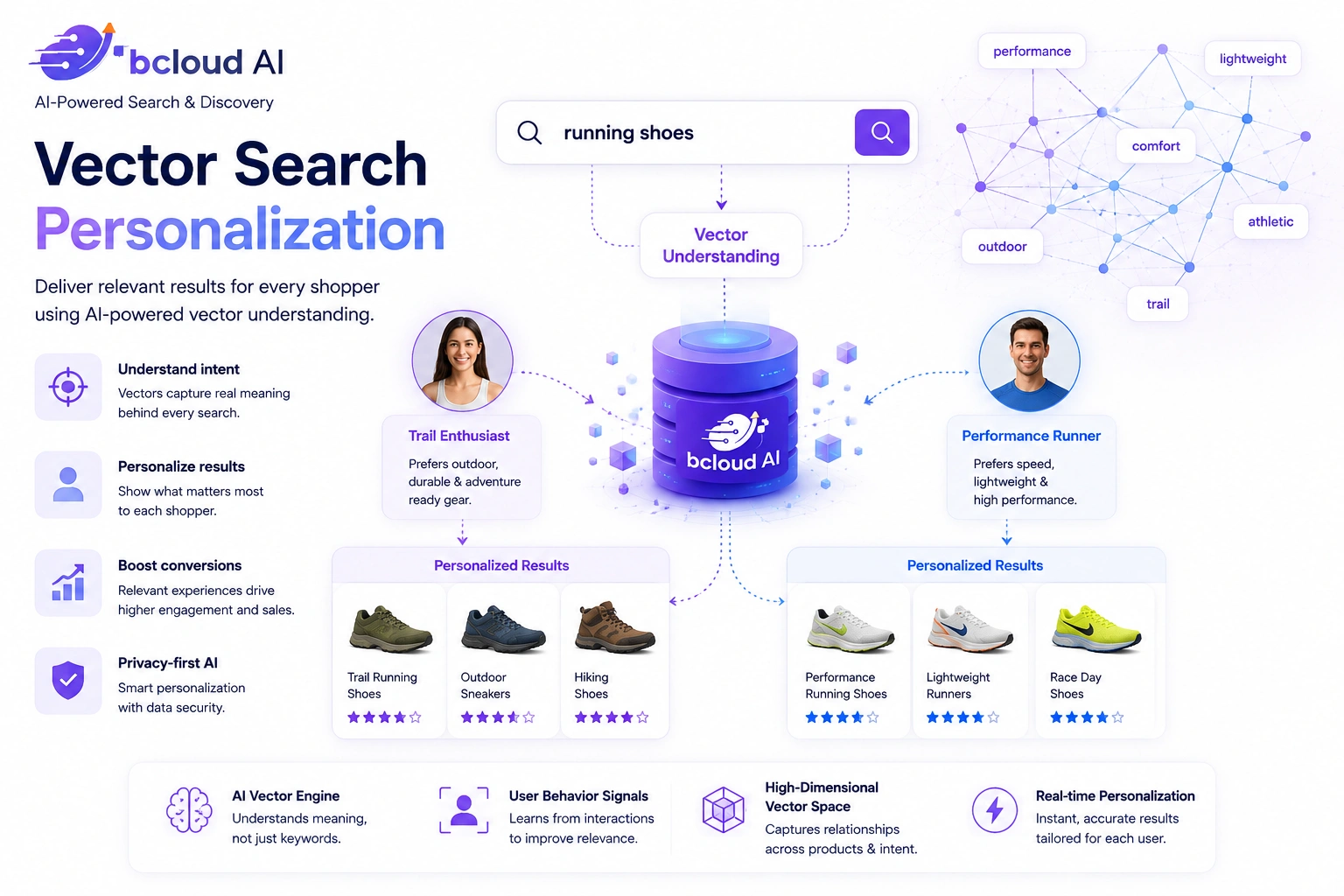
The key insight is that the same mathematics powering semantic matching powers personal matching. If you already convert queries and products into vectors — the foundation covered in what is vector search — then a shopper’s history can be converted too, and “products like the ones this person loves” becomes a nearest-neighbor problem. Search personalization stops being a rules engine and becomes geometry.
How shoppers become vectors
There are three main ways to represent a person as an embedding, and mature systems blend all three.
Cold-start deserves a plain answer: new visitors have no history, so search personalization must degrade gracefully. Good systems fall back to strong unpersonalized relevance, lean on session signals the moment they exist (two product views is already signal), and borrow from similar-shopper patterns. Personalization should be a bonus layer on excellent baseline search — never a crutch for weak relevance.
AI Search Grader by bCloud AI
Grade your ecommerce search in 10 quick questions
31% of ecommerce searches return zero results — and most shoppers who hit a dead end leave for a competitor. How does your store's search stack up?
Answer 10 short questions and get your AI search score, plus a personalized report to fix the gaps. Free, takes about 2 minutes.
No signup needed to take the quiz.
Understanding intent…
Scoring your answers across relevance, AI, experience, and insights.
Your AI search score is ready
Tell us where to send your personalized report. You'll see your score and recommendations right away.
Your score by pillar
Personalized recommendations
Fix the gaps in weeks, not quarters
bCloud AI replaces keyword-only search with hybrid AI retrieval — sub-200ms responses, 99.99% uptime, and conversion lifts of up to 40% across 50+ implementations.
Where the person enters the pipeline
There are three insertion points, and where you personalize matters as much as whether you do.
The pragmatic architecture for most stores: personalize primarily at reranking, add gentle retrieval-time blending only after you can measure its effect, and reuse the user vector everywhere else.
5 proven wins from vector-based search personalization
The failure modes — and how to avoid them
Search personalization has sharp edges, and pretending otherwise is how teams get burned.
Over-personalization. Weight the user too heavily and search stops answering the query — the shopper searching “formal dress shoes” gets sneakers because they usually buy sneakers. The guardrail: the query always dominates, personalization only reorders among genuinely relevant candidates, and you cap the personal signal’s influence.
Filter bubbles. Feeding people only what they’ve engaged with narrows discovery and, over time, suppresses the serendipity that grows baskets. Inject controlled exploration — a slice of diverse, non-personalized results — and measure long-term engagement, not just next-click.
Stale vectors. A taste vector that still thinks it’s December is worse than none. Recency-weight aggressively, let session signals override history, and expire dormant components.
Privacy and trust. Personalization must run on first-party behavioral data, disclosed plainly, with sane retention. The moment it feels like surveillance, the conversion math inverts. This is also a durable advantage of on-site search personalization over third-party targeting: the data is yours, consented, and contextual.
Unmeasured “wins.” Personalization is exactly the kind of change that demos well and needs proof. Hold out a control group permanently — not just at launch — because personalization quality drifts as models and catalogs change. Your search relevance metrics should be segmented personalized-vs-control forever.
A worked example: one query, three layers
Search personalization is easiest to trust when you can watch it move a single result, so trace one shopper through the stack.
Maya has bought trail-running gear twice this year and spent this session comparing wide-toe-box shoes. Her long-term taste vector sits near trail and outdoor products; her session vector, built from the last six product views, sits even more precisely near wide-fit trail shoes. She types “running shoes.”
Without search personalization, retrieval returns the globally strong candidates — bestselling road shoes up top, trail options on page two. Perfectly relevant, personally wrong.
With retrieval-time blending, her query embedding is nudged a small, capped amount toward her session vector before the nearest-neighbor lookup. Trail-oriented candidates now enter the pool that would otherwise have missed the cut. The query still dominates — these are all running shoes — but the neighborhood shifted.
At reranking, each candidate is scored on similarity to Maya’s vectors alongside the usual relevance and business signals. Wide-fit trail shoes rise into the top five; narrow road racers fall without disappearing. She sees her version of “running shoes,” and if she’d searched something contradicting her history — “dress shoes for a wedding” — the query-dominant design means her trail affinity would barely register. That asymmetry is the mark of search personalization done right: history whispers, the query speaks.
The metrics that keep personalization honest
Because this is a change that always demos well, hold it to numbers permanently. Four are enough. Personalized-vs-control conversion from an always-on holdout is the headline — search personalization that can’t beat its control doesn’t deserve its complexity. Click position delta shows whether the right products actually moved up for each shopper. Result diversity guards the filter-bubble edge: if personalized result sets narrow over time, exploration needs a bigger slice. And contradiction-query performance — queries that conflict with a shopper’s history — verifies the query is still winning. Segment all four by new versus returning visitors, since search personalization should show near-zero effect on first-time traffic and clear lift on repeat traffic; any other pattern means the fallback or the weighting is miscalibrated.
What search personalization changes elsewhere
Personalization does not stay inside the results list. It quietly breaks assumptions in other tools.
Once no two shoppers see the same order, several familiar workflows need rethinking. Otherwise teams end up debugging problems that are not problems. Four surface first.
In short, tell the wider team before you switch personalization on. A neutral preview mode solves most of the confusion on its own. Our ecommerce search analytics guide covers how to segment the reporting.
Build vs. buy for search personalization
Building it yourself means an embedding pipeline for users and sessions, a feature store, retrieval-or-rerank integration, exploration logic, and a permanent experimentation harness — a serious, ongoing program on top of the search stack you already maintain. It’s the right call for engineering-led companies where discovery is the product.
For most retailers, the managed route is faster and safer: an AI-native platform where search personalization ships as part of the engine — user and session vectors maintained automatically, personalization applied at rerank with relevance protected, and impact measured against a built-in control. bCloud AI’s AI search engine works this way, so no two shoppers see identical results and the lift is a reported number rather than a belief. Either way, the sequencing advice is the same: get baseline relevance excellent first — personalization multiplies good search and merely rearranges bad search.
Sequencing: when to turn personalization on
A short roadmap, because order matters more than ambition here. Quarter one: fix baseline relevance and instrument everything — search personalization multiplies good search and merely rearranges bad search, so relevance debt comes first. Quarter two: launch session-level personalization at the reranking stage only, behind a permanent holdout; session vectors need no history, help ambiguous queries immediately, and carry the least filter-bubble risk. Quarter three: add long-term taste vectors with aggressive recency weighting, and begin reporting the four honesty metrics above to whoever owns the P&L. Only after all of that earns its keep should retrieval-time blending or a learned two-tower model enter the conversation — they’re the highest-effort layers of search personalization and the easiest to get subtly wrong.
Teams that invert this order — shipping learned user embeddings onto mediocre relevance — spend a year debugging personalization that was never the problem. Teams that follow it typically see their first measurable search personalization lift within a single quarter, on infrastructure they already had.
Myth vs. Reality: Understanding Vector Search Personalization
As AI-powered search becomes more common, there are still several misconceptions about how vector search personalization works. Separating myths from reality helps businesses build customer experiences that are both effective and trustworthy.
The Bottom Line
Successful vector search personalization is about finding the right balance between customer intent and individual preferences. When implemented correctly, it enhances search relevance without limiting product discovery, creating a shopping experience that feels both intelligent and natural.
When Should You Personalize Search?
Not every search query benefits from personalization. The strongest AI search experiences know when to use shopper preferences—and when to rely entirely on the search intent. The goal is to enhance relevance, not override it.
Best practice: Effective personalization is selective rather than universal. AI should strengthen product discovery where customer preferences genuinely matter while preserving unbiased search results for precise or information-driven queries. This balance creates search experiences that feel intelligent without becoming unpredictable.
Frequently asked questions
What is vector search personalization?
It’s the technique of representing each shopper as an embedding in the same vector space as your products — built from their behavior and current session — and using that embedding to influence retrieval and ranking, so search results adapt to the individual in real time.
How does search personalization work with embeddings?
Shopper history is aggregated into a taste vector, the current visit produces a fast-moving session vector, and optionally a trained two-tower model learns user embeddings directly. Those vectors then blend into retrieval or, more safely, feed the reranker that orders relevant candidates per person.
Does personalization override what I searched for?
It shouldn’t. Well-built search personalization keeps the query dominant and uses personal signals only to reorder among genuinely relevant results. Systems that let the user vector outweigh the query produce the classic failure of showing your habits instead of your request.
How do you personalize for brand-new visitors?
Gracefully. With no history, results fall back to strong unpersonalized relevance, session signals kick in within a couple of interactions, and similar-shopper patterns fill gaps. Personalization is a layer on top of good baseline search, never a substitute for it.
Is search personalization worth it for smaller stores?
Usually yes, if baseline relevance is already solid — session-level personalization needs no long histories and helps immediately with ambiguous queries. Measure it with a held-out control so the lift is proven on your own traffic.
Is vector-based personalization privacy-safe?
It can and should be: it runs on first-party, on-site behavioral data rather than third-party tracking, disclosed in your privacy policy with sensible retention. That first-party foundation is both the compliance answer and the competitive one.
Same query, right results — for each shopper.
bCloud AI maintains user and session vectors automatically and personalizes at rerank with relevance protected, measured against a live control.