
Why search relevance metrics matter
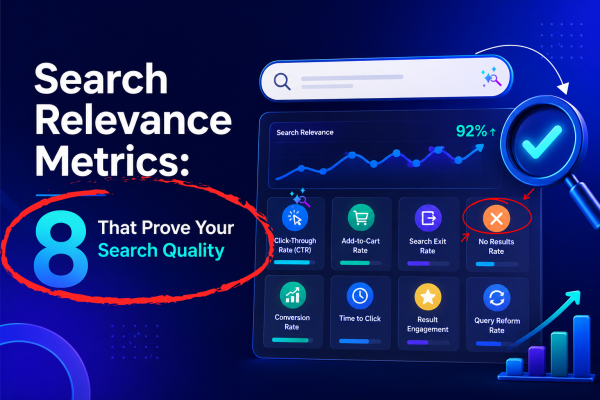
There are two families to track: relevance metrics (is the ranking good?) and business metrics (are shoppers succeeding?). You need both.
The 8 search relevance metrics that matter
1. Precision@k
The share of the top k results that are actually relevant. Precision@10 = 0.7 means 7 of the first 10 results belong there. It answers “how much of what I showed is useful?” — critical because shoppers rarely scroll past the first screen.
2. Recall@k
The share of all relevant products that appeared in the top k. Recall catches the opposite failure: relevant items your engine missed entirely. Low recall is often the hidden cause of a high zero-result rate.
3. F1 score
The harmonic mean of precision and recall — a single number when you need to balance “showing the right things” against “not missing things.” Useful for comparing candidates at a glance, though the two underlying numbers tell the fuller story.
4. MRR (Mean Reciprocal Rank)
The average of 1 ÷ (rank of the first relevant result) across queries. MRR rewards getting one right answer to the top — ideal for known-item and navigational searches like a specific SKU or brand, where the shopper wants one exact product fast.
5. MAP (Mean Average Precision)
The mean of average precision across all your test queries. MAP is order-sensitive across the whole result set, rewarding engines that rank all relevant items well, not just the first. It’s a strong overall relevance summary.
6. nDCG (Normalized Discounted Cumulative Gain)
The gold standard for ranked relevance. nDCG uses graded relevance (a perfect match scores higher than a so-so one), discounts results further down the page, and normalizes to 0–1 so you can compare across queries. If you track one ranking metric, track nDCG@10.
7. Top-3 (or top-k) hit rate
The share of searches where a relevant product lands in the top three. It’s blunt but intuitive and closely mirrors real shopper behavior — and it’s the metric bCloud recommends benchmarking on your own logs. Easy to explain to non-technical stakeholders.
8. Zero-result rate
The percentage of searches returning nothing. It’s the clearest single sign of a relevance (usually recall) failure and a direct revenue leak — the average store loses around 31% of searches to zero results. Lower is always better.
Business proxies to pair with these: click-through rate, average click position, search conversion rate, revenue per search, and pogo-sticking (shoppers bouncing back to results) all reveal whether good-looking rankings actually convert. Your ecommerce search analytics should surface these alongside the relevance numbers above.
AI Search Grader by bCloud AI
Grade your ecommerce search in 10 quick questions
31% of ecommerce searches return zero results — and most shoppers who hit a dead end leave for a competitor. How does your store's search stack up?
Answer 10 short questions and get your AI search score, plus a personalized report to fix the gaps. Free, takes about 2 minutes.
No signup needed to take the quiz.
Understanding intent…
Scoring your answers across relevance, AI, experience, and insights.
Your AI search score is ready
Tell us where to send your personalized report. You'll see your score and recommendations right away.
Your score by pillar
Personalized recommendations
Fix the gaps in weeks, not quarters
bCloud AI replaces keyword-only search with hybrid AI retrieval — sub-200ms responses, 99.99% uptime, and conversion lifts of up to 40% across 50+ implementations.
How to actually measure search relevance
Metrics are only as good as the process behind them. Here’s the practical workflow:
Build a judged query set.
Pull a representative sample from your real search logs — head terms, long-tail and descriptive queries, typos, and synonyms. This is your benchmark; without it, you’re guessing.
Add relevance judgments.
Decide, per query, which products are relevant (and how relevant, for graded metrics like nDCG). These come from human raters, merchandiser review, or click/conversion signals from your logs. Click-derived labels scale; human labels are cleaner — most teams blend both.
Run offline evaluation.
Compute precision, recall, nDCG, MRR, and MAP against your judged set. This is fast, repeatable, and perfect for comparing platforms or catching regressions before they reach shoppers — the same discipline behind a good hybrid search benchmark.
Validate online.
Offline metrics predict; online metrics prove. Confirm improvements with a live A/B test measuring conversion and revenue per search, since a ranking that scores well offline still has to convert. Interleaving is a faster online alternative for comparing two rankers.
A managed platform helps here: bCloud AI’s AI search engine trains ranking models on real search sessions and measures results against a control group, so relevance is tracked continuously rather than checked once. For the underlying technology, see our AI ecommerce search guide.
Reading your search relevance metrics
A score on its own means little. The pattern between scores is what points at a cause.
Four combinations show up repeatedly, and each one sends you to a different part of the stack. Recognising them saves days of guesswork.
Good recall, weak nDCG.
The right products are being found but ranked poorly. Therefore look at reranking and business signals rather than at retrieval.
Good precision, weak recall.
What you show is fine, but plenty is missing. The cause is usually thin product data or a retrieval layer that is too narrow.
Strong offline scores, flat conversion.
Relevance improved but shoppers did not respond. Consequently check the result page itself, including images, price display and load speed.
Everything looks fine, users disagree.
Your judged set has drifted from real traffic. Refresh it from recent logs before trusting any of the scores above it.
In short, always read two numbers together rather than one alone. Write down which metric each change should move too, so every release becomes a small prediction. Our ecommerce search analytics guide covers the business side.
Common mistakes with search relevance metrics
- Measuring only business metrics. Conversion tells you something changed; relevance metrics tell you why.
- Judging on clean queries. Test typos, synonyms, and descriptive phrases — that’s where relevance breaks.
- Ignoring recall. Precision looks great while relevant products silently never appear.
- One metric to rule them all. Pair a ranking metric (nDCG) with recall, a business metric, and zero-result rate.
- Offline only. Always confirm with an online test before declaring victory.
How Often Should You Measure Search Relevance?
Search quality isn’t something you evaluate once and forget. Every catalog update, ranking adjustment, or AI model change can affect relevance. Establishing a regular measurement schedule helps catch issues before they impact customer experience and revenue.
Weekly
Monitor zero-result rate, top search queries, and search conversion trends to identify immediate relevance issues.
Monthly
Review offline relevance metrics such as Precision@10, Recall@10, and nDCG using a representative benchmark query set.
After Major Changes
Whenever you introduce a new ranking model, indexing strategy, or AI search feature, rerun your complete relevance benchmark before deployment.
Best practice: Treat search relevance like site performance or security monitoring. Consistent measurement makes it easier to detect ranking regressions, validate improvements, and maintain a high-quality search experience as your catalog and customer behavior evolve.
Frequently asked questions
What are search relevance metrics?
Search relevance metrics are quantitative measures of how well a search engine returns the right results for a query. They include ranking metrics like precision, recall, nDCG, MRR, and MAP, plus business proxies like click-through rate, zero-result rate, and search conversion rate.
What is the best metric to measure search quality?
For ranked results, nDCG (Normalized Discounted Cumulative Gain) is widely considered the gold standard because it uses graded relevance and rewards putting the most relevant products at the top. Pair it with recall, zero-result rate, and a business metric like search conversion rate for a complete picture.
What’s the difference between precision and recall in search?
Precision measures how many of the results you showed are relevant; recall measures how many of all the relevant products you actually surfaced. High precision with low recall means you show good results but miss others — often the hidden cause of zero-result searches.
How do I measure search relevance for my store?
Build a judged query set from your real search logs, add relevance judgments (human or click-derived), compute offline metrics like nDCG and recall, then validate improvements with a live A/B test measuring conversion and revenue per search.
Are relevance metrics or conversion more important?
Both. Conversion and revenue per search prove business impact, but relevance metrics explain the cause and let you compare platforms objectively before shopper behavior data exists. Use relevance metrics to diagnose and business metrics to confirm.
Measure relevance, don’t guess it.
bCloud AI tracks search quality continuously — ranking, zero-results, and conversion against a live control — so every change is proven, not hoped. Start free or book a demo.
bcloud.ai