
What semantic search solutions actually do
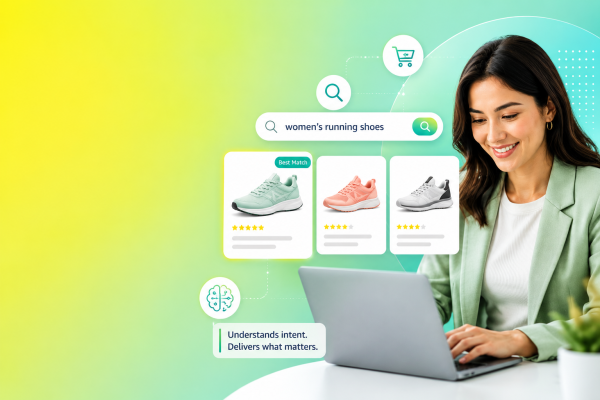
One thing to internalize before comparing vendors: in production, semantic-only is a liability. Pure vector retrieval drifts on exact identifiers — search a SKU and you get “close enough.” Every credible solution on this list therefore runs hybrid retrieval, pairing semantic matching with classic keyword scoring and fusing the results. When you evaluate the top semantic search solutions, you’re really evaluating how well each one blends the two, which our guide to hybrid search unpacks in detail.
Check whether search is your real problem first
Semantic search solutions fix relevance. They do not fix everything upstream of it.
Some teams switch platforms and see little change. That usually means the bottleneck sat somewhere else. Three checks tell you quickly, and each takes under an hour.
How many shoppers search at all?
If very few use the box, a better engine reaches almost nobody. Check placement and visibility first. Sometimes the fix is a bigger search field, not a new platform.
Do searchers already convert well?
Compare conversion for searchers against browsers. A healthy gap means search is working. Therefore your upside lies in getting more people to use it, rather than in relevance.
Where do failed searches actually end?
Read your top hundred zero-result queries. If most name products you genuinely do not stock, that is a range problem. No semantic layer invents inventory.
In short, confirm the leak is in relevance before shortlisting semantic search solutions. These numbers also become the baseline you judge any new platform against. Our search relevance metrics guide covers how to capture them.
The 8 top semantic search solutions for e-commerce in 2026
Each entry below notes what the platform does best and the trade-off worth knowing. Read them against your own constraints — the strongest of these semantic search solutions on paper is not automatically the strongest for your catalog.
1. bCloud AI — best overall for mid-market retailers
bCloud AI is a managed, AI-native platform combining hybrid BM25 + vector retrieval with conversational search, AI recommendations, and personalization on one stack. Response times run sub-200ms cached and under 400ms cold, ML ranking models retrain weekly on clicks and purchases, and the free tier is unusually generous — 20,000 searches and 100,000 catalog records per month, with free implementation and 24×7 support included, pay-as-you-go with no contract. Pricing is based on catalog size rather than per-search, so peak-season traffic doesn’t spike the bill. Native connectors cover Shopify Plus, BigCommerce, Magento, WooCommerce, and headless stacks. Best for: mid-market retailers who want semantic understanding included at every tier rather than gated.
2. Algolia (NeuralSearch) — best for developer-first teams
Algolia pairs famously fast keyword search (1–20ms) with a huge integration ecosystem, polished InstantSearch UI libraries, and a free Build tier of 10,000 requests per month. Its semantic layer, NeuralSearch, is the genuine article — but it’s available only on the top-tier Elevate enterprise plan, and usage-based pricing climbs with traffic. Best for: engineering-led teams that value developer experience and can reach the tier where semantics live. See our Algolia alternatives guide for the wider field.
3. Klevu — best for Shopify and Magento mid-market
Klevu built its reputation on strong NLP-driven discovery and merchandising automation, and it’s a well-established choice among Shopify and Magento retailers. Pricing is custom and quote-based with annual billing and a 14-day trial — no permanent free plan — and reviewers note a steeper configuration curve. Best for: catalog retailers on Shopify or Magento who want mature merchandising automation.
4. Constructor — best for revenue-optimized enterprise discovery
Constructor is commerce-native discovery that learns from clickstream and purchase behavior to optimize search, browse, and recommendations toward conversion and revenue rather than relevance alone. Strongest in high-SKU environments like fashion and marketplaces. Pricing is custom and sales-led with a 30-day trial. Best for: enterprise retailers prioritizing measurable revenue outcomes.
5. Coveo — best for multi-property enterprises
Coveo offers mature machine-learning ranking with hybrid retrieval and personalization spanning commerce and service or support properties — useful when you need unified search beyond the storefront. Enterprise pricing, and a correspondingly heavier implementation. Best for: large enterprises consolidating search across multiple properties.
6. Bloomreach Discovery — best as part of a full suite
Bloomreach blends AI search and merchandising with content and customer-data modules under one platform, and is a repeat analyst-recognized leader. It’s built and priced for large brands: quote-based, commonly reported at $50K+ per year, with implementations typically running 3–6 months, and real-time personalized search requiring both the Discovery and Engagement modules. Best for: enterprise retailers consolidating CDP, CMS, and search with one vendor.
7. Typesense — best open-source value
Typesense is a fast, Rust- and C++-lineage open-source engine with built-in vector search (S-BERT and E5 models), native hybrid retrieval, and conversational RAG. Self-hosting is free; Typesense Cloud prices on resources (RAM and CPU) with no per-search charges, starting in the low tens of dollars per month for entry configurations. Fewer commerce merchandising features out of the box. Best for: cost-conscious technical teams wanting open-source semantics without enterprise licensing.
8. Weaviate — best native hybrid for builders
Weaviate fuses BM25 keyword scoring, dense vectors, and metadata filtering in a single query, and ships built-in vectorization modules (OpenAI, Cohere, Hugging Face) so raw text can be embedded automatically. Arguably the most natively hybrid of the open engines. GraphQL adds a learning curve and self-hosting is resource-hungry. Best for: teams assembling a custom discovery stack who want semantic retrieval as a first-class primitive.
AI Search Grader by bCloud AI
Grade your ecommerce search in 10 quick questions
31% of ecommerce searches return zero results — and most shoppers who hit a dead end leave for a competitor. How does your store's search stack up?
Answer 10 short questions and get your AI search score, plus a personalized report to fix the gaps. Free, takes about 2 minutes.
No signup needed to take the quiz.
Understanding intent…
Scoring your answers across relevance, AI, experience, and insights.
Your AI search score is ready
Tell us where to send your personalized report. You'll see your score and recommendations right away.
Your score by pillar
Personalized recommendations
Fix the gaps in weeks, not quarters
bCloud AI replaces keyword-only search with hybrid AI retrieval — sub-200ms responses, 99.99% uptime, and conversion lifts of up to 40% across 50+ implementations.
SaaS semantic search solutions vs self-hosted: the delivery decision
The same capability arrives in two very different packages, and the delivery model shapes cost, speed, and staffing more than any feature comparison will.
SaaS semantic search solutions are fully hosted: the vendor operates the embedding models, vector index, fusion, and ranking while you integrate through connectors or an API. You get deployment in weeks rather than quarters, no machine-learning or infrastructure staffing, and continuous model improvements without migration projects. The trade-offs are configuration ceilings and vendor dependency. bCloud AI, Algolia, Klevu, Constructor, Coveo, and Bloomreach all sit here, and for the large majority of retailers this is the correct default — the operational weight of running semantic retrieval is precisely what you’re paying to avoid. The delivery model itself is covered in our search as a service guide.
Self-hosted semantic stacks — Typesense, Weaviate, Elasticsearch or OpenSearch with dense vectors, or a vector database plus your own pipeline — trade convenience for control: custom embedding models, bespoke ranking logic, data residency on your terms. The real cost is ownership: index operations, nearest-neighbor tuning, re-embedding migrations whenever you change models, and 24/7 reliability. Right for engineering-led companies where discovery is the product; expensive theater for everyone else.
A useful tiebreaker when comparing SaaS semantic search solutions against building: model the fully loaded three-year cost of each path at twice your current catalog and three times your traffic, including engineering salaries on the self-hosted side. SaaS usually wins that math until genuine mega-scale — and by the time you reach it, you’ll have the data to know.
How to evaluate semantic search solutions: the 5-test bench
Run every finalist through the same five tests, on your catalog rather than a demo index. This is what separates the top semantic search solutions from the ones that merely market well.
1. The messy-query test.
Pull a hundred real queries from your logs — typos, long descriptive phrases, half-remembered brand names, problem-framed searches like “shoes for standing all day.” Score which platform puts the right products on the first screen. Semantic understanding shows up here or nowhere, and decades of Baymard Institute research confirm these are exactly the query types most stores fail.
2. The exact-match floor.
Search precise SKUs, model numbers, and part codes. They must resolve literally, every time. If a vendor’s semantics drift on identifiers, the hybrid layer underneath is weak — a dealbreaker for B2B, electronics, auto parts, and any catalog with technical identifiers.
3. The speed test at your scale.
Sub-200ms at p95 and p99, measured with your catalog size and your real filters applied, under concurrent indexing load. Unfiltered latency on a small demo index predicts nothing about production, because nearly every real ecommerce query carries facets.
4. The measurement test.
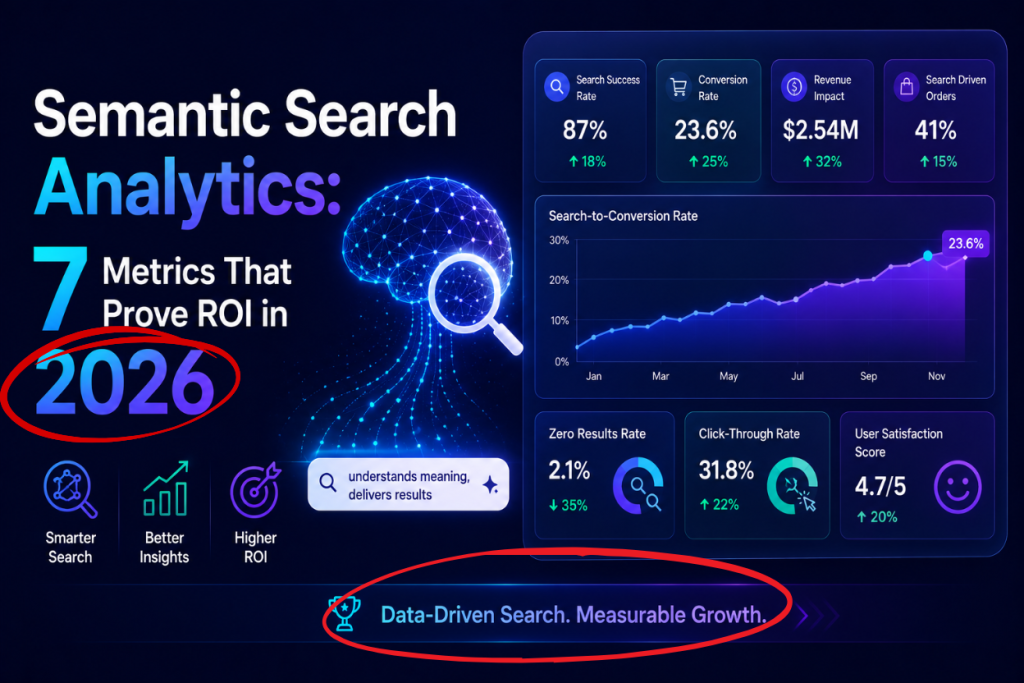
Can the solution prove lift — rollout against a control group, with search conversion, revenue per search, and zero-result rate reported? If quality is a slide rather than a dashboard, keep looking. The metric set is in our search relevance metrics guide, and the deeper quality layer in semantic search analytics.
5. The pricing-shape test.
Ask two questions: where does the semantic capability sit in your tiers? and what does my bill look like at three times this traffic? Several vendors reserve vector search for their top enterprise plan, which means the capability you’re evaluating them for may not be in the plan you’re quoted. Per-query models convert your best sales month into your worst invoice; catalog- or resource-based pricing stays flat through spikes.
Five mistakes that undermine semantic search solutions
- Buying semantics onto a thin catalog. Semantic search solutions can only understand meaning your product data actually expresses. Three-word titles and empty attributes cap every vendor’s ceiling on day one. Most retailers discover on audit that a meaningful share of their catalog has missing descriptions or poor categorization — enrichment first, vendor selection second, and ask each finalist whether they offer AI-assisted enrichment as part of onboarding.
- Judging semantic search solutions on the vendor’s demo data. Curated sample catalogs make every engine look brilliant. Your evaluation set should be your own worst hundred queries, especially the ones currently returning nothing.
- Treating semantic and hybrid as competing options. They aren’t. Hybrid contains semantic — the vector half is the semantic half, plus a lexical half for precision. A vendor pitching pure vector search as superior is describing a limitation. Our roundup of the best hybrid search systems compares the same field through that lens.
- Skipping the live test. Offline relevance gains that don’t survive an A/B test on conversion aren’t gains. Confirm with a traffic split before full rollout, per our A/B testing guide.
- Launching and walking away. Vocabulary shifts, catalogs grow, embeddings age. The teams that keep their advantage score quality monthly and re-embed on a cadence; the ones that treat it as a project lose ground within two quarters.
What changed in 2026
Three shifts reframe this year’s evaluation. First, semantic became baseline — the question moved from “does it understand meaning” to “how good is the hybrid blend, and is it in my tier.” Second, measurement became the differentiator: buyers now expect control-group proof of lift, and the vendors that can’t provide it are increasingly screened out. Third, the top semantic search solutions became the grounding layer for generative experiences — the composed, cited answers appearing on storefronts and inside AI assistants are built on exactly this architecture, as our generative search guide covers.
That last shift gives semantic search solutions a second job worth planning around: the same structured, semantically rich catalog that makes on-site search work is what external AI engines read when deciding which products to recommend. Investing in the top semantic search solutions now improves discovery on your own site and your visibility inside AI-generated answers — one project, two returns.
How AI Agents and LLMs Are Reshaping Semantic Search Solutions
Semantic search has rapidly evolved beyond understanding the meaning of a customer’s query. In 2026, the most competitive semantic search solutions are becoming the intelligence layer that powers AI shopping assistants, conversational commerce, and generative product discovery.
Modern shoppers increasingly ask complex questions instead of typing short keywords. Queries such as “Suggest a waterproof hiking backpack for a three-day trip under $150” or “Which office chair is best for long working hours?” require much more than matching keywords or even semantic similarity. They require reasoning over product attributes, customer intent, availability, pricing, and historical buying patterns.
This is where Large Language Models (LLMs) and semantic search work together.
Semantic Search Retrieves, LLMs Explain
Semantic search solutions remain responsible for retrieving the most relevant products from millions of catalog records within milliseconds. The LLM then uses those highly relevant results to generate natural, conversational responses instead of presenting a simple product list.
This architecture, commonly known as Retrieval-Augmented Generation (RAG), reduces hallucinations while ensuring that AI-generated answers remain grounded in your actual product catalog rather than the model’s general knowledge.
For ecommerce retailers, this means customers can receive detailed buying guidance without sacrificing search accuracy.
Personalization Is Becoming a Core Ranking Signal
Traditional semantic search focuses primarily on the meaning of a query. Modern AI-powered search platforms increasingly incorporate behavioral signals such as:
- Previous purchases
- Browsing history
- Preferred brands
- Budget preferences
- Recently viewed products
- Geographic availability
- Seasonal shopping behavior
Instead of serving identical results to every shopper, advanced semantic search solutions dynamically personalize rankings to increase relevance and conversion rates.
Rich Product Data Improves AI Responses
Even the most advanced semantic search platform depends on high-quality catalog information. Product titles alone are no longer sufficient.
Retailers with structured attributes, detailed descriptions, specifications, compatibility data, and rich metadata consistently achieve better AI-generated recommendations because LLMs have more context to reason over.
As a result, product enrichment has become just as important as the search engine itself.
Frequently asked questions
What are the top semantic search solutions for ecommerce?
The 2026 leaders are bCloud AI, Algolia (NeuralSearch), Klevu, Constructor, Coveo, Bloomreach Discovery, Typesense, and Weaviate. Managed platforms suit most retailers; open-source engines like Typesense and Weaviate suit teams with engineering depth. The right pick depends on catalog size, staffing, and whether semantic capability is included in the tier you can afford.
What are SaaS semantic search solutions?
Fully hosted semantic search delivered via API or connectors: the vendor operates the embedding models, vector index, and ranking while you integrate. They deploy in weeks with no machine-learning staffing and stay current without migration projects — the practical default for most retailers versus self-hosting the stack.
How do I choose between semantic search solutions?
Run a five-test bench on your own catalog: messy real queries, the exact-SKU floor, p95/p99 speed with your filters applied, provable measurement against a control group, and pricing modeled at three times current traffic. Then confirm the winner with a live A/B test on conversion and revenue per search.
Do semantic search solutions replace keyword search?
No. The best implementations are hybrid, running semantic and keyword retrieval together so descriptive queries and exact identifiers both resolve. Vector-only solutions drift on SKUs and model numbers; keyword-only systems fail natural language. Treat any vendor pitching semantic as a keyword replacement with caution.
Is semantic search worth it for a smaller store?
Usually yes, via a managed platform with a free or low-cost tier. The relevance gains on typos, synonyms, and descriptive queries apply at any catalog size, and SaaS delivery removes the operational cost that once made semantic search an enterprise-only architecture.
How much do semantic search solutions cost?
It varies widely by model. Open-source engines are free to self-host (you pay in infrastructure and engineering), resource-based cloud plans start in the low tens of dollars monthly, managed platforms range from generous free tiers to usage-based billing, and enterprise suites are commonly quoted at $50K+ per year. Model your real cost at three times traffic before signing.
Semantic understanding, included — not gated.
bCloud AI combines keyword precision with semantic intelligence in one sub-200ms engine, with 20,000 free searches, free implementation, and catalog-based pricing that doesn’t spike on Black Friday.
bcloud.ai