
What is vector search?
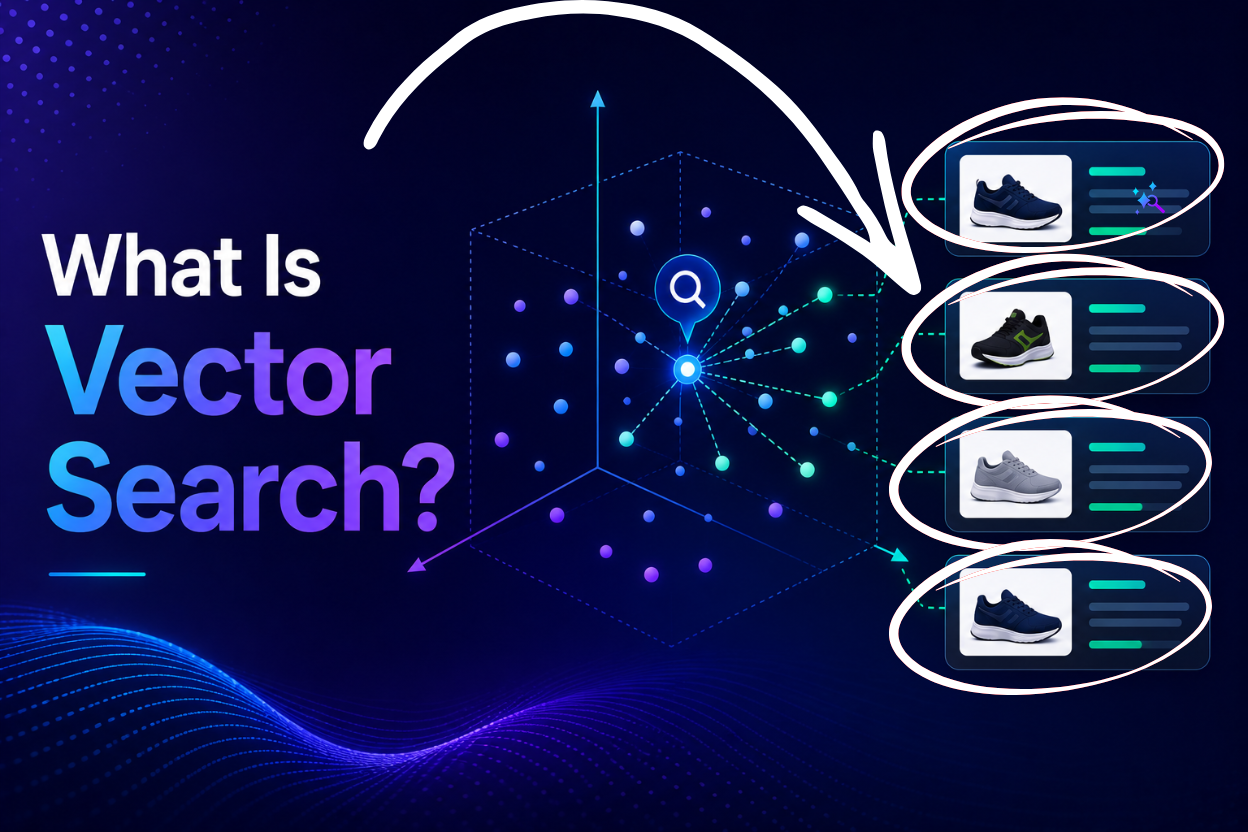
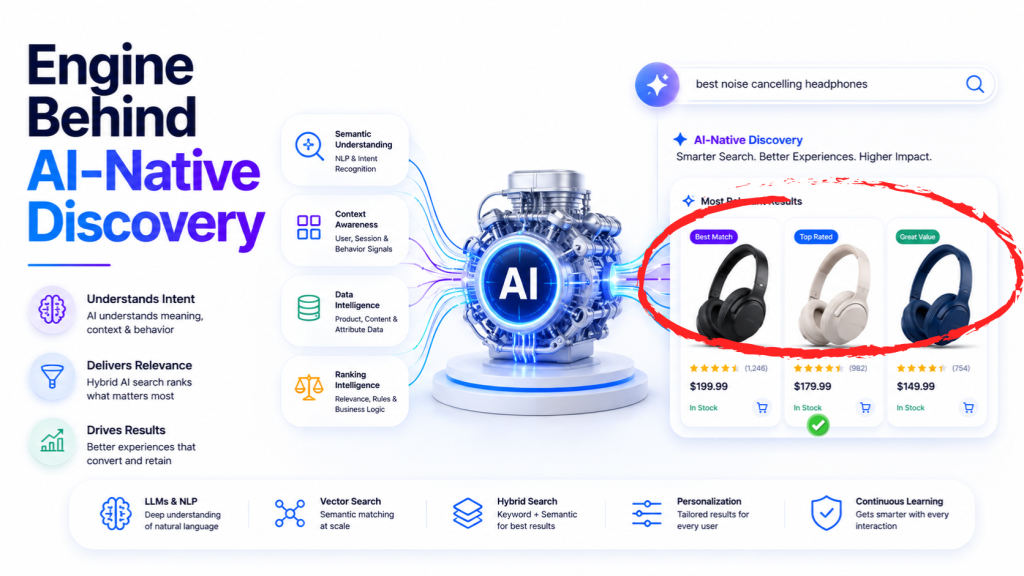
That’s the whole idea. When someone asks what is vector search, the honest one-sentence answer is: it’s search that measures similarity in meaning as a distance between points.
Here’s why that answer to what is vector search matters. In this numerical space, “couch” and “sofa” end up almost on top of each other, because the model that created those vectors learned they mean roughly the same thing. “Couch” and “carburetor” end up far apart. Nobody wrote a rule telling vector search that. The relationships came from the model reading enormous amounts of text and learning how words relate.
How does vector search work?
Understanding what is vector search requires walking through four stages. All of them happen in well under a second, even across millions of items.
Stage 1: Everything gets embedded.
An embedding model reads each item in your index and outputs a vector — commonly 768 to 3,072 numbers long. Those numbers encode meaning. This is a one-time cost per item, with incremental updates as your data changes. Which model you pick matters enormously, and our guide to embedding models compares the current field.
Stage 2: Your query becomes a vector too.
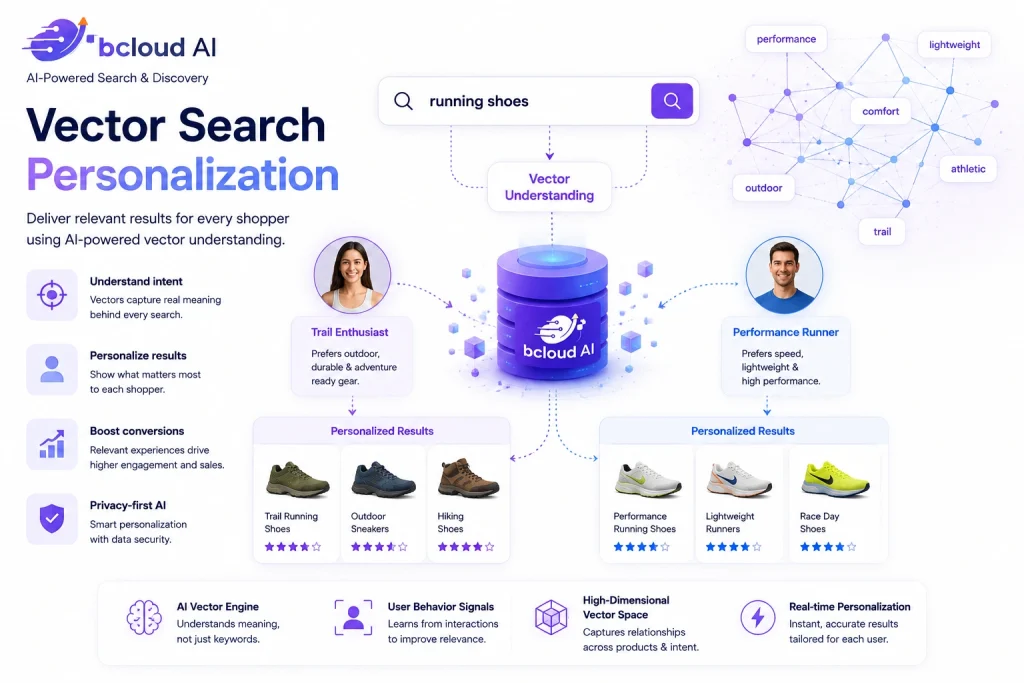
When someone searches, that query runs through the same embedding model and comes out as a vector in the same space. This shared space is the critical part — query and content are now directly comparable as geometry rather than as text.
Stage 3: The system finds nearest neighbors.
Now it measures which item vectors sit closest to the query’s, usually with cosine similarity. Comparing against every vector one by one would be far too slow at scale, so real systems use approximate nearest-neighbor algorithms. The dominant one is HNSW, introduced in this research paper, which most implementations still build on today. Approximate means vector search trades a tiny bit of perfect accuracy for enormous speed gains — a trade almost always worth making.
Stage 4: Results get reranked.
Most explanations of what is vector search stop before this stage, which is a mistake. Raw similarity isn’t the final word. A second model reorders candidates using signals like popularity, freshness, and conversion history, so the most useful results surface rather than just the most mathematically similar. Our explainer on search reranking covers this stage properly.
AI Search Grader by bCloud AI
Grade your ecommerce search in 10 quick questions
31% of ecommerce searches return zero results — and most shoppers who hit a dead end leave for a competitor. How does your store's search stack up?
Answer 10 short questions and get your AI search score, plus a personalized report to fix the gaps. Free, takes about 2 minutes.
No signup needed to take the quiz.
Understanding intent…
Scoring your answers across relevance, AI, experience, and insights.
Your AI search score is ready
Tell us where to send your personalized report. You'll see your score and recommendations right away.
Your score by pillar
Personalized recommendations
Fix the gaps in weeks, not quarters
bCloud AI replaces keyword-only search with hybrid AI retrieval — sub-200ms responses, 99.99% uptime, and conversion lifts of up to 40% across 50+ implementations.
What is a search vector, exactly?
Let’s demystify the jargon, since this trips people up. A search vector is simply the numerical representation of a query — the output of running what someone typed through an embedding model. If your model produces 1,536-dimensional vectors, that representation is a list of 1,536 numbers.
Individually those numbers mean nothing to a human. Collectively they encode position in “meaning space.” Two queries that mean similar things produce representations that sit near each other, even with zero words in common. “Affordable laptop for college” and “cheap student notebook computer” land close together, which is exactly the behavior keyword systems can’t replicate without hand-built synonym lists.
One practical consequence: dimensionality determines your storage and memory costs. A 1,024-dimension float32 vector is roughly 4KB, so ten million items means about 40GB of vector storage. Doubling dimensions doubles that bill. This is why “bigger model” isn’t automatically the right answer.
What vector search needs from your content
An embedding captures the meaning in a piece of text. It cannot capture meaning that is not there.
That single fact explains most disappointing rollouts. Vector search inherits whatever your records express, so the content sets the ceiling. Four things make a real difference.
Say what it is for.
Shoppers describe situations, not product names. A description mentioning the use case gives the model something to match against. A bare title does not.
Keep length roughly even.
Very short records embed weakly beside very long ones. Consequently your tail products lose ground for reasons unrelated to fit. Aim for a consistent minimum.
Strip the boilerplate.
Shipping notes and warranty text repeat across every product. Therefore they add noise and pull unrelated items closer together in the vector space.
Decide what goes in.
Title, description, category and key attributes usually earn their place. Price and stock rarely do, since those belong in filters rather than in meaning.
In short, read fifty tail records as a shopper would before you embed anything. If you cannot tell what several of them are, the model cannot either. Our embedding models guide covers the model half of this decision.
Semantic search vs vector search: what’s the difference?
The semantic search vs vector search question is the most common point of confusion, and it deserves a straight answer. People use these terms interchangeably, but they aren’t the same thing.
Semantic search describes the goal: returning results based on meaning and intent rather than exact words. It’s an outcome you’re trying to achieve.
Vector search describes a method: representing things as vectors and retrieving by distance. It’s a technique.
So in the semantic search vs vector search comparison, the relationship isn’t rivalry — it’s that one implements the other. Vector search is the most common way to achieve semantic search today, but not the only way. You could get semantic behavior from a large language model reasoning over documents, or from older techniques like latent semantic indexing.
That’s the short version of semantic search vs vector search, and the distinction matters practically. When a vendor says they offer semantic search, ask how. When they say vector search, you know the mechanism but should still ask about the embedding model and index. Framing the semantic search vs vector search question this way — outcome versus method — cuts through most marketing language you’ll encounter. If you want the meaning side in depth, see our companion guide on what is semantic search.
What is a semantic search vector database?
Once you have vectors, they need somewhere to live. A semantic search vector database is a database purpose-built to store embeddings and run fast nearest-neighbor queries against them — indexing, filtering, and retrieving by similarity rather than by exact-match lookups. Wikipedia’s overview of vector databases is a solid neutral primer if you want the formal definition.
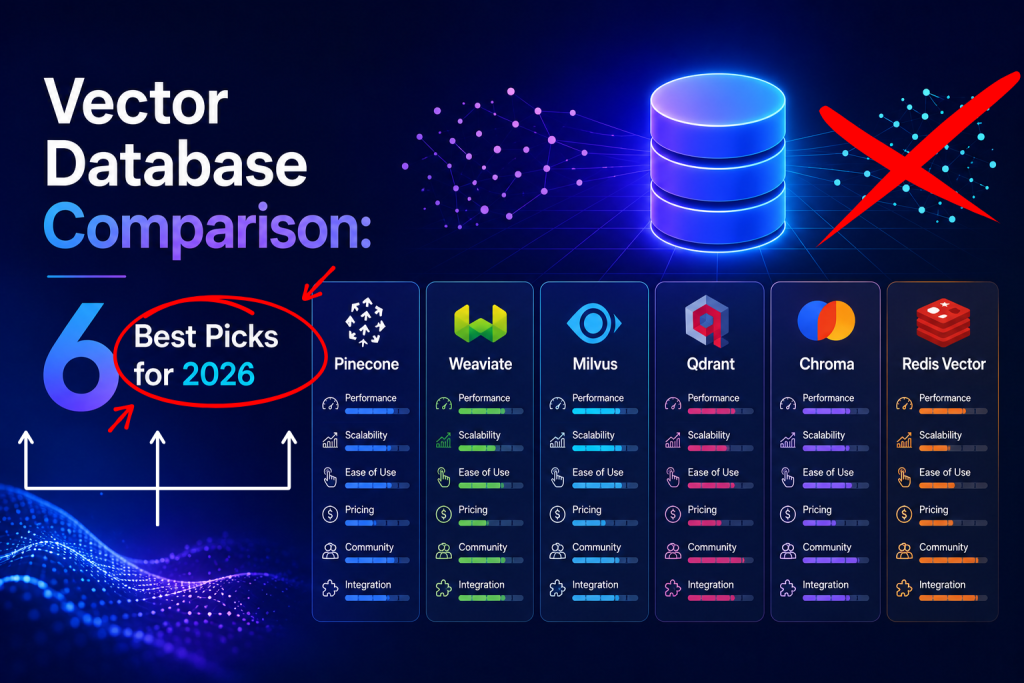
The main options fall into four camps. Dedicated systems like Pinecone, Qdrant, Weaviate, and Milvus are built specifically for this workload and often include native hybrid retrieval and metadata filtering. A Postgres extension (pgvector) adds a semantic search vector database capability to infrastructure many teams already run — usually the pragmatic pick below a few million vectors. General search engines like Elasticsearch and OpenSearch now support k-nearest-neighbor search alongside keyword matching. And managed AI search platforms bundle the index with everything around it.
Choosing a semantic search vector database comes down to four questions: how many vectors you’ll store, whether you want managed or self-hosted, whether you need native hybrid retrieval, and whether you’re already committed to a data platform. Our vector database comparison walks through the trade-offs in detail.
Worth saying plainly: a semantic search vector database is one component, not a finished product. You still need an embedding pipeline, hybrid blending, reranking, and an interface around it.
Vectorized search vs keyword search
You’ll also see this described as vectorized search — same technology, different label. Here’s how vectorized search compares to the keyword matching it’s often deployed alongside:
| Keyword search | Vectorized search | |
|---|---|---|
| Matches on | Exact characters | Meaning as distance |
| “Couch” finds “sofa”? | No | Yes |
| Typos | Usually fails | Handled naturally |
| Full sentences | Breaks down | Built for them |
| Exact SKUs / part numbers | Excellent | Can drift to “close enough” |
| Maintenance | Synonym lists and rules | Model selection and reindexing |
| Zero results | Common | Rare |
Neither wins outright, which surprises people learning what is vector search for the first time. Keyword matching is genuinely more precise for exact identifiers. Vectorized search is better at everything human and imprecise. That’s why serious production systems in 2026 run hybrid retrieval — both methods in parallel, results fused together, usually with Reciprocal Rank Fusion. You get precision and understanding rather than picking one. Our guide to hybrid search systems explains the blending mechanics.
Where this technology shows up
Vectorized search stopped being niche a while ago. You’re interacting with it constantly:
- AI assistants and RAG. Retrieval-augmented generation — grounding an AI’s answer in real documents — is built entirely on this retrieval method. It’s how ChatGPT, Gemini, and Copilot find relevant material before writing an answer.
- Ecommerce product discovery. Matching shoppers to products by intent.
- Recommendation engines. “More like this” works by finding nearby vectors.
- Image and multimodal search. Photos can be embedded too, which is what makes visual search possible.
- Enterprise document search. Finding the right file by describing what it covers.
Vector search is the through-line in every answer to what is vector search: anywhere meaning matters more than exact wording, this is the machinery underneath.
Why it matters for online stores
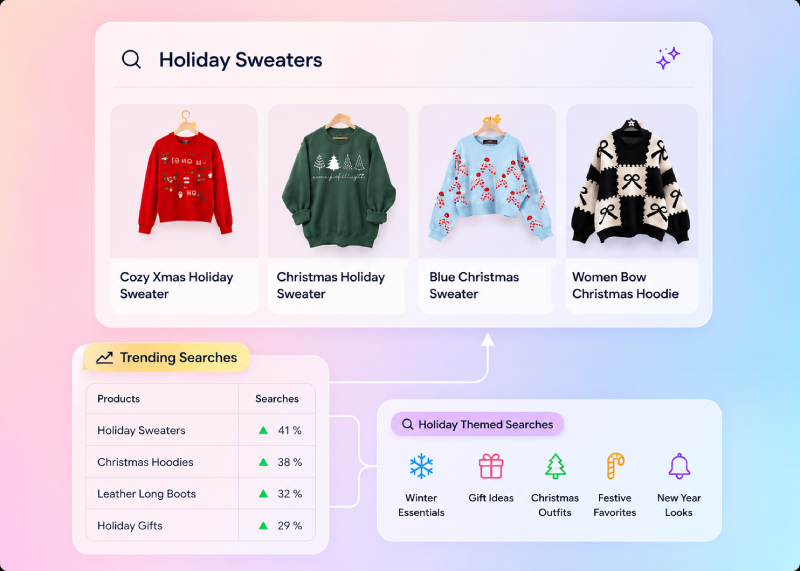
For retailers, vector search is a revenue question, not a technical curiosity. Site search is where your highest-intent visitors announce exactly what they want — and where vocabulary mismatches quietly kill sales. A shopper searching “ladies trainers” against a catalog labeled “women’s sneakers” gets nothing from keyword matching, and leaves.
The gains show up as fewer zero-result searches, better handling of long-tail descriptive queries, and higher conversion on search traffic. Our deep dive on vector search for ecommerce covers the retail application specifically, and semantic search for product catalogs gets into catalog-specific tuning.
Vector search and getting found by AI
Here’s a development worth attention. Shoppers increasingly skip search boxes entirely and ask an AI assistant instead. Those assistants run on exactly the retrieval described above — they embed the question, search for meaning, and recommend a handful of options.
Which means the same technology powering good on-site search also determines whether external AI engines can understand and recommend your products. A clean, well-structured, embedded catalog is legible to both. Investing here tends to improve visibility inside AI-generated answers as a side effect — a genuine two-for-one that reframes what is vector search from a site feature into a discoverability strategy.
Limitations and misconceptions
A few things get muddled often enough to correct when people research what is vector search.
“It replaces keyword search.” It shouldn’t. Hybrid outperforms either alone, and exact identifiers still need lexical matching.
“More dimensions means better results.” Not reliably. Higher dimensions cost more to store and query, and many modern models beat older high-dimension ones at fewer dimensions.
“You need a PhD team.” You used to. Managed platforms now handle embedding, indexing, and reranking, so implementation is measured in weeks.
“It’s slow.” Outdated. Approximate nearest-neighbor indexes return results in well under 200 milliseconds at scale.
“Set it and forget it.” Embeddings go stale. New items must be embedded promptly or they’re invisible, and changing models means reindexing everything.
How to add vector search to your stack
Three realistic paths. Build it yourself: choose an embedding model, stand up a semantic search vector database, build ingestion, fusion, and reranking, then wire it into your interface. Maximum control, realistically a multi-month project. Add a layer to existing search: keep your current engine and bolt on vector retrieval or reranking — lower risk, inherits existing limits. Use a managed platform: an AI-native search platform ships all of it together, typically live in weeks with no ML expertise in-house, which is how bCloud AI’s AI search engine works.
Whichever route, measure it. Compare zero-result rate, conversion, and revenue per search before and after. That’s the practical test of what is vector search actually delivering for you.
How to Tell If Vector Search Is Working
Deploying vector search is only the first step. The real measure of success is whether shoppers find what they need faster and with fewer search attempts. Monitoring the right indicators helps ensure your search engine continues delivering meaningful results as your catalog evolves.
Fewer Zero-Result Searches
Customers should rarely see empty result pages, even when using different wording, synonyms, or descriptive phrases.
Better Search Engagement
Higher click-through rates and fewer repeated searches indicate that users are finding relevant results more quickly.
Improved Conversion Rate
Relevant search results should translate into more product views, add-to-cart actions, and completed purchases.
Consistent Performance
Response times should remain fast even as new products are added and search traffic continues to increase.
Remember: The best vector search implementation isn’t the one with the most advanced AI model—it’s the one that consistently helps users discover the right information or product with minimal effort.
Frequently asked questions
What is vector search?
Vector search is a retrieval method that converts items and queries into numerical vectors representing meaning, then returns the items whose vectors sit closest to the query’s. It finds results by measuring similarity in meaning rather than matching exact text, so “couch” can find sofas.
How does vector search work?
In four stages: an embedding model converts all indexed content into vectors, the query is converted into a search vector using the same model, an approximate nearest-neighbor algorithm like HNSW finds the closest vectors, and a reranking model reorders results using additional signals like popularity and conversion history.
What is a search vector?
A search vector is the numerical representation of a query produced by an embedding model — typically a list of hundreds or thousands of numbers encoding the query’s meaning. Queries meaning similar things produce representations positioned close together.
Semantic search vs vector search — what’s the difference?
Semantic search is the goal: returning results by meaning rather than exact words. Vector search is a method for achieving it: representing content as vectors and retrieving by distance. In the semantic search vs vector search comparison they aren’t rivals — vector search is the most common way to deliver semantic search.
What is a semantic search vector database?
A semantic search vector database stores embeddings and runs fast nearest-neighbor queries against them. Options include dedicated systems like Pinecone, Qdrant, Weaviate, and Milvus, the pgvector extension for Postgres, kNN-capable engines like Elasticsearch, and managed platforms that bundle the index with the surrounding pipeline.
Is vectorized search better than keyword search?
Neither is universally better. Vectorized search handles synonyms, typos, and natural language far better; keyword search is more precise for exact SKUs and model numbers. Most modern systems run both in parallel as hybrid retrieval.
Do I need a vector database to use this?
Not necessarily. You can use a dedicated vector database, a Postgres extension like pgvector, a kNN-capable search engine, or a managed AI search platform that includes vector indexing along with the embedding pipeline and reranking.
See vector search running on your own catalog.
Now that you know what is vector search, the fastest way to judge it is watching it handle your real products and your customers’ messiest queries. bCloud AI combines keyword precision with vector meaning in one sub-200ms engine — no enterprise tier required.
bcloud.ai