

AI Search for Grocery Ecommerce: Built for Baskets, Not Browsing
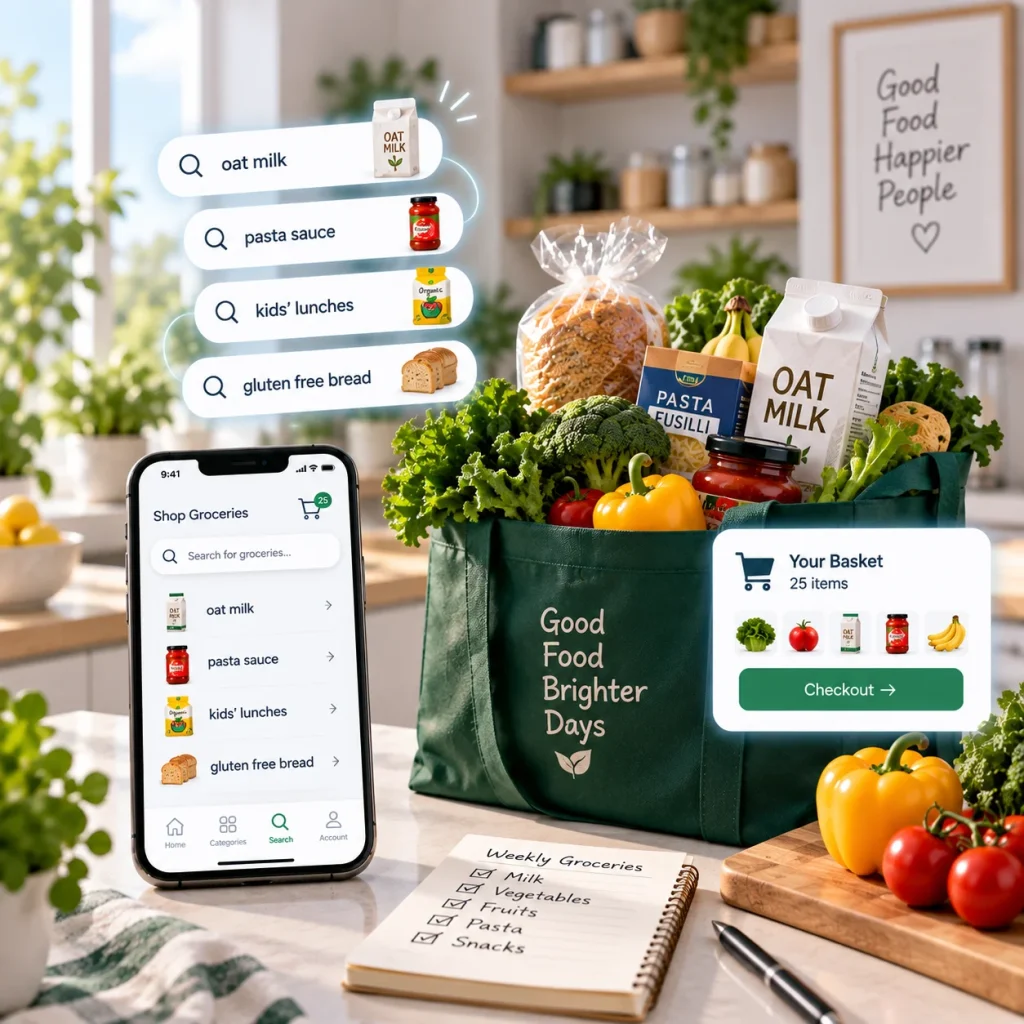
Why grocery search is its own discipline
Search frequency is extreme.
Most verticals see one or two searches per session. Grocery ecommerce sees twenty to fifty. A 95% success rate sounds excellent until you realize it means two or three failures in every basket.
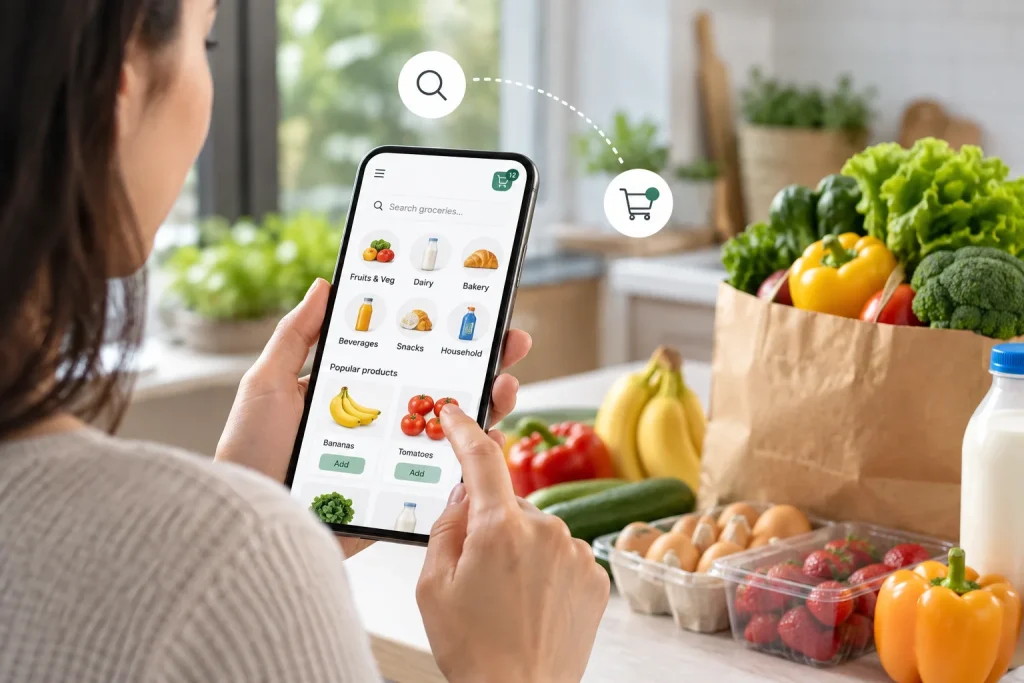
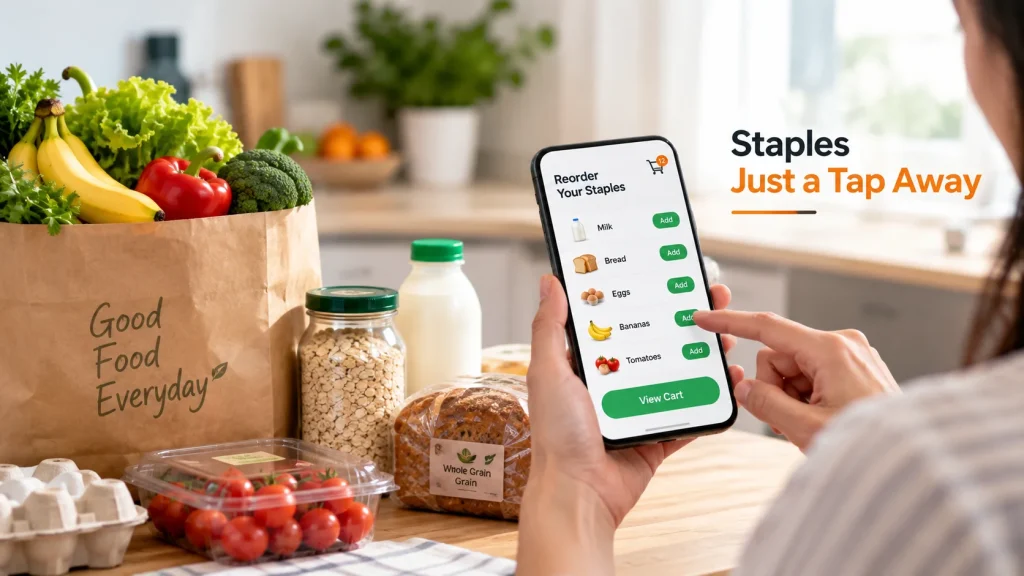
Most of the grocery ecommerce basket is repeat.
Shoppers buy the same staples weekly. Search here is less discovery than retrieval — getting a known item into a cart quickly.
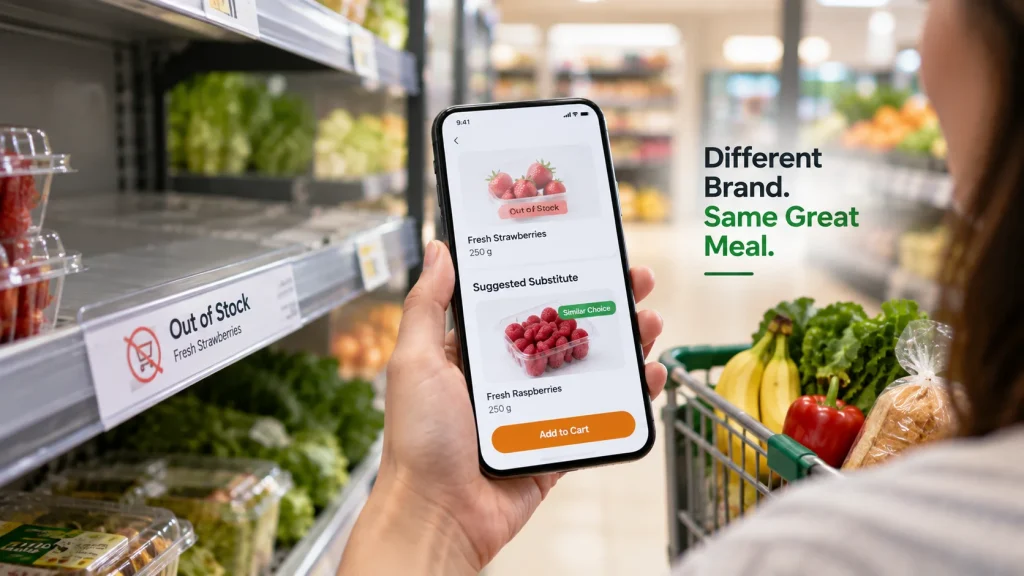
In grocery ecommerce, out-of-stock is constant and substitution is expected.
Perishables sell out daily. Unlike other retail, grocery shoppers expect a substitution rather than an apology — but they expect a sensible one.
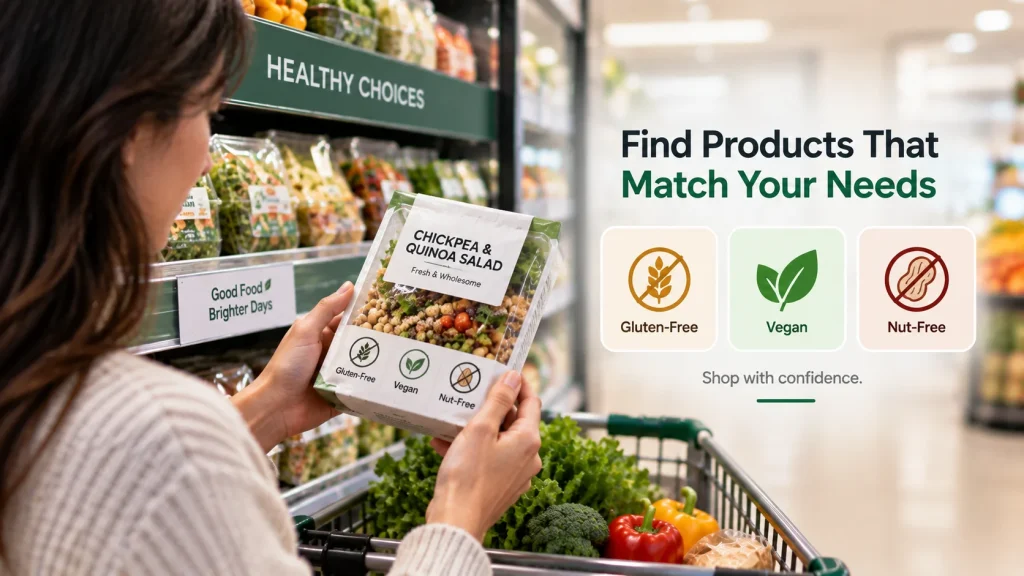
Dietary constraints are hard filters.
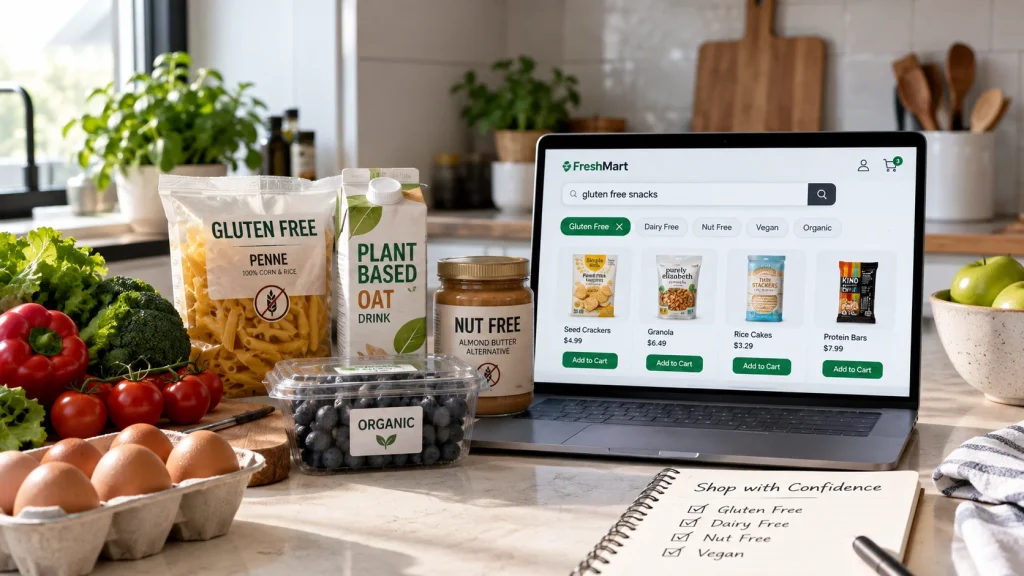
Gluten-free, vegan, kosher, halal, nut-free, low-sodium. These aren't preferences to weight; they're requirements, and some carry health consequences.
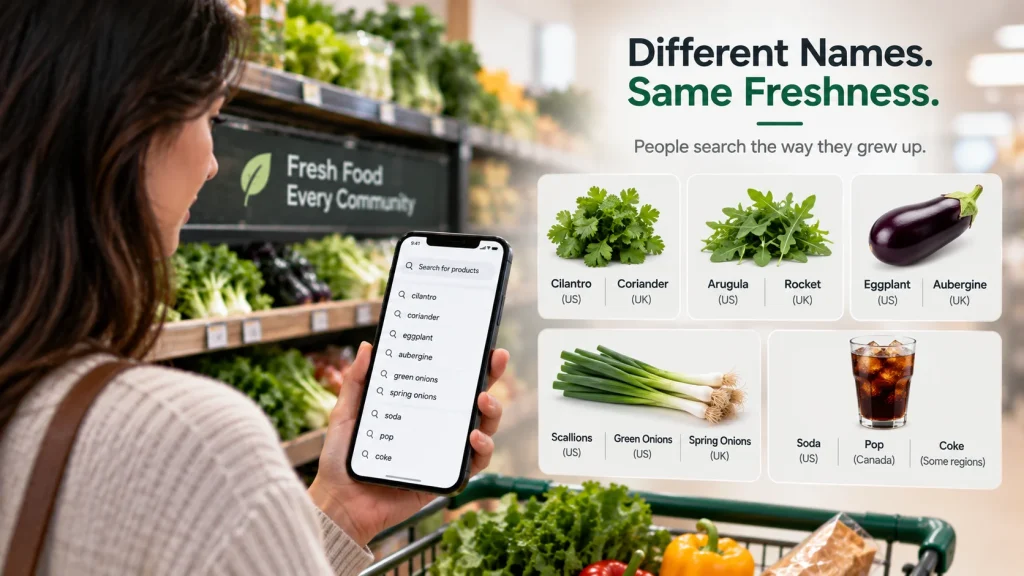
Grocery ecommerce naming varies by region and household.
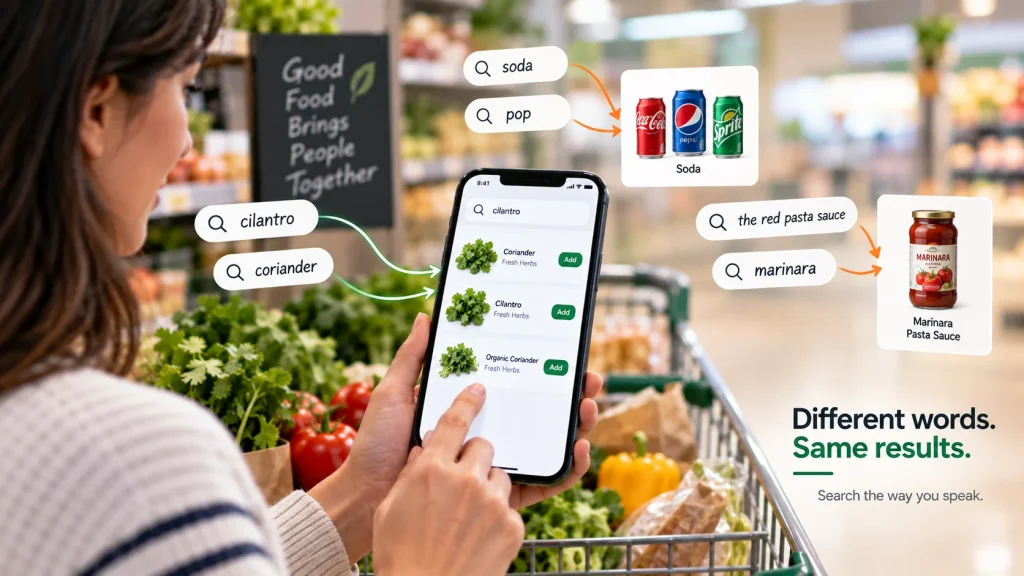
Cilantro or coriander. Arugula or rocket. Eggplant or aubergine. Scallions, green onions, or spring onions. Soda, pop, or coke. Shoppers use the word they grew up with.
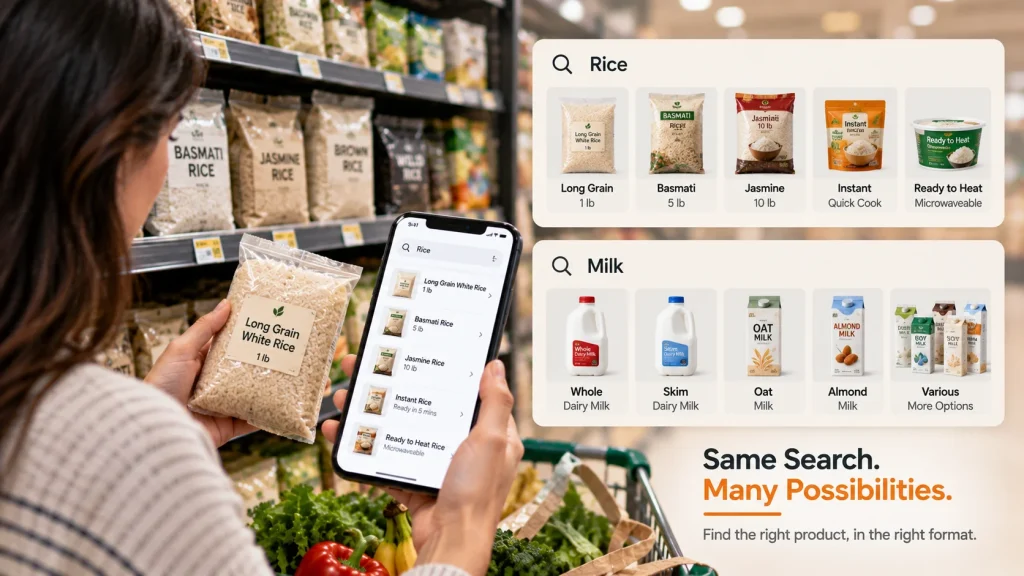
Units and formats are ambiguous.
"Rice" could be a 1lb bag, a 10lb sack, instant, or ready-to-heat. "Milk" spans dairy, oat, almond, whole, skim, and forty SKUs.
Recipe and meal-based discovery
Recipe-to-basket.
A named dish resolves to its ingredient list, matched against your catalog, with quantities scaled to servings. Genuinely useful and increasingly expected.
Constraint-aware meal suggestion.
"Vegetarian dinner ideas under $15" combines dietary constraints, budget, and meal type. This is where conversational grocery search earns its cost, since shoppers naturally refine — "something quicker," "without mushrooms," "the kids will actually eat."
Pantry-aware planning.
Suggesting meals based on what a shopper has bought recently and might still have. Early, and the most likely to feel intrusive if handled clumsily.
How AI helps shoppers find groceries faster
Predictive personal results.
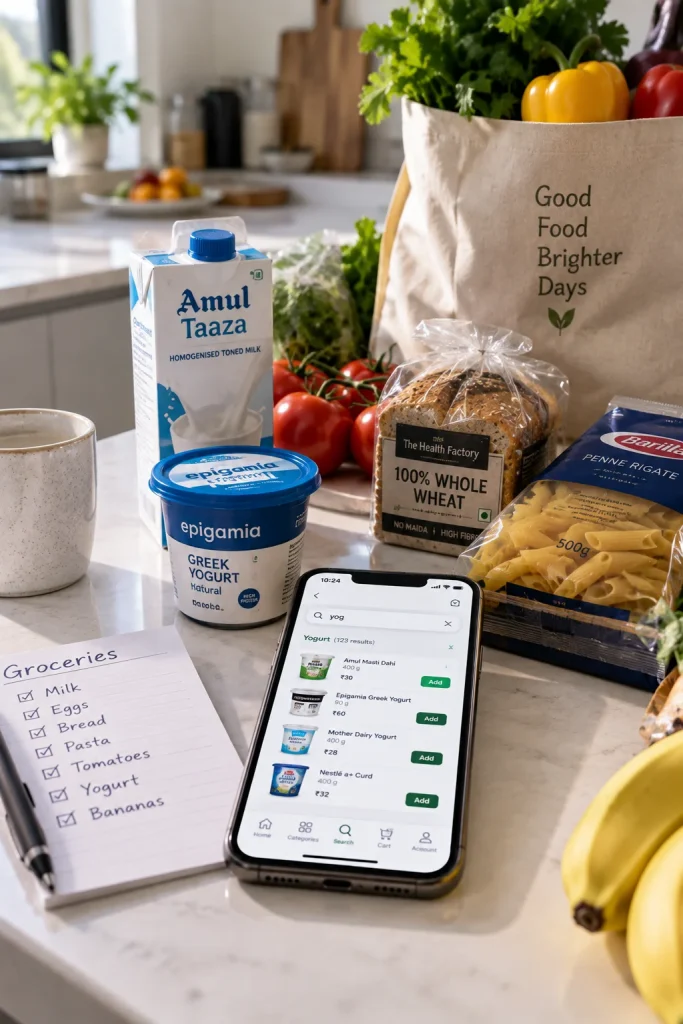
The first result for a returning customer should reflect what they buy. A shopper typing "yog" should see their usual yogurt in autocomplete before finishing the word.
Product-level autocomplete is the grocery ecommerce workhorse.
Not query suggestions — actual products with price, size, and availability, so shoppers add to cart directly from the dropdown. In grocery this is genuinely the primary interface for repeat items, and it deserves more attention than it usually gets.
Quick-add from results.
Add-to-cart without leaving the results page. A shopper working through forty items shouldn't navigate to forty product pages.
Reorder and list surfaces.
"Buy it again," saved lists, and previous-order views handle the repeat portion of the basket without search at all. The best AI grocery product discovery recognizes that the fastest search is the one the shopper doesn't have to run.
Multi-item entry.
Pasting or dictating a shopping list and matching all of it at once is a genuine differentiator, and it maps to how people actually plan meals.
Substitutions: the grocery-specific problem
Semantic similarity alone gets this wrong.
Vector retrieval will happily suggest a dairy yogurt for an unavailable oat yogurt, because they're semantically close. That's a failed substitution, and for a vegan shopper it's a broken trust.
What works better:
constraint-first substitution. Filter on the dietary and format requirements of the original item, then rank by similarity, price proximity, and whether the shopper has bought it before. Our vector database for recommendations guide covers the retrieval architecture, and real-time indexing covers keeping availability accurate enough for any of this to work — in grocery, a stale index means recommending items that sold out this morning.
Dietary constraints deserve care
Measuring grocery search
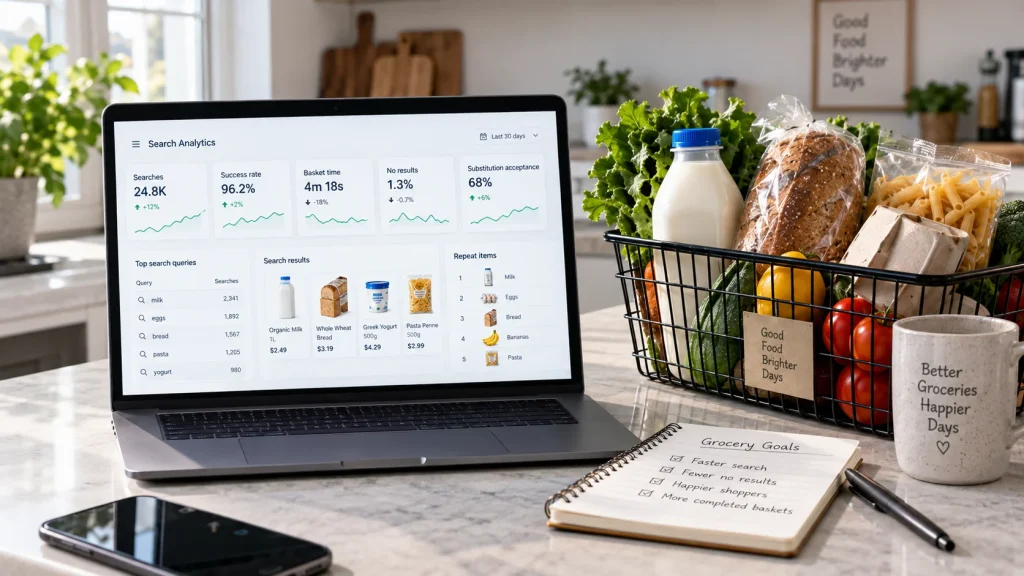
Searches per basket and success rate per search.
Because frequency is so high, a small failure rate compounds badly. Track both.
Time to complete a basket.
The metric shoppers feel, and the one that predicts whether they come back.
Zero-result rate by query type.
Segment brand queries, category queries, and descriptive queries — they fail for different reasons.
Repeat-item retrieval position.
For known repeat purchases, where does the shopper's usual product rank? It should be first, and if it isn't, personal ranking isn't working. Our search relevance metrics and A/B testing guides cover methodology.
Substitution acceptance rate.
What share of offered substitutions get added rather than rejected. This measures whether your substitution logic actually understands the constraint.
How AI search improves online grocery shopping
Semantic understanding of everyday language.
Semantic search for grocery ecommerce is what lets "cilantro" find coriander, "soda" find pop, and "the red pasta sauce" find marinara. Keyword systems need a synonym list nobody has time to maintain against regional and household vocabulary. Our what is semantic search guide covers the mechanics.
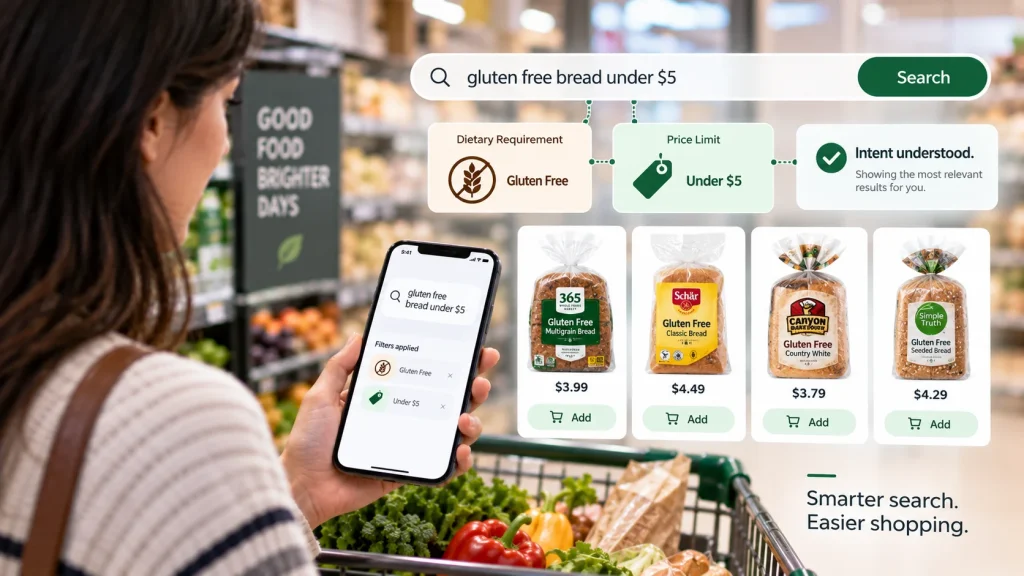
Intent parsing for constraints.
"Gluten free bread under $5" contains a dietary requirement and a price ceiling. Extracting those automatically beats making a shopper apply two filters for every one of forty items. Our query understanding guide covers this layer.
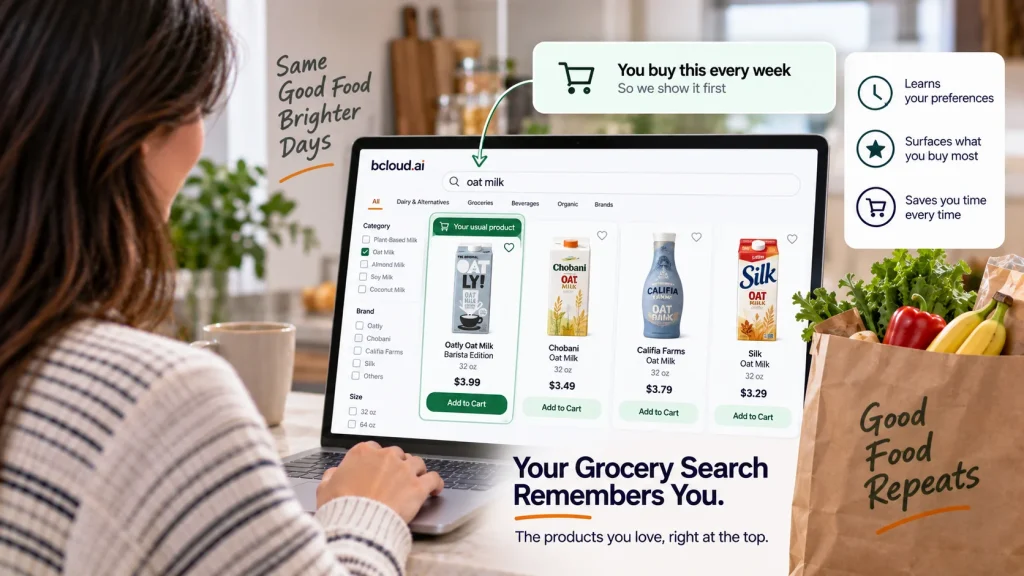
Purchase-history-aware ranking.
For a shopper who buys the same oat milk weekly, that product should rank first for "oat milk" — every time, without them scrolling. This is the single highest-impact ranking signal in grocery ecommerce search, because most of the basket is repeat.
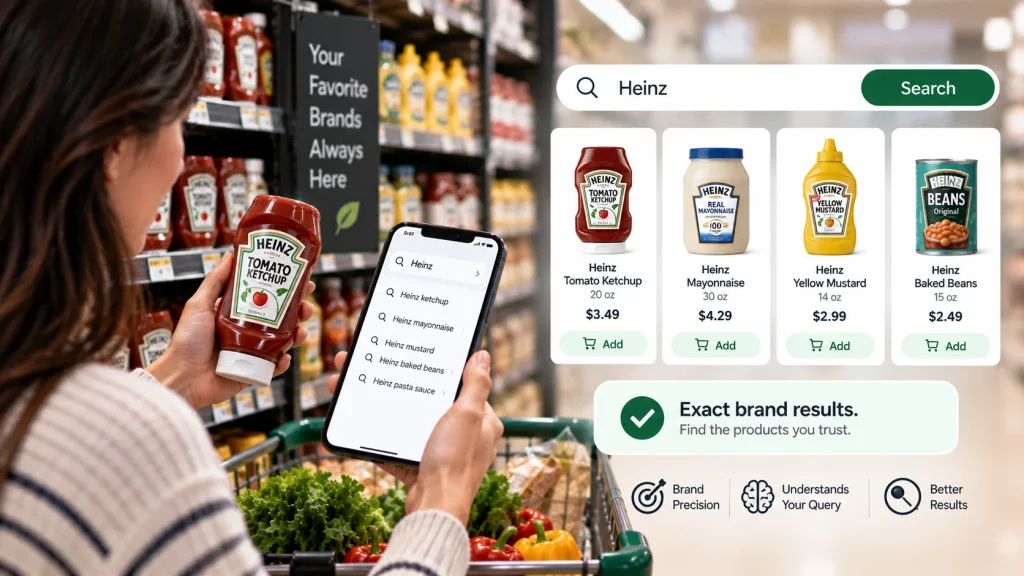
Exact matching for brands and products.
"Heinz" must return Heinz. Shoppers are brand-specific on some items and indifferent on others, so hybrid retrieval matters — semantic for descriptive queries, keyword precision for brands and named products. See our hybrid search guide.
How AI improves grocery product discovery beyond search
Category browsing
This is how AI improves grocery product discovery beyond the query field. How people think about aisles, and default ordering is usually arbitrary. Applying relevance, availability, promotion status, and personal history to category ranking is often a larger gain than improving the search box.
Recommendations that understand meals.
"Frequently bought together" is genuinely useful in grocery because baskets have structure — pasta and sauce, taco shells and seasoning. This is complementarity rather than similarity, which nearest-neighbor retrieval doesn't solve on its own.
Promotion surfacing.
Weekly specials are a primary driver of grocery behavior. Discovery that surfaces relevant deals on items a shopper actually buys beats a generic promotions page.
Zero-result recovery.
Offer the closest available alternative rather than an empty page. Our product discovery guide covers the surface map, and the ecommerce search pillar covers the framework.
How to improve grocery ecommerce search
01
Surface purchase history in results.
The highest-leverage change available, because most of the basket is repeat. Personal relevance beats general relevance in grocery by a wide margin.
02
Complete your dietary and format attributes.
These are the constraints shoppers filter on most, and partial coverage makes facets actively misleading.
03
Fix substitution logic
with constraint-first filtering, and let shoppers set per-item preferences.
04
Mine failed searches weekly.
In grocery these sort into regional naming gaps, products you don't carry, format ambiguity, and brand requests — four different actions, generated automatically. Our ecommerce search analytics guide covers the reporting, and search returned no results covers recovery design.
05
Get store-level availability into results.
Grocery stock is local. A product shown as available that isn't at the shopper's store is worse than not showing it — and it's the failure that generates the most support contacts.
What's next for grocery ecommerce
Assistants are entering meal planning.
Shoppers increasingly ask AI assistants what to cook and what to buy, which means your catalog needs to be readable to systems outside your app — covered in our how LLMs find products and AI visibility guides.
Recurring orders are becoming semi-automated.
Replenishment based on consumption patterns is the grocery category most likely to see genuine agentic behavior first, since the purchase is routine and the specification is known. Our agentic commerce guide covers that honestly, including what's still unresolved.
Grocery Ecommerce FAQs
What is AI search for grocery ecommerce?
Why is grocery search harder than other ecommerce search?
How does AI help shoppers find groceries faster?
How should grocery search handle substitutions?
Can grocery search filters guarantee allergen safety?
What is conversational grocery search useful for?
How do I improve grocery ecommerce search?