

What is a conversational search engine?
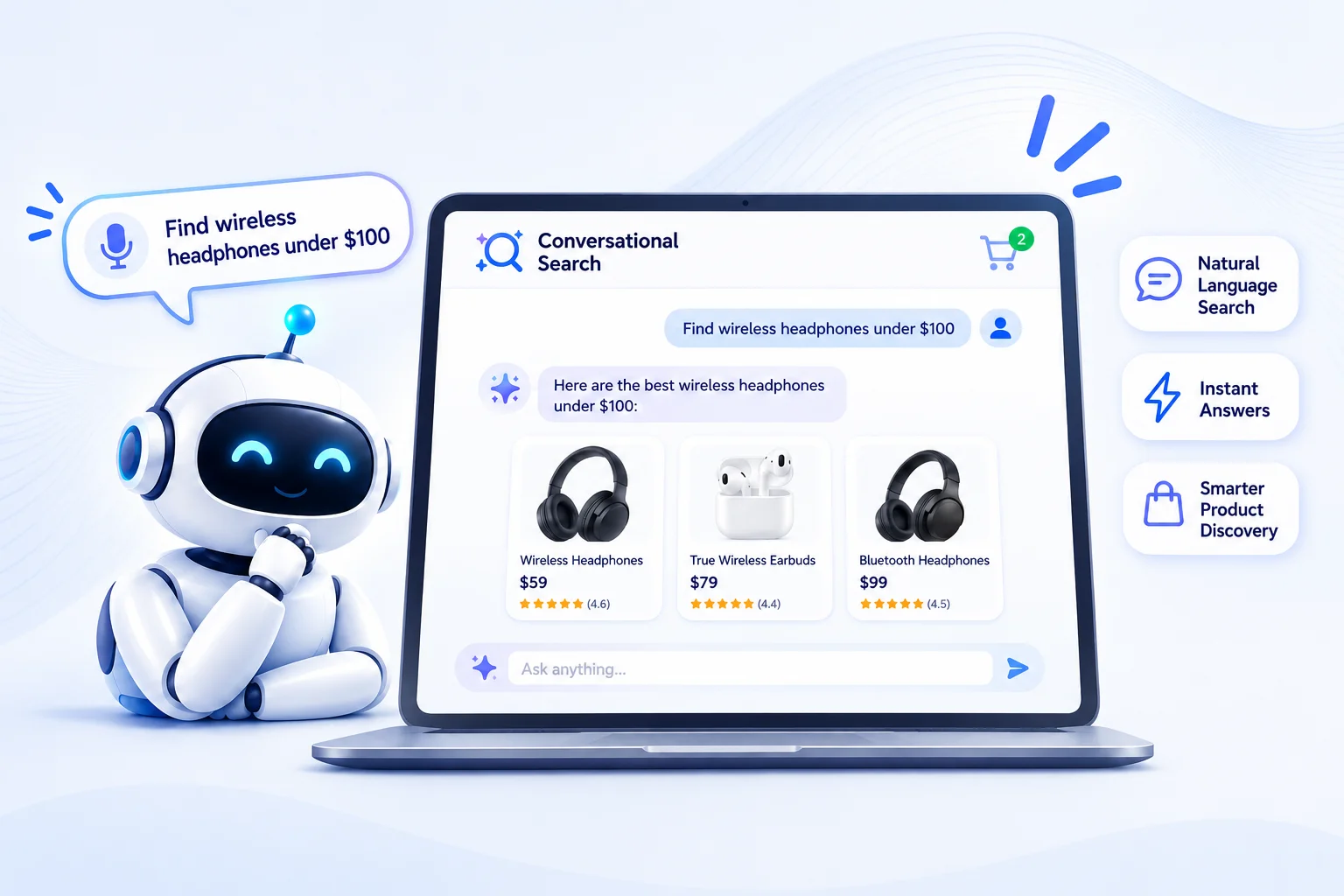
The distinction that matters is memory across turns. Plenty of search systems now handle a long natural-language query in one shot: type “warm waterproof jacket for winter dog walks under $150” and get sensible results. That’s excellent, and it’s not the same thing. A conversational search engine handles what comes next: “in navy,” “something lighter,” “actually, does it pack down small?” Each of those is meaningless in isolation. Understanding them requires remembering the jacket conversation you’re already having.
That’s the working definition, and it’s a useful filter during vendor evaluations. If a system treats every query as fresh, it does natural language search — worth having, covered in our natural language search guide — but it isn’t conversational.
How a conversational search engine works
Four layers, running in sequence on every turn.
Dialogue state.
The engine tracks what’s been established: category, constraints already applied, products viewed or rejected, and preferences expressed. This is the layer that separates a conversational search engine from a stateless one, and it’s where most implementations are weakest.
Query resolution.
Each new utterance is interpreted against that state. “Something lighter” resolves to the same category with a weight constraint added; “in navy” adds a color filter without discarding everything else. Modern systems use language models for this rather than rules, which is why they handle phrasings nobody scripted. Our query understanding guide covers the mechanics.
Retrieval.
The resolved query goes to the search index — in practice a hybrid of keyword matching and vector semantic search, so exact SKUs resolve literally while descriptive language resolves by meaning. Semantic-only retrieval drifts on identifiers, which matters the moment a shopper types a model number mid-conversation. See our hybrid search guide.
Response generation.
Results are presented, often with a composed explanation of why these products fit. When that explanation is generated by a language model, it must be grounded in retrieved catalog data rather than invented — the architecture known as retrieval-augmented generation. Ungrounded generation is how a conversational search engine ends up confidently describing features a product doesn’t have.
AI Search Grader by bCloud AI
Grade your ecommerce search in 10 quick questions
31% of ecommerce searches return zero results — and most shoppers who hit a dead end leave for a competitor. How does your store's search stack up?
Answer 10 short questions and get your AI search score, plus a personalized report to fix the gaps. Free, takes about 2 minutes.
No signup needed to take the quiz.
Understanding intent…
Scoring your answers across relevance, AI, experience, and insights.
Your AI search score is ready
Tell us where to send your personalized report. You'll see your score and recommendations right away.
Your score by pillar
Personalized recommendations
Fix the gaps in weeks, not quarters
bCloud AI replaces keyword-only search with hybrid AI retrieval — sub-200ms responses, 99.99% uptime, and conversion lifts of up to 40% across 50+ implementations.
Conversational search engine vs. chatbot vs. natural language search
These three get conflated constantly, and the differences are practical.
Chatbots
Were built for support deflection — scripted flows, FAQ matching, escalation. Bolting product search onto one rarely produces good discovery, because the underlying system was never designed to rank a catalog.
Natural language search
Interprets rich queries well and starts fresh each time. For many stores this is enough, and it’s meaningfully cheaper and simpler.
A conversational search engine
Adds the state layer. It’s the right investment when your products involve genuine consideration — apparel, furniture, electronics, gifting — where shoppers naturally narrow through several rounds. For a commodity reorder, it’s overhead.
What good conversational search actually looks like
Five behaviors distinguish a competent implementation from a demo.
Context that persists appropriately.
The engine holds constraints across turns but drops them when the shopper clearly moves on. “Actually, show me boots instead” should reset the jacket context rather than filtering boots by jacket attributes — a surprisingly common failure.
Graceful ambiguity handling.
When a refinement could mean two things, a good conversational search engine asks a short clarifying question rather than guessing silently. One question, not an interrogation.
Constraint arithmetic.
Adding “under $100” to an existing conversation should narrow, not restart. Removing a constraint (“forget the price limit”) should widen. Sounds obvious; many systems handle only addition.
Honest empty states.
When nothing matches the accumulated constraints, saying so and offering to relax one beats returning loosely related products as though they satisfied the request. Trust erodes fast when a conversational search engine pretends.
A visible exit to normal results.
Some shoppers want to browse a grid. Forcing everyone into dialogue backfires — Baymard Institute’s research consistently shows that removing familiar navigation patterns frustrates users who came with a clear goal.
The first turn decides the rest
Demos always open with a rich opening query. Real shoppers rarely do.
Most people still type two words, because twenty years of keyword search taught them to. As a result, a conversational search engine often starts with almost nothing to work with. How it handles that opening move matters more than any later refinement. Three patterns work.
Show results first, then ask
Return products immediately for “jacket”. Then offer one narrowing question beside them. The shopper sees progress straight away, so the question feels helpful rather than obstructive.
Ask about the biggest split
Pick the attribute that divides the result set most usefully. For jackets that is usually warmth or occasion, not colour. One good question can halve the catalog.
Suggest, do not interrogate
Offer two or three tappable refinements instead of an open text prompt. Tapping is faster than typing, especially on mobile. It also teaches shoppers that follow-ups are possible.
In short, do not wait for a perfect opening query. Design for the vague one instead, since that is what most sessions actually start with. Our query understanding guide covers how short queries get expanded.
Where a conversational search engine earns its keep
Not every catalog justifies one, and being honest about that saves money.
Strong fit: considered purchases with multiple attributes.
Furniture, mattresses, appliances, technical apparel, cameras, bikes. Shoppers genuinely don’t know the right terms and narrow through discussion.
Strong fit: gifting and occasion shopping.
“Gift for my dad who grills, under $75” is a persona, not a category, and follow-ups refine it naturally. A conversational search engine turns a hard query into a guided conversation.
Strong fit: large catalogs where browsing is impractical.
When filtering through 50,000 SKUs means fourteen facet clicks, dialogue is faster.
Weak fit: commodity replenishment.
Someone reordering printer cartridges wants one click, not a conversation.
Weak fit: single-attribute catalogs.
If products differ mainly on one dimension, filters do the job.
Weak fit: thin product data.
This is the constraint that sinks most deployments. A conversational search engine can only discuss attributes your catalog actually contains. If your records are three-word titles from a supplier feed, no dialogue layer rescues them — and the products most in need of explanation are usually the ones with the least data.
Evaluating a conversational search engine
Five tests, run on your own catalog rather than a curated demo.
The three-turn test.
Start with a realistic opening query, then refine twice without repeating context. Does the engine hold the thread? This single test eliminates most candidates, because stateless systems fail it immediately on turn two.
The redirect test.
Mid-conversation, change categories entirely. Does context reset cleanly, or does the engine filter your new category by irrelevant old constraints?
The SKU test.
Type an exact model number mid-dialogue. It should resolve literally. If the conversational layer swallows identifiers, B2B and technical catalogs will suffer.
The hallucination test.
Ask about a specific attribute — waterproof rating, material, compatibility — for a product where your data doesn’t contain it. A grounded conversational search engine says it doesn’t have that information. An ungrounded one invents a plausible answer, which is worse than useless.
The exit test.
Try to get out of the conversation into a normal filtered results grid. It should take one click.
Score outcomes with the methodology in our search relevance metrics guide, and validate any rollout with a live traffic split per our A/B testing guide — conversational interfaces are exactly the kind of feature that demos brilliantly and needs measurement.
Measuring conversational search
Standard search metrics don’t fully transfer, so a conversational search engine needs its own scoreboard alongside the usual ones.
Turns to outcome.
How many exchanges before an add-to-cart or an abandonment. Falling turn counts on successful sessions means the engine is converging faster; rising counts before abandonment means it’s failing to narrow.
Containment versus escape.
What share of shoppers complete the journey in dialogue versus bailing to the standard results grid. High escape rates on specific query types tell you where conversation isn’t earning its place.
Grounding accuracy.
Sample generated responses weekly and verify factual claims against catalog data. Generation quality drifts as models and prompts change, and only an audit catches it.
Conversion and revenue per session
Against a control group that never sees the conversational interface. This is the number that justifies the investment, and running it permanently matters because quality drifts.
Cost per conversation.
Each turn costs generation tokens and compute. Track that against the conversion lift it produces — a conversational search engine that lifts conversion modestly while tripling infrastructure cost isn’t a win, and teams that measure this from day one scale it deliberately.
Our semantic search analytics guide covers the underlying quality layer these sit on top of.
Implementation paths
A managed platform
Ships dialogue state, query resolution, hybrid retrieval, and grounded generation together, typically live in weeks. bCloud AI’s conversational AI layer works this way, running on the same hybrid engine that powers standard search — which matters, because a conversational search engine built on weak retrieval produces fluent wrong answers. Our roundup of the top semantic search solutions for e-commerce covers the wider field.
A layer on existing search
Adds a dialogue front end to your current engine. Faster and cheaper, and bounded by whatever your existing retrieval can do.
Building from components
An LLM for dialogue, a vector index, your own state management and grounding logic — gives full control and realistically takes a quarter or more. Justified when conversational discovery is genuinely your differentiator.
Whichever path: get baseline relevance right first. Conversation amplifies good retrieval and merely decorates bad retrieval.
Common mistakes to avoid
Five errors account for most disappointing rollouts.
- Launching on thin product data. The ceiling on everything. A conversational search engine discusses attributes your catalog contains, so sparse records produce vague, unhelpful dialogue — and the long-tail products that most need explaining are usually the sparsest. Enrich before you deploy, not after.
- Building on weak retrieval. Fluent language over bad results is worse than plain results, because confident wrongness costs trust that a mediocre grid never would. Get hybrid relevance right first.
- Forcing everyone into conversation. Plenty of shoppers arrive knowing exactly what they want. A conversational search engine should be an option, not a toll booth — keep the standard results grid one click away.
- Letting generation run ungrounded. If the response layer can describe attributes without checking catalog data, it eventually will. Enforce grounding and audit samples weekly.
- Skipping the control group. Conversational interfaces demo beautifully and don’t always convert. Run a permanent holdout so the lift is a measurement rather than a memory of the demo.
What’s coming next
Two developments worth planning around. Agentic shopping — where assistants don’t just recommend but compare, configure, and initiate purchases — makes conversational infrastructure the interface those agents talk to. And cross-surface continuity, where a conversation started on mobile resumes on desktop, is becoming an expectation rather than a novelty.
Both raise the value of getting dialogue state and grounding right now, because they’re built on the same foundation. Our generative search guide covers where composed answers are heading more broadly.
Frequently asked questions
What is a conversational search engine?
A conversational search engine is a search system that maintains context across multiple exchanges, so shoppers can refine, redirect, and ask follow-up questions without restating what they already said. The defining capability is memory across turns — “in navy” or “something lighter” only makes sense if the system remembers what you were discussing.
How is a conversational search engine different from a chatbot?
Chatbots were built for support deflection using scripted flows and FAQ matching, and they frequently invent answers when asked about products. A conversational search engine searches your live catalog with hybrid retrieval, grounds every response in real inventory data, and maintains dialogue state specifically for product discovery.
How is it different from natural language search?
Natural language search interprets a full-sentence query well but treats each query as independent. A conversational search engine adds a state layer that carries context between turns, so follow-up refinements work. Natural language search is sufficient for many stores; conversation matters when purchases involve several rounds of narrowing.
Does a conversational search engine work with exact SKUs?
It should. Good implementations run hybrid retrieval underneath, so keyword matching resolves part numbers and model codes literally while the conversational layer handles descriptive language. Test this explicitly by typing an exact SKU mid-dialogue.
Which stores benefit most?
Catalogs involving considered purchases with multiple attributes — furniture, appliances, technical apparel, electronics — plus gifting and occasion shopping, and large catalogs where filtering is tedious. Commodity replenishment and single-attribute catalogs typically don’t justify the added complexity.
How do I measure whether it’s working?
Track turns to outcome, containment versus escape to standard results, grounding accuracy through weekly response audits, cost per conversation, and conversion plus revenue per session against a permanent control group that never sees the conversational interface.
Search that holds the thread.
bCloud AI runs conversational discovery on the same hybrid engine that powers standard search — grounded in your live catalog, measured against a control.
bcloud.ai