
Which AI crawlers actually matter
GPTBot
OpenAI’s crawler, gathering content that may inform ChatGPT’s responses. Distinct from OAI-SearchBot and ChatGPT-User, which handle search and live browsing respectively. Blocking one doesn’t block the others, and blocking the wrong one is a common mistake.
Bingbot
The crawler behind Microsoft Copilot as well as Bing search. For most ecommerce sites this is currently the highest-value AI crawler by citation volume, because Copilot surfaces citations prominently and Bing’s grounding index feeds it.
PerplexityBot
Perplexity is answer-first by design, and its citations drive genuine referral traffic rather than just visibility.
ClaudeBot
Anthropic’s crawler for Claude.
Google-Extended
Controls whether your content informs Gemini and AI Overviews. Note that this is separate from Googlebot: blocking Google-Extended doesn’t remove you from Google search, and allowing Googlebot doesn’t automatically opt you into AI features.
Applebot-Extended
The equivalent control for Apple Intelligence.
The practical implication: these are separate bots with separate directives. A single blanket rule in your robots file is almost certainly not expressing what you actually want.
How to check whether AI crawlers can reach you
Four checks, most of which take minutes.
Read your robots.txt properly.
Visit yoursite.com/robots.txt and look for user-agent blocks naming any of the crawlers above, plus any blanket Disallow rules. The robots.txt standard is advisory rather than enforced, but reputable AI crawlers honor it — which means an accidental disallow genuinely costs you citations. Pay particular attention to rules added by security plugins, which frequently block bots aggressively by default.
Check your WAF and CDN separately.
This is where most surprises hide. Cloudflare, security plugins, and hosting-level bot protection can block AI crawlers regardless of what robots.txt permits — and the block is invisible unless you look. If your host has ever thrown 503s under bot load, assume some crawls failed.
Review server logs for bot user agents.
Filter access logs for GPTBot, Bingbot, PerplexityBot, and ClaudeBot over the past thirty days. Are they arriving? What status codes are they receiving? A pattern of 403s or 503s is your answer.
Test a page as a bot would see it.
Fetch a product page with a plain HTTP request rather than a browser. If the content only appears after JavaScript execution, some AI crawlers may see an empty shell — covered in fix four below.
AI Search Grader by bCloud AI
Grade your ecommerce search in 10 quick questions
31% of ecommerce searches return zero results — and most shoppers who hit a dead end leave for a competitor. How does your store's search stack up?
Answer 10 short questions and get your AI search score, plus a personalized report to fix the gaps. Free, takes about 2 minutes.
No signup needed to take the quiz.
Understanding intent…
Scoring your answers across relevance, AI, experience, and insights.
Your AI search score is ready
Tell us where to send your personalized report. You'll see your score and recommendations right away.
Your score by pillar
Personalized recommendations
Fix the gaps in weeks, not quarters
bCloud AI replaces keyword-only search with hybrid AI retrieval — sub-200ms responses, 99.99% uptime, and conversion lifts of up to 40% across 50+ implementations.
7 fixes that improve AI citation odds
1. Make your robots.txt intentional, not accidental
Decide per crawler rather than inheriting defaults. If you want AI visibility, explicitly allow GPTBot, Bingbot, PerplexityBot, ClaudeBot, and Google-Extended. If you want to exclude some — a legitimate choice — do it deliberately and document why. The worst outcome is discovering a year later that a plugin update quietly blocked the crawler driving most of your citations.
2. Fix availability under bot load
AI crawlers hitting timeouts or 503s simply move on, and you lose ground you’d already earned. Add caching and a CDN, confirm your host handles concurrent bot traffic, and monitor error rates specifically for bot user agents. This is unglamorous infrastructure work with a direct citation consequence.
3. Make product data machine-readable
AI crawlers can only recommend what they can parse. Product structured data (schema.org markup for name, price, availability, brand, and attributes) turns your pages from prose into data. This is the same structured foundation that powers good on-site search, which is why the two investments compound — see our AI site search guide.
4. Don’t hide your catalog behind JavaScript
Many AI crawlers execute limited or no JavaScript. If product details, prices, and descriptions only render client-side, those crawlers see an empty page. Server-side rendering or static generation for product and category pages solves it, and it’s frequently the single highest-impact technical fix for stores built on heavy front-end frameworks.
5. Enrich the content that AI crawlers actually read
A three-word title inherited from a supplier feed gives an AI nothing to work with. Products need real descriptions covering materials, use cases, sizing, and differentiators — the specifics an assistant needs to say why your product fits a shopper’s request. This is the same enrichment that improves semantic search relevance, covered in our what is semantic search guide, and it’s usually the highest-return work available.
6. Keep the crawlable version current
AI crawlers cite what they last read. If prices and availability are stale by the time they crawl, assistants recommend products at wrong prices or ones you can’t ship. Real-time accuracy on your live pages matters here for the same reason it matters in search — our real-time indexing guide covers the discipline.
7. Publish content that answers questions directly
AI systems favor content that answers a question cleanly and can be quoted. Clear definitions in the opening lines, question-form headings, and FAQ sections with direct answers all make a page easier to cite. This is why buying guides and comparison content earn disproportionate AI citations relative to product pages — and why a strong content library is an AI-visibility asset, not just an SEO one.
Measuring whether it’s working
You can’t improve what you don’t track, and AI citation measurement is newer and patchier than search analytics.
Bing Webmaster Tools AI Performance
Currently the most direct instrument available, reporting citations and cited pages from Microsoft Copilot and partners. Two caveats worth internalizing: data lags two to three days, so the final days of any chart are always incomplete, and the report is explicitly a sample rather than a complete count.
Referral traffic from AI domains
Filter analytics for chat.openai.com, copilot.microsoft.com, perplexity.ai, and gemini.google.com. Volumes are typically modest but the traffic converts unusually well, because these visitors arrive with a recommendation rather than a hypothesis.
Manual spot-checking.
Ask each assistant the questions your customers would ask and note whether you appear. Crude, but it catches problems no dashboard surfaces, and it tells you how you’re being described.
Server log analysis
For crawler frequency and status codes — the leading indicator, since crawl problems precede citation problems by days or weeks.
One honest note on volatility: AI citation counts swing for reasons outside your control. Grounding indexes get rebuilt, sampling methodology changes, and sites have experienced total citation collapse for one to three weeks before recovering spontaneously with nothing changed on their end. Watch trends over weeks, not days, and investigate crawl access before assuming a content problem.
The connection to your on-site search
Here’s the part most teams miss: the work that lets AI crawlers to recommend your products is largely the same work that makes your own search good.
Both need structured, complete product data. Both need accurate real-time prices and availability. Both need descriptions that express what a product is for rather than just what it’s called. Both benefit from consistent categorization and clean attributes.
That’s a genuine two-for-one, and it reframes catalog enrichment from a chore into infrastructure with compounding returns. A store that invests in product data quality improves internal product discovery and external AI visibility simultaneously — and our roundup of the top semantic search solutions for e-commerce covers the platforms that use that data on the internal side.
Should you block AI crawlers?
A fair question about AI crawlers, and the answer isn’t automatically no.
Reasons some sites block them:
AI answers can reduce click-throughs when assistants satisfy the query without a visit; there are legitimate objections to content being used as model training material; and crawler traffic consumes server resources.
Reasons most ecommerce stores shouldn’t:
Product discovery is genuinely shifting toward assistants, so blocking means invisibility in a growing channel. Unlike publishers, retailers don’t monetize pageviews — they monetize purchases, and an AI recommendation that sends a ready-to-buy shopper is worth more than several browsing visits. The traffic-cannibalization concern that motivates news publishers doesn’t map cleanly onto commerce.
A middle path exists: allow AI crawlers on product, category, and guide content while restricting them from account areas, checkout, and internal search result pages. That’s usually the right posture — visibility where it helps, exclusion where it doesn’t.
Which pages AI crawlers should spend time on
Access is only half the question. Where that access goes matters too.
AI crawlers do not read every page on every visit. Large catalogs get sampled instead. So if bots burn their time on low-value URLs, your best pages may go unread for weeks. Here is where to point them.
Worth crawling: buying guides
These earn more citations than product pages do. They answer questions directly, so assistants can quote them cleanly. Keep them updated and linked from your main navigation.
Worth crawling: category pages
One category page describes many products at once. As a result, it gives a crawler far more context per request than a single product URL.
Not worth crawling: filter URLs
Faceted navigation generates thousands of near-identical pages. Disallow those parameter patterns. Otherwise they consume most of your crawl activity for no benefit.
In short, treat crawl attention as a budget rather than a free resource. Check your logs to see which URL patterns bots actually request most. If filter pages dominate that list, you have found an easy fix. Our product discovery guide covers the catalog structure underneath.
A 30-minute crawl audit you can run today
If you only do one thing after reading this, do this audit. It takes half an hour and usually surfaces at least one genuine problem.
Minutes 1–5: read robots.txt.
Open yoursite.com/robots.txt and search it for each AI crawler by name, plus any wildcard User-agent: * block with broad disallows. Write down what you find rather than trusting memory — you’ll want the before state if you change anything.
Minutes 5–15: check the layers that can block AI crawlers above it.
Log into your CDN and security plugin and look for bot-management rules. Cloudflare’s bot fight mode, WordPress security plugins, and host-level protection all block crawlers independently of robots.txt, and none of them announce it. This step finds more problems than the robots.txt check does.
Minutes 15–25: pull AI crawlers logs.
Filter the last thirty days of access logs for GPTBot, Bingbot, PerplexityBot, and ClaudeBot. You’re looking for two things: whether each is arriving at all, and what status codes they get. Any meaningful share of 403s or 503s is a live problem costing you citations right now.
Minutes 25–30: fetch a product page as a bot.
Request one with curl or any plain HTTP client and read the raw HTML. Can you see the product name, price, description, and availability in the source? If not, AI crawlers likely can’t either, and no amount of content work fixes that until rendering does.
Record the results somewhere durable. When citations swing months from now — and they will — having a baseline turns a panic into a comparison.
Common mistakes
- Assuming robots.txt is the whole story. WAF and CDN rules override it invisibly. Check both.
- Blocking one bot thinking you blocked all. GPTBot, OAI-SearchBot, and ChatGPT-User are separate agents with separate purposes.
- Treating Google-Extended as Googlebot. Different directives, different consequences. Confusing them either removes you from AI features unintentionally or fails to opt you out when you wanted to.
- Ignoring server errors when AI crawlers arrive under load. Availability failures cost citations silently, and nothing in your analytics flags it.
- Reacting to short-term swings in AI crawlers activity. These reports are sampled, lagged, and occasionally volatile for platform-side reasons. Check crawl access first, then wait a week before concluding anything.
- Expecting markup to fix thin content. Structured data helps machines parse what’s there; it can’t manufacture meaning that was never written.
Frequently asked questions
What are AI crawlers?
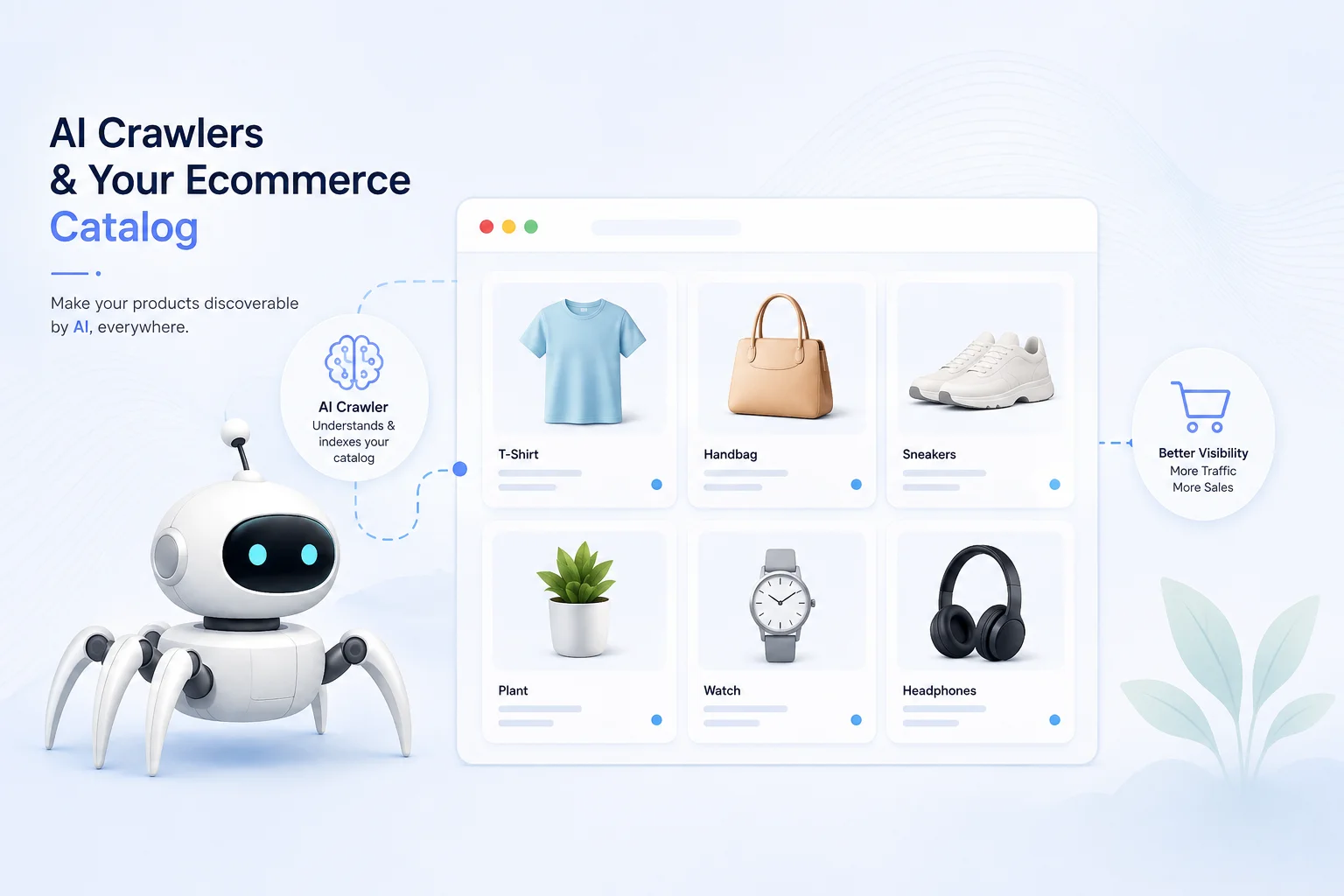
AI crawlers are bots that browse and download web content for use by AI systems rather than traditional search indexes. The main ones are GPTBot (OpenAI), Bingbot (Microsoft Copilot), PerplexityBot, ClaudeBot (Anthropic), Google-Extended (Gemini and AI Overviews), and Applebot-Extended.
How do I let AI crawlers access my ecommerce site?
Add explicit allow directives for each crawler in robots.txt, then verify that your WAF, CDN, and security plugins aren’t blocking them independently — that’s where most unintended blocks live. Confirm by checking server logs for those user agents and the status codes they receive.
Does blocking AI crawlers hurt ecommerce sales?
For most retailers, yes, over time. Product discovery is shifting toward AI assistants, and blocking crawlers means your products can’t be recommended there. Unlike publishers who monetize pageviews, retailers monetize purchases, and AI-referred visitors typically arrive with high purchase intent.
How do I know if AI crawlers are citing my products?
Bing Webmaster Tools has an AI Performance report showing citations from Copilot and partners, though data lags two to three days and represents a sample. Supplement it with referral traffic from AI domains, manual spot-checks asking assistants your customers’ questions, and server log analysis of crawler frequency.
Why did my AI citations suddenly drop?
Check crawl access first — robots.txt changes, WAF rules, or server errors under bot load are the common site-side causes. Platform-side causes also exist: grounding indexes get rebuilt, and sites have seen citations collapse for one to three weeks before recovering with no changes on their end. Investigate access, then watch for a week before concluding.
What matters most for getting cited by AI?
Crawlability first, then content quality: complete structured product data, server-rendered pages that don’t require JavaScript to read, enriched descriptions covering use cases and attributes, accurate real-time pricing, and content that answers questions directly in a quotable form.
Be findable everywhere shoppers look.
The catalog quality that makes AI assistants recommend your products is the same quality that powers great on-site search. bCloud AI helps you build both.
bcloud.ai