
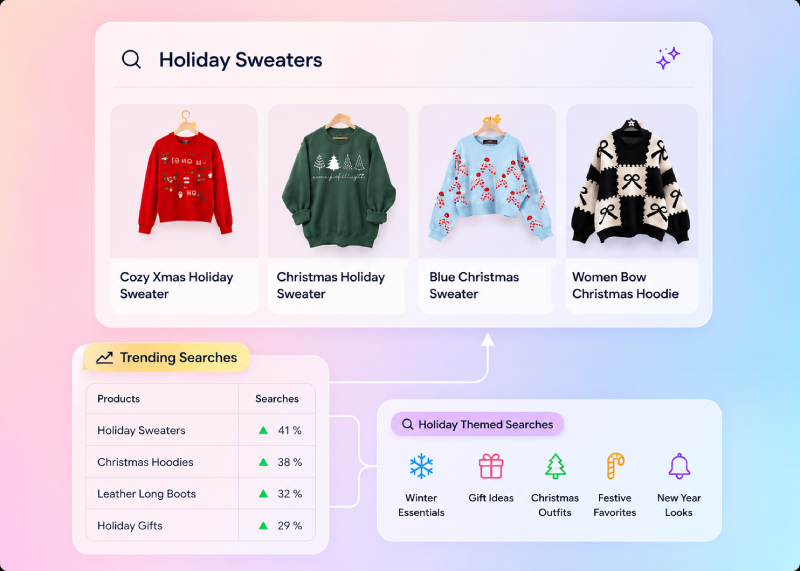
The Complete Guide to E-Commerce AI Search

What is E-Commerce AI Search?
Footwear specifically
(not apparel)
Blue color
(not red or black)
Running-specific features
(not casual shoes)
Price constraint
(maximum $150)
This semantic understanding—knowing what words mean rather than just matching characters—is the core innovation that makes e-commerce AI search transformative.
Why E-Commerce AI Search Matters Now
💰
Revenue Impact is Real
Studies show that implementing e-commerce AI search increases conversion rates by 25-40%, click-through rates by 200%+, and reduces zero-result pages from 8-12% to under 1%.
🎯
Customer Expectations Changed
Customers now expect search to work like Google or ChatGPT. They're frustrated with keyword-only search that requires them to guess exact product titles. E-commerce AI search meets these expectations.
⚙️
Technology Finally Matured
LLMs like GPT-4, vector databases, and semantic embeddings are now affordable and practical at scale. What was expensive research 3 years ago is now mainstream.
🏆
Competitive Necessity
Your competitors are already implementing AI search. Stores using e-commerce AI search are winning market share from those still using legacy keyword matching.

How E-Commerce AI Search Works
Think: Instead of storing “blue running shoe” as text, the system stores it as a point in 768-dimensional space that clusters near other running shoes and near the color blue, far from casual shoes.
Example: “blue running shoes under $150” → System understands: category=footwear, color=blue, activity=running, price_max=150, etc.
This is why “sapphire sneaker” returns results when a customer searches for “blue running shoes”—the semantic meaning is the same.
A perfectly relevant product that nobody buys gets ranked lower than a slightly less-perfect product that converts at 40%.
Black Friday arrives? The system automatically adjusts for peak-season shopping patterns. Seasonal products emerge? The model adapts.
Key Features of E-Commerce AI Search Systems
Semantic Search
Understands meaning, not just keywords. “Summer footwear” finds winter boots if they're lightweight.
Vector Embeddings
Products mapped to high-dimensional space where similarity = relevance. Enables true semantic matching.
LLM Query Rewriting
GPT-class models understand intent, constraints, and implicit requirements in natural language queries.
Zero-Result Recovery
When exact matches don't exist, intelligently returns similar products instead of empty pages.
Conversational Interface
Multi-turn dialogue. Customers ask follow-up questions and refine results naturally.
Automated Learning
Weekly retraining based on behavior. Your search automatically improves without manual tuning.
Personalization
Results adapt to each customer's history, preferences, and behavior patterns.
Real-Time Analytics
Track intent, conversion rates, zero-result queries, and trending searches in real-time.
The Benefits of E-Commerce AI Search
📈 Conversion Rate Improvement
E-commerce AI search increases conversion rates by 25-40%. Customers find products faster, products are more relevant to their intent, and they buy at higher rates. This is the single biggest ROI driver.
+31% CTR
+27% AOV
+$310K
📊 Reduced Manual Work
No more manual relevance tuning, boost rules, or configuration. The system learns automatically. This saves engineering time and reduces errors from manual configuration.
🎯 Better Search Experience
Zero-result pages disappear. Typos are forgiven. Intent is understood. Customers love the search experience and tell others about it.
- Zero-result pages drop from 8-12% to <0.5%
- Typo-tolerant search (misspelling is no problem)
- Synonym understanding (“boots” finds “footwear”)
- Intent inference even with vague queries
⚡ Performance & Speed
Modern e-commerce AI search systems are fast. Sub-100ms latency means instant results. No customer waiting, no bounce rate increase from slow search.
87ms
Real-World Use Cases
+32% conversion, -95% zero-result pages
+18% search efficiency
Relevance improves 5-8% monthly automatically
Zero-result pages reduced 95%
How to Implement E-Commerce AI Search
Option 1: Dedicated AI Search Platform
Use a modern, AI-native search platform like bCloud AI. This is the fastest path to production (4 weeks to live, typically). You get a complete e-commerce AI search solution with no engineering overhead.
Option 2: Vector Database + LLM API
Build your own using Pinecone, Weaviate, or Milvus for vectors + OpenAI/Claude API for LLM. This gives you full control and flexibility.
Option 3: Traditional Search + AI Layer
Keep your existing Elasticsearch/Algolia infrastructure and add an AI reranking layer on top. Quickest to market for existing systems.
Step-by-Step Implementation Checklist
🔍
🖥️
📄
🧪
👁️
📊
🚀
🔄
The Future of E-Commerce AI Search
Multimodal Search
E-commerce AI search will soon accept photos, sketches, and voice queries—not just text. Upload a photo of shoes you like, and the system finds similar ones in your catalog.
01
02
Cross-Device Learning
Your search experience will follow you across devices. Browsed dresses on mobile but left? Your desktop search remembers that context and continues helping you find what you want.
Conversational Commerce
Multi-turn dialogue will become standard. Ask questions, refine results, explore options—all in natural conversation. ChatGPT-like shopping experience will be the baseline.
03
04
Real-Time Personalization
Instant personalization based on browsing, purchases, season, weather, time of day—all optimized for your individual preferences. No two customers see the same search results.
Frequently Asked Questions
What's the difference between AI search and regular keyword search?
Do we need to replace our entire search infrastructure?
Not necessarily. You can add an AI reranking layer on top of existing search, or gradually migrate to an AI-native platform. Most companies start with a phased approach.
How long does it take to implement e-commerce AI search?
Will AI search be faster or slower than keyword search?
What if our product catalog is messy or incomplete?
Is AI search expensive?
Can we use multiple search systems in parallel?
What happens if our data changes (new products, discontinued items)?
Is e-commerce AI search prone to “AI hallucinations”?
How do we measure success after implementation?