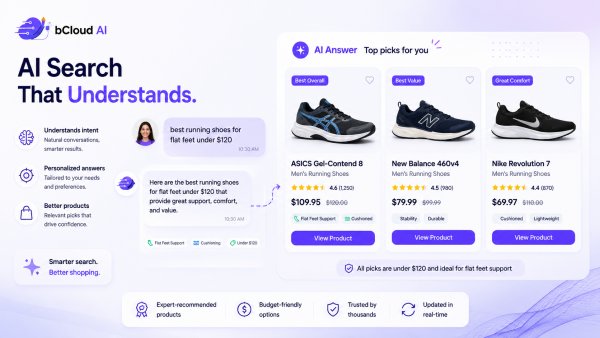
Five years ago, a shopper looking for running shoes typed “best running shoes” into Google and scrolled through ten blue links. Today, that same shopper opens ChatGPT and asks, “What are the best running shoes for flat feet under $120?” — and gets two or three specific recommendations, no scrolling required.
Achieving AI visibility for ecommerce is key in today’s digital marketplace.
That shift is the whole story. The buyer’s decision is increasingly made inside the AI conversation, before they ever click through to a store. If your brand is one of the products the AI names, you’re in the running. If it isn’t, you’re invisible — and you never even saw the customer.
Brands that focus on enhancing their AI visibility for ecommerce will stand out.
This is what AI visibility is about, and it’s quickly becoming as important to U.S. retailers as ranking on Google’s first page. This guide explains what AI visibility means, why it matters now, how AI engines decide which products to recommend, and seven practical things you can do to get your store into those answers. Understanding AI Visibility for Ecommerce is essential for staying competitive.
What is AI visibility?
AI visibility is how often your brand, content, or products appear in the answers generated by AI search engines — tools like ChatGPT, Google AI Overviews, Google AI Mode, Gemini, and Perplexity. Instead of ranking a page in a list of links, you earn a mention or a citation inside an AI-generated answer. For ecommerce specifically, AI visibility means your products get surfaced when a shopper asks an AI assistant for a recommendation, a comparison, or a “best X for Y” pick.
Understanding AI visibility for ecommerce can significantly influence your sales strategy.
Incorporating strategies to enhance AI Visibility for Ecommerce can lead to better brand recognition and sales opportunities.
To maximize your AI visibility for ecommerce, consider leveraging data analytics.
Think of it as the new front page. Traditional SEO gets you onto the results page; AI visibility gets you into the answer itself — the only thing many shoppers now read.
Why AI visibility matters now for U.S. retailers
The reason is simple: shoppers have changed where they research, and they’re not coming back.
AI assistants now shape demand rather than just respond to it. As one industry analysis put it, the funnel is narrowing — most of the decision now happens before the shopper visits a website, because the AI returns one to three options instead of twenty links. G2’s buyer-behavior research found that generative AI chatbots have become a leading influence over the products and vendors people shortlist, ahead of review sites and even salespeople.
Improving AI visibility for ecommerce directly correlates with higher sales conversion rates.
The numbers are still early but the trajectory is steep. Reporting through 2025 and into 2026 points to explosive growth in AI shopping queries — some analyses cite increases of several thousand percent year over year — while ChatGPT alone is described as handling tens of millions of shopping-related queries a day across a weekly audience in the hundreds of millions. The channel is still a small slice of total ecommerce revenue today, but it punches above its weight: AI-referred visitors tend to arrive already informed, having compared their options inside the chat, and several studies report they convert at meaningfully higher rates than non-branded organic traffic.
There’s also a defensive reason. As AI answers absorb more of the journey, “zero-click” behavior climbs. Industry trackers report that when an AI Overview appears, the share of searches that end without a click jumps dramatically, and Google’s AI Mode pushes it higher still. When the generated answer is the experience, being named in it is the difference between being considered and being skipped.
Every brand must prioritize AI visibility for ecommerce to remain relevant.
The honest caveat: this is a fast-moving, sometimes messy space. AI engines still make mistakes — a smartwatch occasionally turns up in “basketball shoes” results — and purchasing infrastructure is immature (OpenAI’s early Instant Checkout experiment was paused in 2026 after limited merchant uptake). So AI visibility is about discovery and influence today, with the buying mechanics still catching up.
AI Search Grader by bCloud AI
Grade your ecommerce search in 10 quick questions
31% of ecommerce searches return zero results — and most shoppers who hit a dead end leave for a competitor. How does your store's search stack up?
Answer 10 short questions and get your AI search score, plus a personalized report to fix the gaps. Free, takes about 2 minutes.
No signup needed to take the quiz.
72Search score
31%of site searches end in zero results
40%conversion lift possible with AI search
<200msis the response speed shoppers expect
RelevanceQuestion 1 of 10
Understanding intent…
Scoring your answers across relevance, AI, experience, and insights.
✓ Quiz complete
Your AI search score is ready
Tell us where to send your personalized report. You'll see your score and recommendations right away.
0
out of 100
Grade —
Your score by pillar
Personalized recommendations
Fix the gaps in weeks, not quarters
bCloud AI replaces keyword-only search with hybrid AI retrieval — sub-200ms responses, 99.99% uptime, and conversion lifts of up to 40% across 50+ implementations.
It’s tempting to treat AI visibility as a replacement for SEO. It isn’t. The two are deeply connected, and the connection works in your favor.
AI visibility for ecommerce and traditional SEO strategies should be integrated for maximum effect
Most AI shopping answers don’t appear out of thin air — they’re built on the same web and product data Google already uses. Industry analyses estimate that a large majority of ChatGPT’s shopping data (commonly cited around 75–83%) is pulled directly from Google Shopping. Google AI Overviews sit on top of the regular search results and draw on the pages Google has already crawled and trusted. In other words, the Google Merchant feed and the on-page SEO you’ve already invested in are the foundation that AI engines read from.
That’s good news. It means the work you do to support traditional Google keyword search — clean product data, strong product pages, useful content, technical health — does double duty by powering your AI visibility too. You don’t get to choose one. A complete strategy strengthens both at once.
7 ways to improve your store’s AI visibility
Companies need to innovate to improve their AI visibility for ecommerce.
Here’s the practical part. None of this requires reinventing your business — most of it sharpens work you should be doing anyway.
1
Nail your structured data
Nailing your structured data is essential for enhancing AI visibility for ecommerce.
This is the foundation. Implement complete Product schema (JSON-LD) with Offer, price, availability, and AggregateRating, and make sure it renders server-side so AI crawlers can actually read it. Confirm your robots.txt allows the AI crawlers (such as OpenAI’s OAI-SearchBot and other answer-engine bots) rather than accidentally blocking them. If an engine can’t crawl and parse your pages, you can’t be recommended — full stop.
2
Complete and clean your product feed
Because so much AI shopping data flows through Google Shopping, your Merchant Center feed is doing more work than ever. Aim for near-complete attribute coverage — titles, GTINs, descriptions, images, sizes, materials, availability. Sparse or messy feeds are the single most common reason a product that should qualify never gets surfaced.
Complete and clean product feeds are vital for AI visibility for ecommerce.
3
Write answer-direct, buyer-guide content
AI engines reward content that answers the question fast. For every key category and product, make sure your page quickly answers five things: who it’s for, what problem it solves, what the alternatives are, what trade-offs matter, and what proof backs it up. Put those answers near the top — don’t bury them under a long intro — and expand with comparison tables, examples, and FAQs. A clean decision table (“best for budget,” “best for durability,” “best for small spaces”) is exactly the kind of structured comparison an AI can lift into an answer.
Writing answer-direct content will significantly enhance your AI visibility for ecommerce.
4
Build entity and brand authority
AI engines need to recognize you as a real, consistent entity. Keep your brand name, descriptions, and core facts consistent across your site, your profiles, and the wider web. Earn mentions in places the AI already trusts — relevant publications, roundups, and communities. The more consistently the web describes who you are and what you’re known for, the more confidently an AI will name you.
Building authority enhances your brand’s AI visibility for ecommerce.
Because the major shopping surfaces are organic and unsponsored, independent proof carries real weight. Steady, genuine reviews — and visible review summaries on your pages — give engines the validation they look for. This is one of the highest-leverage, lowest-cost moves available to most retailers.
Earn reviews to boost your AI visibility for ecommerce strategies.
6
Keep everything fresh
AI engines favor current signals: accurate availability, up-to-date pricing, recent content. Stale “out of stock” data or year-old buyer guides quietly cost you recommendations. Build a cadence of refreshing your highest-value pages and feeds.
Fresh content is crucial for maintaining AI visibility for ecommerce.
7
Upgrade your on-site search to be intent-ready
Here’s the connection most retailers miss. The same intelligence that lets an AI match “comfortable shoes for standing all day” to the right product is exactly what your own store search needs — and the work overlaps.
A modern AI ecommerce search engine reads, structures, and enriches your entire catalog so every product becomes fully discoverable — by shoppers and by the AI systems crawling your store. That same clean, semantic understanding of your products is what makes them legible to answer engines. Just as important, an on-site AI shopping assistant captures first-party data on exactly what your customers ask — the real language and intent behind their searches — which is gold for shaping the buyer-guide content and product attributes that earn AI visibility in the first place.
In short: getting recommended by external AI and serving great AI-powered search on your own store are two sides of the same coin. Both start with a catalog an AI can actually understand.
To improve your AI visibility for ecommerce, ensure your catalog is clear and organized.
For ecommerce brands, AI visibility is becoming an essential part of product discovery as shoppers increasingly rely on ChatGPT, Google AI Overviews, Gemini, and Perplexity for recommendations and comparisons. Instead of competing only for traditional search rankings, retailers now need to make their products easy for AI systems to understand, evaluate, and confidently recommend. This starts with accurate product data, complete feeds, structured product information, helpful buyer-focused content, genuine reviews, and strong brand authority across the web. When these signals work together, your products have a better opportunity to appear in AI-generated answers, reach high-intent shoppers earlier in the buying journey, and turn AI-driven discovery into measurable ecommerce growth.
How to measure your AI visibility
You can’t improve what you don’t track, and traditional analytics won’t show you this — no click event fires when an AI simply names you in an answer.
Track your AI visibility for ecommerce to understand your performance in AI queries.
Start by understanding the three states your brand can be in for any AI answer: cited (your URL appears as a source), mentioned (your brand name appears in the text without a link),
or absent. Each calls for a different response.
For free starting signals, Google Search Console has begun reporting AI Overview impressions and clicks in some markets, which gives you a rough read on where AI answers are appearing for your queries. Beyond that, a category of dedicated AI visibility tools now tracks brand mentions, citations, and share of voice across ChatGPT, Perplexity, Gemini, and Google’s AI surfaces — including options built into platforms you may already use, like Semrush’s AI visibility toolkit. Because cross-engine overlap is low, track each engine you care about separately rather than assuming one predicts the others.
Finally, connect visibility to revenue. Tag and watch AI-referred traffic in GA4, and compare its conversion rate and revenue per session against your other channels. Given how well-qualified these visitors tend to arrive, that comparison usually makes the business case on its own.
Common AI visibility mistakes to avoid
Avoid common pitfalls to maintain strong AI visibility for ecommerce.
⚠️ Blocking the AI crawlers. Double-check robots.txt; many sites lock out the exact bots they’re trying to reach.
⚠️ Thin or keyword-stuffed pages. AI engines reward genuine, answer-first usefulness, not keyword density.
⚠️ Ignoring reviews. Independent proof is one of the strongest ranking signals in organic AI recommendations.
⚠️ Treating AI and SEO as separate projects. They run on shared data; siloing them wastes effort.
⚠️ Skipping measurement. If you’re not tracking mentions, you’re optimizing blind.
⚠️ Letting the AI get you wrong. Inaccurate or missing data invites AI hallucination about your products — fix the source data so the answer is right.
Where this is heading: agentic commerce
Future advancements will further influence AI visibility for ecommerce.
The next phase is already taking shape. AI assistants are moving from recommending products to acting — comparing options, assembling carts, and (eventually) completing purchases on a shopper’s behalf. The buying infrastructure is still maturing, but the direction is clear: the brands that are easy for AI to understand, trust, and act on will win the most ground as that shift accelerates.
The takeaway is the same whether you’re optimizing for today’s recommendations or tomorrow’s shopping agents: make your store the source AI trusts. Clean data, answer-first content, real authority, and search that understands intent — that’s the foundation that pays off across every channel a shopper uses.
AI Visibility Checklist for Ecommerce Brands
Improving AI visibility isn’t about chasing a single ranking factor. It’s about building a store that AI search engines can easily understand, trust, and confidently recommend. Use this checklist to evaluate whether your ecommerce business is ready for the AI-first shopping era.
✅ Technical Foundation
Product Schema (JSON-LD) implemented
Google Merchant Center feed optimized
AI crawlers allowed in robots.txt
Fast page speed and Core Web Vitals
Mobile-friendly product pages
📝 Content Quality
Detailed product descriptions
Buyer guides and comparison pages
Frequently Asked Questions
Fresh and updated content
Natural language writing
⭐ Trust Signals
Verified customer reviews
Consistent brand information
Accurate pricing and availability
High-quality product images
Authoritative backlinks and mentions
📊 Performance Tracking
Monitor AI mentions and citations
Track Google AI Overview traffic
Measure AI referral conversions
Review search queries regularly
Continuously improve product data
Pro Tip: Don’t wait until every item on this checklist is complete before optimizing for AI visibility. Many retailers start seeing improvements simply by strengthening their product data, publishing helpful buying content, and keeping their catalog accurate. AI visibility is built through continuous improvements rather than a one-time setup.
Frequently asked questions
Q1
What is AI visibility in ecommerce?
AI visibility in ecommerce is how often your brand and products appear in answers generated by AI search engines like ChatGPT, Gemini, Perplexity, and Google AI Overviews. Instead of ranking in a list of links, you earn a mention or citation inside the AI’s answer when a shopper asks for a recommendation or comparison.
Q2
How is AI visibility different from SEO?
SEO gets your page ranked in a list of search results; AI visibility gets your brand named inside an AI-generated answer. They’re closely linked — AI engines draw on the same web pages and product feeds Google uses — so strong SEO supports strong AI visibility, but you optimize for AI by adding structured data, answer-direct content, and third-party authority on top of your SEO foundation.
Q3
Which AI engines should ecommerce brands prioritize?
In the U.S., focus on ChatGPT, Google AI Overviews, Google AI Mode, Perplexity, and Gemini. Because a brand visible on one engine is often absent on another, track and optimize for each one separately rather than assuming success on one carries over.
Prioritizing AI visibility for ecommerce is essential for brands to thrive.
Q4
How do I get my products recommended by ChatGPT?
Make your products easy to read and trust: complete Product schema with GTINs, a near-complete Google Shopping feed (which powers most of ChatGPT’s shopping data), genuine reviews, answer-first buyer-guide content, and crawler access for AI bots. ChatGPT’s shopping recommendations are organic and unsponsored, so visibility is earned through quality signals, not paid placement.
Q5
Does my on-site search affect AI visibility?
Indirectly, yes. A clean, semantically structured catalog — the kind that powers a good AI ecommerce search engine — is the same data AI answer engines read when deciding what to recommend. An on-site AI shopping assistant also reveals the real questions your customers ask, which helps you build the content and product attributes that earn AI visibility.
Q6
How long does it take to improve AI visibility?
Once the technical foundation is in place, AI engines can pick up new or updated content within days for a well-structured site. Building durable brand authority and review signals takes longer — typically a few months of consistent effort before you see compounding gains.
Improving AI visibility for ecommerce is a gradual process but yields significant rewards.
Q7
Ready to make your catalog AI-ready?
The same intelligence that gets your products recommended by AI is what powers a search experience your shoppers love. See how bCloud AI turns shopper intent into revenue — clean, semantic, sub-200ms search built for commerce.