
What is semantic search?
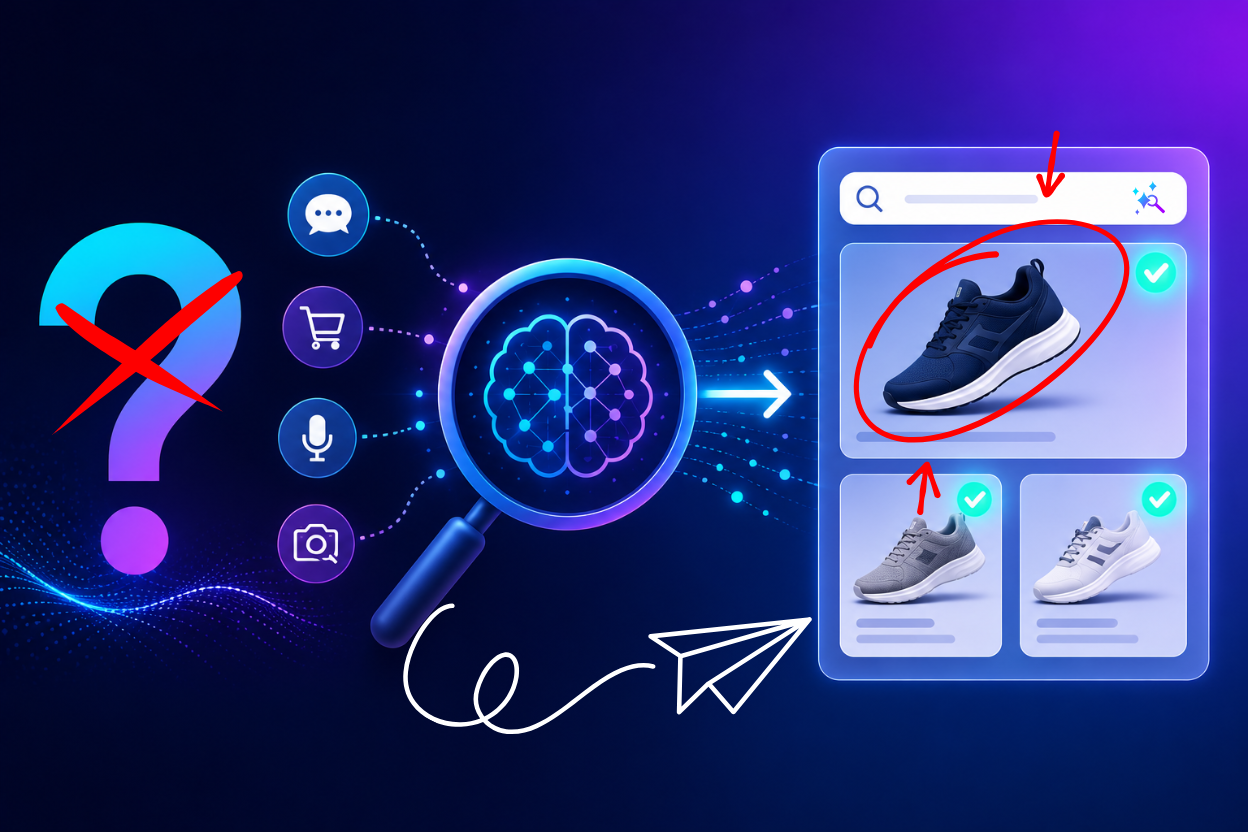
To really understand what is semantic search, start with what it replaced. Traditional keyword search treats your query as a string of text to find. If you search “couch” and every product in the catalog is labeled “sofa,” you get nothing — even though the store is full of exactly what you want. A meaning-based engine understands that a couch and a sofa are the same thing, that “affordable” implies a price constraint, and that “for a small apartment” is a size signal. It answers the question you meant to ask.
Here’s the thing most explanations skip: it isn’t one piece of technology. It’s an outcome produced by several working together — language models that interpret your query, embeddings that represent meaning as numbers, and retrieval systems that find the closest matches. We’ll unpack each of those in a moment.
What is the meaning of semantic search?
Since people search for this phrasing constantly, let’s tackle what is the meaning of semantic search directly. What is the meaning of semantic search as a term? It combines “semantic” (relating to meaning in language) with “search” (finding information). Put together, the meaning of semantic search is: retrieving results based on what words mean in context, rather than on whether those exact words appear in the source.
Anyone asking what is semantic search eventually lands here: the distinction matters because meaning is contextual. The word “apple” means something different in “apple pie recipe” than in “apple laptop deals.” A keyword system sees the same five letters both times. A semantic system reads the surrounding context and routes each query somewhere completely different. That contextual awareness is the entire point — and it’s why understanding what is the meaning of semantic search helps clarify why it succeeds where keyword matching fails.
So when someone asks what is the meaning of semantic search, that contextual reading is the heart of it. You’ll sometimes see the term used interchangeably with “vector search” or “AI search.” They’re related but not identical. Vector search is one technique that enables semantic search. AI search is a broader umbrella that usually includes it plus other capabilities like conversational interfaces and personalization. Our AI ecommerce search guide maps how these pieces fit together.
AI Search Grader by bCloud AI
Grade your ecommerce search in 10 quick questions
31% of ecommerce searches return zero results — and most shoppers who hit a dead end leave for a competitor. How does your store's search stack up?
Answer 10 short questions and get your AI search score, plus a personalized report to fix the gaps. Free, takes about 2 minutes.
No signup needed to take the quiz.
Understanding intent…
Scoring your answers across relevance, AI, experience, and insights.
Your AI search score is ready
Tell us where to send your personalized report. You'll see your score and recommendations right away.
Your score by pillar
Personalized recommendations
Fix the gaps in weeks, not quarters
bCloud AI replaces keyword-only search with hybrid AI retrieval — sub-200ms responses, 99.99% uptime, and conversion lifts of up to 40% across 50+ implementations.
How does semantic search work?
This is where it gets interesting, because how does semantic search work is really a question about four moving parts. How does semantic search work in practice? Four steps, all happening in well under a second.
Step 1: Your query gets interpreted.
(If you only remember one part of how does semantic search work, make it this one.) Before anything is retrieved, the system analyzes what you typed. Modern setups use large language models to pull out intent and constraints. “Blue running shoes under $150” gets decomposed into category (footwear), activity (running), color (blue), and a price ceiling of $150. Typos get corrected. Vague phrasing gets clarified.
Step 2: Everything becomes numbers.
This is the core trick. An embedding model converts your query into a list of numbers — a vector — that captures its meaning mathematically. Every document or product in the index has already been converted the same way. Similar meanings produce similar vectors that sit close together in what’s called vector space. “Couch” and “sofa” land nearly on top of each other. “Couch” and “carburetor” land far apart.
Step 3: The system finds the nearest neighbors.
Now that meaning is geometry, finding relevant results means finding the closest vectors. Doing that exhaustively across millions of items would be far too slow, so search engines use approximate nearest-neighbor algorithms — most commonly HNSW, described in the original research paper that most modern implementations still build on. This is what keeps retrieval fast at scale.
Step 4: Results get reranked.
This final stage is often left out of explanations of what is semantic search, and it matters. Raw similarity isn’t the final answer. A second model reorders the candidates using additional signals — popularity, freshness, conversion history, availability — so the most useful results land on top, not just the most mathematically similar ones.
Understanding how does semantic search work also explains its limits, and knowing how does semantic search work helps you spot a weak implementation. Because it matches meaning rather than exact text, it can be too generous with precise queries. Search an exact model number and a pure meaning-based engine might return “close enough” products. That’s why serious systems combine both approaches, which we’ll cover next.
Semantic search vs. keyword search
| Keyword search | Semantic search | |
|---|---|---|
| Matches on | Exact words and characters | Meaning and intent |
| “Couch” finds “sofa”? | No | Yes |
| Handles typos | Poorly | Well |
| Full sentences | Breaks down | Built for them |
| Exact SKUs | Excellent | Can drift |
| Setup | Rules and synonym lists you maintain | Models that learn |
| Zero results | Common | Rare |
Neither wins outright, which surprises people learning what is semantic search for the first time. Keyword search is genuinely better at precision — exact part numbers, specific model names, literal phrases. Meaning-based retrieval is better at everything human and messy. That’s why most production systems in 2026 run hybrid search: keyword and semantic retrieval running in parallel, with results fused together. You get precision and understanding instead of choosing. Our guide to hybrid search systems breaks down how that blending actually works.
What is a semantic search example?
Abstract definitions only go so far, so let’s get concrete about what is a semantic search in the wild. What is a semantic search doing differently in real situations? Here are four examples where the gap is obvious.
Each scenario below is a small lesson in what is a semantic search actually solving.
The synonym problem.
A shopper searches “ladies trainers.” Your catalog says “women’s sneakers.” Keyword search returns nothing. A meaning-based engine returns the sneakers, because it knows those phrases mean the same thing — no synonym list required.
The descriptive query.
Someone searches “something warm for hiking in the fall.” No product on earth is titled that. The engine returns insulated jackets, fleece layers, and technical shells, because it understood the use case rather than hunting for those words.
The typo.
A customer types “comptuer monitor.” Keyword search shrugs. A meaning-based engine corrects and understands, and the shopper never notices anything went wrong.
The constraint.
“Gift for my mom who loves gardening, under $50.” This is really three requests in one: a recipient, an interest, and a budget. The engine parses all three and filters accordingly.
Each of those is a sale that keyword search quietly loses, and each is a working answer to what is a semantic search built to do. When people ask what is a semantic search worth in business terms, that’s the answer — it’s the difference between a shopper finding what they came for and bouncing to a competitor. If you want to see how this plays out across large product catalogs specifically, our deep dive on semantic search for product catalogs covers the details.
Queries semantic search still gets wrong
Meaning-based matching solves a lot. It does not solve everything.
Knowing where semantic search struggles helps you spot problems early rather than blaming the wrong layer. Four query types cause most of the trouble.
Negation.
“Jacket without a hood” often returns hooded jackets. The word hood pulls the meaning toward them. Filters handle this far better than embeddings do.
Numbers and measurements.
A model treats 40mm and 45mm as nearly identical. Shoppers do not. Consequently size and spec queries need real filtering rather than similarity.
Brand-new words.
A product line launched last month is unknown to a model trained earlier. Therefore the keyword half of a hybrid setup is what rescues those searches.
Comparisons.
“Cheaper than the X200” needs a price lookup, not a meaning match. Retrieval finds the neighbourhood, but ranking rules have to finish the job.
In short, test these four families before you launch. Each one is fixable, but the fix lives in filters or keyword matching rather than in a better model. Our query understanding guide covers how constraints get extracted.
Where you’ll find semantic search in 2026
It stopped being a niche technology a while ago. You’re interacting with it constantly:
- Web search engines. Google has been layering semantic understanding into results for years, which is why it answers conversational questions well.
- AI assistants. ChatGPT, Gemini, Perplexity, and Copilot all rely on semantic retrieval to find relevant information before generating an answer.
- Ecommerce site search. Online stores use it to match shoppers to products by intent.
- Enterprise and document search. Finding the right internal document by describing what it covers rather than guessing its title.
- RAG systems. Retrieval-augmented generation — where an AI grounds its answers in real documents — is built on semantic retrieval. Our explainer on LLM search covers this architecture.
The common thread in every answer to what is semantic search: anywhere people express what they want in natural language, semantic search is what makes the response feel intelligent.
Why semantic search matters for online stores
For retailers, this isn’t an academic topic. Site search is where your highest-intent customers show up — they’ve already decided roughly what they want and are telling you in their own words. When that search fails them, you lose the visitors most likely to buy.
The failure rate is worse than most teams realize. Industry research consistently finds that a large share of site searches return zero results, and the cause usually isn’t a missing product. It’s a vocabulary mismatch — the shopper’s words and the catalog’s words didn’t line up. That’s precisely the problem semantic search solves, which is why the answer to what is semantic search matters commercially and not just technically.
The knock-on effects are real: fewer dead-end searches, higher conversion on search traffic, better handling of long-tail queries that signal buying intent, and an experience that works for shoppers who type the way they talk. If you’re evaluating options, our roundup of the best AI ecommerce search platforms compares the leaders, and the top semantic search solutions guide narrows it further.
Semantic search and getting found by AI
Here’s a development worth paying attention to. Shoppers increasingly skip the search bar entirely and ask an AI assistant instead — “what’s the best waterproof jacket under $150?” Those assistants run on semantic retrieval. They interpret the question, search for meaning, and recommend a handful of products.
Which means the same technology that powers good on-site search also determines whether external AI engines can understand and recommend your products. A clean, semantically structured catalog is legible to both. Stores that invest here tend to improve their visibility inside AI-generated answers as a side effect — a genuinely useful two-for-one. It’s another angle on what is semantic search: not just a feature on your site, but the language your catalog needs to speak to be found anywhere.
Common misconceptions
A few things get muddled often enough to be worth clearing up when people research what is semantic search.
“It replaces keyword search.” It doesn’t, and shouldn’t. Hybrid systems outperform either approach alone. Keep keyword precision for exact matches.
“It requires a PhD team.” It used to. Managed platforms now handle embeddings, indexing, and reranking for you — implementation is measured in weeks, not quarters.
“It’s slower.” Also outdated. Modern implementations return results in under 200 milliseconds, often faster than rule-heavy legacy keyword systems.
“It works out of the box with no data quality effort.” The technology is more forgiving of messy catalogs than keyword search, but garbage in still degrades results. Clean product data makes it noticeably better.
“Vector search and this are the same thing.” Vector search is a technique. It’s the outcome. You can achieve it with vectors, language models, or a combination.
How to add semantic search to your store
If you’ve read this far, you probably want to know what implementing it takes. There are three realistic paths.
Build it yourself.
Choose an embedding model, stand up a vector database, build the ingestion and reranking pipeline, and wire it into your storefront. Maximum control, and realistically a multi-month project for an engineering team.
Add a semantic layer to existing search.
Keep your current engine and bolt on semantic reranking. Faster and lower-risk, though you inherit your existing system’s limits.
Use a managed platform.
An AI-native search platform ships semantic understanding, hybrid retrieval, reranking, and merchandising together. This is the fastest route for most retailers — typically live in weeks, with no machine learning expertise required in-house. bCloud AI’s AI search engine and product search engine work this way, combining keyword precision with semantic meaning by default rather than gating it behind an enterprise tier.
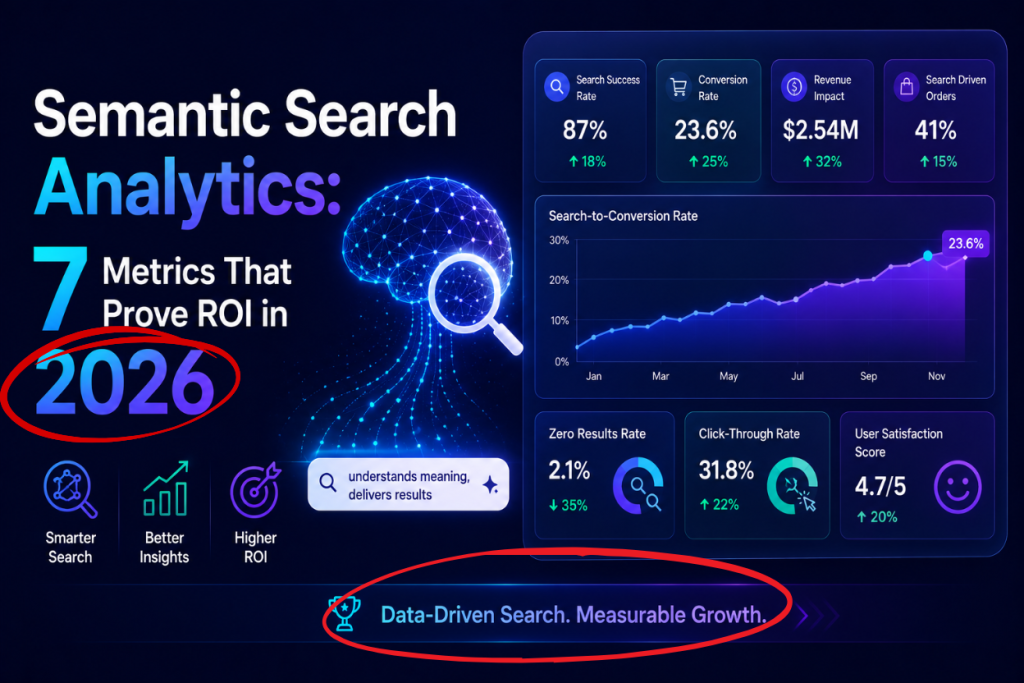
Whichever route you take, measure the result — that’s the practical test of what is semantic search delivering value. Compare zero-result rate, search conversion rate, and revenue per search before and after. If semantic search is working, those numbers move.
Signs Your Store Needs Semantic Search
Many ecommerce businesses continue using keyword-based search without realizing how much revenue it leaves behind. If your search experience shows any of the following signs, adopting semantic search can significantly improve product discovery and customer satisfaction.
High Zero-Result Searches
Customers frequently receive no results because they use different words, synonyms, or descriptive phrases than your catalog.
Long Natural-Language Queries Fail
Searches like “comfortable shoes for standing all day” or “gift ideas for coffee lovers” return poor or irrelevant products.
Customers Keep Refining Searches
Users repeatedly modify their queries before finding the right product, indicating that the search engine isn’t understanding their original intent.
Growing Product Catalog
As your catalog expands, keyword matching alone becomes less effective, making it harder for shoppers to discover relevant products.
Quick assessment: If your store experiences two or more of these challenges regularly, it’s a strong indication that semantic search can improve search relevance, reduce zero-result pages, and help shoppers find products with fewer searches.
Frequently asked questions
What is semantic search?
Semantic search is a search method that understands the meaning and intent behind a query rather than matching exact keywords. It uses language models and vector embeddings to interpret what someone means, so “couch” finds sofas and “warm jacket for fall hiking” returns relevant products even when those exact words never appear.
What is a semantic search, and how is it different from normal search?
In simple terms, it’s search that reads for meaning instead of characters. Rather than hunting for your literal words, it figures out what you’re actually asking for and returns results that match that intent — handling synonyms, typos, and full sentences naturally.
How does semantic search work, step by step?
It works in four stages: a language model interprets your query and extracts intent, an embedding model converts the query and all indexed content into numerical vectors that capture meaning, an approximate nearest-neighbor algorithm finds the closest vectors, and a reranking model reorders results using signals like popularity and relevance.
What is the meaning of semantic search as a phrase?
The term combines “semantic,” meaning relating to meaning in language, with “search.” So the meaning of semantic search is retrieving results based on what words signify in context, rather than whether those exact words appear in the source material.
Is semantic search better than keyword search?
Neither is universally better. Semantic search handles synonyms, typos, and natural language far better; keyword search is more precise for exact SKUs, model numbers, and literal phrases. Most modern systems use hybrid search, running both together for precision and understanding.
Does semantic search slow down a website?
No. Modern semantic search typically returns results in under 200 milliseconds, often faster than legacy keyword systems weighed down by complex ranking rules.
Do I need a machine learning team to use semantic search?
Not anymore. Managed AI search platforms handle embedding generation, vector indexing, and reranking for you, so most stores can implement semantic search in weeks without in-house ML expertise.
See semantic search running on your own catalog.
Now that you know what is semantic search, the fastest way to understand its impact is to watch it handle your real products and your customers’ messiest queries. bCloud AI combines keyword precision with semantic meaning in a single sub-200ms engine — no enterprise tier required.
bcloud.ai