
Why growth stage changes the answer

Three things shift as you scale, and they decide which search software features earn a place, and they determine which search software features earn their place:
Catalog complexity.
Under a few thousand SKUs, shoppers can browse. Past twenty thousand, search becomes the primary path, and past a hundred thousand, filtered performance starts to matter more than raw relevance.
Team capacity.
Whether anyone owns search outcomes determines whether configurable features get configured. This is the single most underweighted factor in platform selection.
Traffic volume.
Below a certain point you can’t A/B test meaningfully, which changes how you should make decisions — and it changes which pricing models make sense.
Stage 1: Under $5M — get the basics right
At this stage the goal is search software features that work without supervision. Five search software features matter, and the rest are distractions.
Semantic understanding.
The single highest-value capability, because it eliminates the need for the synonym maintenance you have no time for. “Couch” finds sofas automatically. See our what is semantic search guide.
Typo tolerance.
Unglamorous and among the highest-ROI features available. A transposed letter shouldn’t produce a dead end.
Fast autocomplete.
Suggestions as shoppers type, showing products rather than just query strings. Reduces abandonment before submission.
Zero-result recovery.
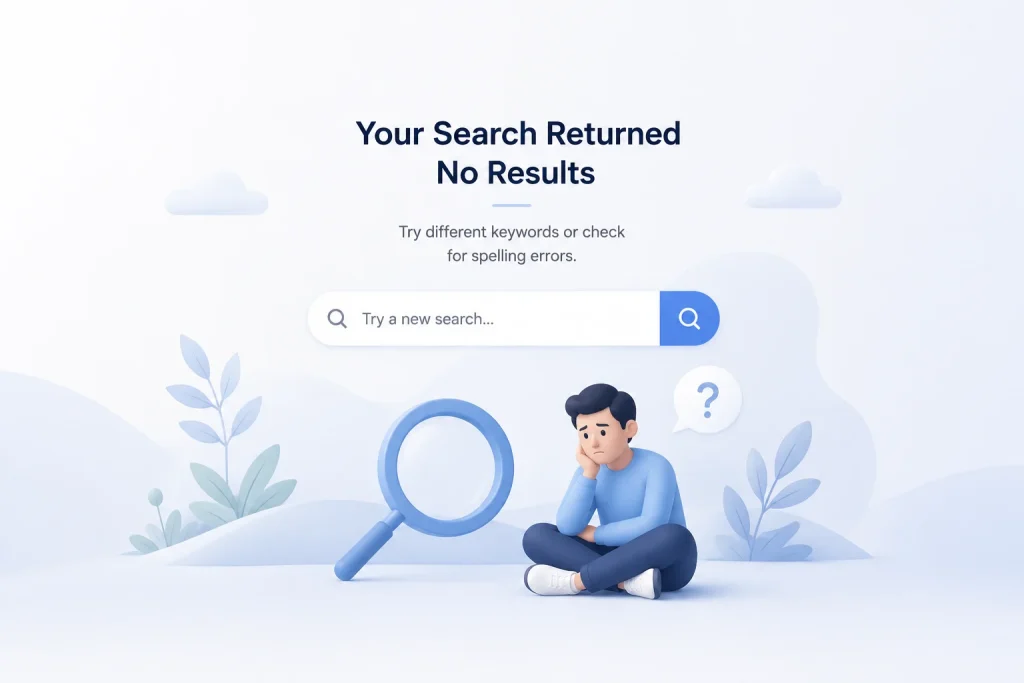
When nothing matches, show something — related products, broader suggestions, a spelling correction. An empty page is an exit, and at this stage you can’t afford to lose high-intent visitors. Our no-results guide covers the recovery design.
Native platform integration.
Shopify, BigCommerce, WooCommerce, or Magento connectors turn a project into a configuration task. At this stage, if it needs an engineer you don’t have, it won’t happen.
Search software features to skip for now: personalization, conversational search, visual search, and advanced merchandising. All genuinely valuable, all requiring data or attention you don’t yet have.
The pricing consideration for search software features: look for a genuine free tier and avoid per-query billing. Your traffic is about to grow, and a pricing model that punishes that growth is the wrong foundation.
AI Search Grader by bCloud AI
Grade your ecommerce search in 10 quick questions
31% of ecommerce searches return zero results — and most shoppers who hit a dead end leave for a competitor. How does your store's search stack up?
Answer 10 short questions and get your AI search score, plus a personalized report to fix the gaps. Free, takes about 2 minutes.
No signup needed to take the quiz.
Understanding intent…
Scoring your answers across relevance, AI, experience, and insights.
Your AI search score is ready
Tell us where to send your personalized report. You'll see your score and recommendations right away.
Your score by pillar
Personalized recommendations
Fix the gaps in weeks, not quarters
bCloud AI replaces keyword-only search with hybrid AI retrieval — sub-200ms responses, 99.99% uptime, and conversion lifts of up to 40% across 50+ implementations.
Stage 2: $5M–$20M — add control and measurement
You now have someone who owns ecommerce outcomes, enough traffic to see patterns, and a catalog large enough that browsing alone doesn’t work. Four more search software features now earn their configuration cost.
Merchandising controls — the search software features your team touches daily.
Pin, boost, bury, and schedule campaigns without an engineering ticket. This is where a merchandiser starts adding value daily, and it’s the capability most likely to be neglected in evaluation because the demo shows an engineer using it.
Search analytics.
Zero-result rate, top failing queries, search conversion versus site average, and revenue per search. Without this you’re improving blind. Our ecommerce search analytics guide covers what to expect.
Business-signal ranking.
Weighting stock, margin, and conversion history into results so search serves revenue rather than relevance alone.
Faceted navigation that adapts.
Filters that adjust to the query rather than a static list — the faceted search pattern applied intelligently. At this catalog size, filtering becomes how shoppers actually narrow.
The habit to build here: read your top hundred failed queries monthly. It takes an hour and it’s the single most actionable report in ecommerce search. Decades of Baymard Institute research show most stores never look at it.
Stage 3: $20M–$100M — personalize and prove
Now you have traffic to test with and a team to act on findings. Three capabilities that were premature earlier start paying.
Personalization.
Session-level first — the current visit shapes results, which works for anonymous visitors and needs no history. Long-term taste vectors come after. The guardrail matters: the query must stay dominant, or you show shoppers their habits instead of their request. Our vector search personalization guide covers the calibration.
A/B testing with control groups.
Among all search software features, this is the one that converts every other feature from a claim into a measurement. Roll changes to a traffic slice, measure conversion and revenue per search against a control, ramp on evidence. See our A/B testing guide.
Hybrid retrieval, verified.
You probably already have it, but at this catalog size verify the exact-match floor explicitly — SKUs and part numbers must resolve literally while descriptive queries resolve by meaning. Our hybrid search guide covers the mechanics.
The operational shift: search moves from a feature someone maintains to a discipline someone owns, with metrics in their objectives. Teams that skip this shift plateau regardless of platform.
Stage 4: $100M+ — scale and governance
At enterprise scale the constraints change again, and different search software features carry the weight, and different search software features become load-bearing.
Filtered performance at volume.
Every query carries facets, and filtered latency is where implementations diverge most. Benchmark p95 and p99 with your real constraints under concurrent indexing.
Real-time indexing.
Price and stock changes searchable in seconds. At high catalog velocity a stale index doesn’t just rank poorly — it actively misleads shoppers. See our real-time indexing guide.
Governance.
Role-based permissions, staging environments, approval workflows, and audit logs. Rarely demoed, always required in enterprise procurement.
Multi-site and multi-region.
One index serving several storefronts with regional filtering, versus separate indexes per site — a decision that materially changes cost and operational burden.
Conversational and generative capability.
Now genuinely worth evaluating, since you have the traffic to justify it and the data quality to ground it.
What changes when you move between stages
The transitions cause more problems than the stages themselves, because search software features that worked at one size fail quietly at the next rather than breaking visibly.
Crossing roughly 20,000 SKUs.
Browsing stops being viable as a primary path, and search shifts from a convenience to the main route through your catalog. Zero-result rate usually climbs here without anyone noticing, because more of the catalog is now only reachable through queries.
Hiring your first dedicated merchandiser.
The moment someone owns results daily, configurable search software features stop being theoretical. This is when a platform that requires engineering tickets for every change becomes a genuine bottleneck rather than an inconvenience.
Passing enough traffic to A/B test.
Below a certain volume you can’t reach significance in a reasonable window, so decisions are judgment calls. Above it, they should be measurements — and teams that don’t make that shift keep making judgment calls with data available.
Adding a second storefront or region.
Multi-site handling, regional availability, and per-market pricing turn a simple index into a structural decision about whether one index serves all sites or each gets its own.
Peak-season traffic multiples.
The first Black Friday at real scale is where per-query pricing and untested tail latency both surface simultaneously. Load-test before it rather than during.
None of these arrive with a warning. Reviewing your search software features against the stage you’re entering, rather than the one you’re in, is the difference between planning and reacting.
Worth naming, because these search software features consume evaluation attention disproportionately.
Counting search software features.
“300+ capabilities” is a marketing metric. Twenty configured features beat three hundred unconfigured ones, and nobody uses three hundred anything.
Sub-millisecond latency claims.
Below roughly 200ms, further speed produces no perceptible improvement. What matters is p95 and p99 under your real load with filters applied.
Voice search, for most catalogs.
Real in specific contexts, marginal traffic for the majority.
Visual search, outside visual categories.
Genuinely valuable in fashion, furniture, and décor; largely decorative in industrial supply.
Advanced ML tuning knobs
you’ll never turn. If configuring a capability requires expertise you don’t have, it isn’t a feature you own.
The three things that outrank every feature
Product data quality.
The ceiling on everything. Search software features can only work with meaning your catalog expresses, and thin titles cap every platform equally. Enrichment usually moves results more than any configuration change — and it hits hardest on the long-tail products that most need surfacing.
Which tier includes what.
Several vendors reserve semantic and vector capability for their top plan, so the feature you’re evaluating may not be in the plan you’re quoted. Ask directly, in writing.
Who operates it.
Every configurable feature is a maintenance commitment. Search quality drifts as catalogs grow and vocabulary shifts, and a system nobody owns reverts to defaults within two quarters.
Buying for two stages ahead, not five
A common overcorrection: teams who’ve been burned by outgrowing a platform buy enterprise capability far too early, then spend two years paying for search software features nobody configures.
The workable rule is to buy for your current stage plus the next one. That gives you room to grow without paying for capability you can’t yet operate, and it acknowledges that platform switching — while genuinely disruptive — is survivable and sometimes the right call.
Three things make a platform outgrow-resistant without requiring you to buy enterprise now. Pricing that doesn’t punish growth matters most, since per-query billing is the mechanism that most often forces a premature switch. A clean API underneath the interface means your integration survives even as your usage sophistication grows. And capability available on upgrade rather than on migration — search software features you can switch on when you’re ready, rather than needing a different vendor.
Ask each vendor directly what happens when you triple in size: do you change plans, or do you change platforms? The answer tells you whether you’re buying a starting point or a ceiling.
Whatever your stage, four tests on your own catalog beat any search software features matrix.
A hundred real queries from your logs
— typos, long descriptions, half-remembered brands. Score which platform puts the right product first.
Exact SKUs and part numbers.
Must resolve literally.
p95 and p99 latency
at your catalog size with your real filters, under concurrent indexing.
Can a non-engineer merchandise?
Have someone from your team pin a product and schedule a campaign. If it needs a ticket, the merchandising features exist on paper only.
Then model pricing at three times current traffic. For platform comparison, our top semantic search solutions for e-commerce roundup and AI site search guide cover the field, and high-intent shoppers covers who these features are actually serving.
Frequently asked questions
What search software features do growing ecommerce teams need most?
At under $5M: semantic understanding, typo tolerance, autocomplete, zero-result recovery, and native platform integration. From $5M–$20M add merchandising controls, analytics, business-signal ranking, and adaptive facets. Past $20M add personalization, A/B testing with control groups, and verified hybrid retrieval.
Which site search features should smaller stores skip?
Personalization, conversational search, visual search, and advanced merchandising. All are genuinely valuable and all require data volume or team attention that smaller stores don’t yet have. Buying them early produces shelfware rather than results.
How do I know if I’m outgrowing my current search?
Three signals: your zero-result rate is climbing as the catalog grows, your merchandising team is waiting on engineering to change results, or you can’t answer whether a recent change helped because there’s no measurement. Any of the three means you’ve outgrown the tooling.
What matters more than features when choosing search software?
Product data quality, which caps what any platform can achieve; which pricing tier actually includes the capabilities you’re evaluating; and whether anyone on your team will own the system after launch. All three outrank the feature list.
How do I test search software features before buying?
Run a hundred real queries from your logs, verify exact SKUs resolve literally, measure p95 and p99 latency with your real filters applied, and have a non-technical team member try to merchandise. Then model pricing at three times current traffic.
Does pricing model matter as much as features?
For growing teams, often more. Per-query billing means your success raises your bill, which is exactly backwards during a growth phase. Catalog- or feature-based pricing stays predictable through traffic spikes.
Search that grows with you, not against you.
bCloud AI includes semantic search at every tier with catalog-based pricing — so scaling traffic doesn’t scale your invoice.
bcloud.ai