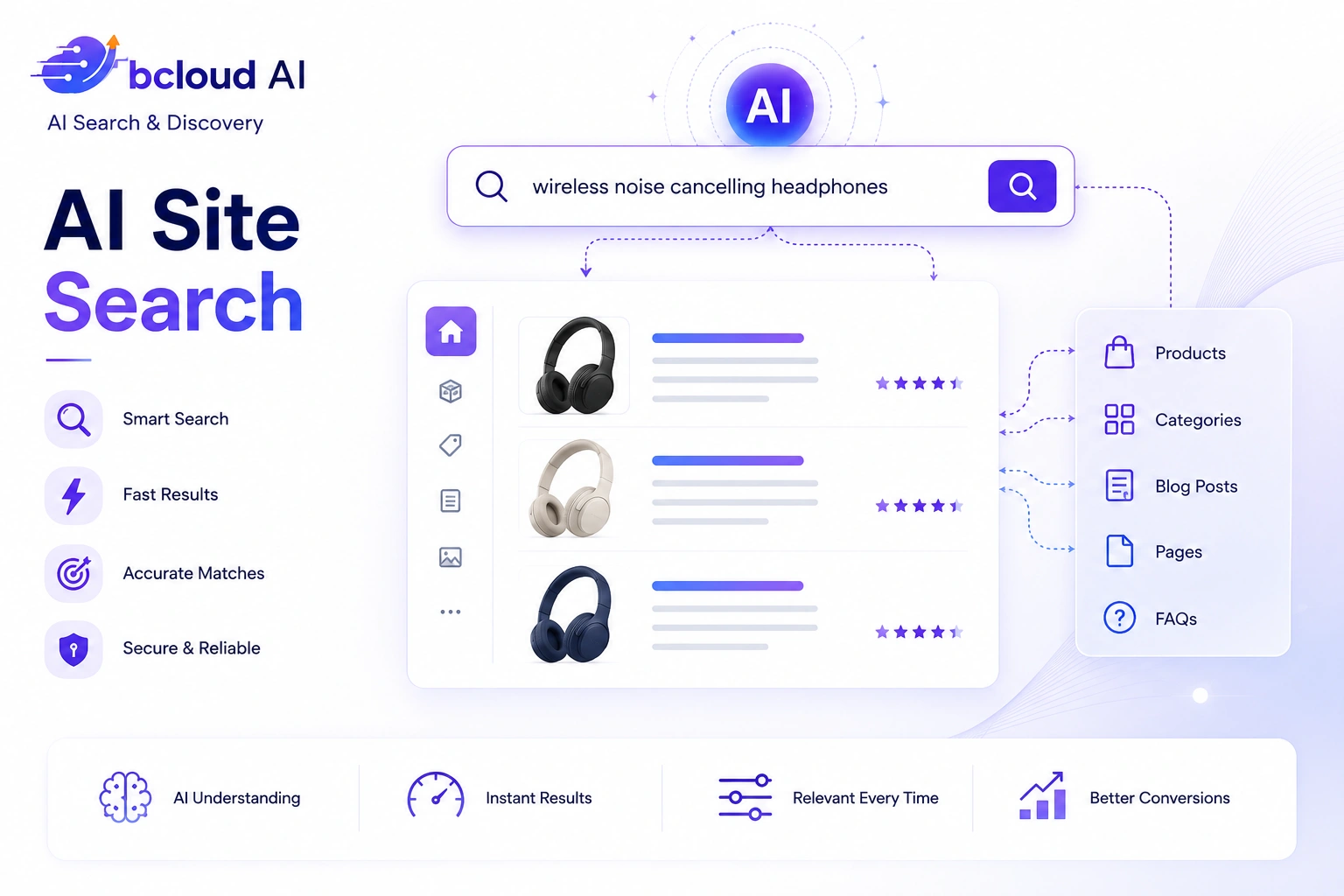
What is AI site search?
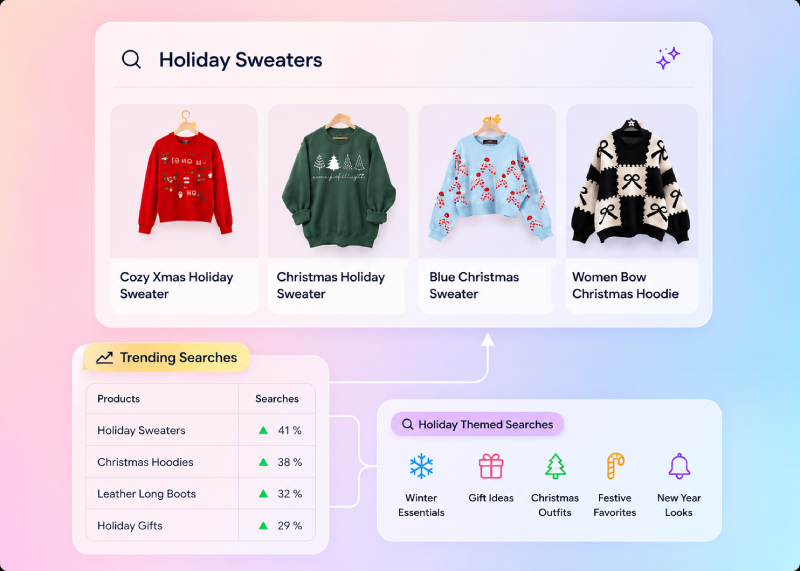
Three capabilities separate AI site search from the old kind. It matches meaning, so “couch” finds sofas and descriptive sentences find products no one titled that way — the discipline formally called semantic search. It learns, adjusting ranking from real click and purchase behavior instead of hand-written rules. And it adapts per visitor, so the same query can rank differently for a trail runner and a road racer. Everything else — typo tolerance, autocomplete, filters — existed before; those three are what the “AI” is actually doing.
How AI site search works
Under the hood, modern AI site search is a pipeline of five layers, each doing one job in a few milliseconds.
One unglamorous layer underneath all five: freshness. Prices and stock change constantly, and results are only as truthful as the index. That’s why serious AI site search runs on event-driven, real-time indexing rather than nightly rebuilds.
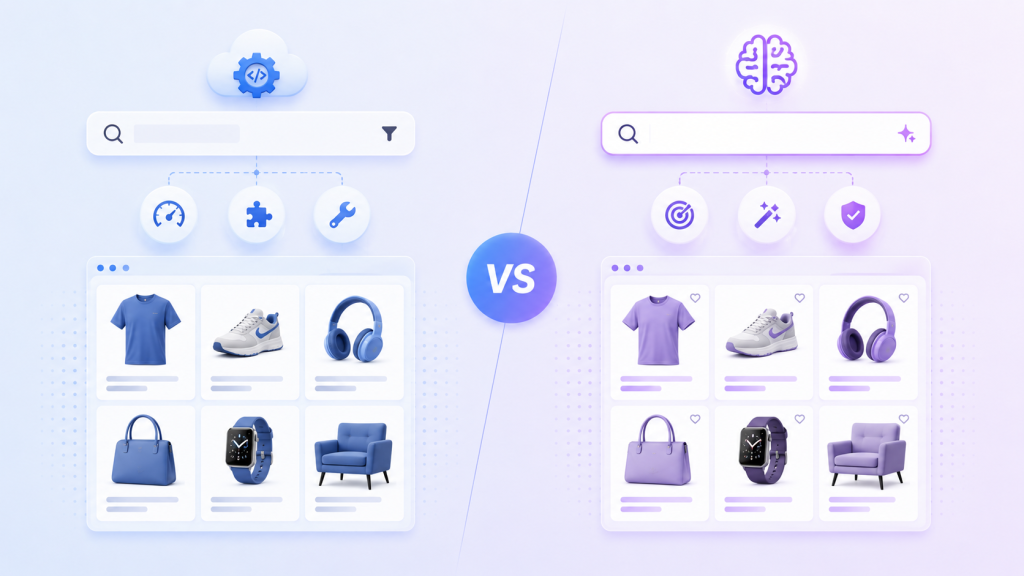
AI site search vs. traditional site search
| Traditional site search | AI site search | |
|---|---|---|
| Matches on | Exact words | Meaning and intent |
| “Couch” finds “sofa”? | Only with a synonym list you maintain | Yes, automatically |
| Typos and misspellings | Often zero results | Corrected and understood |
| Full-sentence queries | Break down | Native territory |
| Ranking | Static rules | Learned from behavior |
| Personalization | None | Per-visitor, in real time |
| Maintenance | Constant rule and synonym upkeep | Model-driven, self-improving |
| Zero-result rate | High — the average store loses roughly 31% of searches | Dramatically lower |
The last row is the one that pays for everything else. Zero-result and near-miss searches are concentrated revenue leaks — a visitor with declared intent, told “no.” Decades of Baymard Institute research show most sites still fail exactly the messy, human query types where AI site search is strongest.
7 powerful wins from AI site search
How to evaluate AI site search (without being demo’d)
Every vendor demo looks brilliant on clean queries. Real evaluation looks like this:
For a structured scorecard across these dimensions, the site search software buyer’s guide goes criterion by criterion, and the best AI ecommerce search platforms roundup compares the current field.
Implementing AI site search
Three realistic paths, in ascending effort. A managed platform ships the full pipeline — understanding, hybrid retrieval, ranking, personalization, analytics — typically live in weeks with no ML team; bCloud AI’s AI search engine works this way, with a developer-friendly search API underneath for headless builds. A semantic layer on existing search keeps your current engine and adds vector retrieval or reranking on top — faster than a rebuild, bounded by the old system’s limits. Building from components — embedding models, a vector database, fusion, rerankers — offers maximum control and a realistic multi-month timeline, the right call mainly for engineering-led companies where discovery is the product.
Whichever route: get your product data in shape first. AI site search understands meaning your catalog actually expresses; thin titles and missing attributes cap every model’s ceiling. Then measure from day one — zero-result rate, search conversion, revenue per search, before and after — so the business case is a number, not an anecdote.
Common mistakes when adopting AI site search
Watching teams roll this out, the same five errors repeat — all avoidable.
Buying AI, shipping defaults. Platforms arrive with generic configurations, and teams launch without connecting behavioral data or tuning for their catalog. The learning loop is the product; leaving it starved of signals buys the badge without the benefit.
Judging on the demo, not the logs. The vendor’s sample catalog is curated to shine. Your evaluation set should be your own ugliest hundred queries — the ones currently returning nothing — because that’s the traffic you’re paying to fix.
Letting product data stay thin. Meaning-based matching can only work with meaning your catalog expresses. Launching on top of missing attributes and three-word titles caps the ceiling on day one; a data-enrichment pass before go-live routinely moves results more than any configuration afterward.
No baseline, no control. Teams flip the switch, feel good, and can never prove the lift. Capture zero-result rate, search conversion, and revenue per search before launch, and keep a holdout slice running after — the difference between a business case and a belief.
Treating launch as the finish line. Search quality drifts as catalogs, seasons, and shopper vocabulary change. The stores that compound their advantage review search metrics on a cadence and feed the findings back into merchandising — a habit, not a project.
Where AI site search is heading
Two shifts are worth planning for now. First, conversation is becoming the interface: shoppers increasingly refine in dialogue — “cheaper,” “in green,” “for wide feet” — and site search is evolving from a results page into an assistant that holds context across turns. The engines built on genuine intent understanding make that jump naturally; keyword engines cannot.
Second, your search layer is becoming your AI-visibility layer. External assistants recommending products parse the same structured, semantically rich catalog that powers good on-site results. Every improvement you make for AI site search — cleaner attributes, better descriptions, machine-readable structure — doubles as an investment in being found and represented accurately inside AI-generated answers. The search bar and the AI assistant are converging on the same requirement: a catalog that expresses meaning. Stores that meet it get discovered everywhere; stores that don’t become invisible twice.
Frequently asked questions
What is AI site search?
AI site search is website search powered by machine learning that understands the intent behind queries — using language models, vector embeddings, and behavioral learning — and returns what visitors meant rather than pages containing their exact words. It handles typos, synonyms, and full sentences natively and improves from real click and purchase behavior.
How is AI site search different from regular site search?
Regular site search matches literal keywords and depends on hand-maintained synonym and boost rules. AI site search matches meaning, learns ranking from behavior, personalizes per visitor, and keeps results fresh in real time — which is why it dramatically reduces zero-result searches and lifts conversion on search traffic.
Does AI site search handle exact SKUs and model numbers?
Good implementations do, because they’re hybrid: keyword matching handles exact identifiers with precision while vector matching handles meaning. Vector-only engines can drift to “close enough” on precise queries, which is why hybrid retrieval is the production standard.
How fast should AI site search be?
Sub-200ms responses at your real catalog size and traffic are the modern bar, measured at p95 and p99 rather than the average. Speed is a conversion factor: results that lag get abandoned regardless of relevance.
How do I measure whether AI site search is working?
Track zero-result rate, search conversion rate, and revenue per search before and after, ideally with a control-group rollout so the lift is proven rather than assumed. Deeper quality measurement — intent coverage, semantic match rate — belongs in your semantic search analytics.
How long does AI site search take to implement?
Managed platforms typically go live in weeks, including catalog indexing and integration through native connectors or an API. Building your own stack from components is a multi-month engineering project. Either way, cleaning product data first shortens the path and raises the ceiling.
Search that understands your shoppers — live in weeks.
bCloud AI delivers hybrid, learning, sub-200ms AI site search with measurement built in, priced on your catalog rather than your traffic.