

AI Search for Higher Education: Making University Site Search Actually Work
Why grocery search is its own discipline
01
Higher education means one box, many audiences.
Prospective students, enrolled students, faculty, staff, alumni, parents, researchers, and journalists all use the same search. Their intent behind identical words differs completely — "housing" means residence hall applications to one and facilities maintenance to another.
02
Higher education content is radically decentralized.
A large institution runs hundreds of departmental sites, often across several content management systems, maintained by people whose actual job is teaching or research. Nobody owns the whole estate.
03
Vocabulary is institutional, not human.
Universities name things after committees, buildings, and legacy systems. Students search for "dropping a class"; the page is titled "Course Enrollment Modification Procedures."
04
Volume is seasonal and spiky.
Application deadlines, registration windows, orientation, finals. Higher education search traffic patterns look nothing like steady commercial traffic.
05
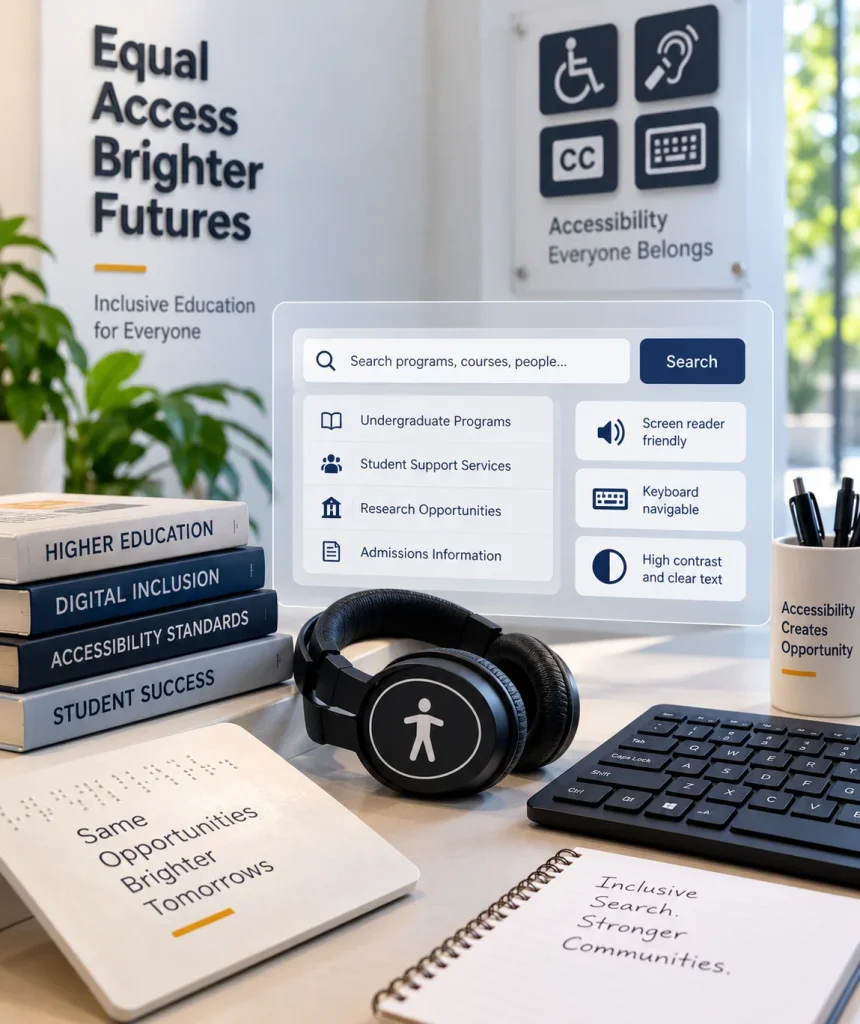
Accessibility is a legal requirement.
US institutions receiving federal funding must meet accessibility standards, and search interfaces are squarely in scope.
06
In higher education, nobody owns search.
Marketing owns the public site, IT owns infrastructure, departments own their own pages, and search quality belongs to none of them. This is the root cause behind most of the symptoms above.
What AI search for universities actually adds
Semantic understanding of student language.
This is the single highest-impact improvement. AI-powered university site search for higher education can connect "dropping a class" to withdrawal procedures, "how much does it cost" to tuition and fees, and "when do I have to apply" to admissions deadlines — without anyone maintaining a synonym list against how eighteen-year-olds actually phrase things. Our what is semantic search guide covers the mechanics.
Audience-aware ranking.
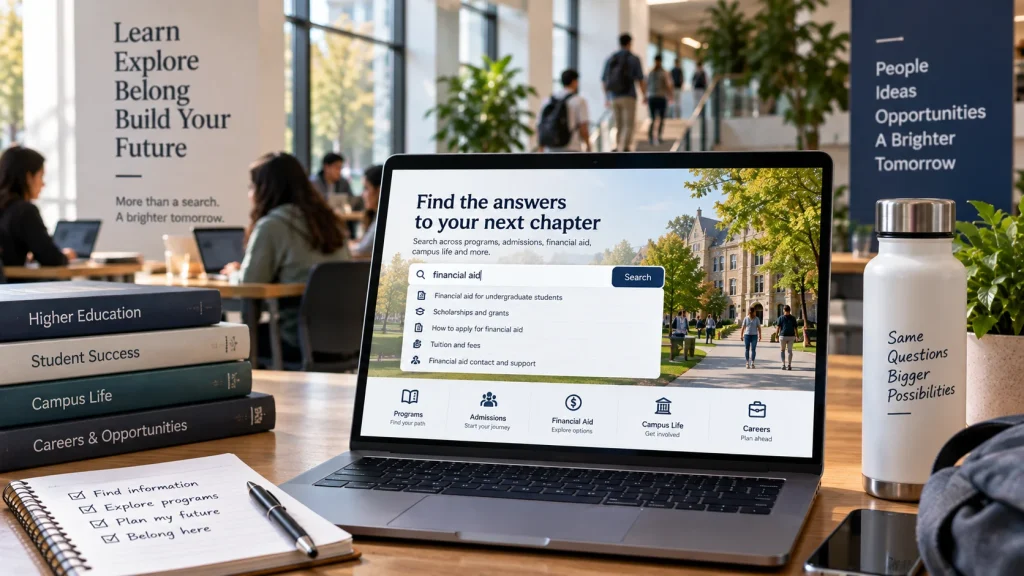
The same query surfaced differently for an authenticated student versus an anonymous visitor. A logged-in student searching "financial aid" should get the aid portal; an anonymous visitor should get the prospective-student aid overview. This is the fix for the multi-audience problem, and it's genuinely achievable with session and authentication signals.
Exact matching for codes and identifiers.
Course codes, building abbreviations, form numbers, program codes. These must resolve literally, which means hybrid retrieval — semantic for natural language, keyword for identifiers. See our hybrid search guide.
Unified indexing across the estate.
Web pages, PDFs, course catalogs, faculty directories, policy documents, and knowledge base articles in one index, with source as a facet. Most university search covers a fraction of the actual content, and the gaps are where frustration concentrates. This is closer to enterprise search than to commercial site search.
The queries that matter most
Program and course discovery.
The recruitment-critical path. A prospective student searching "environmental science" or "can I study psychology part time" is evaluating whether to apply. Failures here cost enrollment, which makes this the easiest business case for AI campus search investment.
Administrative self-service.
"Change my major," "parking permit," "transcript request," "reset my password." Every one of these answered by search is a call the registrar's office doesn't field. This is where the operational savings live, and it's measurable.
Faculty and expertise search.
Journalists seeking commentary, prospective graduate students seeking supervisors, industry partners seeking collaborators. Often badly served, and a genuine reputational surface.
Deadline and date queries.
Highly seasonal and highly urgent. "When is the application deadline," "last day to add a class." Freshness matters enormously — a stale date is worse than no answer, as covered in our real-time indexing guide.
How students use AI to discover university information
Your content is being read by machines making recommendations.
Program pages, tuition information, and admissions requirements now function as source material for answers you never see. Our how LLMs find products guide covers the retrieval mechanics, which apply to programs as readily as to products.
Crawler access determines whether you're in the conversation.
If AI crawlers can't reach your pages — because of a WAF rule, a robots directive, or JavaScript-only rendering — you're absent from those answers entirely. Our AI crawlers guide covers the diagnostics.
Structure beats prose for machine readability.
Program pages stating duration, entry requirements, tuition, and outcomes explicitly get quoted accurately. Pages of aspirational brochure language give an assistant nothing to extract, which means a competitor's clearer page gets recommended instead.

The uncomfortable version:
the same content problems that make your site search bad make you invisible to the assistants students now consult first. Our AI visibility guide covers measurement.
How to improve university site search
01
Fix vocabulary first.
Mine your failed and low-engagement searches, then either rename pages in human language or add the student terms as searchable alternatives. This costs nothing and typically produces the largest single improvement in higher education search quality.
02
Expand index coverage.
Audit what your search actually indexes versus what exists. Most institutions discover significant portions of their estate — PDFs, departmental subsites, course catalogs — are entirely invisible.
03
Add audience signals.
Even a simple authenticated-versus-anonymous distinction meaningfully improves relevance for the multi-audience problem.
04
Surface answers, not just links.
For high-frequency administrative queries, a direct answer with a link beats a list of ten results. This is where AI-powered search for university websites most visibly outperforms legacy tools.
05
Build a proper no-results experience.
Suggest alternatives, offer contact routes, and log every failure. Our search returned no results guide covers the design.
06
Assign an owner.
The organizational fix, and the one that makes the other five stick. Someone needs search metrics in their objectives, or the system reverts to defaults within two terms.
Accessibility is not optional
Measuring higher education search
Zero-result rate, segmented by audience.
Anonymous versus authenticated traffic fails differently, and averaging them hides both.
Top failed queries.
The single most actionable report available — it serves as both your content gap list and your vocabulary translation list, showing exactly what users are searching for, where your site is failing to meet their needs.
Click-through position.
If users routinely click result seven, ranking is wrong even though the content exists.
Administrative deflection.
Searches for high-volume administrative topics that didn't produce a call or ticket. This is the operational savings number that funds the work with leadership.
Program page reach from search.
For recruitment-critical pages, what share of arrivals come via search, and do those visitors convert to inquiry or application? Our search relevance metrics and A/B testing guides cover the methodology.
What to require from a platform
Hybrid retrieval
given the higher education mix of natural language and institutional codes.
Multi-source indexing
covering web pages, PDFs, course data, and directories with source as a facet.
Audience or authentication awareness
in ranking.
Accessibility conformance
documented, with the search interface tested.
Freshness controls
for date-sensitive content during peak cycles.
Failed-query analytics
segmented by audience.
Who owns search on a campus
The typical arrangement is that nobody owns it.
Marketing owns the public-facing site and cares about recruitment pages. IT owns the infrastructure and treats search as a service to keep running rather than a quality to improve. Individual departments own their own content and optimize for their own visitors. Search quality is an emergent property nobody is accountable for.
Three arrangements that work.
Marketing-led with IT support suits institutions where recruitment is the priority use case, since program discovery is the revenue-linked path. Digital-team-led works where a central web team already has authority across the estate. Shared ownership with a named individual is the pragmatic middle — a person whose objectives include search metrics, with a working group spanning marketing, IT, the registrar, and student services.
Whichever fits, two things are non-negotiable.
Someone's performance objectives must include higher education search metrics, and that person must have authority to change page titles and content structure. A search owner who can only file requests with departments will not move the numbers.
Governance tooling makes decentralization survivable.
With hundreds of contributors, the ability to centrally promote, pin, and correct results is what stops quality drifting between reviews. It's the feature most often overlooked in procurement and most needed six months in.
A Practical Roadmap to Better University Search

Higher Education FAQs
What is AI search for higher education?
Why does university site search perform so poorly?
How do students use AI to discover university information?
How do I improve university site search?
Does AI campus search need to be accessible?
What should universities measure in search?
Is AI-powered university site search different from commercial site search?