
What artificial intelligence searching means
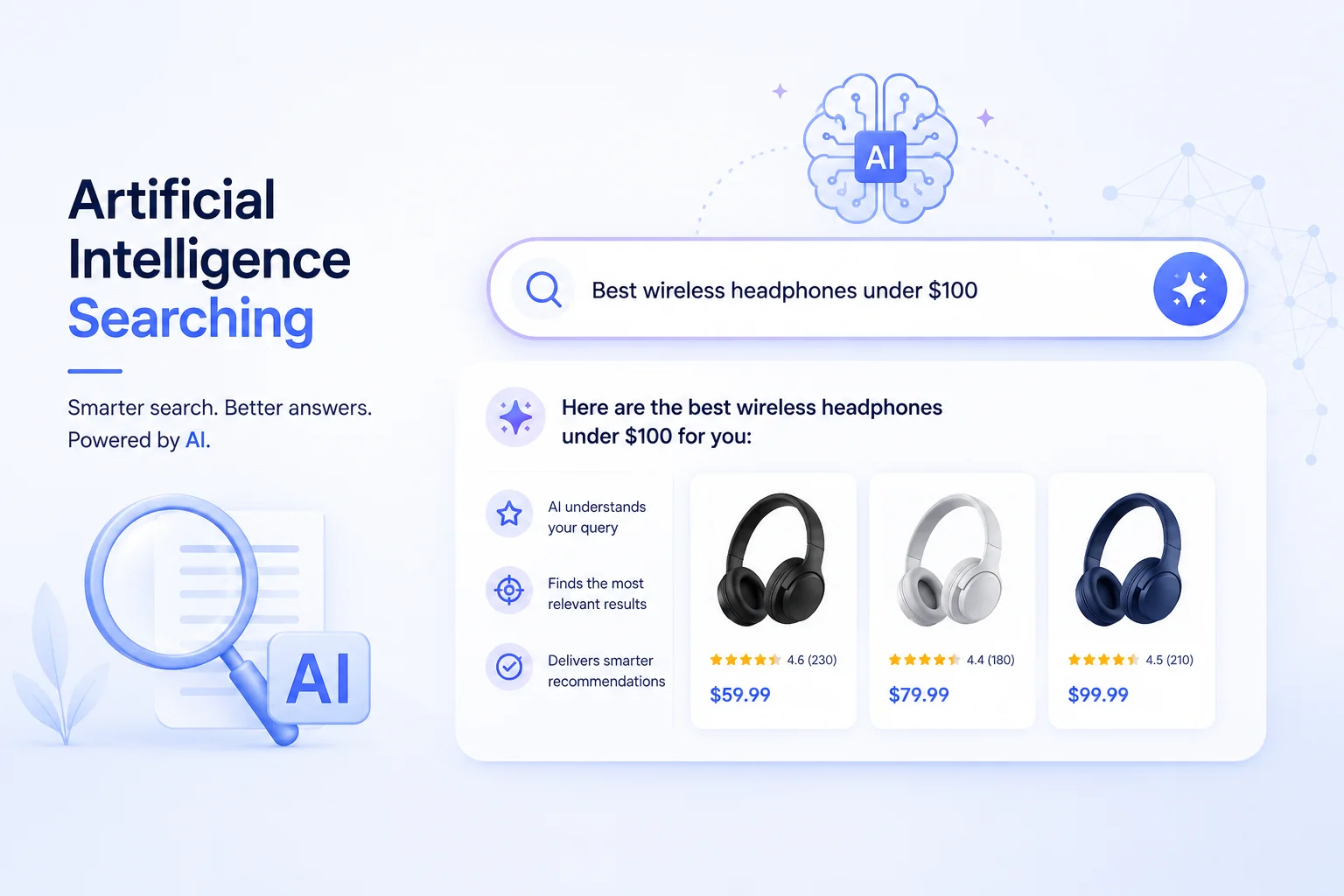
The distinction is easier to see through failure. Type “couch” into an old-fashioned search system when everything in the database is labeled “sofa,” and you get nothing. The information exists; the system just couldn’t recognize that two different words point at the same thing. Every frustrating search you’ve ever had probably traces back to some version of that gap.
An artificial intelligence search system closes it by representing meaning mathematically. It knows couches and sofas belong together, that “affordable” implies a price ceiling, and that “for a small apartment” is a size signal — not because someone wrote those rules, but because the underlying model learned how language works by reading enormous amounts of text.
The academic field underneath all of this is information retrieval, which has existed for decades. What changed recently is that artificial intelligence made the “understanding” part genuinely work.
How artificial intelligence searching works, step by step
Four stages, all completing in well under a second even across millions of documents.
Stage one: understanding the question.
Before anything is retrieved, the system interprets what you asked. It corrects typos, detects language, works out intent, and pulls out constraints. “Blue running shoes under $150” becomes a structured request: category footwear, activity running, color blue, maximum price 150. Modern systems use language models for this, which is why they handle phrasings nobody anticipated. Our query understanding guide covers this layer.
Stage two: turning meaning into numbers.
This is the core trick. An embedding model converts your question into a vector — a long list of numbers that encodes its meaning. Everything in the index has already been converted the same way. Similar meanings produce similar vectors that sit close together; unrelated things sit far apart. Meaning becomes geometry, and “find relevant items” becomes “find nearby points.” Our what is vector search guide unpacks the mechanics.
Stage three: finding the nearest matches.
Comparing your query against every item one by one would be far too slow at scale, so systems use approximate nearest-neighbor algorithms that skip most of the index intelligently — trading a sliver of perfect accuracy for enormous speed. This is why artificial intelligence searching feels instant even across huge collections.
Stage four: deciding the order.
Raw similarity isn’t the final answer. A second model reorders candidates using additional signals — popularity, freshness, quality, and in commerce, things like stock levels and what actually converts. Our search reranking guide covers this stage.
One nuance worth knowing: the best systems don’t rely on AI alone. They run meaning-based retrieval alongside traditional keyword matching and blend the results, because exact matching is still better for precise identifiers like part numbers. That combination is called hybrid search, and it’s the production standard.
AI Search Grader by bCloud AI
Grade your ecommerce search in 10 quick questions
31% of ecommerce searches return zero results
— and most shoppers who hit a dead end leave for a competitor.
How does your store’s search stack up?
Answer 10 short questions and get your AI search score,
plus a personalized report to fix the gaps.
Free, takes about 2 minutes.
Understanding intent…
Scoring your answers across relevance,
AI, experience, and insights.
Your AI search score is ready
Tell us where to send your personalized report.
You’ll see your score and recommendations right away.
0
out of 100
Grade —
Your score by pillar
Personalized recommendations
Where you already encounter it
Artificial intelligence searching stopped being exotic a while ago. You’re using it constantly, usually without noticing.
Web search engines.
Google and Bing have layered semantic understanding into results for years, which is why conversational questions now return useful answers instead of keyword soup.
AI assistants.
ChatGPT, Copilot, Gemini, and Perplexity all rely on AI-powered retrieval to find relevant material before writing a response. When an assistant cites sources, that’s search happening underneath the conversation.
Online stores.
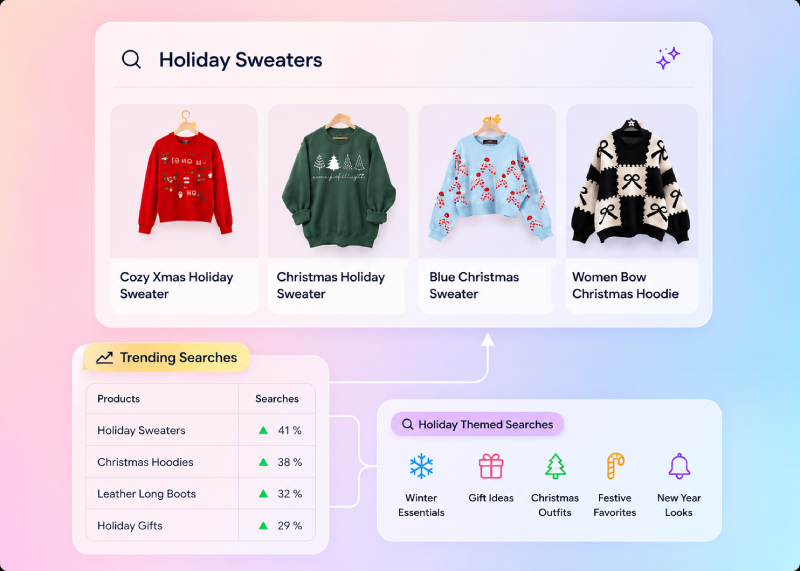
Retailers use it to match shoppers to products by intent — the difference between “we found nothing” and finding the right jacket from a description. Our AI site search guide covers this application specifically.
Workplace tools.
Finding the right document by describing what it covers rather than remembering its filename.
Photo libraries and streaming services.
Searching your camera roll for “dog at the beach” without ever having tagged anything works because images can be embedded too.
The common thread: anywhere people express what they want in ordinary language, artificial intelligence searching is what makes the response feel intelligent.
AI searching vs. traditional search
Neither approach wins outright, which surprises people. Keyword matching is genuinely more precise for exact identifiers — a specific model number, an ISBN, a SKU. Artificial intelligence searching is better at everything human and imprecise. Serious systems use both.
Why it matters commercially
For any business where people search to find things, the gap between these two approaches shows up in revenue.
The clearest example is online retail. Search visitors are the highest-intent traffic a store gets — they’ve decided roughly what they want and are describing it. When search fails them, the business loses the customers most likely to buy. Industry research consistently finds a substantial share of on-site searches return nothing, and the cause is usually vocabulary mismatch rather than missing inventory: the shopper’s words and the catalog’s words didn’t line up.
That’s precisely the problem artificial intelligence search solves, which is why it moved from a nice-to-have to a standard expectation. The measurable effects are fewer dead-end searches, better handling of descriptive long-tail queries, and higher conversion on search traffic. Our search relevance metrics guide covers how to measure whether it’s actually working, since “it feels better” isn’t evidence.
There’s a second commercial angle that’s newer. Shoppers increasingly skip search boxes entirely and ask an AI assistant for recommendations. Those assistants run on the same retrieval technology, reading structured catalogs to decide what to suggest. So investing in AI-readable, well-described product data improves discovery on your own site and whether external AI engines can recommend you at all — one investment, two returns.
What artificial intelligence searching still gets wrong
Being honest about limitations is more useful than enthusiasm.
- It approximates when you wanted exact. Ask for a specific part number and a purely AI-driven system may return something similar rather than the exact item. This is why hybrid approaches exist.
- It’s only as good as the underlying content. An AI system can only understand meaning that’s actually expressed. Thin, poorly written product descriptions or sparse documents produce weak results no matter how sophisticated the model — and the items with the least description are usually the ones most in need of help.
- It can be confidently wrong. Old keyword search failed loudly with zero results. AI search almost always returns something, which means a wrong answer can look like a right one. That’s a subtler failure mode and harder to detect without deliberate measurement.
- It goes stale. Language shifts, catalogs change, and models trained months ago gradually represent the world less accurately. Systems need periodic refreshing.
- It costs more to run. Embedding content, storing vectors, and running models require real infrastructure. At small scale this is trivial; at large scale it’s an architectural consideration.
What this means if you’re evaluating it
For a business considering artificial intelligence searching, four practical points.
Test artificial intelligence search on your own messy data.
Vendor demos run on curated collections. Take a hundred real queries from your own logs — typos, long descriptions, half-remembered names — and see what happens. That’s where systems genuinely differ.
Insist on hybrid.
Pure AI retrieval that fails on exact codes is a problem for anyone with technical products, part numbers, or SKUs.
Fix your content first.
Enrichment usually improves results more than switching platforms does, because it raises the ceiling every system operates under.
Measure artificial intelligence search, don’t assume.
Compare failed-search rate and conversion before and after, ideally with a control group. Our A/B testing guide covers the methodology.
If you’re specifically evaluating platforms for an online store, our roundup of the top semantic search solutions for e-commerce compares the options, and the full AI ecommerce search guide covers the architecture end to end.
Common misconceptions
A few things get muddled often enough to correct directly.
- “It replaces keyword search.” It shouldn’t, and in production it doesn’t. The best systems run artificial intelligence searching alongside traditional matching, because each covers the other’s blind spot. Any vendor pitching pure AI retrieval as a wholesale replacement is describing a limitation rather than a strength.
- “AI search and semantic search are different things.” Largely the same territory with different emphasis. Semantic search describes the goal — results based on meaning. Artificial intelligence searching describes the broader family of techniques used to achieve it, including the language models that interpret queries and the ranking models that order results.
- “It’s slow because it’s doing more work.” Outdated. Modern implementations return results in under 200 milliseconds, frequently faster than legacy keyword systems weighed down by decades of accumulated ranking rules.
- “You need a data science team.” You used to. Managed platforms now handle model selection, embedding generation, indexing, and ranking, which moved implementation from a research project to a configuration exercise measured in weeks.
- “Once it’s running, it’s done.” The most expensive misconception. Language shifts, catalogs grow, and models age. Systems that aren’t measured and refreshed degrade quietly — and because artificial intelligence searching rarely fails visibly, nobody notices until the numbers do.
- “More sophisticated always means better results.” Not reliably. A well-tuned system on well-described content beats a state-of-the-art model on thin data every time. Content quality is the ceiling, and no amount of model sophistication raises it.
How to check if artificial intelligence searching is working
Old keyword search failed loudly. You saw an empty page and a zero on the dashboard.
Artificial intelligence searching fails quietly instead. It always returns a full page of plausible results. So a bad match looks exactly like a good one. Your no-results rate can fall to almost zero while relevance slowly gets worse. Watch these three signals instead.
Repeat searches
Count how often shoppers search again straight after searching. A rising number is your clearest early warning. It also shows up in standard analytics, so you need no extra setup.
Click depth
Good results get clicked near the top. If people scroll far down before clicking, your ranking stage is misfiring. If nobody clicks at all, the retrieval stage missed entirely.
A monthly manual check
Pick fifty real queries. Run them by hand each month. Then have someone who knows the catalog score the results. It takes about an hour and catches drift no dashboard reports.
In short, behaviour tells you more than infrastructure metrics do. Speed and uptime look healthy right up to the point where results stop being useful. For the full measurement picture, see our search relevance metrics guide.
Where it’s heading
Two developments are worth watching. Conversation is becoming the interface — instead of one query and a list, people increasingly refine across several turns (“cheaper,” “in blue,” “for wide feet”), which requires systems that remember context. And multimodal search is arriving: images, audio, and video can be embedded in the same space as text, so searching a video library by describing a scene is becoming ordinary.
Both build on the same foundation described above. The underlying idea — represent meaning as numbers, find what’s close — turns out to generalize remarkably well.
Frequently asked questions
What is artificial intelligence searching?
Artificial intelligence searching is the use of machine learning, particularly language models and vector embeddings, to find information based on meaning and intent rather than exact keyword matching. It’s why a search for “couch” can return sofas, and why full-sentence questions now return useful results.
How does artificial intelligence search work?
In four stages: a language model interprets your question and extracts intent and constraints, an embedding model converts the question and all indexed content into numerical vectors capturing meaning, an approximate nearest-neighbor algorithm finds the closest matches, and a ranking model reorders results using signals like popularity and quality.
Is AI search better than keyword search?
Neither is universally better. AI search handles synonyms, typos, and natural language far better; keyword search is more precise for exact identifiers like part numbers and product codes. Most production systems run both together in what’s called hybrid search.
Where is artificial intelligence searching used?
Web search engines, AI assistants like ChatGPT and Copilot, online store product search, workplace document search, and photo and video libraries. Anywhere people describe what they want in ordinary language rather than exact terms.
Does AI search require a lot of technical expertise?
Not anymore. Managed platforms handle the embedding models, indexing, and ranking, so most organizations can implement it in weeks without machine learning specialists. Building your own system from components remains a substantial engineering project.
What are the limitations of AI search?
It can approximate when you wanted an exact match, it’s constrained by the quality of the underlying content, it can return confidently wrong results rather than failing visibly, it degrades as language and catalogs change, and it costs more to run than simple keyword matching.
Search that understands what people mean.
bCloud AI combines keyword precision with AI understanding in one engine — sub-200ms results, live in weeks, priced on your catalog.
bcloud.ai