Why search users are different
They’re impatient.
Having stated what they want, high-intent shoppers expect it immediately. Tolerance for irrelevant results is far lower than in browse, where wandering is the point.
They’re specific.
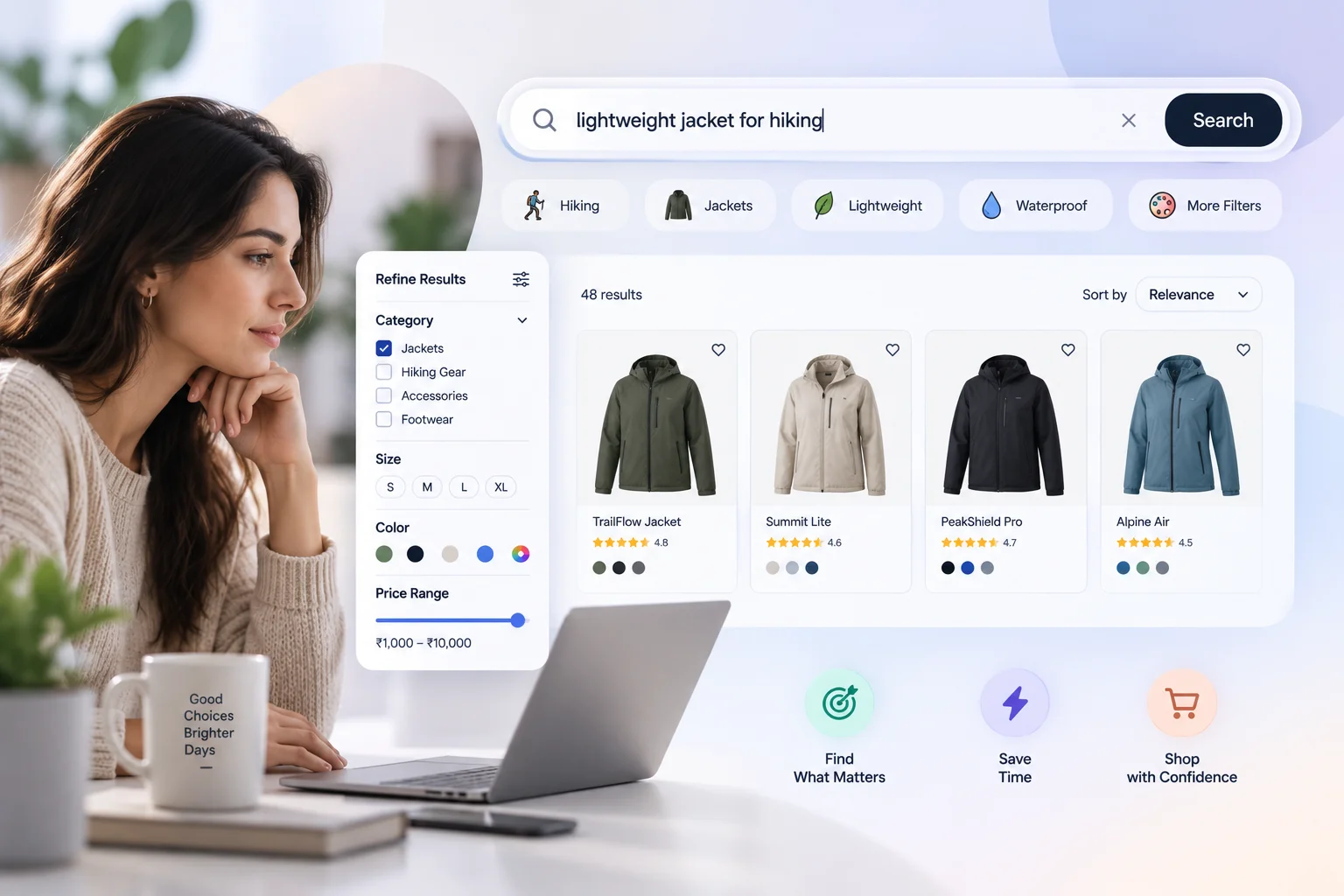
Long, descriptive, constraint-laden queries — “waterproof jacket under $150 for bike commuting” — signal exactly how close to purchase someone is. Query length correlates with intent.
They fail silently.
A shopper who can’t find what they searched for almost never complains. They leave. Unlike a checkout error, this produces no ticket, no signal, and no line in your dashboard unless you instrument it.
Decades of Baymard Institute research consistently find that most stores underperform on exactly the query types high-intent shoppers use — and that the resulting dead ends are rarely designed to recover.
The features that serve high-intent shoppers
Six capabilities matter disproportionately for high-intent shoppers, and they’re not always the same ones that improve browse.
Exact-match precision.
A shopper typing a SKU, model number, or precise product name has the highest intent of anyone on your site. That query must resolve literally, every time. Semantic-only search that returns “close enough” fails precisely the people most ready to buy — which is why hybrid retrieval matters, as covered in our hybrid search guide.
Descriptive query understanding.
The other extreme: full sentences with constraints. The system must extract intent and apply constraints automatically rather than forcing shoppers to restate them in filters. See our query understanding guide.
Fast, product-level autocomplete.
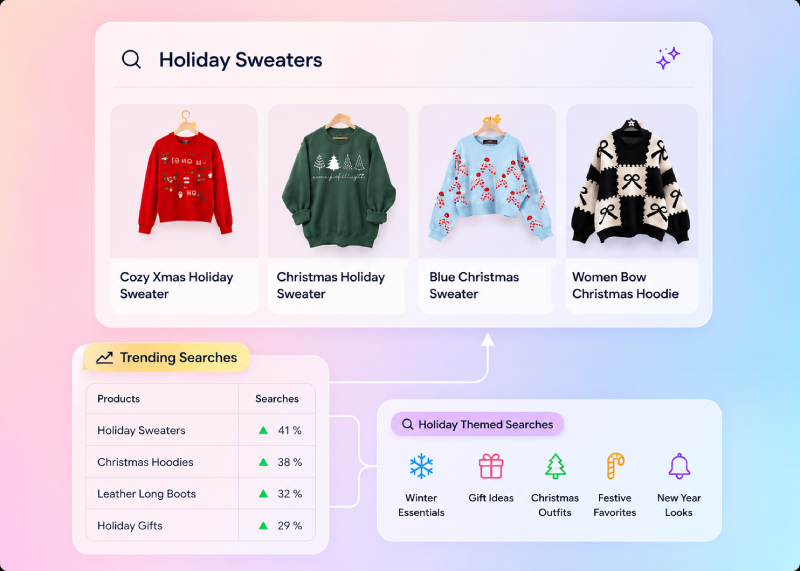
Not query suggestions — actual products with images and prices as they type. High-intent shoppers frequently convert straight from autocomplete without ever loading a results page, which makes this among the highest-leverage surfaces on the site.
Zero-result recovery.
The single most expensive failure for this segment. A high-intent shopper hitting an empty page is a customer with a wallet out being told no. Alternatives, spelling corrections, and broader suggestions turn an exit into a second chance — our no-results guide covers the design.
Availability and price clarity in results.
Someone ready to buy needs to know immediately whether you have it and what it costs. Results that omit stock status waste the click.
Speed.
Sub-200ms at p95 and p99 with real filters applied. Impatient shoppers abandon slow results regardless of how relevant they’d have been.
The four failures that lose them
Vocabulary mismatch.
High-intent shoppers search “ladies trainers,” your catalog says “women’s sneakers,” and a keyword system returns nothing. The product exists; the words didn’t line up. This is the largest single cause of lost high-intent traffic, and semantic understanding is the structural fix — see what is semantic search.
Over-filtering dead ends.
They found products, applied three filters, and hit zero. Different from a failed search and needing different handling: say which filter caused it and offer to remove that one.
Promoted irrelevance.
Merchandising that overrides relevance for a high-intent query is uniquely damaging. A browser might forgive an off-topic promotion; someone who typed a specific request reads it as the site not listening.
Personalization that overrides the query.
Showing a shopper their usual category when they searched something different is the classic over-personalization failure. For high-intent shoppers it’s worse than no personalization at all — the query must always dominate, as covered in our personalization guide.
AI Search Grader by bCloud AI
Grade your ecommerce search in 10 quick questions
31% of ecommerce searches return zero results — and most shoppers who hit a dead end leave for a competitor. How does your store's search stack up?
Answer 10 short questions and get your AI search score, plus a personalized report to fix the gaps. Free, takes about 2 minutes.
No signup needed to take the quiz.
Understanding intent…
Scoring your answers across relevance, AI, experience, and insights.
Your AI search score is ready
Tell us where to send your personalized report. You'll see your score and recommendations right away.
Your score by pillar
Personalized recommendations
Fix the gaps in weeks, not quarters
bCloud AI replaces keyword-only search with hybrid AI retrieval — sub-200ms responses, 99.99% uptime, and conversion lifts of up to 40% across 50+ implementations.
Measuring the segment properly
Aggregate metrics hide what’s happening to high-intent shoppers. Four measurements, segmented specifically to search users.
Search conversion versus site average.
High-intent shoppers should convert at a clear multiple of browsers. If they don’t, search is failing your most valuable segment — and this single comparison is the most diagnostic number in ecommerce search.
Zero-result rate for search users.
Every one is a high-intent visitor turned away.
Revenue per search.
The number that funds improvement work in a leadership conversation.
Reformulation rate.
How often someone immediately rephrases — the behavioral fingerprint of a misunderstood query, and a leading indicator that costs nothing to instrument.
Segment all four by query length, because short keyword queries and long descriptive ones behave differently and averaging them obscures both. Our ecommerce search analytics and search relevance metrics guides cover the instrumentation.
The conversion math
The reason this segment deserves disproportionate investment is arithmetic.
If search users are a modest share of your traffic but convert at several times the site average, they contribute a share of revenue far out of proportion to their volume. Improving conversion for that group produces more absolute revenue than an equivalent percentage improvement across everyone else — which is the standard conversion rate optimization logic of working where the leverage is highest.
It also compounds differently. A browse improvement helps people who might buy. A search improvement helps people who intended to and couldn’t. The second group was already yours to lose.
Run the numbers on your own store: search users as a share of sessions, their conversion rate versus site average, and revenue attributed to sessions including a search. Most teams doing this for the first time reprioritize immediately.
Where high-intent shoppers are arriving from now
One shift worth planning around. A growing share of high-intent shoppers arrive having already asked an AI assistant for a recommendation — meaning they land with a specific product in mind rather than a category.
Two consequences. First, they’ll search for that exact product name or model, which raises the stakes on exact-match precision. Second, whether you appeared in that assistant’s answer at all depends on your catalog being readable to it, as covered in our LLM product search guide.
This traffic converts unusually well because the recommendation did the persuading. Losing it at your search box because a model number didn’t resolve is the most avoidable loss in this entire article.
What high-intent shoppers do that browsers don’t
Understanding the behavioral signature helps you spot the segment in your own analytics, and it’s more distinctive than most teams realize.
They search early in the session.
Often within the first few seconds, sometimes before the homepage finishes rendering. A search in the first interaction is one of the strongest intent signals available.
They use longer queries.
Query length correlates with intent because specificity requires knowing what you want. Three-word-plus queries behave very differently from single-word ones, and averaging them in reporting hides both.
They refine rather than abandon — up to a point.
A high-intent shopper will reformulate two or three times before giving up. That reformulation sequence is visible in your logs and is a precise map of where understanding failed.
They filter aggressively.
Having stated what they want, they narrow hard. This is why filtered-query performance affects this segment disproportionately.
They return.
High-intent shoppers who don’t convert often come back within days, which means recovering a failed search isn’t only about this session. A shopper who found nothing twice usually doesn’t come back a third time.
They convert from unexpected places.
Autocomplete, a related-products module, or a zero-result recovery suggestion — because they’re evaluating rather than browsing, any surface presenting the right product can close the sale.
The practical takeaway: instrument sessions containing a search as a distinct segment in your analytics. Most stores report search metrics in aggregate and never see this behavior pattern, which means they never prioritize around it.
A practical improvement sequence
Four weeks, ordered by return.
Week 1 — measure the segment.
Separate search users from browsers in analytics and calculate the conversion multiple. This number decides how much everything else is worth.
Week 2 — fix the dead ends.
Pull your top hundred zero-result queries, add synonyms for vocabulary gaps, confirm typo tolerance is on. Immediate, measurable, and cheap.
Week 3 — verify the exact-match floor.
Test SKUs, model numbers, and product names. Any drift here is losing your highest-intent traffic daily.
Week 4 — improve autocomplete.
Product-level suggestions with images, prices, and availability. High-intent shoppers convert from here more than most teams realize.
Ongoing — review failed queries weekly.
Validate changes against a control group per our A/B testing guide.
For platform capability, our search software features guide covers what to require at each growth stage, and top semantic search solutions for e-commerce compares the field.
The autocomplete opportunity
Worth separating out, because it’s the most underinvested surface for this segment.
High-intent shoppers frequently never reach a results page. They start typing, see the product they wanted, and click straight through — which means autocomplete isn’t a convenience feature, it’s a conversion surface handling a meaningful share of your best traffic.
Four things separate autocomplete that converts from autocomplete that decorates.
Show products, not queries.
An image, name, price, and availability, so the shopper can decide inside the dropdown.
Respond in well under 100ms.
Suggestions that lag behind typing get ignored entirely.
Include categories and collections.
Alongside products, since some shoppers are narrowing rather than seeking one item.
Handle partial identifiers.
A buyer typing the first six characters of a part number sees it before finishing.
Measure it separately from search: what share of sessions containing a search converted directly from autocomplete without loading results? Most teams have never calculated this and are surprised by the answer.
Why this segment gets neglected
If high-intent shoppers are so valuable, why does search stay under-optimized at most retailers? Three structural reasons, and recognizing them is usually the first step to fixing it.
The failures are invisible.
Checkout errors generate tickets. Failed searches generate silence. Nobody escalates a problem nobody reports, so search stays off the priority list while noisier issues get attention.
Ownership is split.
Merchandising owns what should be promoted, engineering owns the system deciding what appears, and neither owns whether shoppers found things. Work that belongs to everyone belongs to nobody.
Aggregate reporting hides it.
Site-wide conversion rate averages high-intent shoppers together with browsers, which mathematically buries the signal. Until someone segments the two, the opportunity is invisible in every dashboard leadership sees.
The fix for all three is the same and costs nothing: segment search users in your analytics, put the conversion comparison in front of whoever owns ecommerce revenue, and give one named person the metric in their objectives. Teams that do this reprioritize within a quarter, because the number is usually more striking than anyone expected.
Frequently asked questions
What are high-intent shoppers?
High-intent shoppers are visitors who have already decided roughly what they want and are actively looking for it — most visibly, the people who use your search box rather than browsing. They convert at a multiple of the site average because they arrive at a later funnel stage.
Which search features matter most for high-intent shoppers?
Exact-match precision for SKUs and model numbers, descriptive query understanding for full-sentence searches, fast product-level autocomplete, zero-result recovery, clear availability and pricing in results, and sub-200ms speed at p95 and p99.
Why do high-intent shoppers leave without buying?
Usually vocabulary mismatch — they searched words your catalog doesn’t use and got nothing, even though you stock the product. Other causes are over-filtering dead ends, promoted results that override relevance, and personalization that overrides the query.
How do I measure search conversion for high-intent shoppers?
Segment search users from browsers in analytics and compare conversion rates. Search users should convert at a clear multiple of site average; if they don’t, search is failing your best traffic. Also track zero-result rate, revenue per search, and reformulation rate.
Are search users really worth more than browsers?
Substantially, in most stores. They’re a modest share of traffic contributing a disproportionate share of revenue, because they arrive with formed intent. That makes conversion improvements for this segment worth more in absolute revenue than equivalent improvements elsewhere.
How do AI assistants change high-intent shopper behavior?
An increasing share arrive having already received a recommendation, so they search for a specific product name or model rather than a category. That raises the stakes on exact-match precision, and it means being recommended in the first place depends on your catalog being readable to those assistants.
Your best customers are typing in the search box.
bCloud AI handles exact SKUs and full-sentence queries in one engine — because high-intent shoppers do both.
bcloud.ai