
What is search as a service?
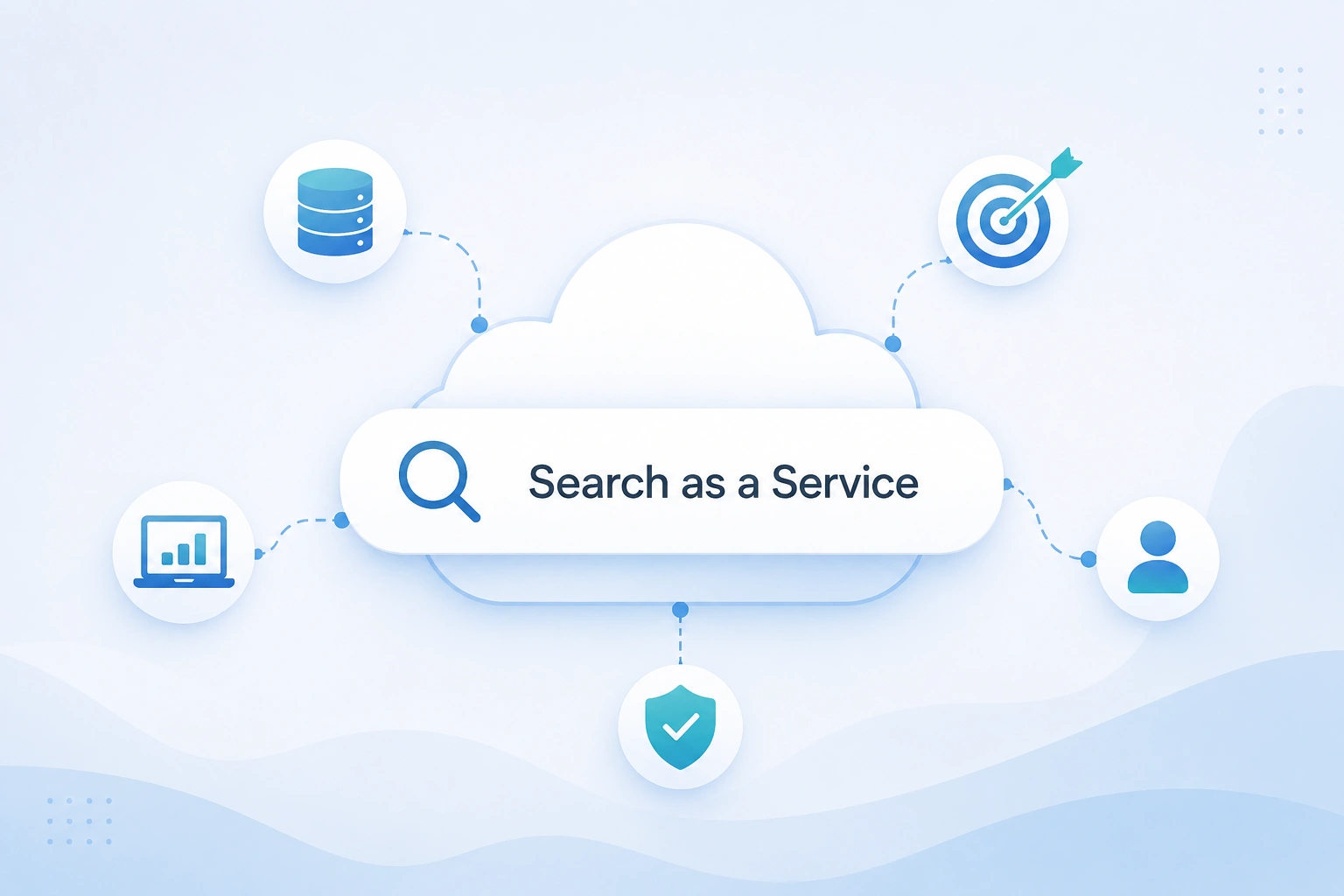
The practical contrast is with self-hosting: standing up Elasticsearch, OpenSearch, or a vector database yourself, then owning cluster sizing, index lifecycle, relevance tuning, upgrades, and uptime forever. Search as a service collapses all of that into an integration project measured in days or weeks, with the operational burden transferred to the vendor. What you keep is configuration and content; what you give up is infrastructure control — a trade most teams happily make, and a few genuinely shouldn’t. The rest of this guide is about knowing which you are.
AI Search Grader by bCloud AI
Grade your ecommerce search in 10 quick questions
31% of ecommerce searches return zero results — and most shoppers who hit a dead end leave for a competitor. How does your store's search stack up?
Answer 10 short questions and get your AI search score, plus a personalized report to fix the gaps. Free, takes about 2 minutes.
No signup needed to take the quiz.
Understanding intent…
Scoring your answers across relevance, AI, experience, and insights.
Your AI search score is ready
Tell us where to send your personalized report. You'll see your score and recommendations right away.
Your score by pillar
Personalized recommendations
Fix the gaps in weeks, not quarters
bCloud AI replaces keyword-only search with hybrid AI retrieval — sub-200ms responses, 99.99% uptime, and conversion lifts of up to 40% across 50+ implementations.
Truth 1: You’re buying an outcome, not a technology
The core promise of search as a service isn’t “Elasticsearch without the servers” — it’s good search results without the search team. Modern providers bundle the full pipeline: query understanding, typo tolerance, hybrid keyword-plus-vector retrieval, ranking, merchandising controls, analytics, and increasingly personalization and AI answers. When you evaluate, evaluate the outcome — result quality on your messy queries, at your catalog size — not the feature checklist. A provider with fewer knobs and better defaults routinely beats one with every toggle and mediocre relevance, because the knobs you’d need a search engineer to turn are exactly what you were trying not to hire for.
Truth 2: The pricing model matters more than the price
Search as a service pricing comes in four shapes, and the shape determines your bill’s behavior as you grow.
Per-query (usage-based) billing charges for every search — attractive at low volume, punishing at scale, since your best traffic month becomes your worst invoice; some vendors meter indexed records separately, so catalog growth costs you before a single extra search runs.
Resource-based pricing charges for the memory and compute your index consumes — predictable, but you’re back to sizing infrastructure.
Catalog/feature-based pricing scales with catalog size and enabled capability, staying flat through traffic spikes.
Enterprise custom contracts negotiate all of it annually.
The evaluation move that saves the most money: model every quote at three times your current traffic and twice your catalog before signing. And check where the AI lives — several providers gate semantic and vector capability behind top enterprise tiers, so the reason you’re buying search as a service may not be in the plan you’re quoted.
Truth 3: Latency is a supply chain, and you’re at the end of it
With self-hosted search, latency is your architecture. With search as a service, it’s the provider’s infrastructure plus the network hop to reach it. Good providers make this a non-issue with edge-distributed serving and sub-100ms processing; weaker ones make every search a cross-country round trip. Benchmark honestly: measure end-to-end latency from your users’ regions, at your catalog size, under concurrent indexing load, at p95 and p99 — not the median on a demo index. Sub-200ms end-to-end is the modern bar for commerce; results slower than that get abandoned regardless of relevance, a pattern Baymard Institute’s UX research keeps confirming.
Truth 4: Your data pipeline is still your job
Search as a service removes infrastructure, not responsibility. The provider indexes what you send — so feed quality, freshness, and completeness stay squarely on your side of the line. Three obligations survive the outsourcing.
Sync architecture: real-time, event-driven updates for price and stock (the mechanics in our real-time indexing guide apply; you’re just writing to their API instead of your own index).
Data enrichment: thin titles and missing attributes cap every provider’s ceiling — the engine can only understand meaning your catalog expresses.
Schema decisions: what gets indexed, at product or variant level, with which attributes filterable.
Teams that treat search as a service as “upload and forget” get mediocre results and blame the vendor; teams that treat the feed as a product get the outcomes the demos promised.
Truth 5: Unified search is the quiet superpower
Because search as a service is consumed by API, one index can serve every surface: website, mobile app, in-store kiosk, support portal, even internal tools — one relevance brain, many faces. This “unified search” angle is underrated in evaluations and decisive in practice: consistency across channels (the product findable on web is findable in-app), analytics that aggregate intent across every surface instead of fragmenting it, and one integration to maintain instead of four. If your roadmap includes any second surface, weight this heavily; retrofitting consistency across separately built search experiences is far more painful than starting unified.
Truth 6: The trade-offs are real — respect them
Honesty section. Search as a service isn’t the right answer for everyone, and the exceptions cluster predictably.
- Deep architectural control: if you need custom retrieval algorithms, exotic ranking logic, or research-grade experimentation at the index level, managed platforms will eventually constrain you — that’s when self-hosting or building on components earns its cost.
- Data residency and compliance: regulated industries need providers with the right certifications, regions, and processing agreements; verify before the pilot, not after.
- Vendor dependency: switching providers means re-integration and re-tuning, so exit costs are real — favor providers with clean APIs and exportable configuration.
- True mega-scale economics: at extreme volumes, per-anything pricing can exceed the fully loaded cost of a dedicated team, and the math genuinely flips for a handful of companies.
For everyone else — which is most companies — the operational burden you shed outweighs the control you cede, and pretending otherwise staffs a search team you didn’t need.
Truth 7: Evaluation is a benchmark, not a demo
Choosing among search as a service providers comes down to a structured trial, not a sales cycle. The playbook: pull a hundred real queries from your logs — typos, long descriptions, exact SKUs, your zero-result offenders — and index your real catalog with each finalist. Score results against a judged set using standard relevance metrics (nDCG, recall, top-3 hit rate — methodology in our search relevance metrics guide). Measure latency from your users’ geographies under load. Verify the exact-match floor and the natural-language ceiling — the hybrid balance covered in what is hybrid search. Then confirm the winner with a live split on conversion and revenue per search, per our A/B testing guide. For a current field comparison, our API site search comparison walks the leading options side by side.
Four questions to ask any search as a service vendor
Benchmarks tell you how a platform performs today. These questions tell you what happens later.
Each one is uncomfortable to ask and cheap to answer. Consequently the response itself is informative, whatever the vendor says.
What was your last outage, and what changed after?
Every provider has had one. A clear answer shows maturity. A denial usually means you will find out yourself later.
Who do we reach when search breaks at 2am?
Ask about response times on your actual plan, not the enterprise one. Support quality varies far more by tier than most buyers expect.
How much notice do we get on breaking changes?
APIs evolve and defaults shift. Therefore you want a stated deprecation window in writing rather than a reassuring sentence in a call.
What happens if we double our catalog tomorrow?
Ask for the cost and the performance effect together. Some platforms handle growth invisibly. Others require a migration you were not planning.
In short, these cover the two years after launch rather than the first month. Ask them during the trial, while you still have leverage. Our search API guide covers what a good integration should look like.
Migrating without breaking search
Whether you’re moving from self-hosted to search as a service or switching between providers, the same migration pattern protects you — because search is one of the few systems where a botched cutover is instantly visible to every visitor.
Run in parallel, score before you switch.
Index your full catalog on the new provider while the old system keeps serving traffic, then run your judged query set against both. The new system should beat the old on your relevance metrics before it sees a single real shopper; migrating on vendor promises instead of measured parity is how teams end up rolling back at midnight.
Ramp traffic, don’t flip it.
Route five percent of searches to the new provider, watch conversion, zero-results, and latency against the control, then ramp in steps. Search as a service makes this easy — it’s an API routing decision, not an infrastructure rebuild — which is itself an underrated argument for the model.
Migrate the learnings, not just the data.
Synonym lists, merchandising rules, boost logic, and analytics baselines represent years of accumulated tuning. Inventory them before the move, map what transfers, and rebuild what doesn’t — the catalog migrates in hours; the institutional knowledge is the part that gets forgotten.
Negotiate the exit on the way in.
Configuration export, data portability, and contract terms that don’t punish leaving are easiest to secure before you’ve signed. A search as a service provider confident in their product won’t resist; one who does is telling you something.
Handled this way, a migration is a two-to-four-week overlap with zero shopper-visible risk — and the parallel-run muscle you build makes every future evaluation cheaper, because you can now benchmark any challenger against production with a routing rule.
Where search as a service is heading
Two directions worth planning around.
First, AI-native is becoming the baseline: hybrid retrieval, semantic understanding, and increasingly generative answers are moving from premium tiers toward table stakes — evaluate providers on where AI sits today in their pricing, and on their trajectory.
Second, the API is becoming an agent surface: as shopping shifts toward AI assistants, your search endpoint becomes what external agents call to discover your products; providers building for that (structured responses, agent-friendly interfaces) are building your future distribution.
bCloud AI’s approach reflects both: full search as a service — hybrid keyword-plus-vector retrieval, real-time indexing, personalization, analytics — through a developer-friendly search API, with AI included at every tier rather than gated, catalog-based pricing that stays predictable through growth, and the AI search engine underneath answering in under 200ms. The wider vendor landscape sits in our ecommerce site search software guide whenever you’re ready to shortlist.
Search as a Service Is Becoming the Foundation for AI Agents
Search as a Service is evolving beyond powering website search boxes. As AI agents, shopping assistants, and autonomous commerce applications become more common, hosted search platforms are increasingly serving as the retrieval layer that allows these systems to access accurate product information in real time.
Instead of interacting with a traditional search interface, customers are beginning to ask AI assistants questions such as:
- Find me a lightweight gaming laptop under $1,500.
- Compare the best wireless earbuds for running.
- Recommend office chairs with lumbar support for long workdays.
Behind every successful response is a search platform capable of understanding natural language, retrieving the most relevant products, and supplying structured information that an AI model can safely use.
Without a reliable Search as a Service platform, these AI experiences become inconsistent, slow, or inaccurate.
Search APIs Are Becoming AI Infrastructure
Modern Search as a Service platforms no longer expose simple keyword endpoints. They increasingly provide APIs that support:
- Hybrid keyword and semantic retrieval
- Vector search
- Real-time indexing
- Product recommendations
- Personalization
- Structured metadata
- Faceted filtering
- AI-ready response formats
These capabilities allow AI applications to retrieve trustworthy information instead of relying entirely on the language model’s internal knowledge.
Why Model Context Protocol (MCP) Matters
As enterprises adopt AI agents, many are standardizing on Model Context Protocol (MCP) to securely connect language models with external systems.
For search providers, this creates an important opportunity. Rather than building separate integrations for every AI assistant, an MCP-compatible Search as a Service platform can expose product catalogs, inventory, pricing, and metadata through a standardized interface.
This makes enterprise AI assistants more reliable because every response is generated from live business data instead of outdated training information.
Choosing a Future-Ready Search Platform
Businesses evaluating Search as a Service today should look beyond current search features and consider how well the platform supports future AI initiatives.
Key capabilities include:
Fast API performance
Real-time catalog synchronization
Hybrid keyword and semantic search
Vector retrieval
Personalization
AI-ready APIs
Enterprise security
MCP and agent integration readiness
Platforms designed with these capabilities are better positioned to support conversational commerce, AI shopping assistants, and autonomous customer experiences as they become mainstream.
The Next Evolution of Search as a Service
Search is no longer just about returning a ranked list of products. It is becoming the knowledge layer that powers every AI interaction across websites, mobile apps, enterprise copilots, and autonomous shopping agents.
Organizations that adopt a modern Search as a Service platform today are not simply replacing search infrastructure—they are building the retrieval foundation required for the next generation of AI-powered digital experiences.
Frequently asked questions
What is search as a service?
Search as a service is fully hosted, managed search capability delivered via API: you send your catalog or content to a provider, they index and serve it on their infrastructure, and your site calls their endpoints for ranked results — the SaaS model applied to search, trading infrastructure control for speed and operational simplicity.
How is search as a service different from self-hosted search?
Self-hosting means running your own engine — cluster sizing, tuning, upgrades, uptime — with maximum control and maximum operational burden. Search as a service transfers the infrastructure and much of the relevance engineering to a vendor, turning a months-long build into a weeks-long integration.
How is search as a service priced?
Four models: per-query usage billing (scales with traffic — model it at 3× volume before signing), resource-based (pay for index memory and compute), catalog/feature-based (flat through traffic spikes), and enterprise custom contracts. Also verify which tier includes AI and vector capability.
What stays my responsibility with search as a service?
Your data pipeline: real-time synchronization of price, stock, and catalog changes; enrichment so product data expresses the meaning the engine needs; and schema decisions about what gets indexed and filtered. The provider indexes what you send — feed quality is destiny.
When is search as a service the wrong choice?
When you need deep architectural control or research-grade experimentation at the index level, when data residency or compliance rules exclude available providers, or at extreme scale where usage pricing exceeds the cost of a dedicated team. For most companies, the shed operational burden outweighs the ceded control.
How do I evaluate search as a service providers?
Run a structured benchmark, not a demo: your real queries and catalog with each finalist, scored on relevance metrics like nDCG and top-3 hit rate, latency measured from your users’ regions at p95/p99, exact-match and natural-language checks, then a live A/B on conversion before full rollout.
All the search, none of the servers.
bCloud AI delivers search as a service with hybrid AI retrieval, real-time indexing, and sub-200ms answers — AI at every tier, priced on your catalog, live in weeks.
bcloud.ai