
What Is User Intent?
The 4 Types of User Intent
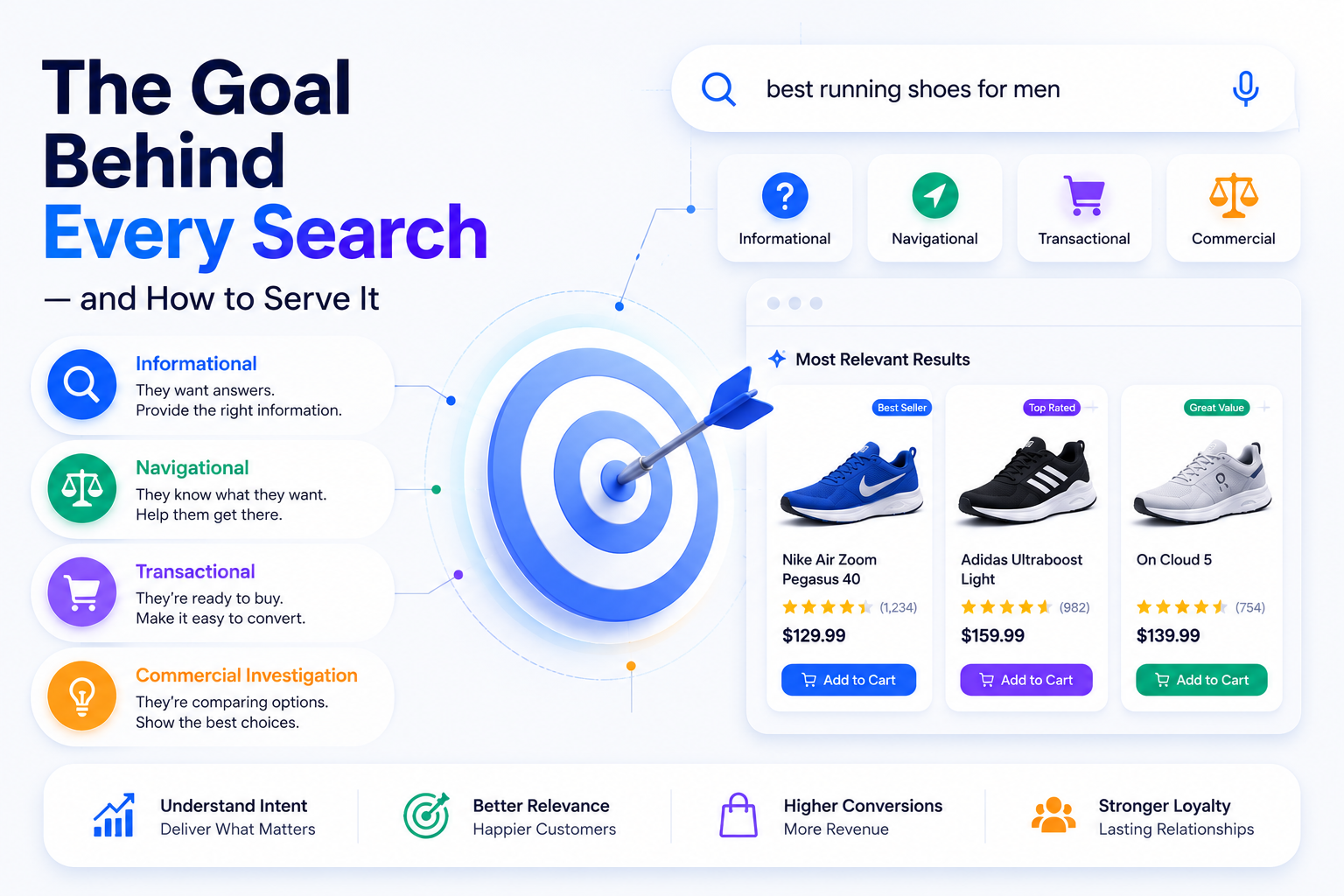
| Intent type | The searcher wants to… | Example query |
|---|---|---|
| Informational | Learn something | “how to clean white sneakers” |
| Navigational | Reach a specific place | “nike official site” |
| Commercial investigation | Compare before buying | “best trail running shoes 2026” |
| Transactional | Do something — usually buy | “buy air max 270 size 10” |
The four types form a spectrum of buying readiness, and they demand different responses: an article for informational intent, a brand or category page for navigational, a comparison for commercial investigation, and a product page with a working buy button for transactional. Mismatching response to intent — an essay for a buyer, a product grid for a learner — is the fundamental failure both Google rankings and onsite search punish.
AI Search Grader by bCloud AI
Grade your ecommerce search in 10 quick questions
31% of ecommerce searches return zero results — and most shoppers who hit a dead end leave for a competitor. How does your store's search stack up?
Answer 10 short questions and get your AI search score, plus a personalized report to fix the gaps. Free, takes about 2 minutes.
No signup needed to take the quiz.
Understanding intent…
Scoring your answers across relevance, AI, experience, and insights.
Your AI search score is ready
Tell us where to send your personalized report. You'll see your score and recommendations right away.
Your score by pillar
Personalized recommendations
Fix the gaps in weeks, not quarters
bCloud AI replaces keyword-only search with hybrid AI retrieval — sub-200ms responses, 99.99% uptime, and conversion lifts of up to 40% across 50+ implementations.
How Search Engines Detect User Intent
Intent detection has evolved through three eras. Keyword-era systems inferred intent from trigger words — “buy,” “best,” “how to” — which worked until phrasing got natural. Machine-learning systems added behavioral evidence: what searchers with similar queries ultimately clicked and did teaches the engine what the query really meant. And the current AI era reads intent directly: large language models parse full natural-language queries, embedding models place them in meaning-space, and classifiers route them — which is how “something comfortable for standing all day” resolves to supportive footwear without sharing a single keyword. Google’s own documentation at Google Search Central makes the same point from the SEO side: systems are built to reward content that satisfies the intent, not content that repeats the words.
User Intent in Ecommerce Search
Inside a store, intent reading happens query by query, in milliseconds, with revenue on the line. It decides result type (a query like “returns” needs a policy page, not products named “Returns”), specificity (exact-match precision for “SKU-4417B” versus semantic breadth for “cozy reading chair”), and ranking (a browsing signal favors variety; a buying signal favors availability and speed to purchase). Intent classification is the routing layer of search query optimization: extract what the shopper wants, then let retrieval and ranking serve it. It’s also the foundation of a conversational search engine, where multi-turn dialogue exists precisely to sharpen intent before answering. This is the layer IntentAI was built for — classifying, enriching, and routing every query by what the shopper is trying to do.
User Intent and Session Context
The same query means different things from different shoppers — and from the same shopper at different moments. “Jordan” from someone who’s browsed basketball shoes all week is a product search; from someone reading your blog, maybe an author. Modern intent systems weigh session behavior, past purchases, and real-time signals to resolve ambiguity, which is where intent reading and personalization merge into one capability: intent tells you what this query means; personalization tells you what it means for this shopper. Together they’re why two people typing identical words correctly see different results.
User Intent for SEO and AI Visibility
Outside your store, user intent decides whether your pages surface at all. Google’s ranking systems evaluate whether content satisfies the dominant intent of a query — which is why a category page rarely ranks for a how-to query and a blog post rarely ranks for a buy-now query, however well-optimized either is. The AI era raised the stakes: AI Overviews and assistants like ChatGPT answer the intent directly, citing sources that map cleanly to it. Practical consequence for your content strategy: classify every target keyword by intent before creating the page, match the format to that intent (guide, comparison, category, product), and answer the core question directly near the top — the pattern that earns both rankings and AI citations, and the reason every guide in our resource hub opens with a direct answer.
9 Proven Ways to Win With User Intent
| # | Move | Where it pays |
|---|---|---|
| 1 | Classify queries by intent type | Onsite routing + SEO targeting |
| 2 | Match result type to intent | Products vs. content vs. pages |
| 3 | Read intent semantically, not by keywords | Descriptive and natural queries |
| 4 | Use session context to disambiguate | Ambiguous short queries |
| 5 | Rank by buying readiness | Transactional queries convert now |
| 6 | Clarify when intent is unclear | Conversational follow-ups beat guessing |
| 7 | Map every SEO keyword to an intent | Format-matched pages rank and get cited |
| 8 | Mine intent data from search logs | Demand signals for merchandising & content |
| 9 | Measure intent satisfaction, not clicks | Conversion per intent class |
Intent Signals Across the Funnel
Intent isn’t only a search-box phenomenon — it accumulates across the whole visit. The queries someone types, the categories they browse, the filters they apply, the products they compare, and the pace they move at all sharpen the picture of what they’re trying to do, and each signal should update how the next surface responds. A shopper who filtered to “waterproof” and sorted by price is telling you the ranking criteria for their next search; a visitor who read two buying guides is announcing commercial investigation even before their first product query. Systems that treat user intent as a session-level model rather than a per-query guess convert measurably better, because every interaction makes the next response smarter — the same compounding logic that powers modern recommendations.
How User Intent Improves Ecommerce Search Relevance
Understanding user intent helps ecommerce search systems deliver results that match what shoppers are actually trying to accomplish. Instead of treating every query as a simple keyword match, intent-aware search can distinguish between shoppers who want to learn, compare products, find a specific brand, or make a purchase. This allows search engines to select the right result type, improve ranking relevance, and use context such as filters, browsing behavior, and previous interactions to resolve ambiguous queries. When user intent is combined with semantic search, personalization, and intelligent ranking, ecommerce businesses can reduce irrelevant results, improve product discovery, and create a search experience that moves shoppers more efficiently from query to conversion.
Measuring Whether You’re Serving Intent
Clicks alone can’t tell you intent was served — a click followed by an instant bounce is a misread, not a win. Better signals: conversion and add-to-cart rate per intent class, reformulation rate (immediate re-searching means the first read missed), zero-results rate on transactional queries (the most expensive failures — see the zero-results guide), click depth (buyers finding answers in the first screenful), and dwell-plus-action after the click. Segment all of it by intent type in your search analytics: informational queries succeeding while transactional ones fail is a very different problem — with a very different fix — than the reverse.
Common User Intent Mistakes
The recurring failures: optimizing for keywords while ignoring the goal behind them — pages that repeat the query but don’t satisfy it. Serving one result type for every query, so policy searches return products and buyers get blog posts. Treating short ambiguous queries as unanswerable instead of using context or a clarifying step. Ranking transactional queries by generic relevance instead of buying readiness. Building SEO pages in formats that fight the query’s dominant intent. And measuring success in clicks, which rewards misleading results. The unifying fix: put intent classification at the front of every search and content decision, and measure satisfaction per intent class.
How bCloud AI Reads User Intent
Intent understanding is bCloud AI’s core layer, not a feature. IntentAI classifies every query — type, entities, constraints, buying readiness — in real time; NeuralSearch’s hybrid semantic retrieval serves the meaning behind descriptive phrasing; session-aware personalization disambiguates per shopper; and the same intent signals flow into recommendations, merchandising, and analytics so the whole platform responds to what shoppers are trying to do. For the wider foundation this sits on, see our pillar guide to AI ecommerce search, and to compare platforms on intent capability, the best ecommerce search engines for 2026.
User Intent Examples in Action
Understanding user intent becomes much easier when you look at real search queries. Although the wording may seem similar, the desired outcome can be completely different. Modern AI search engines analyze these differences to deliver the most relevant results.
Learn
Query: “How to clean leather shoes”
Intent: Informational
Best Result: A step-by-step guide or tutorial.
Compare
Query: “Best gaming laptops under $1500”
Intent: Commercial Investigation
Best Result: Comparison pages with reviews and rankings.
Buy
Query: “Buy iPhone 17 Pro 256GB”
Intent: Transactional
Best Result: Product page with pricing and checkout options.
Navigate
Query: “Nike official website”
Intent: Navigational
Best Result: The brand’s homepage or official store.
Key Insight: Two users may search for similar products, but their intent determines the ideal response. AI-powered search focuses on understanding the shopper’s objective rather than matching keywords alone, resulting in more relevant search experiences and higher conversion rates.
Frequently Asked Questions About User Intent
What is user intent?
User intent is the goal behind a search query — what the searcher actually wants to accomplish, beneath the words they chose. Modern search systems on Google and in ecommerce rank and route results by that goal, not by literal keyword matches.
What are the 4 types of user intent?
Informational (learn something), navigational (reach a specific place), commercial investigation (compare before buying), and transactional (act — usually purchase). Each type demands a different response format, from guides to comparisons to product pages.
Why is user intent important for SEO?
Google’s systems reward content that satisfies a query’s dominant intent, and AI Overviews cite sources that answer it directly. Pages whose format fights the intent — an essay for buyers, a product grid for learners — struggle to rank regardless of optimization.
How do search engines detect user intent?
Modern systems combine language understanding (LLMs parsing the query), semantic embeddings (placing it in meaning-space), behavioral evidence (what similar searchers ultimately did), and session context — replacing the old trigger-word guesswork.
What is user intent in ecommerce search?
It’s the per-query routing decision: what result type to show (products, categories, content, policies), how precisely to match, and how to rank by buying readiness. Intent classification is the front layer of modern ecommerce search platforms.
How does user intent relate to personalization?
Intent tells the engine what a query means; personalization tells it what the query means for this shopper, using session behavior and history to resolve ambiguity. Together they explain why identical queries correctly return different results for different people.
How do I identify the user intent of a keyword?
Check the query’s modifiers (“how to” vs. “best” vs. “buy”), then verify against what currently ranks — the result types Google rewards reveal the dominant intent. Match your page format to that before writing a word.
How do I measure whether search is serving intent?
Track conversion and add-to-cart per intent class, reformulation rate, zero-results on transactional queries, and click depth — not raw clicks. A click followed by an instant return is a misread intent, and click-based metrics hide it.
Serve the Goal, Not Just the Words
Intent-aware search turns messy queries into confident purchases. Start for free or book a demo to see IntentAI read your real shopper queries.
bcloud.ai