

The cost of that blind spot is bigger than most teams realize. Most retailers discover their product search quietly drives 40–60% of total revenue — making it the most important sales channel they weren’t measuring properly. Ecommerce search analytics is how you finally see it: what shoppers search, where they drop off, and which fixes recover the most revenue. Here are the metrics that matter and how to act on them.
By implementing Ecommerce Search Analytics, you can gain insights into what products are in demand.
What is ecommerce search analytics?
Ecommerce Search Analytics helps identify customer intent and friction points in their shopping journey.
Good search platforms hand you data; great ones hand you direction. The job of search analytics is to translate raw numbers into actionable intelligence you can hand to your merchandising team on Monday morning.
Why search analytics matters
Investing in Ecommerce Search Analytics can significantly boost your sales strategy.
Search visitors are your highest-intent traffic — they’ve already decided roughly what they want and are telling you so. That makes search data uniquely valuable: it’s a real-time map of demand, dissatisfaction, and missed revenue. When you measure it well, you stop optimizing on hunches and start fixing the exact terms that move the needle. When you don’t, you’re leaving your biggest revenue channel to run on autopilot. The same logic that makes a modern AI ecommerce search engine worth adopting applies to its analytics: the value is in understanding intent, then acting on it.
AI Search Grader by bCloud AI
Grade your ecommerce search in 10 quick questions
31% of ecommerce searches return zero results — and most shoppers who hit a dead end leave for a competitor. How does your store's search stack up?
Answer 10 short questions and get your AI search score, plus a personalized report to fix the gaps. Free, takes about 2 minutes.
No signup needed to take the quiz.
Understanding intent…
Scoring your answers across relevance, AI, experience, and insights.
Your AI search score is ready
Tell us where to send your personalized report. You'll see your score and recommendations right away.
Your score by pillar
Personalized recommendations
Fix the gaps in weeks, not quarters
bCloud AI replaces keyword-only search with hybrid AI retrieval — sub-200ms responses, 99.99% uptime, and conversion lifts of up to 40% across 50+ implementations.
The search metrics that actually matter
Not every number deserves a place on your dashboard. These are the ones that tie directly to revenue:
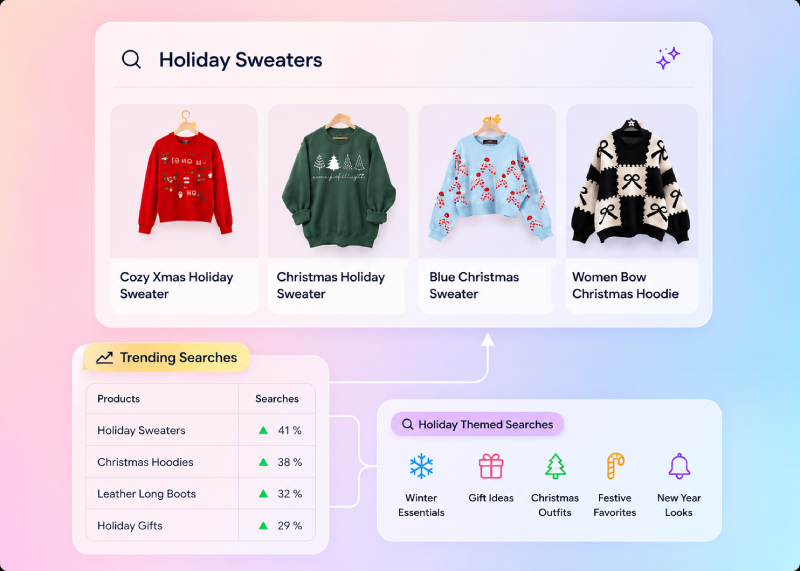
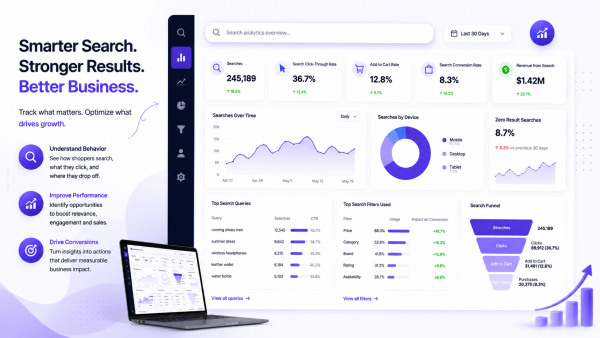
Search volume and top queries. Your most-run searches show where to focus optimization effort, and trending searches reveal emerging demand to capitalize on before competitors do. This is your demand signal in real time.
Understanding search volume through Ecommerce Search Analytics allows you to make data-driven decisions.
Zero-result rate. The single most important number to watch. The average ecommerce site loses around 31% of searches to zero results — and usually not because the product is missing. A shopper searches “wireless noise-canceling headphones” and gets nothing because your titles say “Bluetooth ANC headset.” Every zero-result search is a customer who was ready to buy and hit a wall.
Zero-result searches highlight opportunities in your Ecommerce Search Analytics data.
Click-through rate (CTR). The share of searches that lead to a product click. Low CTR means your results aren’t relevant or compelling — shoppers searched, looked, and didn’t see anything worth tapping.
Improving click-through rates through Ecommerce Search Analytics can lead to higher conversions.
Search conversion rate. The percentage of searches that end in a purchase. Search converters typically buy at several times your site average, so this is one of the highest-leverage numbers you have — and a low figure on a high-volume term is a flashing revenue opportunity.
Ecommerce Search Analytics reveals trends that can enhance your marketing campaigns.
Average order value from search. Searchers who find what they want — and get smart recommendations alongside it — tend to spend more. Tracking AOV from search shows whether your discovery experience is growing baskets.
Using Ecommerce Search Analytics to track average order values can lead to better merchandising decisions.
Search latency. Speed is a conversion lever, not a vanity metric. Slow results lose impatient shoppers, so median and tail (p95/p99) response times belong on the dashboard. A strong product search engine returns results in well under a second.
High search latency can be addressed through insights gained from Ecommerce Search Analytics.
The search funnel. The clearest view of all: Query → Results view → Product click → Add to cart → Purchase. Mapping drop-off at each step shows precisely where and why customers fall out — so you fix the actual leak instead of guessing.
Mapping the search funnel with Ecommerce Search Analytics helps identify drop-off points.
Attribution. Last-touch, first-touch, and multi-touch attribution reveal search’s true contribution to revenue. This is how you prove that search is driving that 40–60% — and justify investing in it.
Attribution in Ecommerce Search Analytics can clarify your revenue sources.
From metrics to action
Numbers only matter if they change what you do. Here’s how the best teams turn search analytics into revenue:
Effective use of Ecommerce Search Analytics leads to actionable insights for your team.
- Zero-result queries → fix the catalog. They’re a precise list of what customers want but can’t find. Add the missing synonyms (“ANC earbuds”), normalize attributes, or flag a genuine assortment gap. bCloud AI’s analytics flag these automatically, so your team isn’t hunting for them.
- High-traffic, low-conversion searches → high-impact fixes. If “laptop” gets 50,000 searches a month but converts at 1.5% while your category average is 3%, fixing that one term roughly doubles its revenue contribution. Better content, pricing, or selection on a single high-volume query can outperform a site-wide campaign.
Fixing issues in high-traffic searches through Ecommerce Search Analytics can maximize revenue.
- Trending searches → merchandising moves. Rising demand is a cue to feature, stock, and promote before the peak.
- Strong-inventory products that never appear in search → metadata fixes. Products with healthy stock that never surface usually have poor titles, missing attributes, or wrong categorization. Analytics surface them so you can fix the data.
Ecommerce Search Analytics provides visibility that can enhance customer experience.
Search analytics and AI visibility
There’s a second payoff worth noting. The queries in your search analytics are the real language your customers use — and that’s the same language shoppers type into ChatGPT, Gemini, and Google’s AI Overviews when they ask for product recommendations. Mining your search data tells you exactly which product attributes, synonyms, and buyer-guide content to create so AI engines can understand and surface your products. On-site search analytics and off-site AI visibility feed each other: the data that sharpens your search experience also sharpens your discoverability across AI.
Leveraging Ecommerce Search Analytics can improve your product recommendations.
Common search analytics mistakes to avoid
- Counting searches without acting. Volume alone is vanity; the value is in the zero-result and low-conversion fixes.
- Ignoring zero-results. It’s the clearest revenue leak you have, and the easiest to plug.
- Treating search as un-attributed. If you can’t tie search to revenue, you’ll under-invest in your biggest channel.
- Watching only averages. A healthy overall conversion rate can hide a high-volume term that’s badly underperforming.
- Forgetting latency. Slow search silently costs conversions no dashboard column will explain unless you track speed.
Ecommerce search analytics becomes most valuable when it creates a continuous feedback loop between shopper behavior and search improvements. Every query, click, zero-result search, and purchase provides evidence about what customers want and where the current experience falls short. Retailers can use these signals to improve product data, add missing synonyms, refine ranking, identify emerging demand, and adjust merchandising decisions before search problems become lost revenue. When analytics is reviewed consistently and connected to measurable outcomes such as conversion rate, average order value, and revenue from search, ecommerce teams can replace guesswork with a repeatable optimization process that steadily improves product discovery and customer experience.
Weekly Search Analytics Dashboard Checklist
Search analytics delivers the most value when it’s reviewed consistently. A short weekly review helps merchandising, marketing, and ecommerce teams spot opportunities before they become lost revenue.
Monday
Review Customer Demand
Identify the most searched products, newly trending keywords, and seasonal search patterns to understand changing customer demand.
Mid Week
Fix Search Issues
Review zero-result searches, poor-performing queries, and missing synonyms that prevent shoppers from finding products.
Friday
Measure Business Impact
Compare search conversion rate, revenue generated from search, and average order value to measure the impact of recent improvements.
Rather than reviewing dozens of reports, focus on a small set of high-impact search metrics every week. Continuous optimization based on real customer behavior produces better search experiences and more consistent revenue growth over time.
Frequently asked questions
What is ecommerce search analytics?
Ecommerce search analytics measures how shoppers use your store’s search — what they query, what results they get, what they click, and what they buy — and turns it into decisions. It reveals demand, friction, and the specific fixes that lift conversion and revenue. Understanding your customers through Ecommerce Search Analytics is key to improving their journey.
What search metrics matter most?
The highest-value metrics are zero-result rate, search conversion rate, click-through rate, average order value from search, search latency, and the full search funnel (Query → Results → Click → Cart → Purchase), plus revenue attribution to prove search’s contribution.
What is a good zero-result rate?
Lower is always better. The average ecommerce site loses around 31% of searches to zero results, so anything well below that is healthy — and an AI search engine that understands synonyms and intent can drive it close to negligible.
How much revenue does site search drive?
For many retailers, product search drives 40–60% of total revenue, because search visitors are the highest-intent traffic on the site. It’s often the most important channel a store wasn’t measuring properly.
How do I reduce zero-result searches?
Use your analytics to find the failing queries, then add synonyms, normalize product attributes, and close genuine catalog gaps. An AI search engine that understands meaning resolves most of these automatically by matching intent rather than exact keywords. Reducing zero-result searches is achievable with Ecommerce Search Analytics insights.
Can search analytics help with AI visibility?
Yes. Your search queries reveal the real language shoppers use — the same language they use with AI assistants — so the data tells you which attributes and content to create to get recommended by ChatGPT, Gemini, and Google AI. Enhancing AI visibility can be achieved through effective Ecommerce Search Analytics strategies.

See what your search bar is telling you.
bCloud AI turns every query into actionable intelligence — zero-result alerts, funnel drop-off, and revenue attribution in a real-time dashboard. See your search analytics in action.
bcloud.ai