

What is a search assistant?
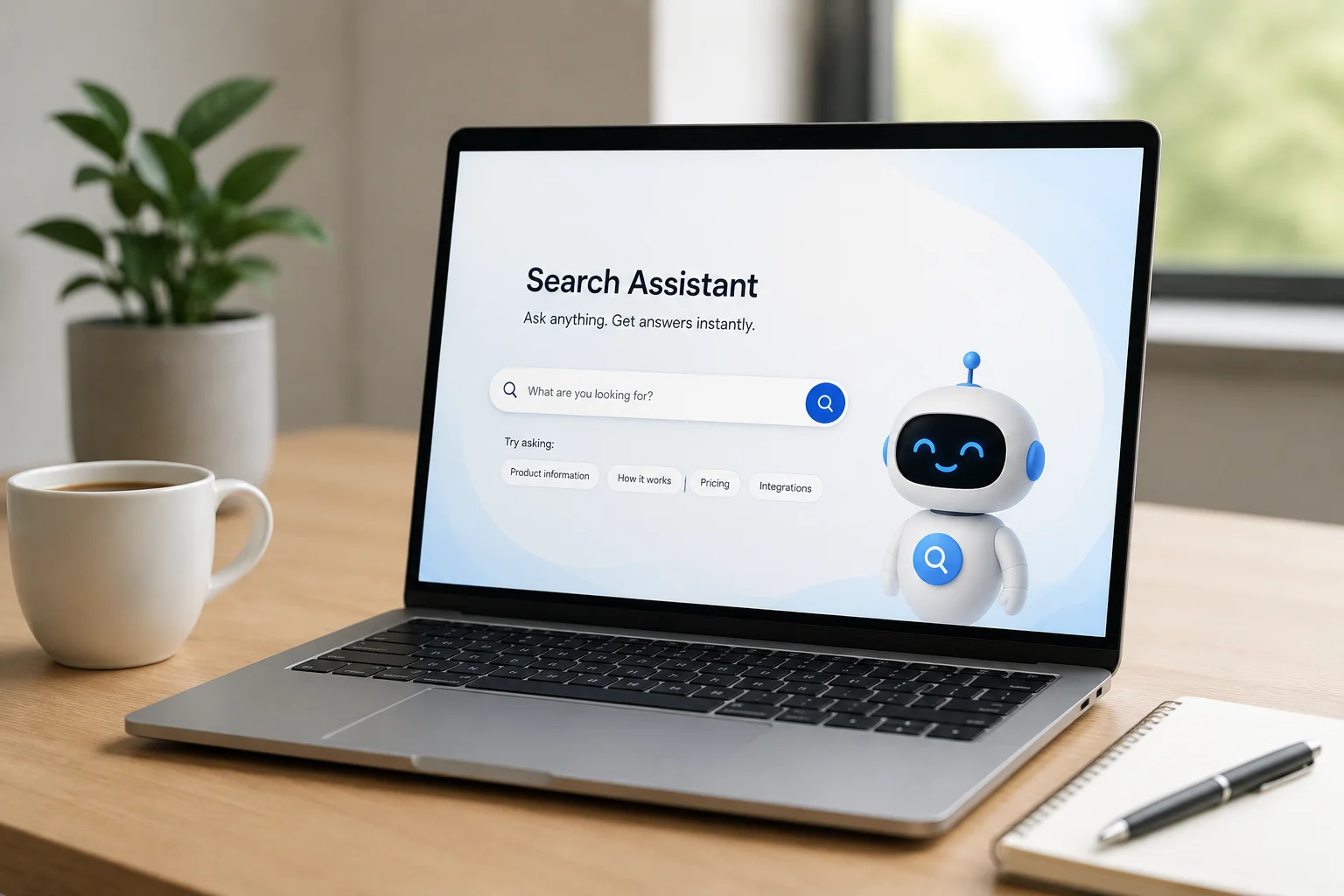
The defining characteristic is agency. A traditional search engine is a directory: it points. A search assistant does work on your behalf. Ask a search engine “what’s the best waterproof jacket under $150 for bike commuting” and you get pages that might contain the answer. Ask a search assistant and you get three specific jackets compared on breathability, hood fit, and price, with links to each.
This puts search assistants in the same family as virtual assistants, but with an important difference: a search assistant is grounded in retrieved information rather than working from what a model memorized during training. That grounding is what makes the answers checkable — and, when it’s missing, is why some AI answers are confidently wrong.
The types of search assistants
The term covers several distinct products, and knowing which one someone means prevents a lot of confusion.
Web search assistants
answer general questions using the open internet. Microsoft Copilot, Google’s AI-powered search modes, Perplexity, and ChatGPT with browsing all sit here. They’re replacing the “search, scan, synthesize” habit for a growing share of everyday questions.
Shopping search assistants
help people find and choose products, either on a retailer’s own site or inside a general assistant. They handle vague, descriptive requests — “something warm for a beach wedding” — and increasingly compare options rather than just listing them. Our guide to the AI shopping assistant covers this commerce-specific application in depth.
Workplace search assistants
find information across a company’s internal systems — documents, tickets, chat history, wikis — and answer questions from it. Microsoft 365 Copilot and Glean are the well-known examples. Useful precisely because internal search has historically been terrible.
In-app search assistants
live inside a specific product and help you use it or find things within it — a documentation assistant, a support assistant, or a data-exploration assistant.
Developer search assistants
help engineers find code, documentation, and solutions, blending retrieval with generation.
Different surfaces, same underlying architecture.
How a search assistant works
Four stages, and understanding them explains both the capability and the failure modes.
Stage one: understanding the question.
The assistant interprets what you asked — intent, constraints, implied context. “Under $150” is a filter, “for bike commuting” implies weather resistance and visibility. Where a keyword engine sees words, a search assistant extracts requirements. Our query understanding guide covers this layer.
Stage two: retrieval.
The assistant searches for relevant material. In practice this usually means semantic retrieval — converting the question into a numerical representation of meaning and finding the closest matching content, as covered in our what is semantic search guide. Good systems combine this with keyword matching so exact terms and product codes still resolve precisely, an approach called hybrid search.
Stage three: synthesis.
A language model reads what was retrieved and composes an answer constrained to that material. The technical name is retrieval-augmented generation, and it’s the difference between a search assistant that cites reality and one that improvises. Remove the retrieval step and you get fluent fiction.
Stage four: presentation and follow-up.
The answer appears with citations, and most assistants let you refine — “cheaper,” “in navy,” “what about waterproofing?” — carrying context forward.
Search assistant vs. search engine vs. chatbot
These three get muddled constantly.
Search engines
remain better when you want to evaluate sources yourself, need comprehensiveness, or are researching something contested where a single synthesized answer would flatten genuine disagreement.
Chatbots
were built for scripted support flows. When one answers a factual question without retrieval, it’s guessing from training data.
A search assistant
sits between them: retrieval like a search engine, conversation like a chatbot, plus synthesis neither does.
What a search assistant gets wrong
Being clear-eyed here is more useful than enthusiasm.
- It can be confidently wrong. The most important limitation. Old search failed visibly — zero results, obviously irrelevant pages. A search assistant almost always produces a fluent, plausible answer, so a wrong one looks identical to a right one. Citations help, but only if you check them.
- Retrieval quality caps everything. If the right source isn’t retrieved, the assistant synthesizes from whatever it did find. Most bad answers are retrieval failures wearing a generation costume.
- It flattens nuance. Contested questions with legitimate disagreement get compressed into one confident-sounding answer. For anything where the debate is the information, links serve you better.
- Recency is uneven. Depending on how it retrieves, a search assistant may work from stale material without signaling it.
- Source quality is invisible. A citation looks equally authoritative whether it’s peer-reviewed research or a content-farm post.
The practical habit: use a search assistant for orientation and synthesis, then verify anything consequential at the source. It’s a very good research partner and a poor final authority.
AI Search Grader by bCloud AI
Grade your ecommerce search in 10 quick questions
31% of ecommerce searches return zero results — and most shoppers who hit a dead end leave for a competitor. How does your store's search stack up?
Answer 10 short questions and get your AI search score, plus a personalized report to fix the gaps. Free, takes about 2 minutes.
No signup needed to take the quiz.
Understanding intent…
Scoring your answers across relevance, AI, experience, and insights.
Your AI search score is ready
Tell us where to send your personalized report. You'll see your score and recommendations right away.
Your score by pillar
Personalized recommendations
Fix the gaps in weeks, not quarters
bCloud AI replaces keyword-only search with hybrid AI retrieval — sub-200ms responses, 99.99% uptime, and conversion lifts of up to 40% across 50+ implementations.
Search assistants in ecommerce
For retailers, this shift has a specific and increasingly urgent consequence.
Shoppers now ask assistants for product recommendations before visiting any store. When someone asks Copilot or ChatGPT for the best running shoes for flat feet under $120, the assistant retrieves from catalogs it can read and recommends specific products. If your catalog isn’t legible to those systems, you’re not in the consideration set — and you’ll never see the impression you lost.
Meanwhile, shoppers arriving on your site increasingly expect the same experience there. A store where search still requires exact keywords feels dated to someone who just described their needs in a sentence to an assistant and got a useful answer.
Both sides run on the same foundation: structured, well-described product data and retrieval that understands meaning. Investing in one improves the other, which makes it unusually good value. Our guides to AI site search and the top semantic search solutions for e-commerce cover the on-site half, and if you want to know whether AI systems can currently read your catalog at all, our AI crawlers guide covers the diagnostics.
The click that never happens
There’s a second-order effect here that most teams haven’t priced in yet.
When an assistant answers well, the visit it replaces never registers anywhere. A shopper who asked three comparison questions, ruled out two brands, and arrived at your product page having already decided looks identical in your analytics to someone who wandered in from a random link — except they convert far better and you have no idea why. The reverse is worse: the shopper the assistant didn’t mention you to leaves no trace at all, because a lost impression inside someone else’s chat window produces no bounce, no exit, no failed query, nothing you can put on a dashboard. That’s a genuinely new kind of blind spot, and it rewards a different habit than the one most retail teams have built. Instead of watching referral traffic decline and guessing at causes, ask the major assistants the questions your customers ask, in the categories you compete in, and read what comes back. Whether you appear, how you’re described, and which competitor gets named instead is information you can act on today, and it costs an hour a month rather than a platform migration.
Building a search assistant into your own product
If you’re considering adding one — to a storefront, a documentation site, or an internal tool — five things determine whether it works.
Retrieval quality first.
A search assistant is only as good as what it retrieves. Fluent language over bad results is worse than plain results, because confident wrongness costs trust that a mediocre list never would.
Grounding discipline.
The generation step must be constrained to retrieved material, and the system needs to say “I don’t have that” rather than improvise. This is a configuration and prompt-design choice, not an inevitability.
Content quality underneath.
An assistant can only discuss what your content expresses. Thin product descriptions or sparse documentation produce vague, unhelpful answers no model rescues.
A visible escape hatch.
Some people want a list. Forcing everyone through conversation frustrates users who arrived knowing exactly what they wanted.
Measurement.
Track whether it actually helps — task completion, escalation rate, conversion — against a control group that doesn’t see it. Assistants demo brilliantly and don’t always convert. Our A/B testing guide covers the methodology, and search relevance metrics covers what to measure underneath.
One honest caveat on cost: every answer a search assistant generates costs compute. At low volume this is negligible; at scale, cost per answered question is a real line item worth tracking against the value it produces.
How to get better answers out of one
Small changes in how you ask produce noticeably better results, and most people never adjust their habits from the keyword era.
Ask in full sentences.
Two-word queries were an adaptation to systems that couldn’t handle more. Describing your actual situation — constraints, context, what you’ve already ruled out — gives the system material to work with.
State your constraints explicitly.
Budget, timeframe, skill level, and what you’re optimizing for all change the answer. “Explain this to someone with no technical background” produces a genuinely different response than the same question without it.
Ask for the reasoning, not just the conclusion.
Requesting the trade-offs behind a recommendation surfaces the assumptions, which is where errors hide. A conclusion you can’t interrogate isn’t much use for a decision that matters.
Follow up rather than restarting.
Refining in place — “narrower,” “cheaper,” “what about the second option?” — is faster and keeps context, which is the whole point of the conversational format.
Check the citations on anything consequential.
Not every answer needs verification, but any answer you’ll act on does. Clicking through takes seconds and catches the class of error these systems are most prone to.
Notice what it avoids.
A system that hedges on a question you expected a clear answer to is often telling you the sources genuinely disagree — which is useful information rather than a failure.
Where search assistants are heading
Two developments are worth watching.
Agentic behavior.
Assistants are moving from recommending to doing — comparing options, filling forms, configuring products, and eventually completing transactions. That turns a search assistant from an information layer into a transaction layer, with real implications for how retailers structure their data and APIs.
Multimodal input.
Photograph a broken part and ask where to buy a replacement; describe a room and get furniture suggestions. Images, audio, and text increasingly share the same representational space, so search assistants can work across all three.
Both build on the same architecture described above. The core idea — understand, retrieve, synthesize — generalizes remarkably well, which is why the category expanded so fast.
Frequently asked questions
What is a search assistant?
A search assistant is an AI system that helps you find information by understanding your question, retrieving relevant material, and synthesizing an answer rather than just listing links. The defining feature is agency: it does the reading and comparing on your behalf, usually citing sources so the answer can be checked.
How is a search assistant different from a search engine?
A search engine returns ranked links and leaves the synthesis to you. A search assistant retrieves the same kind of material but reads it and composes a direct answer, then lets you refine through follow-up questions. Search engines remain better for evaluating sources yourself or researching contested topics.
Is a search assistant the same as a chatbot?
No. Chatbots were built for scripted support flows and often generate answers from training data without retrieving anything. A search assistant retrieves live information first and grounds its answer in what it found, which is why its answers can carry citations.
Are search assistants accurate?
They’re useful but not authoritative. Because they always produce a fluent answer, a wrong one looks identical to a right one — most errors come from retrieval failing to surface the right source. Use them for orientation and synthesis, and verify anything consequential at the cited source.
What are the main types of search assistants?
Web search assistants for general questions (Copilot, Perplexity, ChatGPT), shopping assistants for product discovery, workplace assistants that search internal company systems, in-app assistants inside specific products, and developer assistants for code and documentation.
Why do search assistants matter for online retailers?
Because shoppers increasingly ask assistants for product recommendations before visiting any store, and assistants can only recommend products from catalogs they can read and understand. Structured, well-described product data determines both whether external assistants recommend you and how well your own site search performs.
Can I add a search assistant to my website?
Yes. Managed platforms provide the retrieval, grounding, and conversational layers together, typically live in weeks. The prerequisites are strong retrieval quality, grounding discipline so the assistant doesn’t improvise, good underlying content, and a measurement plan with a control group.
Shoppers are asking assistants. Make sure yours can answer.
bCloud AI grounds conversational discovery in your live catalog — hybrid retrieval underneath, sub-200ms, measured against a control.
bcloud.ai