
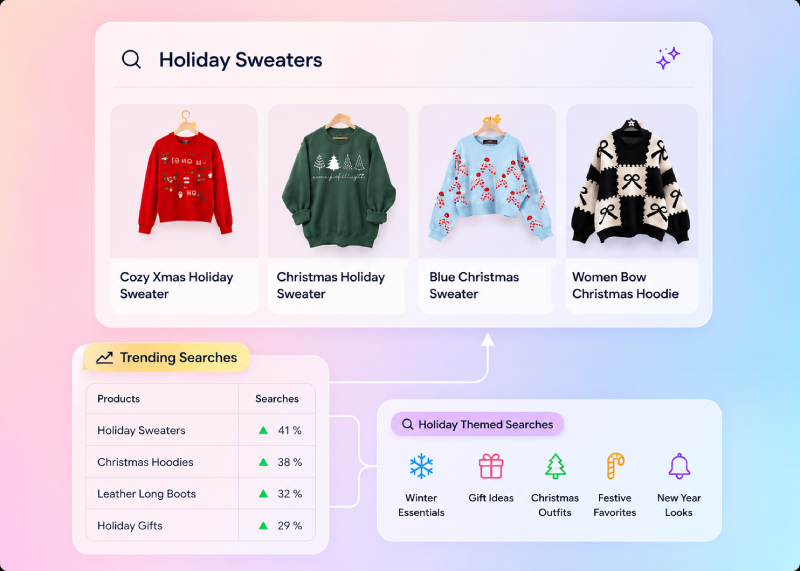
The four categories of personalization engines
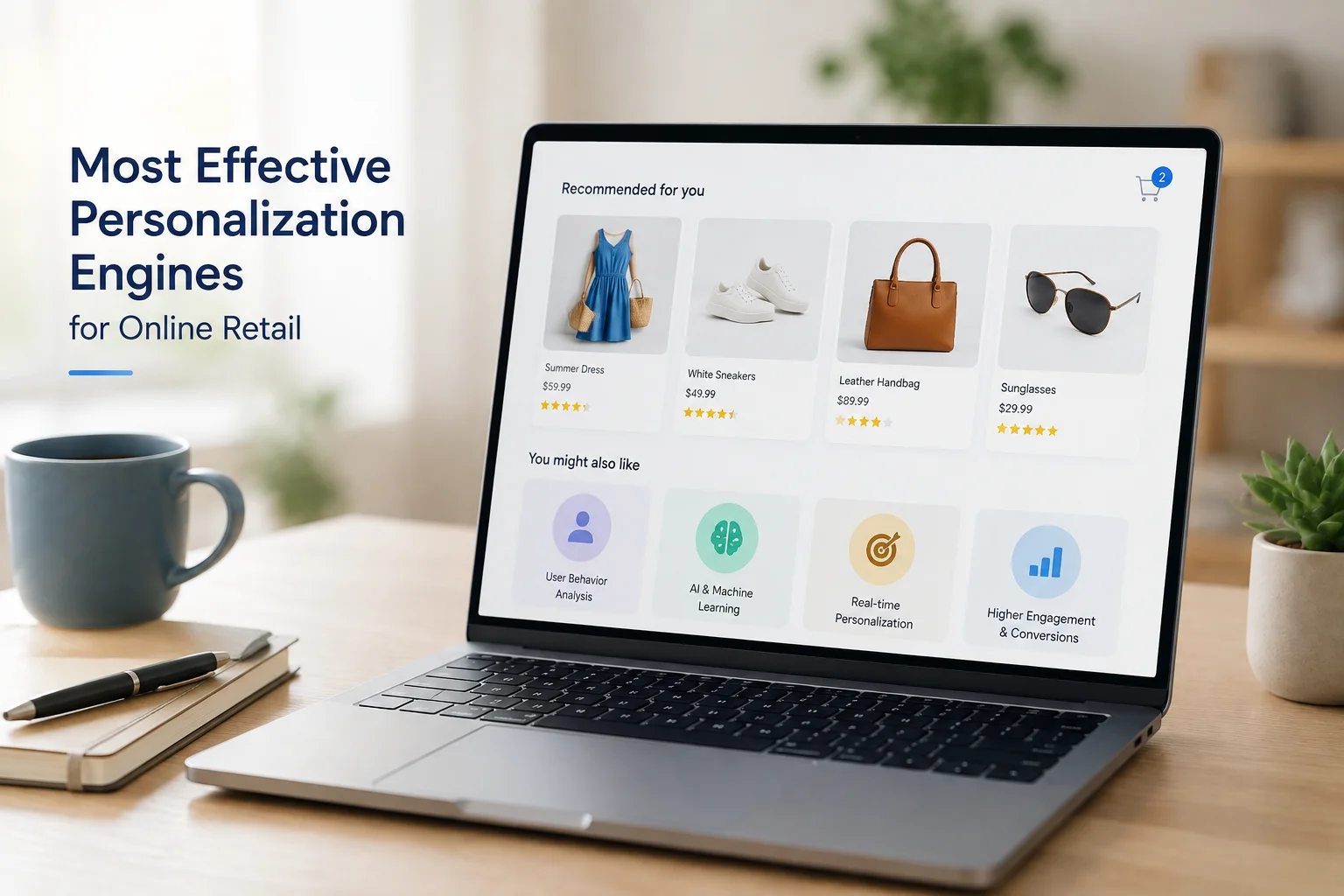
Omnichannel engagement engines.
These personalization engines unify customer data and orchestrate journeys across email, SMS, push, WhatsApp, and web. Personalization here means the right message at the right moment, across channels. They’re CDP-first and marketing-led.
On-site experience engines
personalize what happens on your website and app — banners, content blocks, recommendation widgets, and layout — usually with strong A/B testing built in. Experimentation-led.
Discovery and search personalization engines
personalize the product-finding experience itself: search results, category ordering, and recommendations, adapting per shopper. This is where bCloud AI sits, and being clear about that matters more than claiming to do everything.
Platform-native and SMB engines
run inside a specific ecosystem, typically Shopify, with faster setup and narrower scope.
Most retailers eventually run two of these. Almost nobody needs all four, and paying for overlapping capability is common enough that “what does this replace?” is worth asking every vendor.
Omnichannel engagement engines
Insider One
rebranded from Insider during 2025–2026 and now positions itself as an agentic customer engagement platform — a CDP, journey builder, and AI agent suite spanning web, email, SMS, RCS, WhatsApp, push, and site search. It currently holds the strongest G2 standing in the category at 4.8/5 across roughly 1,360 reviews, and it’s frequently cited as the easiest to use among enterprise options. Best for: enterprise teams consolidating several tools into one engagement stack.
Bloomreach
combines personalization with commerce content and product discovery — Engagement for customer data and campaigns, Discovery for search and merchandising, plus a headless CMS. G2 sits around 4.6/5 across roughly 764 reviews. The structural caveat we’ve noted before still applies: real-time personalized search requires both Discovery and Engagement, so the capability you want may need two modules. Best for: enterprises wanting CDP, CMS, and discovery under one vendor.
Salesforce Personalization and Adobe Experience Cloud
are the suite plays. Both handle enterprise-grade scale, compliance, and multi-region deployment, and both make most sense when you’re already standardized on that ecosystem. Personalization is a component of a much larger platform rather than the product itself. Best for: organizations already committed to Salesforce or Adobe.
Klaviyo
anchors the SMB and mid-market end of channel-based personalization, strongest in email and SMS with growing on-site capability. Best for: DTC brands where email drives the majority of repeat revenue.
AI Search Grader by bCloud AI
Grade your ecommerce search in 10 quick questions
31% of ecommerce searches return zero results — and most shoppers who hit a dead end leave for a competitor. How does your store's search stack up?
Answer 10 short questions and get your AI search score, plus a personalized report to fix the gaps. Free, takes about 2 minutes.
No signup needed to take the quiz.
Understanding intent…
Scoring your answers across relevance, AI, experience, and insights.
Your AI search score is ready
Tell us where to send your personalized report. You'll see your score and recommendations right away.
Your score by pillar
Personalized recommendations
Fix the gaps in weeks, not quarters
bCloud AI replaces keyword-only search with hybrid AI retrieval — sub-200ms responses, 99.99% uptime, and conversion lifts of up to 40% across 50+ implementations.
On-site experience engines
Dynamic Yield
(Mastercard-owned) has deep roots in A/B testing and multivariate experimentation, with capabilities spanning product and content recommendations, audience segmentation, and cross-channel personalization. It’s particularly well regarded for anonymous-visitor targeting — useful when most of your traffic isn’t logged in. The trade-off, consistently reported by reviewers, is that it requires a sales cycle and developer bandwidth. Best for: teams with engineering support that treat personalization as an experimentation discipline.
Nosto
is the ecommerce-first option — on-site recommendations, merchandising, and shoppable user-generated content with notably faster setup and less implementation overhead. G2 around 4.6/5 across roughly 235 reviews. Marketing teams without dedicated engineers tend to prefer it for exactly this reason. Best for: mid-market retailers wanting speed to value over configuration depth.
Optimizely and AB Tasty
approach personalization from the experimentation side, with strong testing engines and personalization layered on. Best for: teams whose primary discipline is conversion optimization.
Monetate and Algonomy
round out the enterprise on-site category, both with long retail track records.
Discovery and search personalization engines
This category of personalization engines deserves its own treatment, because it’s where personalization most directly touches purchase intent — and it’s frequently misunderstood as a subset of the others.
When a shopper searches or browses, they’re telling you what they want right now. Personalizing that moment is different from personalizing an email sent two days later. Discovery personalization engines adapt search results, category ordering, and recommendations using session and history signals, so the same query returns different results for different shoppers.
bCloud AI
personalizes inside product discovery, running search, browse ranking, and recommendations from a single vector foundation — the same embeddings that match a query to products also represent shoppers, so personalization applies consistently across every discovery surface rather than as a bolted-on module. Sub-200ms responses, real-time indexing, and measurement against a live control group. Personalization is included at every tier rather than gated to enterprise plans, with catalog-based pricing. Best for: retailers whose revenue leak is in product finding rather than campaign orchestration. Our vector search personalization guide covers the mechanics.
Constructor
optimizes search, browse, and recommendations toward conversion and revenue using clickstream and purchase behavior, with real strength at high SKU counts. Best for: enterprise retailers measuring discovery on revenue outcomes.
Algolia and Coveo
both offer personalization layered onto strong search infrastructure — Algolia with excellent developer tooling, Coveo with mature enterprise ML spanning commerce and support. Note that Algolia’s semantic layer sits on its top-tier plan.
Klevu
provides discovery personalization with mature merchandising automation, well established among Shopify and Magento retailers.
If product discovery is where your funnel leaks, these personalisation engines address it directly — and our guides to what is hybrid search and search reranking cover the retrieval and ranking layers they personalize on top of. Our roundup of the top semantic search solutions for e-commerce compares this category on relevance quality specifically.
Platform-native and SMB engines
Retailers searching for personalisation engines at this end of the market usually land here. Rebuy and LimeSpot run natively inside Shopify with fast setup and drag-and-drop configuration, trading depth for immediacy. Clerk.io serves similar territory in European markets. For a store doing a few million in GMV without engineering resources, these often deliver more actual personalization than an enterprise platform that never gets fully configured.
How the technology works
Underneath the category differences, most modern personalization engines share one approach.
Shoppers are represented as behavioral profiles — historically as segments and rules, increasingly as vectors that capture taste mathematically. Products are represented the same way. Finding “products this person will like” then becomes a proximity calculation rather than a rule lookup. The model family behind this is documented in Wikipedia’s recommender system entry.
Three signal types feed it. Session signals — what someone is doing right now — matter most and work for anonymous visitors, which is why they’re the fastest path to results. Historical signals build long-term taste from past purchases, powerful for returning shoppers and useless for new ones. Contextual signals cover device, location, time, and referral source.
Keeping that profile current depends on real-time indexing, since a personalization engine reading stale catalog data recommends products at wrong prices. Real-time decisioning is the current dividing line between capable and dated engines: adapting within the session rather than on a nightly batch. Any personalization engine that can’t respond to what a shopper did four minutes ago is solving yesterday’s problem.
Choosing between personalization engines
Six questions settle most personalization engines decisions faster than a feature matrix.
Where does your funnel actually leak?
If shoppers can’t find products, a discovery engine addresses the cause. If they find products but don’t return, an omnichannel engine does. Diagnose before shopping — this single question eliminates two of the four categories for most retailers.
How much of your traffic is anonymous?
Heavy anonymous traffic favors engines strong at session-based personalization. Logged-in, repeat-heavy traffic rewards historical and CDP-driven approaches.
How mature is your data?
CDP-driven engines from Adobe or Oracle reward teams with clean, unified data. On-site-first engines like Nosto deliver faster with less upfront work. Be honest about your current data hygiene, because overestimating it is how implementations stall.
Who will operate it?
Marketing teams without developers need drag-and-drop; teams with engineers can configure APIs and tune algorithms. Many brands buy advanced capability they never implement while neglecting foundational personalization that would have produced immediate results.
What does it replace?
The best purchase often consolidates two tools you already pay for. Ask every vendor this directly.
Can it prove lift?
Personalization is the category most prone to demoing beautifully and converting modestly. Insist on control-group rollout with reported conversion and revenue per session — our A/B testing guide covers the methodology, and search relevance metrics covers what to measure.
When two personalization engines disagree
Most retailers end up running two, and almost nobody plans for what that actually means on the page.
Two engines built on different data will reach different conclusions about the same shopper, and both will render their answer confidently. An omnichannel engine working from purchase history places a “recommended for you” widget promoting the category someone bought from last quarter, while the discovery engine reading this session’s behavior ranks something else entirely at the top of the results — so the shopper sees the store contradicting itself in two places on one screen. Worse, each vendor’s dashboard reports lift on its own surface, so both look like they’re working while the combined experience gets less coherent. The fix is a stated hierarchy decided before rollout rather than after: name which engine owns which surface, agree that the one closest to live intent wins where they overlap, and hold out a control group that sees the whole page rather than one widget. Vendors will tell you their engine plays well with others. Ask instead which one they expect to lose to, and on what surface, because a vendor with no answer has never run alongside anything.
What limits personalization engines
Three constraints matter more than which of the personalization engines you pick, and none of them overcomes these.
- Product data quality is the ceiling. All personalization engines recommend based on attributes your catalog expresses. Thin titles and missing attributes cap every platform equally, and the long-tail products that most need surfacing are usually the sparsest.
- Over-personalization erodes trust. Weight the shopper too heavily and search stops answering the query — someone searching “formal shoes” getting sneakers because they usually buy sneakers is a failure, not a feature. The query must stay dominant. Baymard Institute’s UX research repeatedly finds that unpredictable results frustrate shoppers with clear intent.
- Cold start is most of your traffic. For many retailers the majority of sessions are new or anonymous. Personalization that degrades poorly for them optimizes a minority.
A 30-day evaluation plan
Personalization engines are unusually hard to evaluate from demos, because every demo runs on a mature dataset with months of behavioral history. Here’s a sequence that produces evidence instead.
Week 1 — diagnose, don’t shop.
Pull your own numbers first: what share of sessions are new versus returning, where sessions end, and whether search or browse carries more traffic. Most retailers discover their assumed leak isn’t the real one, which eliminates two of the four engine categories immediately and saves weeks of irrelevant demos.
Week 2 — shortlist by category, not by brand.
Take three vendors from the category your diagnosis points at. Comparing personalization engines across categories produces confusion; comparing three within one produces a decision.
Week 3 — test with your own catalog and traffic profile.
Ask each vendor to run against your real product data, including the thin records. Then test the failure cases specifically: what a brand-new anonymous visitor sees, and what happens when a shopper searches something contradicting their history. Both reveal more than the happy path.
Week 4 — demand the measurement plan before signing.
Ask exactly how the vendor will prove lift: control group size, metrics reported, and reporting cadence. Vendors who answer crisply have done this before; vendors who deflect to case studies are asking you to take personalization on faith.
One more practical note. Ask what happens in month six, when your catalog has grown and your traffic mix has shifted. Personalization engines degrade quietly as data drifts, and the vendors worth buying from have an answer about retraining cadence rather than treating deployment as the finish line.
Frequently asked questions
What are the most effective personalization engines for online retail?
It depends on category. For omnichannel engagement: Insider One, Bloomreach, Salesforce, Adobe, and Klaviyo. For on-site experience and experimentation: Dynamic Yield, Nosto, Optimizely, and Monetate. For discovery and search personalization: bCloud AI, Constructor, Algolia, Coveo, and Klevu. For Shopify-native SMB: Rebuy and LimeSpot.
What is a personalization engine?
A personalization engine is software that adapts what a shopper sees based on their behavior, preferences, and context — product recommendations, search results, content, offers, or messages. Modern engines use machine learning and real-time decisioning rather than static rules.
Which personalisation engine is best for a mid-market retailer?
Diagnose the leak first. If product discovery is failing, a discovery engine like bCloud AI or Klevu addresses the cause directly. If retention is the problem, Klaviyo or Nosto. Mid-market brands scaling toward enterprise often choose Bloomreach, Insider One, or Dynamic Yield to avoid a later platform switch.
How much do personalization engines cost?
Nearly all enterprise personalization engines use custom, quote-based pricing that scales with traffic, catalog size, and modules. Enterprise suites commonly run into five and six figures annually. Shopify-native tools and discovery platforms with published tiers are meaningfully cheaper. Model any quote at three times your current traffic before signing.
Do I need a separate personalization engine if my search platform personalizes?
Often not, if your primary need is discovery. A search platform personalizing results, browse ordering, and recommendations covers the on-site product-finding surface. You’d add an omnichannel engine when you need email, SMS, and cross-channel journeys as well.
How do I measure whether a personalization engine works?
Run a permanent holdout group that never sees personalization, and compare conversion rate and revenue per session against it, segmented by new versus returning visitors. Expect minimal effect on first-time traffic and clear lift on repeat traffic; other patterns signal miscalibration.
If your funnel leaks at product discovery, fix it there.
bCloud AI personalizes search, browse, and recommendations from one vector foundation — included at every tier, measured against a live control.
bcloud.ai