
What is retail media, and why does search sit at its center?
Search is where most of that money concentrates, for an obvious reason: a shopper typing a query is declaring intent at the exact moment of decision. Sponsored products inside search results are the closest thing advertising has to reading someone’s mind — if the placement actually matches what they meant. And that “if” is where legacy retail media struggles.
The keyword problem in retail media
Traditional sponsored-product systems work like a miniature search engine from 2010: advertisers bid on keywords, and ads appear when the shopper’s query contains those words. The failure modes are exactly the ones keyword search suffers everywhere, with money attached.
A shopper searches “comfortable shoes for standing all day.” No advertiser bid on that phrase, so the premium placement goes unfilled or gets backfilled with something generic — lost revenue for the retailer, a lost customer for the brand whose work sneaker was the perfect answer. Another shopper types “sofa” while every ad campaign targeted “couch” — relevant inventory exists, the auction just can’t see it. A third searches a Spanish-language query on a US site and the keyword system finds nothing at all.
Meanwhile the reverse failure erodes trust: loosely matched ads that do fire against broad keywords put irrelevant sponsored products at the top of results. Shoppers learn to skip the sponsored row entirely, click-through rates sag, and the whole retail media flywheel slows. Decades of search UX research from the Baymard Institute document how quickly shoppers abandon results that miss intent — and sponsored slots are the most visible results on the page.
How semantic search changes retail media
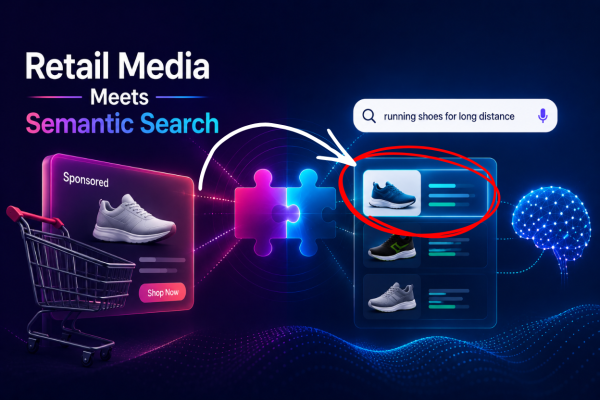
Semantic retail media replaces keyword matching with meaning matching in the ad-selection step. The mechanics mirror organic semantic search: the shopper’s query is converted into an embedding that captures its intent, every advertised product is embedded the same way, and eligible ads are retrieved by semantic similarity — then ranked by a blend of relevance and bid. If the underlying technology is new to you, our guides to what is semantic search and what is vector search cover the foundations.
The consequence is that the ad auction finally understands language. “Comfortable shoes for standing all day” retrieves the work sneaker whether or not anyone bid that phrase. “Sofa” and “couch” resolve to the same intent. Natural-language, long-tail, and even cross-language queries become monetizable inventory instead of dead zones. And because relevance is scored, genuinely irrelevant ads can be filtered out before the auction, protecting the shopper experience that the entire retail media business depends on.
AI Search Grader by bCloud AI
Grade your ecommerce search in 10 quick questions
31% of ecommerce searches return zero results — and most shoppers who hit a dead end leave for a competitor. How does your store's search stack up?
Answer 10 short questions and get your AI search score, plus a personalized report to fix the gaps. Free, takes about 2 minutes.
No signup needed to take the quiz.
Understanding intent…
Scoring your answers across relevance, AI, experience, and insights.
Your AI search score is ready
Tell us where to send your personalized report. You'll see your score and recommendations right away.
Your score by pillar
Personalized recommendations
Fix the gaps in weeks, not quarters
bCloud AI replaces keyword-only search with hybrid AI retrieval — sub-200ms responses, 99.99% uptime, and conversion lifts of up to 40% across 50+ implementations.
5 wins when retail media goes semantic
1. More monetizable queries
The long tail stops leaking. Descriptive, conversational, and misspelled queries — a large and growing share of all searches — become matchable ad inventory. For the retailer, that’s revenue from impressions that previously earned nothing; for brands, it’s reach into high-intent moments keyword campaigns never touched.
2. Higher relevance, higher CTR, better sell-through
When sponsored products actually answer the query, shoppers click them like organic results. Relevance-gated placement lifts click-through and conversion on the ad slots themselves, which raises what advertisers will pay and how much budget they commit. Relevance isn’t a tax on retail media revenue — it’s the engine of it.
3. A shopper experience that survives monetization
The existential risk of retail media is degrading the very search experience that creates the intent being sold. Semantic placement lets a retailer enforce a relevance floor: an ad only wins the slot if it genuinely fits the intent. Monetization and experience stop being a trade-off and start compounding.
4. Simpler campaigns for brands
Instead of maintaining thousands of keyword lists, brands can target intents and product meanings — “reach shoppers looking for ergonomic office seating” — while the semantic layer handles the phrasing explosion. Less campaign micromanagement, broader accurate reach.
5. First-party intent data gets sharper
Retail media’s whole advantage is first-party data. A semantic layer upgrades that asset: instead of raw query strings, the retailer accumulates structured intent — what shoppers meant, which needs converged on which products. That intelligence feeds smarter personalization, better merchandising analytics, and more valuable ad products.
What a semantic retail media stack looks like
Concretely, the architecture is the organic search stack with an auction bolted on. A shared embedding and query understanding layer interprets every search once. Organic retrieval and ad retrieval both run against it — the ad side searching only the promoted catalog. A relevance threshold filters ad candidates; the auction then ranks the survivors by bid and predicted performance; and a final blending step composes the results page so sponsored and organic listings sit together coherently.
Two implementation notes matter more than the rest. First, the relevance floor is a policy decision, and it’s yours: set it high and you protect experience at some revenue cost; set it low and you monetize harder while risking trust. The right setting differs by category and should be tested, not guessed — the methodology in our A/B testing guide applies directly, with revenue per search and long-term engagement as the metrics. Second, latency budgets are unforgiving: the ad selection runs inside the same sub-200ms window as organic search, which is why the semantic ad layer needs to share infrastructure with the organic engine rather than being a separate slow service. A platform built on hybrid retrieval — like bCloud AI’s AI search engine — already has the embedding, retrieval, and ranking machinery that a semantic retail media layer rides on.
Who owns the relevance floor in retail media
The threshold is a policy decision. However, policy needs an owner.
Retail media sits between two teams with opposing incentives, so the floor drifts unless someone is accountable for it. Four questions settle that before launch.
Who can change the number?
Ad sales will want it lower. Merchandising will want it higher. Name one owner and log every change, or the floor quietly slides toward revenue.
What happens when no ad clears it?
Leaving the slot empty is a legitimate answer. Decide that now rather than during a quarter-end push. Backfilling with weak matches undoes the whole point.
Can a big advertiser override it?
This question always arrives eventually. Answer it in writing first. Consequently your team has something to point at when the pressure comes.
How often is it reviewed?
Catalogs and campaigns change, so a floor set once goes stale. Put it on a quarterly calendar with the category data alongside it.
In short, the floor protects long-term retail media revenue rather than limiting it. Governance keeps it from eroding one exception at a time. Our search relevance metrics guide covers how to score the threshold.
Semantic retail media examples in practice
Abstract architecture is easier to trust with concrete cases, so here are three that show the pattern — the same three situations where keyword-based retail media reliably leaks money.
The long-tail apparel query.
A shopper types “dress I can wear to an outdoor September wedding.” No brand bid that phrase; no keyword system could fill the slot. A semantic layer resolves the intent — occasion dressy, weather transitional, style current — and retrieves sponsored candidates from labels whose campaigns targeted the intent “wedding-guest dresses.” The retailer monetizes a previously dead impression; the brand reaches a shopper at peak intent; the shopper sees an ad indistinguishable from a good answer. That’s the whole model in one query.
The gift query that crosses categories.
“Gift for a dad who grills” isn’t a category, it’s a persona — and personas are exactly what embeddings represent well. Semantic retail media can assemble sponsored candidates across grilling tools, rubs, aprons, and cookbooks, ranked by intent fit, where a keyword auction would have matched nothing or matched “dad” embarrassingly. Cross-category intent is among the highest-margin retail media inventory a store owns, and only meaning-based matching can sell it.
The Spanish-language query on an English catalog.
“Regalos para papá” carries identical purchase intent, and multilingual embeddings map it into the same vector space as the English catalog and campaigns. Retail media stops being monolingual by accident — relevant for any US retailer, where a meaningful share of high-intent queries arrive in Spanish.
Getting started, practically. The sequence that works: first, make organic semantic search excellent, because the ad layer inherits its understanding. Second, run semantic ad matching in shadow mode — score what would have served — and review the matches with your merchandising team. Third, launch on one category with a deliberately high relevance floor and a holdout. Fourth, read incrementality and shopper-experience metrics together, then expand category by category, loosening the floor only where the data earns it. Retail media built this way grows on trust rather than spending it.
Honest challenges to plan for
- Measurement gets philosophically harder. When ads match meaning rather than exact bids, attribution questions multiply: did the semantic match or the brand’s overall relevance drive the click? Incrementality testing — holdouts and geo splits — matters more here, not less.
- Advertiser education is real work. Brands fluent in keyword bidding need new mental models for intent-based targeting, and your reporting has to show them why their ad served. Semantic transparency — surfacing the matched intent — becomes a product feature.
- Relevance scoring must be defensible. When placement depends on a model’s similarity score, advertisers will contest it. You need consistent scoring, an appeals path, and the measurement discipline to prove the scores track real shopper behavior.
- Category nuance cuts deep. A relevance floor tuned for fashion will misfire in grocery or electronics. Plan per-category calibration from day one.
None of these are reasons to wait. They’re the operating manual for doing it well — and the retailers who work through them first will set the relevance expectations everyone else gets judged against.
Where this is heading
The direction of travel is clear: retail media is following organic search into the AI era, one step behind. As shoppers move to conversational and assistant-driven discovery, the sponsored placements that survive will be the ones that can participate in a conversation — matched to intent, defensible on relevance, useful enough that removing the “sponsored” label wouldn’t embarrass anyone. Retailers building their retail media on a semantic foundation now are building for that world. Retailers still auctioning keywords are optimizing a format whose queries are evaporating.
How to Measure Success in Semantic Retail Media
Launching semantic retail media is only the beginning. The real value comes from continuously measuring whether intent-based ad placement is improving shopper engagement and advertising performance. Rather than focusing only on impressions, retailers should track metrics that reflect both relevance and business impact.
Click-Through Rate (CTR)
Higher CTR indicates that sponsored products align with shopper intent rather than simply matching keywords.
Search Conversion Rate
Measure how many shoppers complete a purchase after interacting with semantic sponsored results.
Revenue per Search
Track whether semantic ad matching increases revenue without reducing customer satisfaction.
Advertiser ROI
Brands should experience improved campaign performance because ads reach shoppers with genuine purchase intent.
Remember: The goal of semantic retail media isn’t to display more ads—it’s to display more relevant ads. When relevance improves, shoppers discover products faster, advertisers achieve stronger returns, and retailers create a sustainable revenue model without compromising the search experience.
Frequently asked questions
What is retail media?
Retail media is advertising sold by a retailer on its own digital properties — sponsored products in search results, promoted category placements, and on-site display — targeted with the retailer’s first-party shopper data. Search placements dominate because a query captures intent at the moment of decision.
What is semantic search in retail media?
It’s the use of meaning-based matching to select and rank sponsored products. The shopper’s query and every advertised product are converted into embeddings, ads are retrieved by intent similarity rather than keyword bids, and a relevance threshold filters candidates before the auction ranks them.
Why is keyword targeting a problem for retail media?
Keyword systems miss long-tail, conversational, and synonym queries entirely — unfilled premium slots and unreached high-intent shoppers — while loosely matched broad keywords put irrelevant ads in front of shoppers, eroding click-through and trust in sponsored placements.
How does semantic matching improve sponsored product performance?
It expands monetizable inventory to descriptive and misspelled queries, lifts click-through and conversion by making ads genuinely answer the query, and lets retailers enforce a relevance floor so monetization stops degrading the search experience.
What do retailers need to build semantic retail media?
A shared semantic layer — embeddings, query understanding, and fast retrieval — that both organic search and ad selection run on, plus a relevance threshold policy, per-category calibration, and incrementality measurement. Riding on an existing AI search platform is the practical route.
Does semantic retail media reduce ad revenue by filtering ads?
Usually the opposite over time. A relevance floor trades a small number of low-quality impressions for higher click-through, higher conversion, and stronger advertiser demand — the inputs that raise what ad slots are worth.
Your search understands shoppers. Your ads should too.
bCloud AI’s semantic engine gives retail media the same intent understanding that powers organic results — one relevance brain, every placement.
bcloud.ai