
What Is a Vector Search? The Plain-English Answer
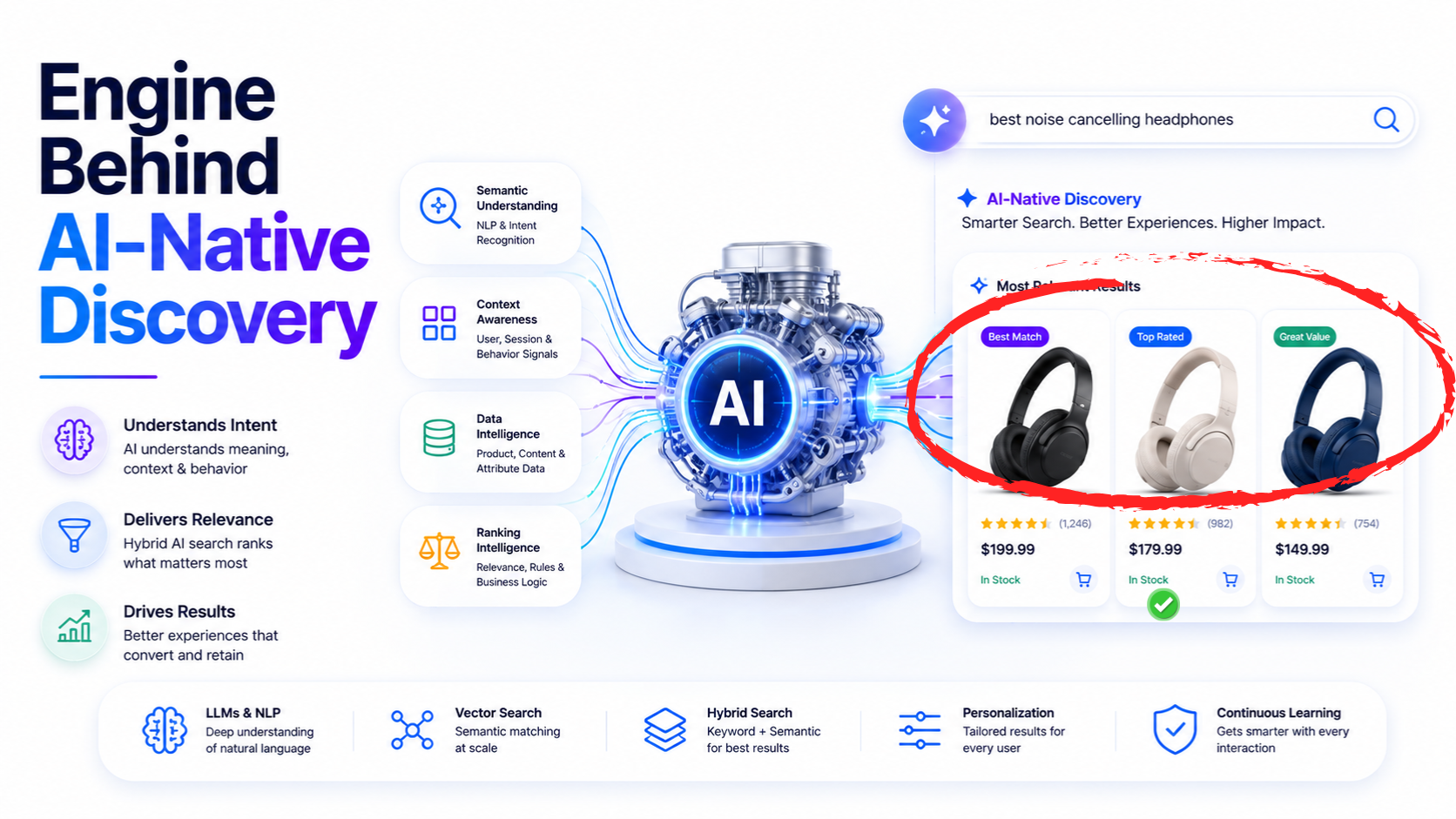
Vector Search vs. Keyword Search
| Aspect | Keyword search | Similarity search |
|---|---|---|
| Matches on | Literal words and their variants | Meaning, encoded as embeddings |
| Handles synonyms | Only with manual mappings | Natively — “couch” and “sofa” sit close together |
| Descriptive queries | Often fail (“warm jacket that packs small”) | Core strength |
| Exact identifiers | Core strength (SKUs, model numbers) | Weaker — approximate by nature |
| Explainability | Easy — the words matched | Harder — similarity is learned |
| Best deployment | Together, as hybrid retrieval — covered below | |
AI Search Grader by bCloud AI
Grade your ecommerce search in 10 quick questions
31% of ecommerce searches return zero results — and most shoppers who hit a dead end leave for a competitor. How does your store's search stack up?
Answer 10 short questions and get your AI search score, plus a personalized report to fix the gaps. Free, takes about 2 minutes.
No signup needed to take the quiz.
Understanding intent…
Scoring your answers across relevance, AI, experience, and insights.
Your AI search score is ready
Tell us where to send your personalized report. You'll see your score and recommendations right away.
Your score by pillar
Personalized recommendations
Fix the gaps in weeks, not quarters
bCloud AI replaces keyword-only search with hybrid AI retrieval — sub-200ms responses, 99.99% uptime, and conversion lifts of up to 40% across 50+ implementations.
How Does Vector Search Work?
Under the hood, every vector retrieval system runs the same five-stage pipeline.
1. Embedding the Content
An embedding model (a neural network trained on huge amounts of text, images, or both) converts each item into a vector — typically 384 to 3,072 dimensions. Rich inputs make rich embeddings, which is why catalog enrichment directly improves retrieval quality: the model can only encode meaning that’s present in the data.
2. Indexing the Vectors
Millions of vectors get organized into a specialized index structure built for fast similarity lookups. Index choice is the biggest performance lever in the whole system — enough that it gets its own section below.
3. Embedding the Query
At search time, the shopper’s query — text, a photo, a voice transcription — passes through the same embedding model, landing in the same space as the catalog. Query-side processing like rewriting and intent extraction (see search query optimization) happens here too.
4. Approximate Nearest-Neighbor Search
The engine finds the vectors closest to the query vector, scored by cosine similarity or dot product. At scale, comparing against every item is too slow, so production systems use approximate nearest-neighbor (ANN) algorithms that trade a sliver of precision for orders-of-magnitude speed.
5. Ranking and Blending
Raw similarity is a starting point, not a results page. Production systems blend vector scores with keyword signals, popularity, availability, personalization, and business rules — the full pipeline our ecommerce search algorithm guide walks through end to end.
How Vector Search Improves Ecommerce Product Discovery
Vector search improves ecommerce product discovery by allowing shoppers to search naturally instead of relying on exact product terminology. A query such as “a lightweight jacket for cold morning runs” can match relevant products even when those exact words are not present in the catalog. By converting queries and product content into embeddings, semantic retrieval connects related concepts, synonyms, and shopping intent across large catalogs. When combined with keyword matching, filters, personalization, merchandising rules, and real-time inventory, vector search helps retailers deliver more relevant results, reduce zero-result searches, and create a more effective path from product discovery to purchase.
How Indexing Affects Vector Search Performance
Indexing is where similarity search gets fast — or doesn’t. A brute-force (“flat”) scan compares the query against every vector: perfectly accurate, and far too slow beyond small catalogs. ANN indexes solve this, each with distinct trade-offs.
HNSW: Graph-Based Speed
Hierarchical Navigable Small World graphs — introduced in the Malkov & Yashunin paper — connect vectors in navigable layers, so a query hops from a rough region to exact neighbors in milliseconds. HNSW dominates production deployments for its excellent recall-latency balance, at the cost of higher memory use and slower index builds.
IVF: Cluster-Based Partitioning
Inverted-file indexes cluster the space into cells and search only the most promising ones. Faster to build and lighter on memory than graphs, with recall that depends on how many cells you probe — a direct speed-versus-accuracy dial.
Quantization: Compressing for Scale
Product quantization and its variants compress vectors so far more fit in memory, trading fine-grained precision for capacity and cost. Large deployments usually combine approaches — IVF partitioning plus quantized vectors, or HNSW over compressed representations.
The practical takeaways: index choice sets your recall/latency/memory triangle — you pick which two to favor. Filtered queries (“similar items, but in stock and under $50”) interact badly with naive ANN indexes and need engines designed for filtered vector retrieval. And index freshness matters in commerce, where prices and stock change constantly — an index that’s fast but stale returns confidently wrong results. This is precisely the engineering a managed platform absorbs so retail teams don’t tune graph parameters by hand.
What Software Provides Fast Vector Search?
The market splits into two categories, and choosing between them is the real decision.
Commerce Discovery Platforms (Vector Search Built In)
bCloud AI’s NeuralSearch delivers hybrid vector + keyword retrieval purpose-built for ecommerce — embeddings, ANN indexing, filtering, real-time updates, and merchandising handled as one managed system with sub-200ms responses. For retail teams, this category turns similarity search from an infrastructure project into a deployed capability; our 2026 platform comparison covers the field.
Vector Databases and Engines (Build-It-Yourself Infrastructure)
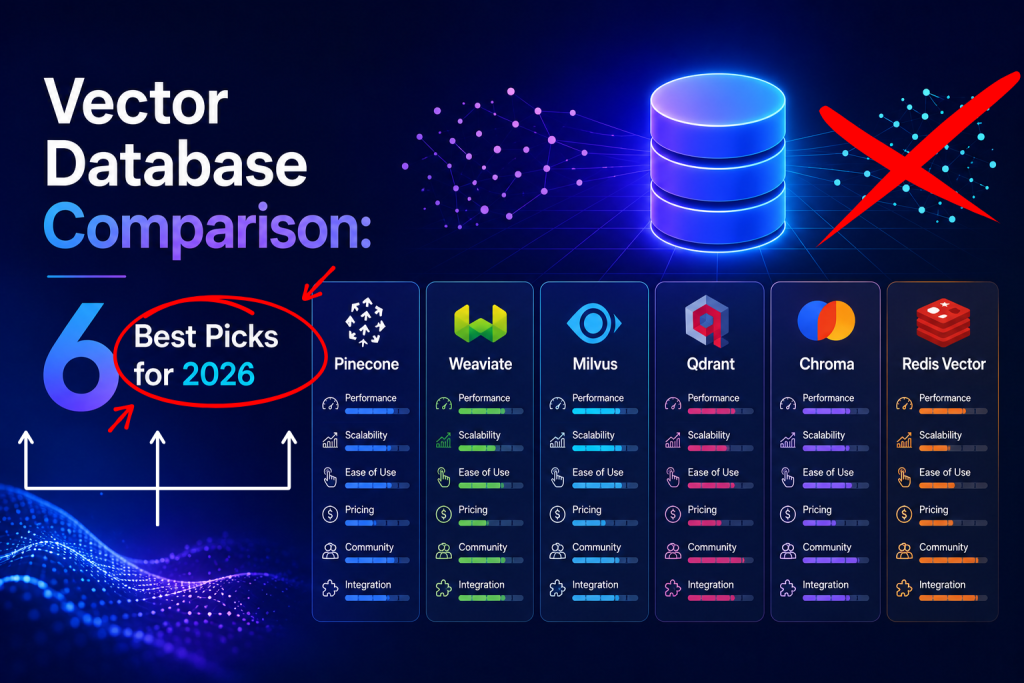
Pinecone (managed vector database), Weaviate and Qdrant (open-source engines with strong filtering), Milvus (open-source at massive scale), Elasticsearch/OpenSearch (vector support added to established keyword engines), pgvector (Postgres extension for existing stacks), and FAISS (Meta’s foundational similarity-search library) all provide fast vector search as components. They’re excellent infrastructure — and they come with the embedding pipelines, relevance tuning, freshness handling, and commerce logic left for your engineering team to build and operate.
The honest guidance: if search is your product, or you have a platform team that wants full control, the infrastructure route is legitimate. If search serves your store, a commerce-native platform gets you the same underlying technology with the retail layer already engineered.
Why Vector Search Matters for Ecommerce
Vector retrieval is the enabling technology behind the discovery upgrades this whole resource hub covers. It’s why descriptive and long-tail queries finally convert, why zero-results rates collapse (meaning-matches exist even when word-matches don’t), how visual search works at all (image embeddings in the same space as products), and what grounds a conversational search engine in your real catalog. It also powers recommendations (“nearest neighbors to what you loved”) and similar-item discovery. One technology, most of the modern discovery feature list — which is why platform evaluations should probe the vector foundation first and the feature checkboxes second.
Hybrid Search: Why Vectors Alone Aren’t Enough
Pure similarity search has real weaknesses in commerce: exact identifiers (“SKU-4417B”), precise model numbers, and brand-exact queries want literal matching, not approximate similarity. That’s why production systems run hybrid retrieval — vector and keyword scoring fused per query, weighted by user intent: semantic breadth for “cozy reading chair,” exact precision for a part number. Hybrid is the architecture behind every credible AI search platform, and the strategic context for it — semantic search, AI ranking, and where ecommerce discovery is heading — lives in our pillar AI ecommerce search guide.
Common Vector Search Misconceptions
A few corrections worth making. Vector retrieval doesn’t replace keyword search — hybrid systems beat either alone, consistently. It isn’t “just for text” — embeddings unify text, images, and audio in one space, which is the whole multimodal story. Bigger embedding models aren’t automatically better — domain fit and data quality dominate raw model size in commerce. ANN’s “approximate” isn’t a defect — at production recall levels the accuracy loss is negligible while the speed gain is the difference between usable and not. And adopting similarity search isn’t inherently a database migration project — for most retailers it arrives inside a discovery platform, not as new infrastructure to run.
How bCloud AI Puts Vector Search to Work
bCloud AI runs vector retrieval as the semantic half of NeuralSearch’s hybrid engine: commerce-tuned embeddings over an enriched catalog, ANN indexing engineered for filtered, real-time retail queries, and fusion with keyword precision, intent signals, and personalization — all at sub-200ms and refreshed as your catalog changes. The same vector foundation powers visual search, conversational discovery, and recommendations, so one investment carries every AI discovery surface. See it against the alternatives in the best ecommerce search engines for 2026.
When Should You Use Vector Search?
Vector search delivers the greatest value when users describe what they want instead of searching with exact keywords. If your search experience needs to understand meaning, context, or intent, vector retrieval becomes an essential part of the search pipeline.
Natural Language Queries
Customers search with phrases like “comfortable chair for long office hours” instead of exact product names. Vector search understands the intent behind these descriptive queries.
Large Product Catalogs
As catalogs grow, relying only on keyword matching becomes less effective. Vector search helps shoppers discover relevant products across thousands or even millions of items.
Multimodal Search
Whether users upload an image, speak a query, or type text, vector search enables all these inputs to retrieve products based on semantic similarity.
Recommendations & Similar Products
Vector similarity makes it easy to recommend related products, “customers also viewed” items, and visually similar alternatives that improve product discovery.
Best practice: Vector search performs best as part of a hybrid search architecture, where semantic understanding is combined with keyword matching, business rules, and personalization to deliver accurate and commercially relevant search results.
Frequently Asked Questions About Vector Search
What is vector search in simple terms?
Vector search finds results by meaning instead of matching words. Content and queries are converted into numerical vectors (embeddings) where similar meanings sit close together, so answering a search becomes finding the nearest vectors — which is why descriptive queries work even without shared keywords.
What is a vector search vs. a keyword search?
A keyword search matches the literal words in a query against documents. A vector search measures similarity of meaning in embedding space — handling synonyms, descriptions, and natural phrasing natively, while keyword search stays stronger for exact identifiers. Production systems combine both.
How does vector search work?
Five stages: an embedding model converts catalog items into vectors; the vectors are organized in an ANN index; the query is embedded into the same space; the engine finds the nearest neighbors by similarity; and results are blended with keyword, business, and personalization signals before display.
What is a vector embedding?
An embedding is a list of numbers — typically hundreds to thousands of dimensions — produced by a neural network to represent what a piece of content means. Similar content produces nearby embeddings, which is the property that makes similarity search possible.
What software provides fast vector search?
Commerce platforms with vector search built in (bCloud AI’s NeuralSearch) deliver it as a managed capability, while vector databases and engines — Pinecone, Weaviate, Qdrant, Milvus, Elasticsearch/OpenSearch, pgvector, FAISS — provide fast vector search as infrastructure you assemble and operate yourself.
How does indexing affect vector search performance?
Indexing determines the recall-latency-memory trade-off. Flat scans are exact but slow; HNSW graphs give millisecond queries with high recall at higher memory cost; IVF partitioning is lighter with tunable accuracy; quantization compresses vectors for scale. Filtered queries and index freshness need purpose-built handling in commerce.
Is vector search the same as semantic search?
Nearly — vector search is the retrieval mechanism, and semantic search is the capability it delivers. In practice “semantic search” usually means vector retrieval plus the query understanding and ranking around it.
Do I need a vector database for ecommerce search?
Usually not as a separate purchase. Retailers typically get vector search inside an AI discovery platform, which includes the embedding pipelines, filtering, freshness, and merchandising a raw database leaves to your engineers. Standalone vector databases fit teams building custom search products.
Put Meaning-Based Search on Your Catalog
See hybrid vector + keyword retrieval answer your shoppers’ real queries. Start for free or book a demo — live in about four weeks.