
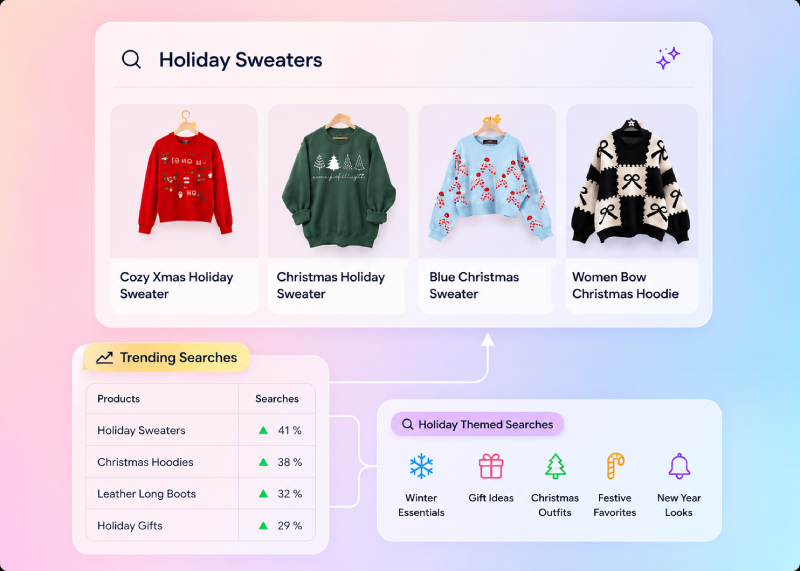

What Is an Ecommerce Search Algorithm?
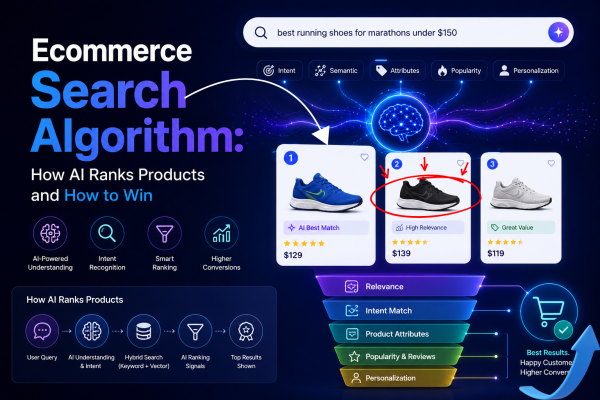
How a Modern Ecommerce Search Algorithm Works
Behind the search box, a modern algorithm runs four stages in a fraction of a second.
Understand the Query
First, the algorithm parses the query, corrects typos, expands synonyms, and interprets natural language and intent — so “warm waterproof jacket for hiking” is understood as a need, not three keywords.
Retrieve Candidates
Next, it retrieves every product that could match, using both keyword (lexical) matching and semantic vector search that finds products with similar meaning, even when they share no keywords.
Score and Rank
Then it scores each candidate against dozens of signals and ranks them — blending textual relevance, semantic similarity, behavior, and business rules into a single ordered list.
Personalize
Finally, it adjusts the ranking for the individual shopper based on their behavior and context, so two people who type the same query see results tuned to each of them.
AI Search Grader by bCloud AI
Grade your ecommerce search in 10 quick questions
31% of ecommerce searches return zero results — and most shoppers who hit a dead end leave for a competitor. How does your store's search stack up?
Answer 10 short questions and get your AI search score, plus a personalized report to fix the gaps. Free, takes about 2 minutes.
No signup needed to take the quiz.
Understanding intent…
Scoring your answers across relevance, AI, experience, and insights.
Your AI search score is ready
Tell us where to send your personalized report. You'll see your score and recommendations right away.
Your score by pillar
Personalized recommendations
Fix the gaps in weeks, not quarters
bCloud AI replaces keyword-only search with hybrid AI retrieval — sub-200ms responses, 99.99% uptime, and conversion lifts of up to 40% across 50+ implementations.
Key Ranking Signals in a Modern Ecommerce Search Algorithm
A modern algorithm weighs many signals at once. The most important fall into six groups.
| Signal | What it measures |
|---|---|
| Textual relevance | Keyword and phrase overlap (BM25) — exact and near-exact matches |
| Semantic similarity | Meaning match via vector embeddings, even without shared words |
| Behavioral signals | Historical click-through, add-to-cart, and conversion rates |
| Personalization | The individual shopper’s history, preferences, and context |
| Business rules | Margin, stock levels, merchandising, and campaign priorities |
| Quality & recency | Review quality, image quality, popularity, and freshness |
The art of a great algorithm is balancing these signals so relevance and business goals reinforce each other. Our pillar AI e-commerce search guide explains the semantic and vector foundations in depth.
Keyword vs. Semantic vs. Hybrid Algorithms
There are three broad approaches. A keyword algorithm matches literal text — fast and precise for exact terms, but blind to meaning, so it fails on synonyms and natural language. A semantic algorithm matches meaning via vectors — excellent for intent and natural phrasing, but it can occasionally miss exact identifiers like SKUs. A hybrid ecommerce search algorithm blends both, combining keyword precision with semantic understanding, and is the approach used by virtually every leading platform because it delivers the best of both. Layer machine-learning re-ranking on top, and the algorithm keeps improving on its own.
7 Proven Ways to Optimize Your Ecommerce Search Algorithm
You do not control every line of a vendor’s algorithm, but these seven moves measurably improve the results yours produces.
Feed It Clean, Rich Data
The algorithm can only rank what it can read. Around 20–30% of catalogs have weak titles or missing attributes, so search enrichment is the single highest-leverage optimization — better data lifts relevance more than any tuning.
Manage Synonyms and Terminology
Map the many ways shoppers refer to your products so the algorithm connects “couch” and “sofa,” brand variants, and industry terms automatically.
Tune the Signal Weights
Adjust how heavily the algorithm weighs semantic similarity, behavior, margin, and stock to match your business goals — without breaking relevance.
Use Behavioral and Personalization Signals
Let the algorithm learn from clicks and conversions and apply personalization, so rankings improve continuously and adapt to each shopper.
Fix the Zero-Results Path
Configure the algorithm to interpret intent and surface related products instead of an empty page, recovering near-miss searches that would otherwise bounce.
Apply Smart Merchandising Rules
Boost high-margin or in-stock items and pin campaign products — ideally with no-code rules layered on top of relevance rather than overriding it.
Measure and A/B Test
Treat the algorithm as a living system: watch search-to-conversion and zero-results rates, and A/B test ranking configurations to keep improving.
How AI Has Changed the Ecommerce Search Algorithm
For years, ecommerce search algorithms were essentially keyword matchers with manual rules bolted on, which is why industry conversion rates stayed stuck at 2–3%. AI changed the foundation. Large language models let the algorithm understand meaning and natural language. Vector embeddings let it match concepts, not just characters. And learning-to-rank models let it improve automatically from real shopper behavior instead of endless manual tuning. The result is an algorithm that understands intent, personalizes results, and gets smarter over time — a categorical leap from the static systems of a few years ago. To compare modern platforms built on this approach, see our roundup of the best ecommerce search engines for 2026.
Common Ecommerce Search Algorithm Mistakes
A few mistakes quietly cap performance: relying on keyword-only matching that cannot handle real shopper language, feeding the algorithm thin or inconsistent product data, over-tuning manual rules until relevance breaks, ignoring behavioral signals that would let it self-improve, and never measuring zero-results or search conversion. Each one leaves relevance — and revenue — on the table. The fix is almost always a combination of cleaner data and a modern hybrid, learning algorithm rather than more manual rules.
How to Measure Your Search Algorithm’s Performance
You cannot improve a ranking system you do not measure. Track the metrics that reveal how well the algorithm is doing its job: search conversion rate (how often searchers buy), zero-results rate (queries returning nothing), click-through depth (how far down results shoppers click — deep clicks suggest weak ranking), result relevance from manual spot-checks of top queries, and search exit rate. Watching these weekly turns abstract “relevance” into a concrete scoreboard. A high zero-results rate points to data or synonym gaps; deep average click positions suggest the ranking model needs better signals; a low search conversion rate flags poor relevance overall. Each metric maps to a specific lever you can pull, so measurement is what makes optimization systematic rather than guesswork.
How Search Ranking Shapes the Ecommerce Experience
The quality of an ecommerce search algorithm directly shapes how confidently shoppers move through a store. When the most relevant products appear first, shoppers spend less time refining queries, comparing irrelevant options, or searching through multiple pages. A strong ranking system can understand natural language, connect related product concepts, and use behavioral signals to surface products that are more likely to match each shopper’s needs. When this relevance is combined with accurate product data, personalization, and sensible merchandising rules, search becomes more than a navigation tool — it becomes a guided discovery experience that helps shoppers find suitable products faster and increases the opportunity for conversion.
Which Businesses Gain Most From a Better Algorithm
Every store benefits, but the upside is largest where catalogs are big, varied, or described inconsistently. Fashion and home retailers, whose shoppers search by style and vibe, gain enormously from semantic ranking. Electronics and B2B catalogs, full of specs and part numbers, need hybrid precision. Grocery and marketplace stores, with vast and fast-changing inventories, depend on a system that scales. And any high-traffic store sees outsized returns, because even a small lift in search conversion compounds across millions of queries. The common thread: the larger the gap between how shoppers describe products and how your catalog names them, the more a modern, meaning-aware approach recovers in sales that keyword matching would have lost.
You Don’t Have to Build It Yourself
Building a ranking engine in-house means owning vector infrastructure, relevance tuning, and constant retraining — a major commitment few teams can sustain. A hosted, AI-native platform delivers a proven hybrid approach, machine-learning re-ranking, and personalization out of the box, so you get state-of-the-art relevance without staffing a search-engineering team. For most retailers that is faster, cheaper over time, and lower risk than reinventing it from scratch.
Relevance Builds Trust
Ranking quality is not only a conversion lever; it is a trust signal. When the first few results consistently match what shoppers meant, they learn to rely on your search and explore more of your catalog. When irrelevant products surface, confidence erodes and shoppers either narrow their behavior or leave for a marketplace. A strong system compounds in both directions, so the gains from getting it right extend well beyond any single session.
How bCloud AI’s Ecommerce Search Algorithm Works
bCloud AI runs a hybrid, AI-native ecommerce search algorithm engineered for both relevance and speed. In under 200 milliseconds, it performs semantic vector search across 1536-dimensional embeddings to find products by meaning, runs a BM25 keyword pass for exact and near-exact matches, then re-ranks candidates with a machine-learning model that weighs 47 signals — historical click-through, conversion rate, profit margin, inventory levels, review quality, and image quality among them — before applying real-time AI ranking and personalization. The blend (roughly 60% semantic, 40% keyword) is tunable, fully transparent, and improves continuously as it learns. It is the difference between an algorithm that guesses and one that understands. Explore the underlying product search engine or how filters sit on top of it.
Traditional vs. AI-Powered Ecommerce Search Algorithms
Not all ecommerce search algorithms are created equal. Traditional search engines depend mainly on keyword matching and manually configured rules, while AI-powered algorithms understand shopper intent, learn from behavior, and continuously improve ranking quality. The difference becomes especially noticeable in large catalogs where shoppers use natural language instead of exact product names.
Key takeaway: Traditional algorithms are effective for exact keyword searches, but they struggle when shoppers use conversational language or incomplete product descriptions. AI-powered ecommerce search algorithms combine keyword relevance, semantic understanding, behavioral learning, and personalization to consistently surface the products shoppers are most likely to purchase.
Frequently Asked Questions About the Ecommerce Search Algorithm
What is an ecommerce search algorithm?
An ecommerce search algorithm is the set of rules and models a search engine uses to interpret a shopper’s query, find matching products, and rank them by relevance. Modern AI-powered algorithms combine keyword matching, semantic understanding, behavioral learning, and personalization to rank by intent rather than literal keywords.
How does an ecommerce search algorithm work?
It runs four stages in a fraction of a second: it understands the query (typos, synonyms, intent), retrieves candidate products using keyword and semantic vector search, scores and ranks them against many signals, and personalizes the order for the individual shopper.
What signals does an ecommerce search algorithm use to rank products?
Key signals include textual relevance (BM25 keyword matching), semantic similarity (vector embeddings), behavioral data (click-through and conversion), personalization, business rules (margin, stock, merchandising), and quality signals like reviews and images.
What is the difference between keyword and semantic search algorithms?
A keyword algorithm matches literal text and is precise for exact terms but blind to meaning. A semantic algorithm matches meaning via vectors and handles synonyms and natural language. A hybrid algorithm blends both for the best relevance.
How can I improve my ecommerce search algorithm?
Feed it clean, enriched product data, manage synonyms, tune signal weights to your goals, use behavioral and personalization signals, fix the zero-results path, apply smart merchandising rules, and continuously measure and A/B test.
How has AI changed ecommerce search algorithms?
AI added large language models for meaning, vector embeddings for concept matching, and learning-to-rank models that improve automatically from behavior — replacing static keyword matching and manual rules with algorithms that understand intent and get smarter over time.
Does an ecommerce search algorithm personalize results?
Yes. Modern algorithms adjust rankings for each shopper based on their behavior, preferences, and context, so two people searching the same term can see results tuned to each of them.
What is the best ecommerce search algorithm?
The best ecommerce search algorithm is a hybrid that blends keyword precision (BM25) with semantic vector search, adds machine-learning re-ranking and personalization, and stays transparent and tunable. Leading platforms include bCloud AI, Algolia, and Coveo.
Put a Smarter Search Algorithm to Work
A modern ecommerce search algorithm is the fastest way to turn the same traffic into more sales. Start for free or book a demo to see hybrid, AI-powered ranking on your catalog.