


What Is Search Query Optimization?
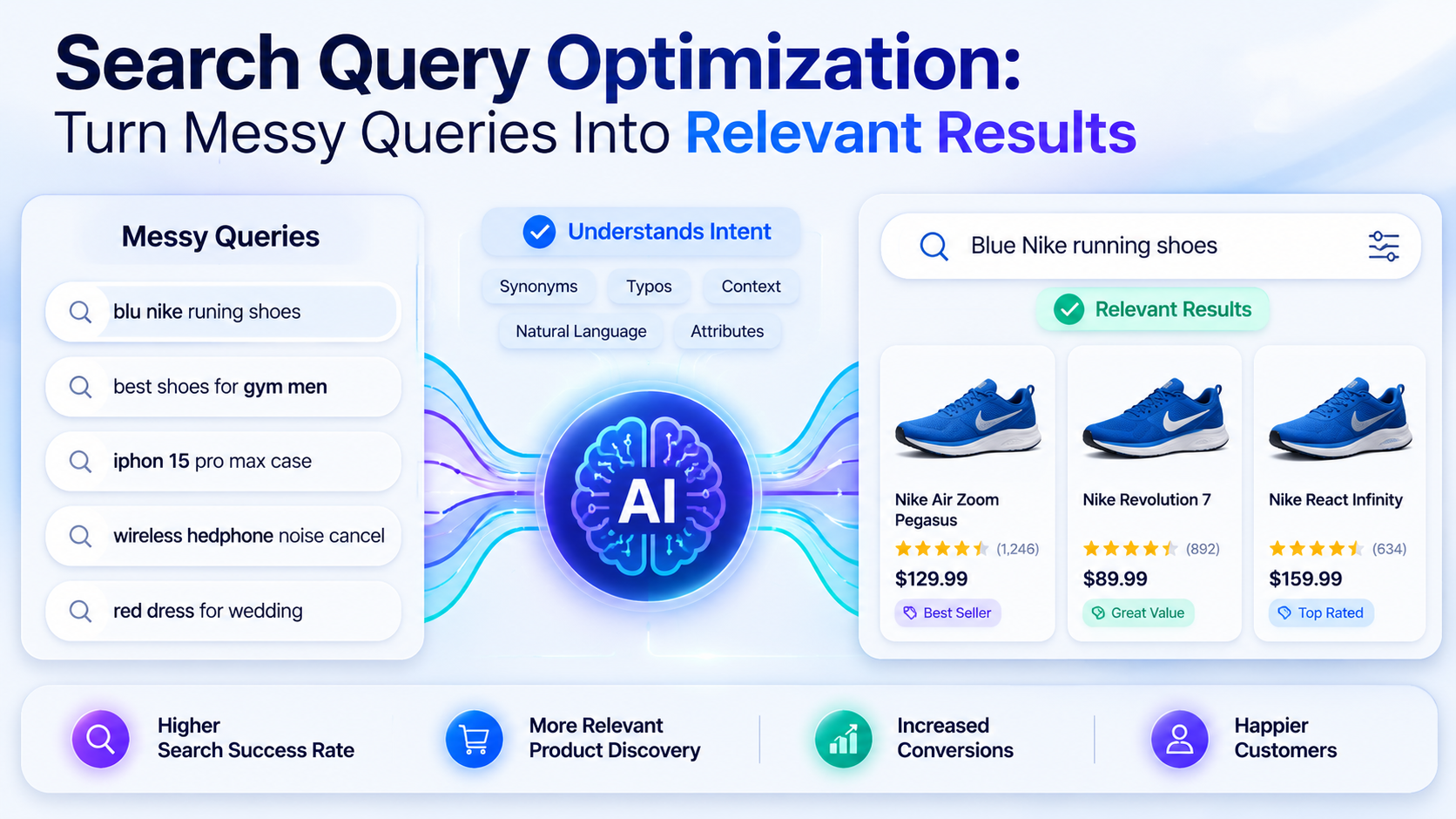
Why Search Query Optimization Matters
Every failed interpretation is a failed sale. Real shopper queries are short, messy, and human — typos on mobile keyboards, brand names spelled from memory, descriptive phrases that share no words with product titles. Without query optimization, those searches return zero results or irrelevant matches, and the shopper leaves at the exact moment of highest intent. The revenue math is direct: query-level fixes lift entire classes of searches at once, because one synonym mapping or one relaxation rule recovers every future query with the same shape. That’s why search query optimization consistently delivers some of the fastest relevance ROI available — it fixes the input problem that caps everything downstream.
AI Search Grader by bCloud AI
Grade your ecommerce search in 10 quick questions
31% of ecommerce searches return zero results — and most shoppers who hit a dead end leave for a competitor. How does your store's search stack up?
Answer 10 short questions and get your AI search score, plus a personalized report to fix the gaps. Free, takes about 2 minutes.
No signup needed to take the quiz.
Understanding intent…
Scoring your answers across relevance, AI, experience, and insights.
Your AI search score is ready
Tell us where to send your personalized report. You'll see your score and recommendations right away.
Your score by pillar
Personalized recommendations
Fix the gaps in weeks, not quarters
bCloud AI replaces keyword-only search with hybrid AI retrieval — sub-200ms responses, 99.99% uptime, and conversion lifts of up to 40% across 50+ implementations.
The 9 Proven Search Query Optimization Techniques
| # | Technique | What it fixes |
|---|---|---|
| 1 | Normalization & tokenization | Case, punctuation, plurals, spacing variants |
| 2 | Spell correction & typo tolerance | Mobile-thumb misspellings |
| 3 | Synonym & terminology mapping | Shopper words vs. catalog words |
| 4 | Query expansion | Short queries missing context |
| 5 | Query relaxation | Over-specified queries returning nothing |
| 6 | Intent classification | Routing to the right result type |
| 7 | Entity & attribute extraction | Sizes, colors, brands, prices inside queries |
| 8 | AI query rewriting | Descriptive, natural-language phrasing |
| 9 | Search tuning & testing | Continuous, data-driven refinement |
Techniques 1–3: Cleaning the Query
Normalization and Tokenization
Before anything clever happens, the query gets standardized: lowercasing, punctuation handling, plural/singular stemming, and spacing variants (“t-shirt,” “tshirt,” “t shirt” should behave identically). It’s unglamorous and foundational — normalization failures cause a surprising share of missed matches.
Spell Correction and Typo Tolerance
Shoppers type imperfectly, especially on phones. Fuzzy matching and learned spell correction catch “runnig,” “backpakc,” and “meduim” automatically. Modern systems correct against your catalog’s actual vocabulary, so brand names and product terms correct properly instead of toward dictionary words.
Synonym and Terminology Mapping
Shoppers say “couch,” catalogs say “sofa”; shoppers say “hoodie,” suppliers say “hooded sweatshirt.” Synonym mapping bridges vocabulary. The strongest programs mine synonyms from behavior — queries that lead to the same clicked products — rather than hand-maintaining dictionaries alone. This is where search analytics feeds directly back into query handling.
Techniques 4–6: Interpreting the Query
Query Expansion
Short queries lack context: “jordan” could be shoes, a brand section, or a name on a jersey. Expansion adds likely terms drawn from behavior, category signals, and session context to widen recall intelligently.
Query Relaxation
The mirror technique: when an over-specified query matches nothing (“waterproof trail running shoes size 14 wide blue under $80”), relaxation progressively drops the least-important constraints instead of returning zero results — one of the highest-impact fixes for the zero-results problem.
Intent Classification
Is the shopper looking for a product, a category, a brand, an order status, or a policy page? Classifying query intent routes each search to the right result type — and it’s the query-side foundation of intent-aware search. Our deeper guide to user intent covers the concept end to end.
Techniques 7–9: The AI Layer
Entity and Attribute Extraction
“Nike running shoes size 10 under $100” contains a brand, a category, a size, and a price cap. Extraction parses those into structured filters automatically, so the query behaves like the shopper already applied the right facets. This depends on clean attribute data — which is why catalog enrichment and query optimization rise together.
AI Query Rewriting
Large language models now rewrite descriptive, natural queries into retrieval-friendly form — “something warm for hiking that packs small” becomes a semantic representation plus extracted constraints. Combined with vector retrieval, rewriting is why modern AI search handles phrasing that keyword systems never could, and it’s the same machinery underneath a conversational search engine.
Search Tuning and Testing
Search tuning is the ongoing discipline: reviewing top and failing queries weekly, adjusting mappings and rules, and A/B testing changes so improvements are proven, not assumed. Tuning turns the other eight techniques from a one-time setup into a compounding system.
A 30-Day Search Query Optimization Sprint
You don’t need a quarter to see results. Week one: pull the failing-query report and classify the top 100 failures by cause — typo, vocabulary gap, over-specification, descriptive phrasing. Week two: ship the class-level fixes those causes point to (catalog-aware spell correction, behavior-mined synonyms, relaxation rules). Week three: enable entity extraction and AI rewriting on the descriptive class, the one manual rules can’t reach. Week four: A/B where traffic allows, measure recovered revenue against the baseline, and lock in the weekly tuning rhythm. Teams running this sprint typically watch zero-results and reformulation rates fall within the first two weeks — search query optimization pays fast because it acts on searches that were already happening and already failing.
How AI Changed Search Query Optimization
A decade ago, most of this list was hand-built: manual synonym files, brittle rules, spreadsheet-driven tuning. AI changed the economics. Embedding-based retrieval matches meaning even when no mapping exists; learned spell correction adapts to your catalog automatically; synonyms emerge from behavioral data; and LLM-based rewriting handles the long tail of phrasing no rule set could enumerate. The human role shifted from writing rules to steering the system — reviewing analytics, encoding business intent, and handling the exceptions AI flags. Teams still hand-tuning everything aren’t just working harder; they’re capped at a relevance ceiling AI-native systems moved past.
Measuring Search Query Optimization
Tune with data or you’re decorating. The core scoreboard: zero-results rate (should fall as relaxation, correction, and synonyms land), reformulation rate (how often shoppers immediately re-search — a proxy for misinterpretation), click-through on first-page results, per-query conversion on your top 100 queries, and recovered-query revenue after each fix. Segment by query class — typo queries, attribute-rich queries, descriptive queries — so you can see which technique needs attention. Then run the weekly loop from our analytics guide: fix the top failures, ship, re-measure. Each cycle compounds.
Common Search Query Optimization Mistakes
The recurring failures: treating query handling as engine defaults instead of a tunable layer. Hand-maintaining giant synonym files while ignoring the behavioral data that would generate better ones. Fixing individual failed queries one by one instead of the query class they represent. Over-correcting — aggressive expansion that buries precise matches under loosely related results. Never testing, so “improvements” ship on instinct. And optimizing queries on top of dirty catalog data, where even perfect interpretation can’t match products whose attributes don’t exist. The fix is structural: AI-native handling, behavior-driven mappings, class-level fixes, and measured tuning on enriched data.
How bCloud AI Handles Search Query Optimization
bCloud AI builds the full query-optimization stack into NeuralSearch. Normalization, catalog-aware spell correction, and typo tolerance are native; synonyms learn from shopper behavior; entity and attribute extraction turns natural queries into structured filters; IntentAI classifies and interprets intent; and LLM-powered rewriting plus hybrid vector-keyword retrieval handle descriptive phrasing at sub-200ms speeds. Relaxation and graceful fallbacks keep zero-results rates low, and analytics expose every failing query class so tuning is a weekly rhythm, not an annual project. To see how the query layer fits the wider platform, start with the best ecommerce search engines for 2026 — and for background on how large-scale engines interpret queries, Google’s own How Search Works is a useful reference.
How Search Query Optimization Improves Product Discovery
Search query optimization helps ecommerce search engines understand what shoppers mean, even when their queries are incomplete, misspelled, overly descriptive, or different from the language used in product catalogs. By combining normalization, typo correction, synonyms, query expansion, intent detection, attribute extraction, and AI-powered rewriting, the search experience can connect shopper language with the most relevant products. This improves recall without sacrificing precision, reduces unnecessary reformulations and zero-result searches, and makes product discovery more efficient. When query optimization is continuously tuned using real search behavior, ecommerce teams can create a more reliable search experience that supports both shopper satisfaction and higher conversion opportunities.
Real-World Examples of Search Query Optimization
The easiest way to understand search query optimization is to see it in action. Below are common shopper searches and how a modern AI-powered search engine interprets them before retrieving results.
Key takeaway: Effective search query optimization doesn’t simply match keywords—it understands shopper intent. By combining spell correction, synonym mapping, entity extraction, semantic understanding, and AI query rewriting, modern search platforms consistently deliver relevant results even when customer queries are incomplete, misspelled, or highly descriptive.
Frequently Asked Questions About Search Query Optimization
What is search query optimization?
Search query optimization is the set of techniques that process and improve user queries before and during retrieval — spell correction, normalization, synonyms, expansion, relaxation, intent classification, entity extraction, and AI rewriting — so messy real-world searches return relevant results.
What are the main search query optimization techniques?
Nine matter most: normalization and tokenization, spell correction and typo tolerance, synonym mapping, query expansion, query relaxation, intent classification, entity and attribute extraction, AI query rewriting, and continuous search tuning with testing.
What is search tuning?
Search tuning is the ongoing discipline of refining query handling and ranking with data: reviewing top and failing queries, adjusting synonyms and rules, and A/B testing changes. It turns query optimization from a one-time setup into a continuously compounding system.
What is query relaxation?
Query relaxation progressively drops the least-important constraints from an over-specified query that matches nothing, returning close alternatives instead of a zero-results page. It’s one of the highest-impact fixes for failed searches.
What is query rewriting in AI search?
AI query rewriting uses large language models to transform natural, descriptive queries into retrieval-friendly form — extracting constraints and generating semantic representations — so phrasing like “something warm that packs small” retrieves the right products.
How does search query optimization reduce zero results?
Spell correction recovers typos, synonyms bridge vocabulary gaps, relaxation rescues over-specified queries, and semantic rewriting matches descriptive phrasing — together collapsing the failure modes that produce most zero-results pages.
How do I measure query optimization?
Track zero-results rate, reformulation rate, first-page click-through, per-query conversion on top queries, and recovered revenue after fixes — segmented by query class (typos, attribute-rich, descriptive) so you can see which technique needs work.
What’s the difference between search query optimization and site search optimization?
Query optimization is the query-side layer: interpreting and improving what shoppers type. Site search optimization is the whole improvement program — data quality, relevance, UX, speed, and the analytics loop. The first is a core workstream inside the second.
Make Every Messy Query Land
The right query layer lifts relevance across your entire search traffic at once. Start for free or book a demo to see AI query optimization on your real shopper queries.
Related resources: Site Search Optimization · Zero Results Search · User Intent · Best Ecommerce Search Engines for 2026