
What Is Ecommerce Search Enrichment?
Why Ecommerce Search Enrichment Matters
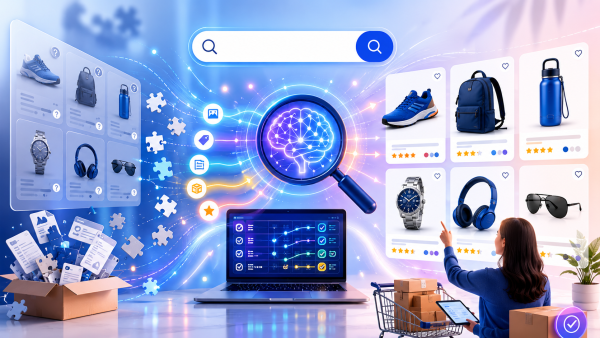
Most search relevance problems are really data problems. On the average store, 20–30% of products have missing descriptions, weak titles, or incorrect categorization — and roughly 31% of searches return zero results, often because the catalog does not contain the words a shopper used. A customer searches “wireless noise-canceling headphones” and sees nothing because your title says “Bluetooth ANC headset.” No algorithm can fix what is not in the data. That is why enrichment delivers some of the biggest, fastest gains in search: better data lifts relevance more than almost any other single change. We quantify the revenue at stake in our breakdown of why poor ecommerce search costs millions.
AI Search Grader by bCloud AI
Grade your ecommerce search in 10 quick questions
31% of ecommerce searches return zero results — and most shoppers who hit a dead end leave for a competitor. How does your store's search stack up?
Answer 10 short questions and get your AI search score, plus a personalized report to fix the gaps. Free, takes about 2 minutes.
No signup needed to take the quiz.
Understanding intent…
Scoring your answers across relevance, AI, experience, and insights.
Your AI search score is ready
Tell us where to send your personalized report. You'll see your score and recommendations right away.
Your score by pillar
Personalized recommendations
Fix the gaps in weeks, not quarters
bCloud AI replaces keyword-only search with hybrid AI retrieval — sub-200ms responses, 99.99% uptime, and conversion lifts of up to 40% across 50+ implementations.
Types of Ecommerce Search Enrichment
Enrichment covers several related improvements, each one removing a different barrier between shoppers and products.
Attribute Extraction
Pulling structured attributes — color, material, size, capacity, compatibility — out of unstructured titles and descriptions. These attributes power both relevance and faceted search filters.
Description Generation
Auto-generating clear, keyword-rich descriptions for products that have little or none, so they become searchable and compelling.
Synonym and Terminology Mapping
Mapping the many ways shoppers refer to a product — “couch” and “sofa,” “sneakers” and “trainers,” brand variants and industry terms — so searches match regardless of wording.
Categorization and Taxonomy
Correcting and standardizing categories so products live in the right place and surface in the right filters and browse paths.
Image and Visual Enrichment
Tagging and describing product images so visual attributes become searchable and support image-based discovery.
Query Enrichment
Expanding and interpreting the shopper’s query itself — adding context and related terms — so the search engine understands intent even when the wording is sparse or ambiguous.
How AI Automates Ecommerce Search Enrichment
Traditionally, enriching a catalog meant slow, manual data entry that never kept pace with new products. AI changes the economics entirely. Large language models read each product’s existing data and generate missing descriptions, extract attributes from unstructured text, normalize brand names and terminology, and infer correct categories — at the scale of an entire catalog, continuously. This is the cleanup work that dramatically improves relevance before ranking algorithms even get involved, and it is built into modern platforms rather than left as a manual chore. Our pillar AI e-commerce search guide explains how enriched data feeds semantic and vector search.
7 Benefits of Ecommerce Search Enrichment
| # | Benefit | Why it matters |
|---|---|---|
| 1 | Fewer zero-results | Adds the words and attributes shoppers actually search for |
| 2 | Higher relevance | Cleaner data improves both keyword and semantic matching |
| 3 | Better filters | Extracted attributes power complete, accurate facets |
| 4 | Higher conversions | Shoppers find the right product faster |
| 5 | Stronger SEO & AI visibility | Rich, structured data helps products surface in Google and AI Overviews |
| 6 | Less manual work | AI handles enrichment at catalog scale, continuously |
| 7 | Faster launches | New products become searchable immediately, not weeks later |
Ecommerce Search Enrichment Best Practices
A few principles make enrichment effective and sustainable. Start with an audit of your worst data — the highest-volume zero-result queries usually point straight to the gaps. Prioritize attributes that drive filtering and relevance for your category. Keep enrichment continuous, not a one-time project, so new products and seasonal lines stay searchable. Preserve a human review step for high-value products, while letting AI handle the long tail. And measure the impact: watch your zero-results rate and search conversion before and after, so enrichment stays tied to revenue. Pairing enrichment with data transformation ensures the data is both clean and correctly formatted for search.
Ecommerce Search Enrichment and Filters
Enrichment and filtering are two sides of the same coin. Filters can only be as good as the attributes behind them, so if your catalog lacks structured data, your facets will be incomplete and shoppers will hit dead ends. Attribute extraction — a core part of enrichment — is what makes dynamic, complete faceted filtering possible. Enrich the data, and both your search relevance and your filters improve at the same time, reinforcing each other across the whole discovery experience.
Where Enrichment Fits in Your Search Stack
PIM vs. Search-Native Enrichment
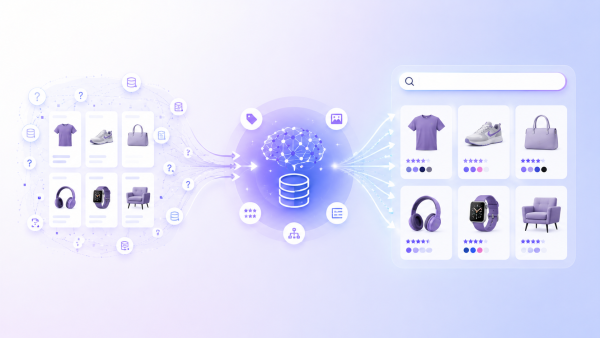
Teams often ask whether enrichment belongs in their Product Information Management (PIM) system or in the search platform. The answer is usually both, at different layers. A PIM is the system of record for canonical product data and is ideal for governance and syndication. Search-native enrichment, by contrast, optimizes that data specifically for findability — generating search-friendly descriptions, extracting the attributes that power facets, and mapping the synonyms shoppers actually use. The most effective setup keeps your PIM as the source of truth while a search-native, AI-driven enrichment layer continuously tunes the data for relevance. That avoids the trap of “clean” PIM data that still fails in search because it was never optimized for how people actually search.
Common Enrichment Mistakes to Avoid
A few mistakes limit the payoff. Treating enrichment as a one-time cleanup is the most common — new products and seasonal lines quickly reintroduce gaps, so it must be continuous. Over-automating without review on high-value or regulated products risks errors in exactly the places they matter most. Enriching everything equally wastes effort; prioritize the attributes and products tied to real search demand. And enriching data without measuring the result leaves you guessing — always tie the work back to zero-results and conversion. Done well, this is a steady, compounding investment rather than a heroic, one-time project.
Measuring Enrichment Impact
Connect enrichment to outcomes by tracking your zero-results rate, the share of products with complete attributes, search-to-conversion rate, and filter coverage (how many products can be filtered by each key attribute). Watching these before and after shows exactly which data improvements moved the needle — and keeps the work focused on the products and attributes that drive revenue rather than vanity completeness scores.
Enrichment and AI Visibility
Enrichment increasingly pays off beyond your own site. As shoppers discover products through Google AI Overviews, ChatGPT, and other assistants, the structure and richness of your product data determine whether those engines can read, trust, and recommend your catalog. Clean titles, complete attributes, and clear descriptions are exactly what both onsite search and external AI engines need. In that sense, ecommerce search enrichment does double duty: it lifts onsite relevance and improves your visibility in the AI-driven discovery channels reshaping how customers find products.
How bCloud AI Delivers Ecommerce Search Enrichment
bCloud AI builds ecommerce search enrichment directly into its platform through AI data enrichment. Its LLM-powered tools auto-generate missing descriptions, optimize titles for searchability, extract attributes from unstructured text, and normalize brand names — continuously and at catalog scale. That enriched data then feeds the hybrid semantic and keyword AI search engine and the underlying product search engine, so relevance, filters, and AI visibility all improve together. The result our customers see is consistent: the 31% of searches that once failed start converting, and product discovery gets dramatically more accurate — usually without any manual data entry.
How Search Enrichment Improves Product Discovery
Search enrichment improves product discovery by making the catalog easier for both shoppers and search systems to understand. When product titles, descriptions, attributes, categories, and terminology accurately reflect the language customers use, more searches can connect with relevant products instead of producing weak or empty results. Enriched attributes also make filters more useful, while clearer product information gives semantic and hybrid search systems more context for matching related concepts. As a result, shoppers can discover suitable products through different search styles — from exact product names to descriptive or natural-language queries — with less effort. This creates a stronger discovery experience that can reduce search friction, improve engagement, and help more shoppers move from search to purchase.
Is Your Catalog Ready for Search Enrichment?
Before investing in AI-powered search enrichment, it’s worth evaluating the quality of your existing product catalog. The following checklist highlights common indicators that your catalog could benefit from automated enrichment.
📦 Product Data
- Missing or incomplete descriptions
- Inconsistent product titles
- Duplicate product information
🏷 Attributes
- Missing color, size, or material data
- Incomplete filter attributes
- Unstructured technical specifications
🔍 Search Experience
- High zero-result searches
- Customers using unexpected search terms
- Poor search relevance for similar products
📈 Performance
- Low search conversion rates
- Poor filter usage
- Frequent manual catalog updates
Quick Tip: If your business checks several items on this list, AI-powered search enrichment can significantly improve catalog quality, search relevance, filtering accuracy, and overall product discoverability without requiring a complete catalog rebuild.
Frequently Asked Questions About Ecommerce Search Enrichment
What is ecommerce search enrichment?
Ecommerce search enrichment is the process of improving the product data that powers search — adding missing descriptions, extracting structured attributes, normalizing terminology, fixing categories, and mapping synonyms — so the search engine can match shopper intent accurately. AI-driven enrichment automates this at catalog scale.
Why is ecommerce search enrichment important?
Most relevance problems are data problems. With 20–30% of catalogs holding weak data and about 31% of searches returning zero results, enrichment adds the words and attributes shoppers search for, often delivering bigger, faster relevance gains than algorithm changes alone.
What is product data enrichment?
Product data enrichment is closely related: it is the cleaning, structuring, and enhancing of catalog data — descriptions, attributes, categories, and synonyms. In a search context, this enriched data is what lets the engine understand and match each product accurately.
What are the types of ecommerce search enrichment?
The main types are attribute extraction, description generation, synonym and terminology mapping, categorization and taxonomy correction, image and visual enrichment, and query enrichment (expanding and interpreting the shopper’s query).
How does AI automate ecommerce search enrichment?
Large language models read each product’s data to generate missing descriptions, extract attributes from unstructured text, normalize brand names, and infer correct categories — continuously and across an entire catalog, dramatically improving relevance before ranking even begins.
Does ecommerce search enrichment reduce zero-results?
Yes. Many zero-result searches happen because the catalog lacks the words a shopper used. Enrichment adds those terms and attributes, so previously empty searches start returning relevant products.
How does enrichment improve search filters?
Filters depend on structured attributes. Attribute extraction — a core part of enrichment — populates the data that powers complete, accurate, dynamic facets, so filters stop returning dead ends.
What is the best ecommerce search enrichment solution?
The best solution automates description generation, attribute extraction, and normalization with AI, keeps enrichment continuous, and feeds the result directly into search. Leading options include bCloud AI, which builds enrichment into its search platform, alongside dedicated PIM and feed tools.
Enrich Your Catalog, Transform Your Search
Ecommerce search enrichment is the fastest way to fix relevance at the source. Start for free or book a demo to see AI enrich your catalog and lift your search performance.
Related resources: Ecommerce Search Filters · Product Search Engine · Ecommerce Search Platform · AI E-Commerce Search Guide