
What is SXO?

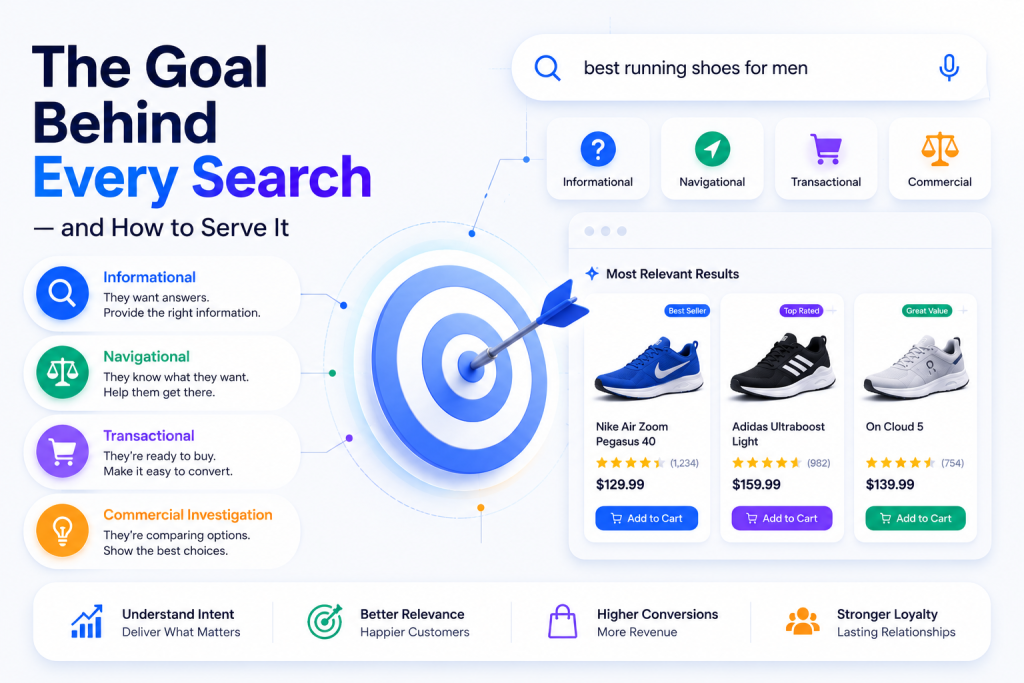
In practice, SXO covers four stages:
1. The query.
What the shopper actually asked, in their own words.
2. The result.
The title, snippet or AI answer that earned the click.
3. The landing.
Whether the page confirms the promise fast.
4. The next step.
On-site search, filters or checkout, wherever the shopper goes next.
Most teams optimize stage two and ignore the rest. SXO treats all four as one funnel.
AI Search Grader by bCloud AI
Grade your ecommerce search in 10 quick questions
31% of ecommerce searches return zero results — and most shoppers who hit a dead end leave for a competitor. How does your store's search stack up?
Answer 10 short questions and get your AI search score, plus a personalized report to fix the gaps. Free, takes about 2 minutes.
No signup needed to take the quiz.
Understanding intent…
Scoring your answers across relevance, AI, experience, and insights.
Your AI search score is ready
Tell us where to send your personalized report. You'll see your score and recommendations right away.
Your score by pillar
Personalized recommendations
Fix the gaps in weeks, not quarters
bCloud AI replaces keyword-only search with hybrid AI retrieval — sub-200ms responses, 99.99% uptime, and conversion lifts of up to 40% across 50+ implementations.
SEO vs SXO: the difference in one table
SXO does not replace SEO. Instead, it extends SEO to the part of the journey where money changes hands.
Why SXO matters more now
Three trends push SXO up the priority list.
First, AI answers change who clicks.
When an AI summary answers a simple question, the shopper may never click. The ones who do click usually want to verify, compare or buy. Therefore, the landing experience matters more per visit.
Second, Google rewards people-first pages.
Google says its ranking systems aim to surface helpful, reliable content created primarily for people, and that its core systems look to reward content with a good page experience (Google Search Central). That is, in effect, an SXO brief.
Third, on-site search has become part of the journey.
Many search visitors land on one page, then use your search box to refine. If that search fails, the SEO win turns into an SXO loss.
9 SXO best practices for ecommerce
1. Match the landing page to the query intent
A shopper searching “best trail runners for wide feet” wants a filtered set, not your homepage. Map your top queries to the page type that answers them: product, category, comparison or guide. Then make sure the right page ranks. For where category pages are heading, see will AI search replace category pages.
2. Confirm the promise in the first screen
The snippet made a promise. The first screen must keep it. Show the product, the price, the key spec or the answer right away. If the shopper has to scroll to confirm they are in the right place, many will not.
3. Treat on-site search as part of SXO
This is the practice most SEO plans skip. Yet visitors who use site search are often your highest-intent sessions. Nielsen Norman Group’s research found ecommerce search success climbing from 64 percent in 2000 to 92 percent in 2017 as sites improved algorithms and interfaces (NN/g). Today’s shoppers expect that level and more. See AI search features for high-intent shoppers.
4. Fix zero-result and zero-click searches
A zero-result page is an SXO dead end. So is a results page nobody clicks. Both are measurable, and both are usually fixable with synonyms, typo tolerance and better product data. Start with search returned no results and product data enrichment.
5. Make autocomplete and filters do real work
Autocomplete can steer a shopper to a category before they finish typing. Filters let them narrow without losing the thread. Both shorten the path to purchase, which is the core of SXO. See search autocomplete and faceted search.
6. Understand intent, not just keywords
Shoppers now type full sentences. Keyword matching struggles with them. Intent-aware retrieval turns “something warm for a toddler at a football game” into relevant products. See query understanding.
7. Keep page, feed and schema consistent
When structured data says one price and the page says another, trust drops for people and machines alike. Consistent data protects rich results and AI citations. See product schema markup.
8. Write for the answer, then for the visit
Structure key pages so an AI answer can quote them cleanly: a direct definition, clear specs and honest comparisons. Then make sure the page rewards the visitor who clicks anyway. Our guide on answer engine optimization covers the first half; SXO covers the second.
9. Test, do not guess
Every SXO change should be tested where traffic allows. Otherwise, seasonality takes the credit or the blame. See A/B testing for ecommerce search and search relevance metrics.
One query, followed end to end
An example shows how the pieces connect. Take the query “waterproof hiking boots wide fit.”
The shopper searches on Google and sees a result for your boots category. So far, so good. They click and land on a page of every boot you sell, sorted by popularity. There is no wide-fit filter, because width is not a structured field.
Next, they type “wide waterproof boots” into your search box. The engine matches “boots” and returns 140 products. Nobody clicks. A minute later, the session ends.
Every step looked fine in isolation. The ranking worked. The page loaded. The search returned results. Yet the journey failed, and no single report showed it. That gap is exactly what this discipline exists to close.
A quick audit you can run this week
You do not need new tools to start. Pull these four things and look at them side by side.
1. Your top 20 organic landing pages.
Note the query each one ranks for and its exit rate.
2. Site search usage on those pages.
Which landing pages send visitors straight to the search box? That is a sign the page did not answer the question.
3. The site search terms used after landing.
Sort by volume. Flag anything that returned nothing or got no click.
4. Revenue per landing session.
Compare pages that rank similarly but earn very differently.
Patterns appear fast. Usually, a handful of pages and a few dozen failed searches explain most of the lost revenue. Fix those first, then re-measure in a month.
Mobile is where the journey breaks first
Most search visits now start on a phone. Small screens punish every extra step.
A filter hidden behind two taps, a search box that is hard to find, or a slow results page costs more on mobile than on desktop. Therefore, run every audit above on a phone first. If the journey works there, it almost always works on desktop too.
How to measure SXO
SXO is only useful if it shows up in revenue. Track these metrics by landing page and by search session.
Then connect the numbers to money. Our AI search revenue model shows how to turn search improvements into a forecast a finance team will accept.
SXO and AI visibility
SXO now has an external half too. Assistants and AI answers increasingly decide which products a shopper sees first.
The good news is that the same work serves both. Complete product data, clear page structure and consistent schema help an assistant understand you and help a visitor trust you. For the external side, see AI visibility for ecommerce. For the shopper behavior behind it, see AI shopping decisions.
The SXO forecast: where this goes by 2027
Here is what we expect, based on the trends above.
SXO becomes the default frame.
Teams will report search revenue, not just search rankings. The SEO report and the site search report will merge into one.
On-site search joins the SEO budget.
Once teams see how many landing visitors search again, site search stops being an IT line item. It becomes part of SXO.
Fewer, better clicks.
As AI answers absorb simple questions, total organic clicks may flatten for some categories. However, the remaining visits will be worth more. SXO is how you capture that value.
For the bigger picture, read our future of ecommerce forecast.
Who should own the search journey
Ownership is usually the real blocker. The SEO team owns rankings. The UX team owns page design. Merchandising owns site search. Nobody owns the whole path.
A simple fix works well. Give one person a single shared metric, revenue per search visit, and a monthly review with all three teams in the room. When everyone looks at the same journey and the same number, the handoffs stop falling through the gaps. As a result, fixes ship faster and get measured properly.
Common SXO mistakes
Celebrating rankings while conversion falls.
A ranking that brings visitors who leave is a cost, not a win.
Ignoring site search.
It is often where the highest-intent visitors go next.
Sending every query to the homepage.
Match the page type to the intent.
Changing five things at once.
You will never know which one worked.
Treating SXO as a one-off audit.
Query patterns shift with seasons and trends. Review monthly.
The bottom line on SXO
SXO is not a new acronym for SEO. It is a different question.
SEO asks, “Did we get the click?” SXO asks, “Did the click turn into a customer?” In a market where AI answers absorb the easy questions, the second question is the one that pays. Start with your landing pages and your search log, measure revenue per search visit, and improve one step at a time.
Frequently asked questions
What is SXO?
SXO, or search experience optimization, is the practice of optimizing the whole search journey: the query, the search result, the landing page and the next step on the site. It combines SEO, user experience and conversion work so search visitors become customers.
What is the difference between SEO and SXO?
SEO focuses on rankings and clicks. SXO extends that work through the landing experience and on-site search to the conversion, and it measures success in revenue per search visit rather than position alone.
What are the most important SXO best practices for ecommerce?
Match landing pages to query intent, confirm the snippet’s promise in the first screen, fix zero-result and zero-click site searches, use autocomplete and filters well, understand natural-language intent, keep data consistent, and test changes.
Does SXO include on-site search?
Yes. Many search visitors land on a page and then use site search to refine. If that search fails, the SEO win is lost, so on-site search is a core part of SXO.
How do I measure SXO?
Track revenue per organic landing session, landing exit rate, site search usage after landing, zero-result and zero-click search rates, search exit rate and search conversion rate.
How does AI search affect SXO?
AI answers absorb many simple informational clicks, so the visitors who do arrive tend to have higher intent. That makes the landing and on-site search experience worth more per visit.
Is SXO only for large retailers?
No. Smaller stores often see faster gains because a few fixes to landing pages and site search affect a large share of their traffic.
What does Google say about page experience?
Google’s guidance on helpful, people-first content says its ranking systems aim to reward helpful, reliable content created for people and that its core systems look to reward content that provides a good page experience.
How often should we review SXO?
Monthly at minimum. Query patterns, assortment and seasonality all shift, so review landing performance and the site search log on a regular schedule.
See where your search journey leaks revenue.
bCloud AI will run your site search log against your top landing pages and show you the zero-result, zero-click and exit points that cost the most. Your data, your catalog.
bcloud.ai