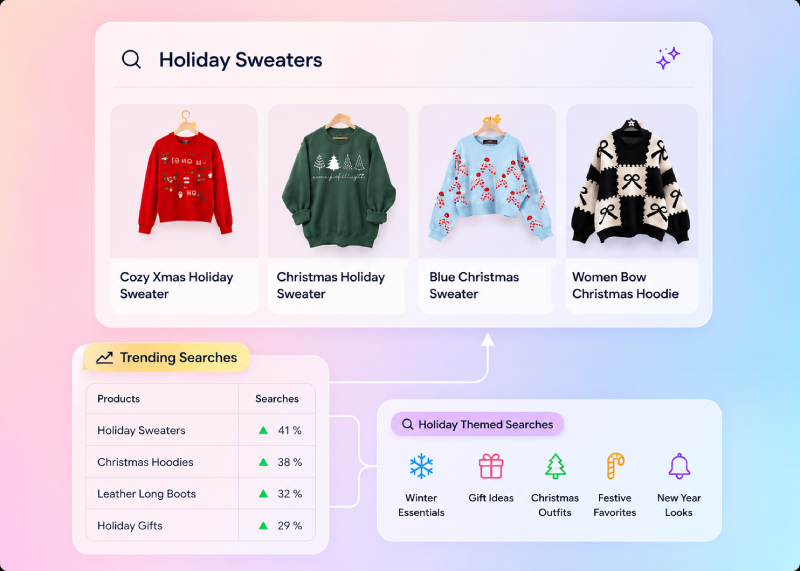

What Is an Ecommerce Search Vendor?
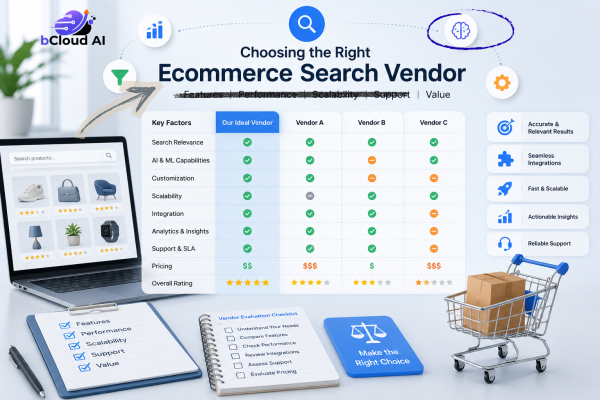
Why the Right Search Vendor Matters
Your search vendor sets the ceiling for product discovery on your store. A weak one returns zero-results on common queries, misses intent, and quietly costs sales every day. A strong one understands meaning, personalizes results, and lifts conversion across the catalog. The gap between the two often shows up in concrete revenue numbers, because shoppers who use search convert at far higher rates than those who only browse — they’re telling you what they want. Picking the right vendor is therefore less about features on a slide and more about how the platform handles your real catalog, real queries, and real shoppers.
AI Search Grader by bCloud AI
Grade your ecommerce search in 10 quick questions
31% of ecommerce searches return zero results — and most shoppers who hit a dead end leave for a competitor. How does your store's search stack up?
Answer 10 short questions and get your AI search score, plus a personalized report to fix the gaps. Free, takes about 2 minutes.
No signup needed to take the quiz.
Understanding intent…
Scoring your answers across relevance, AI, experience, and insights.
Your AI search score is ready
Tell us where to send your personalized report. You'll see your score and recommendations right away.
Your score by pillar
Personalized recommendations
Fix the gaps in weeks, not quarters
bCloud AI replaces keyword-only search with hybrid AI retrieval — sub-200ms responses, 99.99% uptime, and conversion lifts of up to 40% across 50+ implementations.
What an Ecommerce Search Provider Delivers
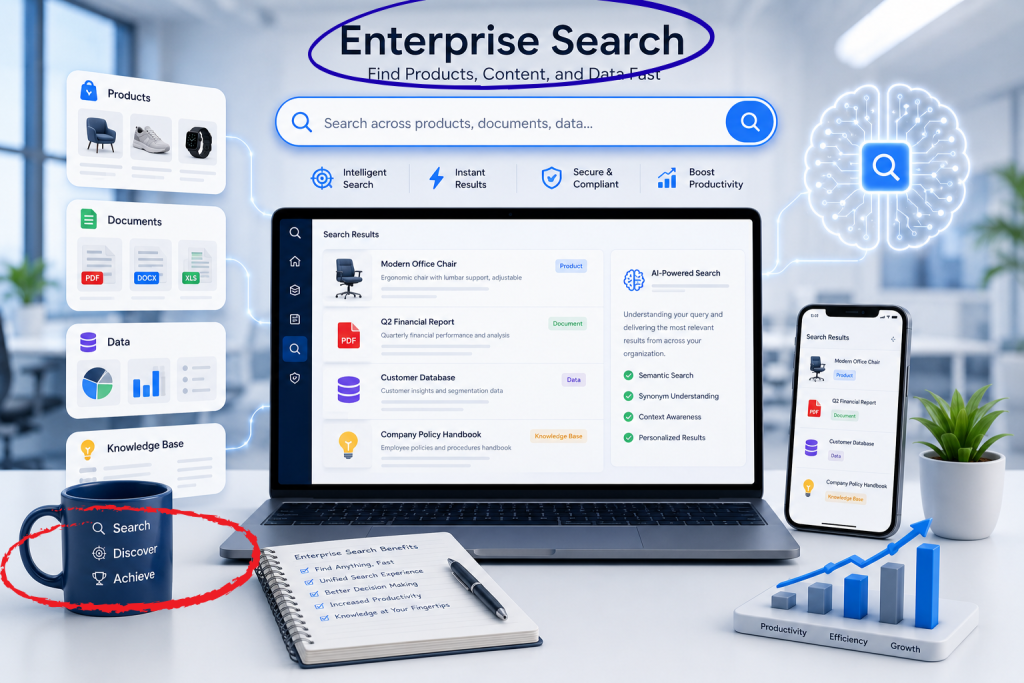
A modern search provider should bundle a complete discovery layer, not just a search box. Core capabilities include indexing your catalog, a fast search bar with autocomplete, semantic and vector search, faceted filters, personalization, merchandising controls, multilingual support, conversational and visual search modes, a developer API, analytics, and uptime guarantees. The best vendors deliver these as one connected platform rather than a patchwork of point tools, so the experience stays consistent across desktop, mobile, app, and increasingly voice and AI assistants. For the deeper technical view, see our AI e-commerce search guide.
Types of Ecommerce Search Solutions
Search solutions come in several shapes, and the right fit depends on your stack.
SaaS / Managed Platforms
Fully hosted vendors handle infrastructure and updates. Fastest to deploy, easiest to maintain — the right fit for most growing brands.
API-First and Headless
API-first vendors fit modern, headless, or composable stacks. You get full control through APIs while the vendor runs the engine.
Plugins and Apps
For Shopify, BigCommerce, Magento, and WooCommerce, vendors offer native apps and plugins that connect in hours rather than weeks.
Self-Hosted / Open Source
Elasticsearch and similar tools give engineering teams maximum control but require significant operational effort. Best for large teams with specific needs.
7 Smart Criteria for Choosing an Ecommerce Search Vendor
| # | Criterion | Why it matters |
|---|---|---|
| 1 | AI-native semantic search | Understands intent, not just keywords |
| 2 | Catalog and feature fit | Filters, personalization, merchandising for your category |
| 3 | Performance at scale | Sub-second results on your catalog and traffic |
| 4 | Integration with your stack | Shopify, BigCommerce, Magento, headless, custom |
| 5 | Transparent pricing | Predictable cost — beware per-search fees that spike on peak days |
| 6 | Implementation and support | Clear path to live, available help when you need it |
| 7 | Roadmap and AI direction | Where will the vendor be in two years on AI, visual, voice |
Questions to Ask an Ecommerce Search Provider
The best evaluations come down to a handful of pointed questions. How does your engine handle a query that doesn’t match any product titles word-for-word? How is pricing structured, and what happens on a Black Friday traffic spike? What does implementation look like for our platform, and how long does it take? Which AI capabilities are live today versus on the roadmap? What happens when our catalog data is messy — do you offer enrichment, or does that fall on us? Who actually answers when something breaks at 2 a.m.? Honest answers separate marketing decks from platforms you can build a business on.
Build vs. Buy: Why Most Retailers Pick a Vendor
Search looks deceptively simple — it’s a box that returns products — but doing it well requires an indexing pipeline, a ranking system that learns, semantic and vector capabilities, personalization, analytics, and uptime engineering. Building all of that takes years and a dedicated team, and the result still trails what specialist vendors deliver. For nearly every retailer, picking an ecommerce search vendor is faster, cheaper, and better than building. The exceptions are very large platforms with bespoke needs and deep engineering benches — and even many of those increasingly buy the AI layer rather than build it. Our ecommerce search platform guide walks through the build-versus-buy math in detail.
Common Mistakes When Picking a Search Vendor
A few mistakes recur. Choosing on a feature checklist rather than a hands-on test with your real catalog and queries. Underestimating data quality — even a great vendor needs clean product data to perform. Locking into per-search pricing that punishes growth. Skipping the implementation and support questions until after you’ve signed. And neglecting the AI roadmap, since today’s vendor decision shapes your discovery experience for years. The fix is a structured evaluation against your real shoppers, your real stack, and your real growth plan.
Measuring the Value of Your Ecommerce Search Vendor
After signing with an ecommerce search vendor, track the metrics that prove it’s working: search conversion versus non-search sessions, zero-result rate, search-led revenue share, top low-converting queries, and personalization lift across return visits. A strong ecommerce search vendor moves all of these in the right direction within the first few weeks of going live, especially zero-result rate and search conversion. If the numbers aren’t moving, that’s a signal — either implementation is incomplete, or the vendor isn’t the right fit for your catalog. Either way, the data tells you fast.
Switching Between Ecommerce Search Vendors
Switching ecommerce search vendors is more straightforward than retailers usually fear. The core steps are catalog export and re-indexing, attribute mapping, integration with your storefront, search-UI implementation, gradual traffic ramp from old to new, and analytics setup. With native integrations and platform-side data enrichment, mid-market retailers commonly go live within about four weeks. The biggest risk is data quality, since messy catalogs limit any new engine — which is why ecommerce search vendors with built-in enrichment tend to deliver faster, cleaner cutovers.
Vendor Roadmap and AI Direction
Today’s ecommerce search vendor decision shapes your discovery experience for years, so the roadmap matters as much as today’s feature list. The market is clearly moving toward conversational, visual, voice, and generative AI — which means a vendor with all of those live now is a safer long-term bet than one promising them in a future release. Ask each vendor where they’ll be in two years on multimodal search, on AI assistants like ChatGPT pulling product data, and on personalization. The answers separate AI-native platforms from those merely adding AI as a marketing layer.
How bCloud AI Stands Out as a Search Provider
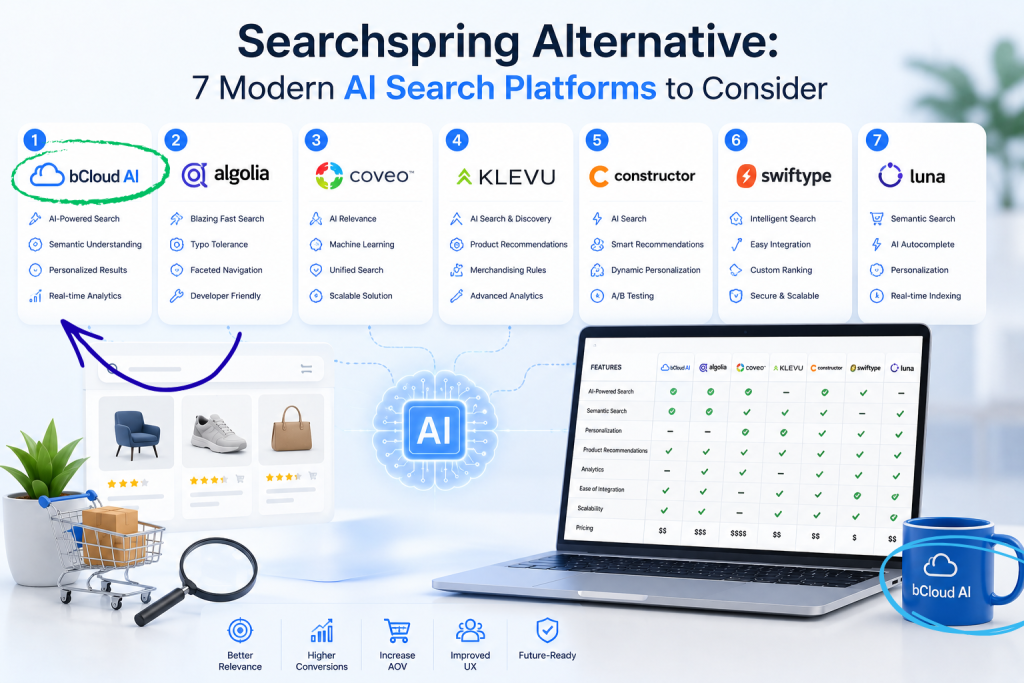
bCloud AI is an AI-native ecommerce search vendor built for what shoppers expect now. Its NeuralSearch combines vector and keyword retrieval for genuine semantic understanding; real-time personalization, AI recommendations, conversational, visual, and voice modes all share one platform; AI data enrichment cleans messy catalogs as part of onboarding; and pricing is predictable — based on catalog size, not per-search, so peak days don’t blow up your bill. Native integrations cover Shopify Plus, BigCommerce, Magento, WooCommerce, and headless stacks. To compare options head-to-head, see our roundup of the best ecommerce search engines for 2026 or the in-depth bCloud vs. 50 competitors comparison.
How an Ecommerce Search Vendor Improves Product Discovery
A strong ecommerce search vendor helps retailers turn shopper intent into faster and more relevant product discovery. Instead of relying only on exact keyword matches, modern search platforms can understand natural-language queries, synonyms, product attributes, and shopping context while combining semantic retrieval with filters, personalization, and merchandising rules. This allows shoppers to find suitable products even when their wording differs from the catalog language, reducing zero-result searches and unnecessary query reformulations. When the search experience is continuously optimized using real shopper behavior and search analytics, the right ecommerce search vendor can improve product visibility, increase search engagement, and create more opportunities to convert high-intent visitors into customers.
Which Ecommerce Search Vendor Is Right for Your Business?
The best ecommerce search vendor depends on your business stage, technical resources, and growth goals. Use this quick guide to identify the type of solution that fits your store today.
Startup Stores
Choose a managed SaaS platform with quick setup, predictable pricing, and minimal maintenance so your team can focus on growing sales instead of managing infrastructure.
Growing Brands
Look for AI-powered semantic search, personalization, merchandising controls, analytics, and native integrations with your ecommerce platform.
Enterprise Retailers
Prioritize scalability, API-first architecture, multilingual support, advanced security, and AI capabilities that can handle millions of products and global traffic.
Key takeaway: Instead of choosing the vendor with the longest feature list, select the one that aligns with your current business size while providing a clear path to support future growth.
Frequently Asked Questions About Ecommerce Search Vendors
What is an ecommerce search vendor?
An ecommerce search vendor is a third-party software provider that powers the search and product-discovery experience on online stores. Retailers connect their catalog to the vendor’s platform, which handles indexing, ranking, autocomplete, filters, personalization, and AI-powered semantic, conversational, visual, and voice search.
What does an ecommerce search provider do?
A provider delivers the full discovery layer: a search bar with autocomplete, semantic and vector search, faceted filters, personalization, merchandising controls, multilingual support, conversational and visual modes, APIs, analytics, and uptime guarantees — usually as one connected platform.
How do I choose the right ecommerce search vendor?
Evaluate on AI-native semantic search, fit for your catalog and category, performance at scale, integration with your stack, transparent pricing, implementation and support quality, and roadmap. Run a hands-on test with your real catalog and queries, not just a generic demo.
What are the types of ecommerce search solutions?
The main types are SaaS/managed platforms, API-first and headless solutions, native apps and plugins for Shopify/BigCommerce/Magento/WooCommerce, and self-hosted or open-source options like Elasticsearch. The right fit depends on your stack and engineering capacity.
Should we build search in-house or use a vendor?
Almost every retailer is better off picking a vendor. Doing search well requires indexing, learning-based ranking, semantic and vector capabilities, personalization, analytics, and uptime — which takes years and a team to build, and still trails what specialist vendors deliver.
How is ecommerce search vendor pricing structured?
Pricing models vary. Some vendors charge per search request, which can spike on high-traffic days. Others charge a predictable flat fee based on catalog size and features. Predictable pricing is generally safer for growing brands because it doesn’t punish success.
How long does it take to implement an ecommerce search platform?
It varies by vendor and stack. Native plugins for Shopify or BigCommerce can be live in hours; SaaS platforms with API integration typically take a few weeks; complex headless or custom builds can take longer. Vendors with strong onboarding and enrichment usually move fastest.
What is the best ecommerce search vendor?
The best vendor combines AI-native semantic search, real-time personalization, conversational/visual/voice modes, clean integration with your stack, and predictable pricing. Leading AI-native options include bCloud AI, whose NeuralSearch and multimodal capabilities are built for AI-driven shopping.
Pick a Search Vendor Built for AI-Driven Shopping
The right ecommerce search vendor lifts conversion every day after launch. Start for free or book a demo to see how bCloud AI compares against your current setup.