
What is AI search for ecommerce?
AI search vs. traditional keyword search
The gap between old and new search shows up directly in revenue. Here’s how they compare:
| Traditional keyword search | AI search for ecommerce | |
|---|---|---|
| How it matches | Exact words in the query vs. words in your catalog | Meaning and intent behind the query |
| Natural language | Breaks on full sentences | Built for “comfortable shoes for standing all day” |
| Typos & synonyms | Often returns zero results | “couch” finds “sofa,” “comptuer” finds laptops |
| Personalization | One result set for everyone | Adapts to each shopper’s behavior in real time |
| Zero-result searches | Common — and they send shoppers away | Rare — there’s almost always a sensible match |
| Business impact | Lost high-intent traffic | Higher conversions, AOV, and loyalty |
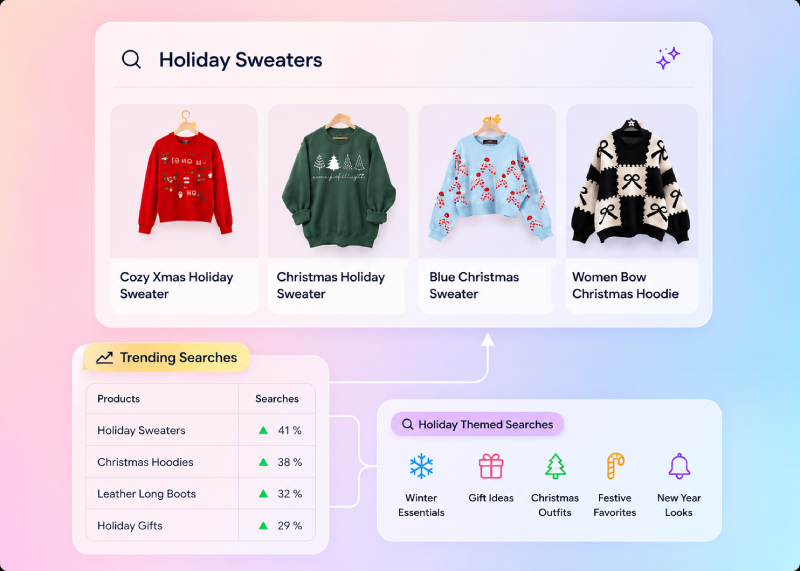
If a shopper searches “comfortable ethnic wear” but your product is titled “Cotton Kurta,” basic search finds nothing. An intelligent engine understands the relationship and surfaces the right product instantly. That’s the whole point.
Utilizing AI search for ecommerce can help bridge the gap between consumer expectations and actual search results.
AI Search Grader by bCloud AI
Grade your ecommerce search in 10 quick questions
31% of ecommerce searches return zero results — and most shoppers who hit a dead end leave for a competitor. How does your store's search stack up?
Answer 10 short questions and get your AI search score, plus a personalized report to fix the gaps. Free, takes about 2 minutes.
No signup needed to take the quiz.
Understanding intent…
Scoring your answers across relevance, AI, experience, and insights.
Your AI search score is ready
Tell us where to send your personalized report. You'll see your score and recommendations right away.
Your score by pillar
Personalized recommendations
Fix the gaps in weeks, not quarters
bCloud AI replaces keyword-only search with hybrid AI retrieval — sub-200ms responses, 99.99% uptime, and conversion lifts of up to 40% across 50+ implementations.
How AI search for ecommerce works
The technology is sophisticated, but the workflow is clear. Understanding it helps you evaluate platforms with confidence, because it tells you exactly what separates a genuine AI ecommerce search platform from a keyword box with a fresh coat of paint.
For ecommerce businesses, AI search creates a more natural product discovery experience by connecting shopper intent with products that match the meaning behind a query. Instead of relying only on exact keywords, AI-powered ecommerce search can understand natural language, synonyms, typos, product attributes, and related concepts while combining semantic understanding with keyword precision. This is especially valuable for large catalogs where shoppers may describe the same product or need in many different ways. When combined with personalization, merchandising rules, real-time catalog data, and continuous learning, AI search helps retailers deliver faster and more relevant results while reducing zero-result searches and turning high-intent traffic into more opportunities for conversion.
The business case: why AI search matters now
Site search isn’t a minor feature — it’s where your most valuable visitors raise their hand. When it delights them, you capture revenue competitors are leaving on the table. Measured in the metrics U.S. retailers actually care about, upgrading to an intelligent ecommerce search platform typically delivers:
Integrating AI search for ecommerce not only increases sales but also improves customer satisfaction.
+20–40%
Higher conversion rates
Through better relevance and intent matching.
↑ AOV
Higher average order value
As AI surfaces complementary, higher-margin products.
↓ Bounce
Lower bounce rate
Because customers find what they need and stay longer.
↓ Zero results
Fewer zero-result searches
The dead ends that quietly send shoppers to a competitor.
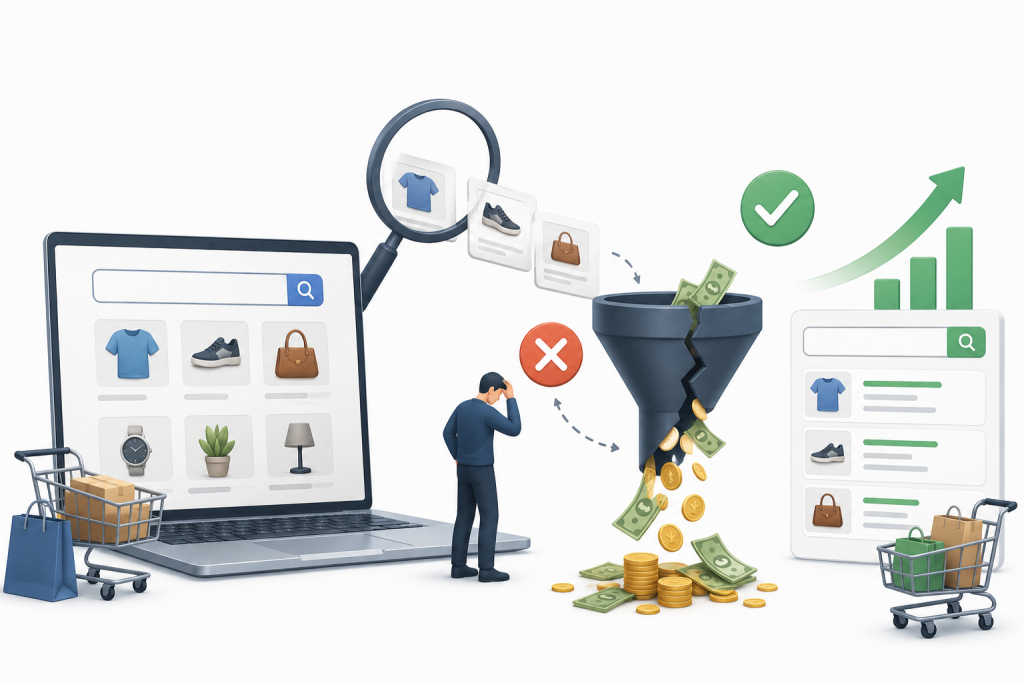
The takeaway is simple: every day your store runs on legacy keyword search, you’re paying to acquire traffic and then failing to convert it. Better search recovers that lost revenue without spending a dollar more on ads.
How to choose the best ecommerce search engine
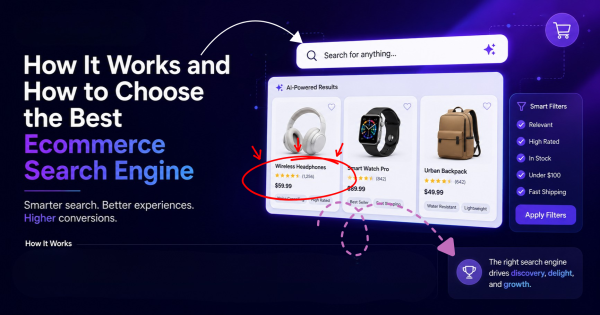
“What’s the best ecommerce search engine?” doesn’t have a single universal answer — the right ecommerce search platform depends on your catalog size, your stack, and your team. But the criteria for separating genuine intelligence from marketing are consistent. When you evaluate ecommerce search vendors, insist on these:
Choosing the right AI search for ecommerce technology is crucial for optimizing your online store’s performance.
| What to look for | Why it matters |
|---|---|
| Semantic understanding | Matches intent, not just keywords — the core capability everything else rests on |
| Conversational / natural language search | “Gift for mom who loves gardening” should return a sensible, curated set |
| Speed | Sub-200ms cached, under 400ms cold — latency directly affects conversion |
| Personalization | Results adapt to each shopper’s history and behavior in real time |
| Merchandising controls | Pin bestsellers, boost high-margin items, bury out-of-stock products on demand |
| Deep analytics | Real-time dashboards for zero-results, conversion attribution, and revenue impact |
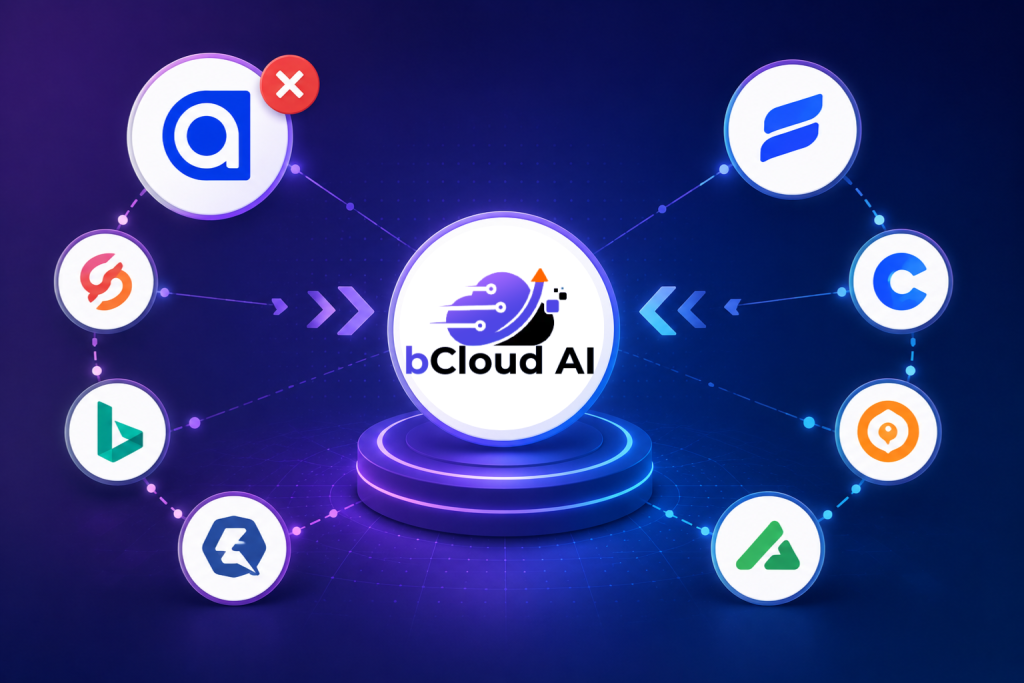
| Native integrations | Pre-built connectors for Shopify, BigCommerce, Magento, WooCommerce, plus a REST API for headless stacks |
| Enterprise security | TLS 1.3, private VPC, GDPR-compliant handling — your data stays yours |
| Reliability at scale | Proven uptime (99.99%) and the ability to handle real traffic without degrading |
A quick test for any demo: search something messy and human — a typo, a full sentence, a vibe. If the results are still relevant, you’re looking at real AI search. If they collapse, you’re looking at keyword matching with better branding.
AI search and AI visibility: two sides of the same coin
Common mistakes when evaluating ecommerce search
Where this is heading
Search is becoming the storefront’s brain — understanding intent on your site, feeding the AI engines that recommend you off it, and increasingly powering shopping agents that compare and act on a buyer’s behalf. The retailers who win are the ones whose catalog is easy for AI to understand and trust. Clean data, semantic understanding, and search that reads intent — that’s the foundation that pays off across every channel a shopper uses.
How to Prepare Your Product Catalog for AI Search
Even the most advanced AI search engine can only work with the data you provide. If your catalog is incomplete, inconsistent, or poorly structured, shoppers receive weaker search results regardless of the technology powering your store. Before investing in AI search, make sure your product data is ready for it.
Use Descriptive Product Titles
Avoid vague names. Include the product type, brand, material, color, size, and other important attributes so AI understands exactly what you’re selling.
Write Rich Product Descriptions
Describe benefits, use cases, materials, compatibility, target audience, and key features instead of relying on short marketing copy.
Standardize Product Attributes
Keep colors, sizes, brands, categories, materials, and specifications consistent across your entire catalog. Clean structured data dramatically improves AI understanding.
Continuously Refresh Your Catalog
Update pricing, inventory, product images, discontinued items, and specifications regularly. AI search performs best when your catalog reflects your actual inventory.
Why it matters: AI search doesn’t simply match words—it understands relationships between products, attributes, and shopper intent. The cleaner and richer your catalog, the more accurately AI can recommend products, reduce zero-result searches, and improve conversion rates.
Frequently asked questions
What is AI search for ecommerce?
AI search for ecommerce is site-search technology that understands the meaning and intent behind a shopper’s query rather than matching exact keywords. Using large language models and vector search, it returns relevant products even when the wording doesn’t match — for example, surfacing swimwear and sandals for “summer beach outfit.”
By leveraging AI search for ecommerce, retailers can ensure a more relevant search experience.
What is the best ecommerce search engine?
There’s no single answer — the best ecommerce search engine depends on your catalog size, tech stack, and team. The criteria that matter are consistent, though: genuine semantic understanding, natural-language and conversational search, sub-200ms speed, real-time personalization, merchandising controls, deep analytics, native integrations (Shopify, BigCommerce, Magento, WooCommerce, plus a REST API), and enterprise security. Evaluate vendors against those, and test each demo with messy, human queries. bCloud AI is built vector-first specifically for these requirements.
The best AI search for ecommerce platforms provide seamless integration with various ecommerce systems.
How is AI ecommerce search different from keyword search?
Keyword search matches the exact words in a query against your catalog and fails when they don’t line up. AI search interprets the meaning and intent behind the query, handles typos and synonyms automatically, understands full sentences, and personalizes results — so shoppers find the right product even when they don’t use your exact terms.
Investing in AI search for ecommerce technology can differentiate your store from competitors.
Does AI search work with Shopify, BigCommerce, Magento, and WooCommerce?
Yes. Leading AI ecommerce search platforms offer direct syncing for Shopify, BigCommerce, Magento, and WooCommerce, plus a REST API for headless React, Vue, or Next.js storefronts.
Will AI search slow down my website?
No. A well-built platform loads a lightweight asynchronous script and edge-caches responses, returning results in under 200ms cached — often faster than native store search.
Can AI search help my products show up in ChatGPT and Google AI?
Indirectly, yes. The clean, semantically structured catalog that powers strong on-site AI search is the same data external AI engines read when deciding what to recommend, and an on-site AI assistant reveals the real questions shoppers ask — both of which support your AI visibility.
Understanding the role of AI search for ecommerce in SEO can boost visibility and sales.