

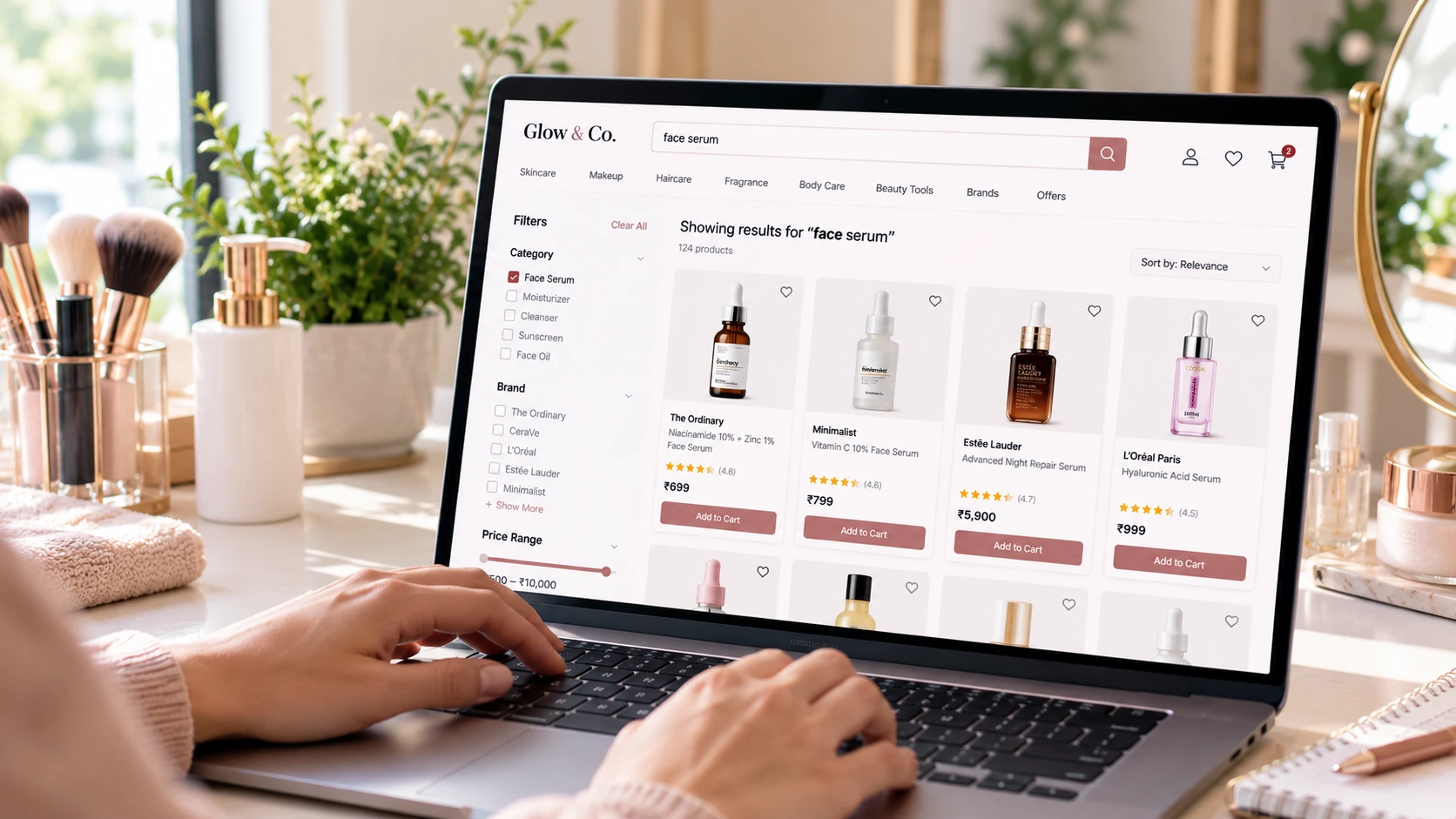
Why beauty search is different
Shades and undertones.
Foundation, concealer and lipstick come in dozens of shades, and shoppers need the right one.
Skin and hair types.
Results should change for oily, dry, sensitive, curly or color-treated needs.
Concerns, not products.
Shoppers search for “dark spots,” “redness” or “frizz” rather than a product name.
Ingredients and “free-from” needs.
Many shoppers look for specific ingredients or avoid others.
Sensory language.
Words like “dewy,” “matte,” “lightweight” and “long-wear” describe how a product feels.
Routines.
Shoppers often build a regimen, not a single purchase.
Fast trends.
Viral products and ingredients can change search behavior overnight.
AI Search Grader by bCloud AI
Grade your ecommerce search in 10 quick questions
31% of ecommerce searches return zero results — and most shoppers who hit a dead end leave for a competitor. How does your store's search stack up?
Answer 10 short questions and get your AI search score, plus a personalized report to fix the gaps. Free, takes about 2 minutes.
No signup needed to take the quiz.
Understanding intent…
Scoring your answers across relevance, AI, experience, and insights.
Your AI search score is ready
Tell us where to send your personalized report. You'll see your score and recommendations right away.
Your score by pillar
Personalized recommendations
Fix the gaps in weeks, not quarters
bCloud AI replaces keyword-only search with hybrid AI retrieval — sub-200ms responses, 99.99% uptime, and conversion lifts of up to 40% across 50+ implementations.
How beauty shoppers search
Each query type needs its own data and handling. Keyword search alone covers only a few of them.
7 proven ways to improve beauty ecommerce search
1. Make ingredients searchable
Ingredient data already exists on every product label. In the US, the FDA requires cosmetic ingredients to be declared in descending order of predominance (FDA). Index that list as structured data, so shoppers can search for ingredients they want and filter out ones they avoid.
2. Handle “free-from” queries correctly
“Fragrance-free” means the shopper wants products without fragrance. Simple keyword search may do the opposite and return products that mention fragrance. Search must understand negation and exclude the ingredient. This is one of the most common beauty search failures.
3. Map concerns to products
Build a mapping between common concerns and the products that address them: “dark spots,” “fine lines,” “redness,” “breakouts,” “frizz.” Semantic search helps, but a reviewed concern taxonomy keeps results accurate. See natural language search.
4. Support shade matching
Group shades into families and undertones, and make both filterable. Let shoppers search with their own words, such as “light warm” or “deep neutral.” Show shade swatches in results, not just on product pages.
5. Understand texture and finish language
Words like “dewy,” “matte,” “glowy” and “lightweight” carry real meaning in beauty. Tag products with finish and texture attributes, and map common synonyms, so search understands them. See query understanding.
6. Guide shoppers through routines
Many beauty shoppers want help choosing a complete routine. A short quiz, a routine builder or an AI shopping assistant can ask about skin type and goals, then recommend products in the right order. See AI shopping assistant.
7. Catch trends fast
A product or ingredient can go viral overnight. Watch your search log daily for new terms, and make sure trending names reach the right products quickly. See ecommerce search analytics.
Beauty search and accurate claims
Beauty search should reflect what products are, not marketing hopes. Keep concern mappings honest, and avoid suggesting that a cosmetic treats a medical condition.
Some products sold alongside cosmetics, such as sunscreens and some acne treatments, are regulated as drugs in the US. Make sure their attributes and claims come from approved product information. Accurate data protects shoppers and your brand.
Visual search and beauty
Some beauty shoppers start with a picture: a look from social media or a shade they saw on a friend. Visual search can help them find similar products. See visual search for ecommerce.
Pair visual search with clear shade and finish data, so image-based results stay accurate.
Product data that powers beauty search
Beauty search depends on rich, consistent product data. Key attributes include skin type, concern, shade family, undertone, finish, coverage, key ingredients, free-from claims, size and routine step.
Use consistent values across brands, so one brand’s “nude” and another’s “beige” can still be filtered together. AI enrichment can extract attributes from descriptions and images at scale, but review the output, since a wrong ingredient or free-from tag can lead to a bad reaction or a return. See ecommerce search enrichment.
Beauty search for multi-brand retailers
Multi-brand retailers face an extra challenge: every brand describes products differently. One brand’s “medium” shade may be another’s “light.”
Normalize attributes across brands into a shared vocabulary for skin type, concern, finish and shade family. Map brand-specific shade names to common families. This is what makes cross-brand filters work, so a shopper can compare options from several brands in one search. It also helps shoppers discover brands they did not know.
Reviews and ratings in beauty search
Shoppers in this category lean heavily on reviews, especially from people with similar skin or hair. Use review data to improve search where you can.
Show ratings on result cards and allow filters for highly rated products. If your reviews include skin type or concern, let shoppers filter reviews by those details. Products loved by people with similar needs are often the best results to show first.
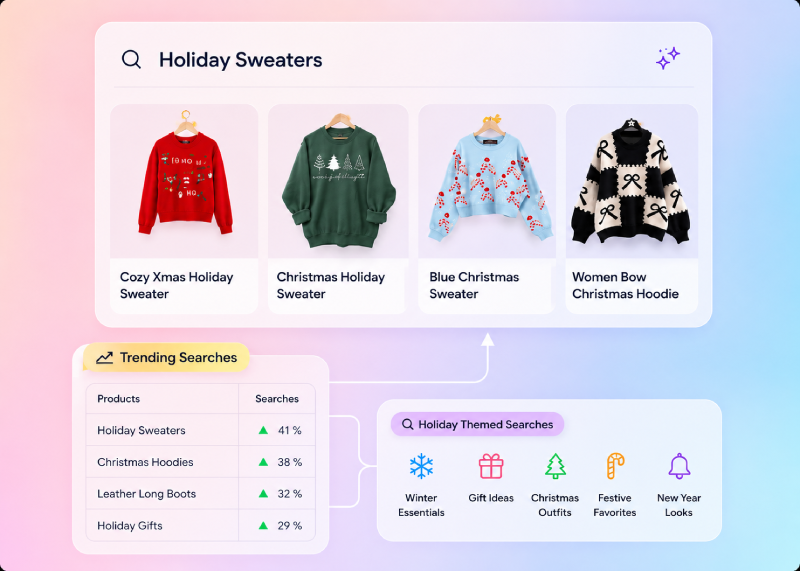
Beauty gift sets and holiday search
The holiday season brings a different shopper: the gift buyer. Many do not know the recipient’s skin type or shade, so they search for “gift sets,” “skincare gift for mom” or “makeup stocking stuffers.”
Make gift sets easy to find with clear names, recipient tags and price bands. Favor products that do not require shade matching, such as skincare sets, fragrances and tools. Add gift filters like “under $50” and shipping cutoff dates. See ecommerce merchandising.
Personalize search for returning shoppers
Returning shoppers often want to reorder a favorite or find something that suits their known skin type and shade. Use what you know to make that faster.
Show previously purchased products first for reorder searches, remember shade and skin type preferences where shoppers have shared them, and suggest complementary products for their routine. Repeat purchases are the backbone of many beauty businesses, so make them easy. See ecommerce personalization.
Beauty search on mobile
Many beauty shoppers arrive on a phone from social media, often searching for a product they just saw in a video. Make search easy to find, autocomplete trending product names and show shade swatches on mobile result cards. See mobile ecommerce search.
Seasonal shifts in skincare searches
Skincare needs change with the weather, and searches follow. Queries for richer moisturizers and lip care rise in winter, while sunscreen, oil control and lightweight formulas rise in summer.
Use last year’s search data to plan these shifts. Adjust boosts, featured collections and autocomplete suggestions ahead of each season, so shoppers see the right products as their needs change.
Test your search with real shopper queries
Before you invest in fixes, test how your current search handles real queries. Pick ten searches that reflect how your shoppers talk, such as:
“fragrance free moisturizer for sensitive skin”
“foundation for olive skin”
“serum for dark spots”
“dewy tinted moisturizer with spf”
“shampoo for color treated curly hair”
“vegan nude lipstick”
For each one, check whether the first row of results would satisfy a real shopper. Note any results that break an exclusion, miss a skin type or ignore a shade request. Share what you find with merchandising and content teams, since many fixes are data fixes. This quick audit shows where to start, and repeating it each quarter shows whether your changes are working.
A simple example
Picture a shopper searching “fragrance free moisturizer for sensitive skin.”
In a weak setup, keyword search matches “fragrance” and returns three scented moisturizers and a perfume gift set. She is frustrated and leaves.
In a strong setup, search understands “fragrance free” as an exclusion and “sensitive skin” as a skin type. It returns unscented moisturizers suited to sensitive skin, with filters for texture and size. A short routine guide suggests a gentle cleanser to pair with it. She buys both.
How to measure beauty search
Wrong-shade returns are especially telling. They point directly to gaps in shade data and filters.
Common beauty search mistakes
Ignoring negation.
“Fragrance-free” searches that show fragrance destroy trust.
Treating shades as plain text.
Shoppers need shade families and undertone filters.
Keyword-only concern search.
Concerns need mapping, not just word matching.
Inconsistent attributes across brands.
Filters fail when every brand uses different terms.
Reacting slowly to trends.
Viral demand fades fast if search cannot find the product.
Where bCloud AI fits
bCloud AI helps beauty retailers understand how shoppers really search. AI search combines keyword and vector retrieval to understand concerns, textures and natural language, and query understanding extracts constraints automatically. Data enrichment helps fill product attributes, Agent Studio powers shopping assistants and Generative Experiences creates buying guides for routines and gifts. On Shopify, bCloud AI installs as a native app and imports and enriches products automatically. See AI search for Shopify.
The bottom line on beauty ecommerce search
Beauty shoppers search with their skin, their concerns and their values, not just product names. Search has to understand all of it.
Make ingredients searchable, handle free-from queries, map concerns, support shade matching, understand texture language, guide routines and catch trends fast. Then measure wrong-shade returns and zero results, because they show exactly where beauty search needs work.
Frequently asked questions
What is beauty ecommerce search?
Beauty ecommerce search is site search designed for cosmetics, skincare and haircare catalogs, handling shades, skin types, concerns, ingredients and routines so shoppers find the right products.
Why is beauty search harder than other categories?
Beauty shoppers search by concern, skin type, shade, ingredient and texture rather than product name, and many queries include exclusions such as fragrance-free.
How big is online beauty spending this holiday season?
Adobe forecasts $9.2 billion in US online spending on cosmetics for the 2026 holiday season.
How should search handle “free-from” queries?
Search should understand negation, so a query like “fragrance-free” excludes products that contain fragrance instead of matching the word.
How can beauty sites improve shade matching?
Group shades into families and undertones, make both filterable, accept shoppers’ own shade words and show swatches in search results.
Should ingredients be searchable?
Yes. Ingredient lists already appear on product labels, and indexing them lets shoppers search for ingredients they want and filter out those they avoid.
How do I measure beauty search performance?
Track zero results for concern and ingredient queries, conversion for shade searches, wrong-shade returns, routine attach rate and search volume for trend terms.
Can AI help shoppers build a beauty routine?
Yes. A quiz, routine builder or AI shopping assistant can ask about skin type and goals, then recommend products in the right order.
How does bCloud AI help beauty retailers?
bCloud AI understands concerns, textures and natural language queries with hybrid search, supports data enrichment, shopping assistants and buying guides, and installs as a native Shopify app.
Search that understands every skin, shade and routine.
bCloud AI turns concern, ingredient and shade searches into the right products. See it on your own catalog before the holiday rush.
bcloud.ai