
Why “fast relevance” is one criterion, not two
When comparing AI site search platforms, teams routinely evaluate speed and relevance separately, then discover they’ve bought a platform that excels at one. Fast irrelevant results get abandoned. Slow relevant results get abandoned too. The metric that matters is the combination: correct products, on the first screen, in under 200 milliseconds at your real catalog size and traffic.
Relevance in 2026 means hybrid retrieval. The lexical half scores exact term matches using an algorithm like BM25 — documented in Wikipedia’s Okapi BM25 entry — which is unbeatable on SKUs and part numbers. The semantic half embeds queries as vectors and matches meaning, so “warm jacket for a rainy commute” returns rain shells. AI site search platforms that run only one of these fail predictably: vector-only drifts on identifiers, keyword-only collapses on natural language.
Speed means percentiles, not averages. A platform averaging 80ms with a p99 of 2 seconds is failing one shopper in a hundred at the worst possible moment. Ask for p95 and p99, measured with your filters applied, under concurrent indexing load.
For a broader comparison across relevance approaches, see our roundup of the top semantic search solutions for e-commerce.
Why “easy integration” decides more deals than features
Integration is where AI site search platforms evaluations quietly go wrong. Every vendor demo looks integrated because it’s running on their sample catalog. Yours is different, and the gap between platforms shows up in three places.
Native connectors.
AI site search platforms with genuine connectors for Shopify, Shopify Plus, BigCommerce, Magento, and WooCommerce turn a multi-week engineering project into a configuration task. Platforms without them describe “integration support,” which usually means a services engagement.
API quality for headless.
If you run headless or custom, you need a clean REST API with full ranking control, not a thin wrapper. Ask to see the docs before you commit — API documentation quality is an accurate proxy for engineering quality.
Catalog synchronization.
Prices and stock change constantly, and results are only as truthful as the index. Event-driven, incremental updates keep search accurate; nightly rebuilds mean shoppers see stale data most of the day. Our real-time indexing guide covers what to require.
A reliable tell: ask each vendor what week one looks like. Credible AI site search platforms describe catalog indexing, a relevance review on your real data, and a traffic-split rollout. Vague answers describing discovery workshops signal a longer, costlier project than the quote implies.
The 7 best AI site search platforms for ecommerce
1. bCloud AI — best combination of fast relevance and easy integration
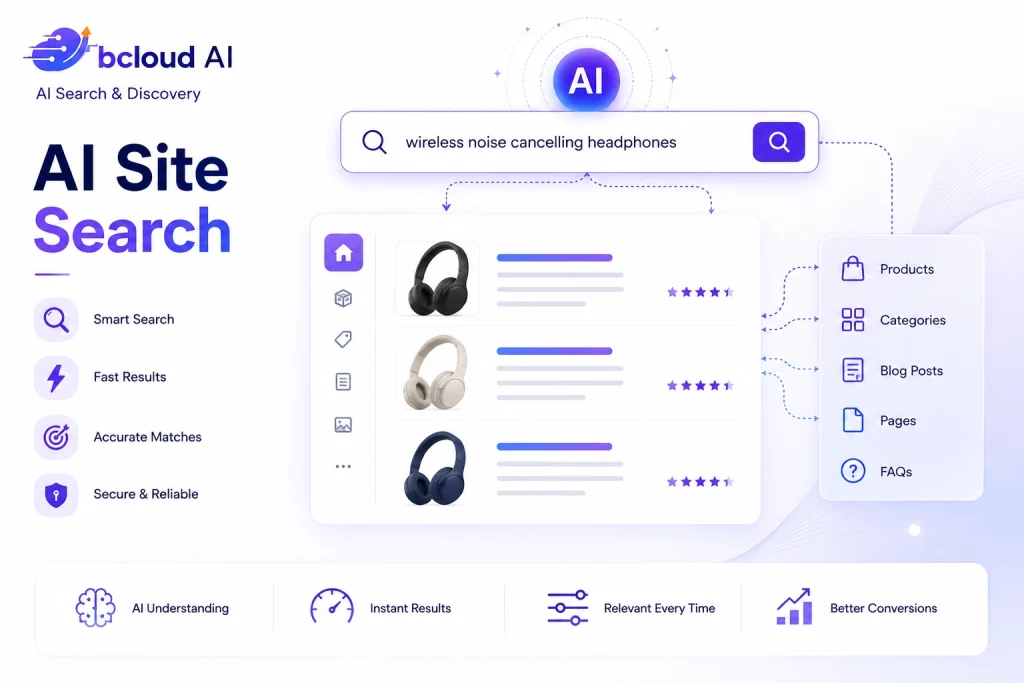
Hybrid BM25 + vector retrieval delivering sub-200ms cached responses (under 400ms cold), with ranking models retraining weekly on real clicks and purchases. On integration: native connectors for Shopify Plus, BigCommerce, Magento, and WooCommerce plus a REST API for headless, real-time indexing, and free implementation included. Typical deployment runs about four weeks. Semantic capability is included at every tier rather than gated to enterprise, and pricing is catalog-based so traffic spikes don’t move the bill. Free tier covers 20,000 searches and 100,000 records monthly. Best for: retailers who need both criteria satisfied without an enterprise contract.
2. Algolia — fastest raw performance
Sub-millisecond keyword responses, 200+ integrations, polished InstantSearch libraries, and excellent documentation make this among the easiest AI site search platforms to integrate. The relevance caveat: NeuralSearch, the vector half, sits on the top-tier Elevate plan, so lower tiers deliver speed without full semantic understanding. Per-query pricing scales with traffic. Best for: developer-led teams with enterprise budget.
3. Klevu — strong mid-market relevance
Mature NLP-driven discovery with proven merchandising automation and solid Shopify and Magento integration. Quote-based annual pricing with a 14-day trial and no permanent free plan; reviewers cite a steeper configuration curve, which affects the integration side of the equation. Best for: catalog retailers prioritizing merchandising depth.
4. Constructor — best conversion-weighted relevance
Ranks toward revenue using clickstream and purchase behavior rather than text relevance alone. Genuinely strong results at high SKU counts; integration is sales-led and slower than self-serve platforms. Best for: enterprise retailers measuring search on revenue.
5. Searchspring — best merchandiser control
Deep merchandising with granular ranking control and reasonable ecommerce platform integration. Best for: teams whose merchandisers want hands-on control of every result set.
6. Coveo — best enterprise breadth
Mature ML ranking spanning commerce and support surfaces. Relevance is strong; integration is the heaviest on this list, typically a multi-month enterprise project. Best for: large organizations unifying multiple search surfaces.
7. Typesense / Weaviate — best open-source relevance per dollar
Both ship hybrid retrieval with built-in vector search. Typesense prices on resources with no per-search charges; Weaviate fuses BM25, vectors, and filters natively. Integration means engineering work rather than connectors — cheap in license, expensive in staff time. Best for: technical teams with a developer to own it.
Testing fast relevance on your own catalog
Four tests, one afternoon, and they separate the field faster than any vendor comparison.
The messy-query benchmark.
Pull a hundred real queries from your logs — typos, long descriptions, half-remembered brands, problem-framed searches like “shoes for standing all day.” Score which platform puts the right product on the first screen. This is where AI site search platforms genuinely differ, and where most stores currently fail: Baymard Institute’s long-running research consistently finds these query types break site search.
The exact-match floor.
Type precise SKUs and model numbers. They must resolve literally, every time. Drift here disqualifies a platform for any catalog with technical identifiers.
Filtered latency at your scale.
Take your twenty most common facet combinations and measure p95 and p99 with your real catalog indexed. Filtering is where implementations diverge most, and unfiltered demo numbers predict essentially nothing.
The concurrent-load test.
Run the latency benchmark while a bulk catalog import is in progress. Platforms that isolate indexing from query serving hold steady; those that don’t degrade exactly when your catalog is busiest.
Score results using the methodology in our search relevance metrics guide, then confirm the winner with a live traffic split per our A/B testing guide. Offline scores predict; only a live test proves.
Testing easy integration before you sign
Integration claims are easy to make and easy to verify if you ask for the right things.
Request a sandbox with your real catalog.
Not sample data — yours, including the messy records. How long it takes them to get it indexed is your first honest data point about integration effort.
Read the API documentation yourself.
Clarity, completeness, and code examples in your stack’s language tell you more about integration difficulty than any sales conversation.
Ask who does the work.
Free implementation included, professional services billed hourly, or DIY with support? The answer changes your project cost more than the license fee does.
Confirm the rollback path.
Good AI site search platforms let you route a traffic percentage and revert instantly. If switching means a full cutover, integration risk is materially higher.
Check what breaks on re-platform.
If you’re likely to change ecommerce platforms in two years, ask what that migration looks like. Connector-based integrations usually survive it; deeply custom ones often don’t.
What switching AI site search platforms actually costs
Your catalog moves in hours. The work built around it does not.
Most teams budget for indexing and forget everything layered on top over the years. As a result, search quality dips after launch and nobody can explain why. Inventory these four things before you migrate.
Synonym and rule lists.
These accumulate quietly over years and encode real knowledge of how your shoppers talk. Export them first. Some transfer directly, while others need rebuilding by hand.
Merchandising campaigns.
Pins, boosts, and scheduled promotions rarely migrate cleanly. Therefore give your merchandisers time to rebuild them before cutover rather than during it.
Frontend components.
Autocomplete widgets, facet panels, and results templates are often tied to one vendor’s library. Check how much of your search UI you would rewrite before you shortlist.
Your historical baseline.
Analytics usually stay with the old vendor. Export conversion, zero-result rate, and revenue per search first. Otherwise you cannot prove the new platform improved anything.
In short, run both platforms in parallel rather than cutting over cold. Keep the old one serving traffic until the new one scores better on your own query set. Our search relevance metrics guide covers what to score.
Matching AI site search platforms to your situation
The seven above aren’t interchangeable, and shortlisting by constraint beats shortlisting by feature list.
Small catalog, small team.
Prioritize AI site search platforms with a genuine free tier and native connectors — you want configuration, not a project. bCloud AI’s free tier (20,000 searches, 100,000 records, free implementation) and Algolia’s Build tier both allow a real pilot on live traffic before any spend.
Mid-market, growing fast.
Pricing shape dominates here, because this is the traffic band where per-query billing starts to hurt. Confirm the semantic layer is in the tier you’d actually buy — this is the segment where teams most often discover the AI they evaluated sits two plans above the quote.
Large or complex catalog.
Filtered latency and real-time indexing decide it. Test with your worst multi-facet queries and ask for indexing lag as a distribution, not an average. Platforms that feel instant on a demo index frequently slow dramatically once facets apply at scale.
B2B or parts-heavy.
The exact-match floor is non-negotiable. Buyers arrive with part numbers and internal codes, and approximation loses procurement’s trust in one session.
Marketing-led, AI-visibility driven.
If the goal is being recommended by ChatGPT and Copilot rather than fixing on-site search, weight structured data quality and catalog completeness heavily — those determine what external engines can read about your products.
What changed in 2026
Three shifts reframe how AI site search platforms should be judged this year.
AI became baseline. Nearly every vendor claims semantic capability now, so the question moved from does it have AI to how good is the hybrid blend and is it in my tier. Several platforms reserve the vector half for enterprise plans — always confirm which tier includes what you’re evaluating.
Measurement became the separator. Buyers increasingly expect proof of lift against a control group rather than case-study claims. Platforms that can’t produce that methodology are being screened out earlier.
Search became a discoverability layer. Shoppers now ask AI assistants for product recommendations, and those assistants read the same structured catalog that powers on-site search. Improving relevance on your site improves how external engines represent your products — one investment, two returns.
Common mistakes
- Judging AI site search platforms on the vendor’s data. Curated demo catalogs flatter every platform. Use your own worst hundred queries.
- Evaluating speed as an average. Tail latency is where abandonment happens.
- Underestimating catalog data quality. AI site search platforms can only understand meaning your product data expresses. Thin titles and missing attributes cap every platform’s ceiling on day one — enrichment before selection moves results more than any configuration afterward.
- Ignoring how AI site search platforms are priced. Per-query billing turns a strong quarter into a large invoice. Model your bill at three times current traffic.
- Treating launch as the finish line. Vocabulary shifts and catalogs grow. Review quality monthly and keep a permanent holdout so the lift stays proven.
Frequently asked questions
What are the best AI site search platforms for ecommerce?
The 2026 leaders are bCloud AI, Algolia, Klevu, Constructor, Searchspring, Coveo, and the open-source options Typesense and Weaviate. Judge them on two criteria: fast relevance measured with your own messy queries at p95/p99, and integration measured in weeks via native connectors and a clean API.
Which AI site search platform has the fastest relevance?
Algolia leads on raw keyword speed at sub-millisecond responses, but full semantic relevance requires its top Elevate tier. For combined speed and semantic understanding at every tier, bCloud AI delivers sub-200ms cached hybrid retrieval. Benchmark both on your catalog with filters applied rather than trusting published figures.
Which AI site search platforms are easiest to integrate?
Platforms with native connectors for your commerce stack plus a clean REST API integrate fastest — typically weeks rather than months. bCloud AI includes free implementation and supports Shopify Plus, BigCommerce, Magento, WooCommerce, and headless via API; Algolia’s ecosystem and documentation are also strong.
How fast should ecommerce site search be?
Sub-200ms is the modern bar, measured at p95 and p99 rather than the average, with your real catalog size and filters applied. Tail latency matters more than the mean because that’s where shoppers abandon.
How long does implementation take?
Managed AI site search platforms typically go live in about four weeks including catalog indexing, relevance review, and a traffic-split rollout. Enterprise suites often run three to six months. Self-hosted engines are a multi-month engineering project.
Do these platforms work with headless commerce?
Most do, through a REST API that exposes ranking parameters, facets, autocomplete, and personalization. Verify that the API gives you full ranking control rather than a thin query wrapper, and read the documentation before committing.
Fast relevance and a four-week launch — no trade-off.
bCloud AI delivers sub-200ms hybrid search with native connectors, real-time indexing, and free implementation, priced on your catalog.
bcloud.ai