bCloud AI

🚨 2026 Vector Guide

Vector Search Ecommerce:

The Complete 2026 Technical Guide

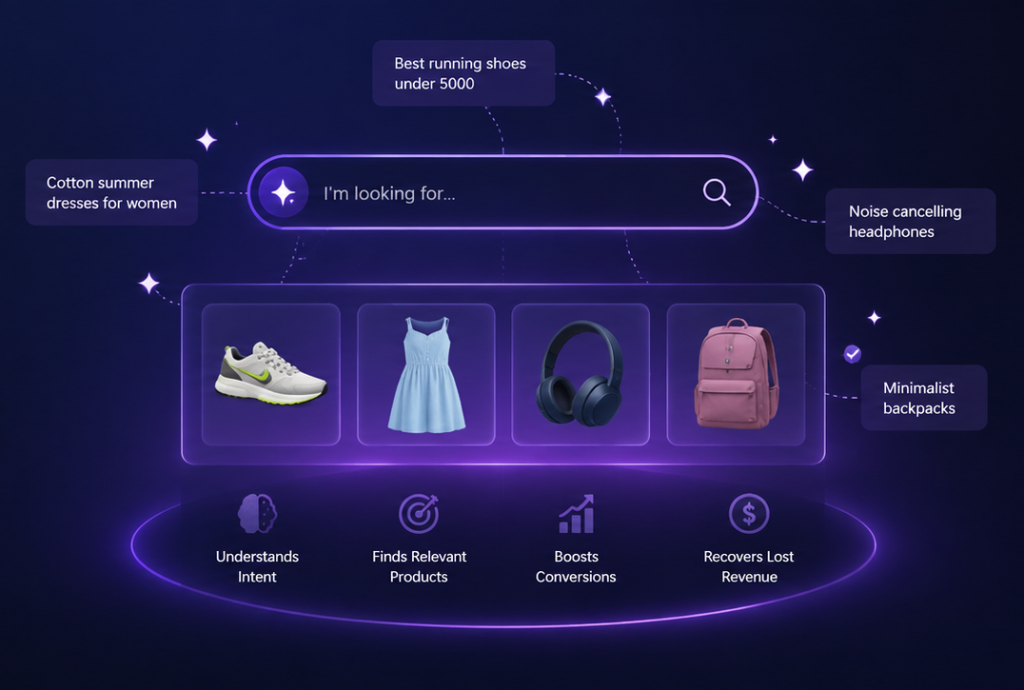
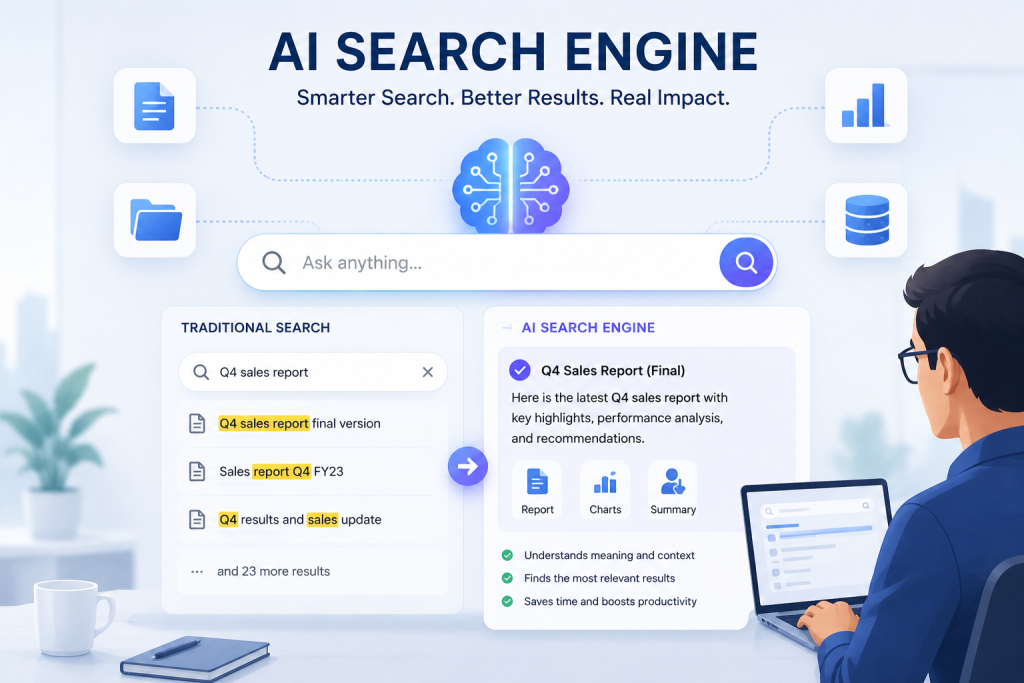
Vector search in ecommerce is a retrieval method that converts shopper queries and product catalogs into high-dimensional numerical vectors and finds matches by mathematical similarity rather than literal word matching.

What is vector search and why does ecommerce need it?

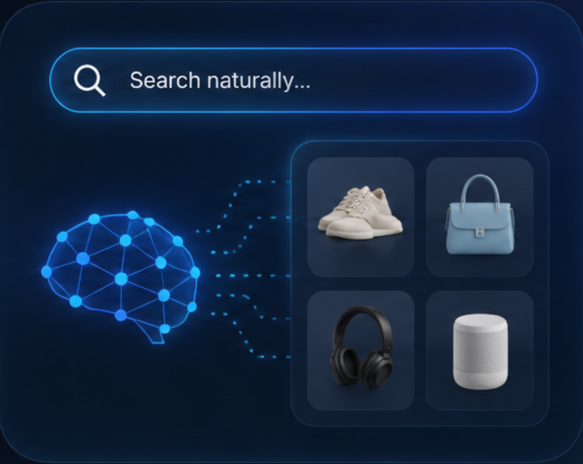
A vector is a list of numbers — typically 384, 768, or 1,536 dimensions long — that represents the meaning of a piece of text. Two phrases with similar meaning will have vectors that are close together in this high-dimensional space, even if they share no words. “Couch” and “sofa” produce nearly identical vectors. “Yoga pants” and “athletic leggings” land in the same neighborhood. Traditional keyword search matches strings. Vector search matches concepts. That single architectural shift is why vector retrieval dominates modern e-commerce search in 2026.

The shopper behavior that made vector search inevitable

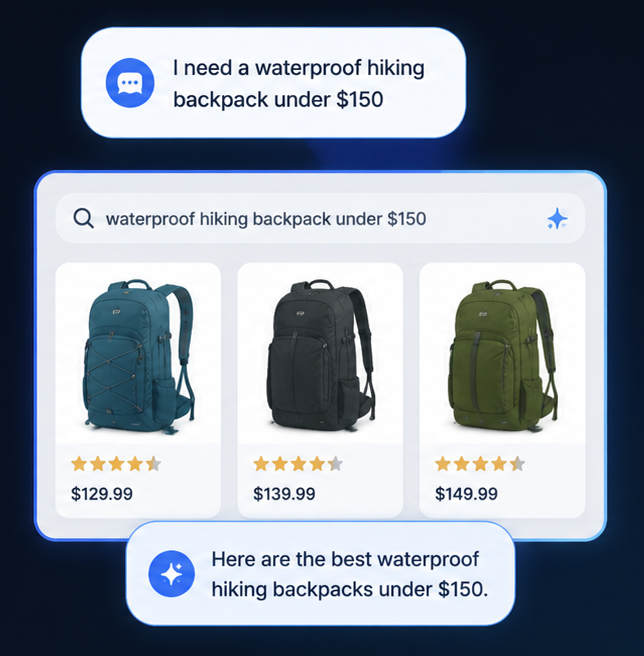
Long-tail descriptive queries

20–40% of e-commerce search queries are unique. Shoppers describe outcomes instead of exact product titles.

Voice and conversational input

Voice assistants and mobile search create longer natural-language queries. Traditional keyword systems struggle to understand these requests.

Multi-attribute intent

Searches combine recipient, price, category, intent, and constraints together. Keyword engines often treat these important attributes as noise.

How vector search ecommerce architectures actually work

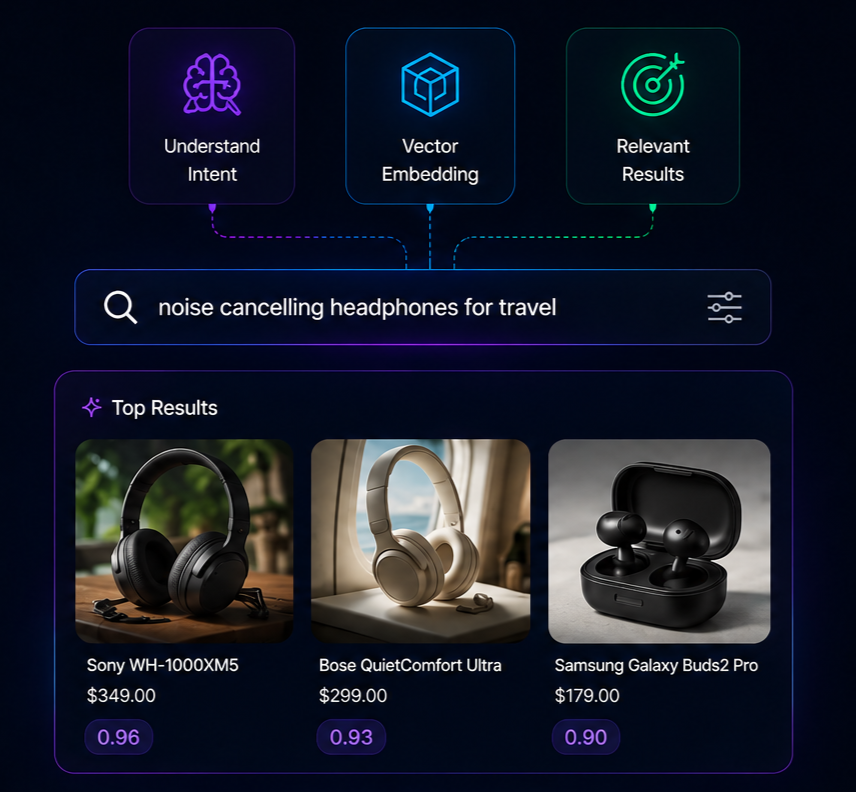
The architecture has three components: an embedding model, a vector index, and a retrieval pipeline.

The retrieval pipeline

At query time, the pipeline runs three steps: embed the query, retrieve the top-K nearest product vectors (typically K=100 or K=200), then rerank using business rules and behavioral signals. The reranking step is where commercial logic — boost in-stock items, surface high-margin SKUs, demote slow movers — gets applied without polluting the semantic similarity scores.

Aggressive facet filtering

Shoppers stack filters (size + color + price + brand) and the result set collapses to zero. Smart faceting suggests the closest matches instead.

Index

Type

Best for

HNSW
Graph-based
Most production deployments
IVF (Inverted File)
Cluster-based
Very large catalogs (10M+ items)
Flat (brute force)
Linear scan
Catalogs under 50K items
Product Quantization
Compressed
Memory-constrained deployments

The embedding model

An embedding model is a neural network that takes text in and produces a fixed-length numerical vector out. Popular open-source choices include all-MiniLM-L6-v2 (384 dimensions, fast) and BAAI/bge-large-en (1,024 dimensions, more accurate). OpenAI's text-embedding-3-small and Cohere's embed-v3 are common API options. Every product in your catalog is run through this model once, and the resulting vector is stored. Every shopper query is embedded the same way at query time.

Hybrid retrieval: why pure vector search isn't enough

Pure vector search has a weakness: it can be too “creative” with exact-match queries. If a shopper types a specific SKU like “SK-9028-BLK,” vector search might return semantically related items instead of the literal product. The solution is hybrid retrieval, which fuses two scoring channels:

BM25

Handles exact-match queries, SKUs, brand names, and rare technical terms.

Vector Similarity

Handles semantic intent, synonyms, descriptive queries, and conceptual matching.

Real-world performance: what vector search actually delivers

Vendor benchmarks and case studies converge on a consistent set of numbers when stores migrate from keyword-only to hybrid vector search:

Metric

Typical lift

Why

Search-to-purchase conversion
+30–50%
More relevant results = more clicks
Zero-results rate
Drops from 8–15% to under 2%
Long-tail queries find matches
Click-through rate (top 5)
+25–40%
Higher relevance density at the top
Average order value
+10–18%
Better cross-sell from semantic neighbors
Search abandonment
−40–60%
Fewer dead-end queries

Operational considerations for vector search at scale

Latency budgets

Modern shoppers expect search results in under 300ms. The biggest contributors to latency are query embedding (typically 30–80ms) and index lookup (5–20ms with HNSW). Edge-cached responses across a global CDN bring p95 latency under 200ms.

Index freshness

Catalogs change. New products launch, prices update, inventory shifts. A robust vector index supports incremental updates — adding, updating, or removing items without rebuilding the entire index. Look for platforms that offer real-time sync rather than nightly rebuilds.

Embedding drift

Embedding models improve over time. When you upgrade from a 384-dimension model to a 1,024-dimension model, the entire catalog must be re-embedded. Plan for this in your architecture by versioning embeddings and supporting hot-swappable index migrations.

How To Fix Zero Results Ecommerce — fast

Zero results ecommerce isn’t a search problem — it’s a revenue problem. Fix it once, and the lift compounds across every campaign, every promotion, every quarter.
Path 01

Roll your own

Sentence-Transformers + Qdrant / Weaviate / pgvector + custom retrieval + reranker

Pros

Cons

Time to ship
3–6 mo
Ops burden
Very high
Control
Full
Path 02

Hosted SaaS

Algolia NeuralSearch · Coveo · Constructor · similar incumbents

Pros

Cons

Time to ship
Weeks
Ops burden
Medium
Control
Partial
Path 03

AI-native platforms

bCloud · Vantage · Searchspring AI tier · similar

Pros

Cons

Time to ship
< 1 week
Ops burden
Low
Control
Good

How to pick the best e-commerce search for your store

Capability

Keyword search

Vector search

Synonym handling
Manual dictionaries
Automatic from embeddings
Typo tolerance
Edit-distance rules
Built-in via embeddings
Long-tail queries
Often returns zero
Returns relevant matches
Multi-language
Per-language indexes
Multilingual embeddings
Exact SKU matching
Excellent
Needs hybrid retrieval
Setup complexity
Low
Medium-high (or zero with SaaS)
Ongoing maintenance
High (synonym dicts)
Low (model updates only)

Common implementation pitfalls

Embedding only product titles
Title-only embeddings miss critical context. Embed a structured concatenation: title + brand + category + key attributes + first 200 characters of description.
Ignoring metadata filtering
A shopper's "blue running shoes under $100" query needs price and color filters layered on top of vector retrieval — pure semantic matching alone won't enforce hard constraints.
Forgetting to rerank
Top-K vector results aren't ordered for commercial outcomes. Layer in business rules and behavioral signals (CTR, conversion rate per query) to lift the right items to the top of the result page.
Skipping hybrid
Pure vector search loses on exact-match queries. Always combine with BM25 or similar sparse scoring.
Not measuring zero-results rate
The headline ROI metric for any vector search ecommerce deployment is the drop in zero-results queries. Track it weekly.

The future of vector search ecommerce

Three trends are reshaping the space in 2026:

Multimodal embeddings

Models like CLIP let shoppers search by image as easily as by text — "find shoes that look like this" works against the same vector index.

Reasoning-augmented retrieval

LLMs sit on top of vector retrieval to handle complex multi-step queries: "I need a gift for my dad who plays golf, costs around $80, and ships before Friday."

Personalized embeddings

Per-shopper embedding adjustments (based on browsing history) are starting to appear in production, customizing the semantic neighborhood for each visitor.

Frequently asked questions

What is vector search in ecommerce?
Vector search in ecommerce is a retrieval method that uses neural network embeddings to find semantically similar products to a shopper’s query, even when the query and product titles share no words. It typically delivers 30–50% conversion lift over keyword-only search.
Modern Elasticsearch (8.0+) supports vector search natively via dense_vector fields and kNN queries — so it’s not “vs” but a superset. The real comparison is hybrid vector search platforms versus keyword-only deployments, where vector consistently wins.
Self-hosted with open-source components: $300K–$800K year-one TCO for mid-market. Hosted SaaS like Algolia NeuralSearch: $1,000–$10,000+ monthly depending on volume. AI-native platforms: typically $500–$5,000 monthly with all features included.
Yes, every product needs an embedding for vector search to work. Modern embedding APIs process 1M+ products in under an hour. Incremental updates handle new products in real time.
Beyond pure vector search ecommerce infrastructure, modern platforms layer additional capabilities on top. Our deep dive on semantic search for product catalogs covers how embeddings get tuned for SKU, brand, and category vocabulary specifically. The LLM search for e-commerce guide explains how large language models extend retrieval into reasoning — handling queries like “gift for my brother who likes camping.” For shopper-facing implementations, see our natural language product search playbook. And if you’re on a specific commerce platform, our integration guide on AI search for BigCommerce shows the drop-in deployment path.
Scroll to Top