
What Is a Shopping Search Engine?
Why Shopping Search Engines Matter
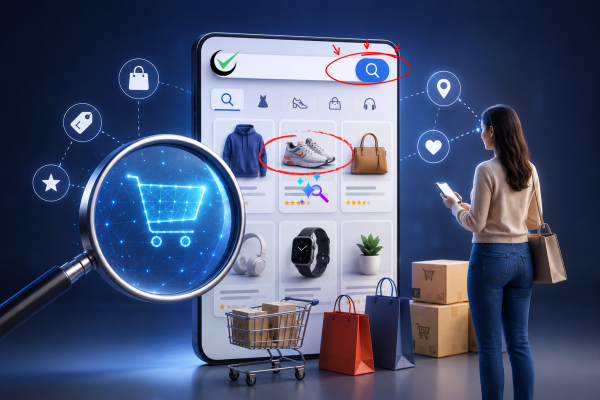
Product discovery no longer happens in one place. A single shopper might ask ChatGPT for a recommendation, compare prices on Google Shopping, check reviews on a marketplace, then land on your store and search again before buying. Each of those is a discovery channel, and being absent from any of them means lost sales. The shift toward AI is accelerating this: assistants now return one to three options instead of twenty links, so visibility on each engine matters more, not less. To go deep on the AI side, see our guide to AI visibility for ecommerce.
AI Search Grader by bCloud AI
Grade your ecommerce search in 10 quick questions
31% of ecommerce searches return zero results — and most shoppers who hit a dead end leave for a competitor. How does your store's search stack up?
Answer 10 short questions and get your AI search score, plus a personalized report to fix the gaps. Free, takes about 2 minutes.
No signup needed to take the quiz.
Understanding intent…
Scoring your answers across relevance, AI, experience, and insights.
Your AI search score is ready
Tell us where to send your personalized report. You'll see your score and recommendations right away.
Your score by pillar
Personalized recommendations
Fix the gaps in weeks, not quarters
bCloud AI replaces keyword-only search with hybrid AI retrieval — sub-200ms responses, 99.99% uptime, and conversion lifts of up to 40% across 50+ implementations.
General Search Engines
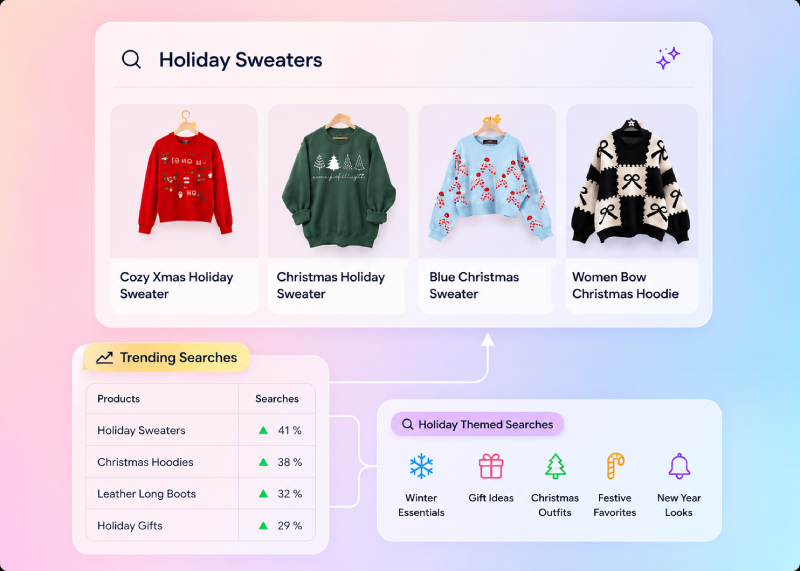
Google and Bing remain the front door for most product research, now augmented with AI Overviews that summarize options directly in results. Ranking here depends on classic SEO plus structured data.
Comparison-Shopping Engines
Dedicated comparison engines and Google Shopping aggregate products and prices from many retailers into one view. Visibility depends on a clean, complete product feed and competitive pricing.
Marketplace Search
The search box inside Amazon, eBay, Walmart, and Etsy is where a huge share of buying intent now begins. Each marketplace has its own ranking algorithm rewarding relevance, conversions, and reviews.
AI Shopping Assistants
ChatGPT, Gemini, and Perplexity increasingly act as a shopping search engine, recommending specific products in response to natural-language requests. Getting named here is the new frontier of discovery.
Social and Visual Search
Shoppers search and discover on TikTok, Instagram, and Pinterest, often visually. These platforms blend content, search, and checkout into a single shopping surface.
Voice Assistants
Voice platforms let shoppers search and reorder by speaking, favoring concise, structured product data that an assistant can read aloud and act on.
Onsite Store Search
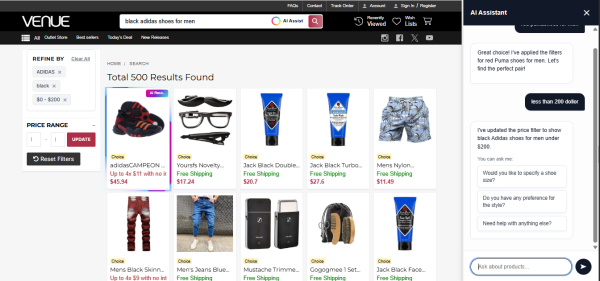
The most important shopping search engine you actually control is your own. Once a shopper reaches your store, your site search decides whether they find the product and buy — or bounce.
External Shopping Engines vs. Onsite Search
It helps to separate engines you optimize for from the one you own.
| Aspect | External shopping engines | Onsite store search |
|---|---|---|
| Examples | Google Shopping, Amazon, ChatGPT | Your store’s search box |
| You control | Your data feed and visibility | The full experience and ranking |
| Goal | Get found and click through | Convert the visit to a sale |
| Key lever | Clean feeds + structured data | AI relevance + personalization |
You need both: external engines bring shoppers to you, and great onsite search turns them into buyers. The common foundation is a clean, structured, machine-readable catalog.
7 Proven Ways to Get Found on Shopping Search Engines
These moves improve your visibility across every shopping search engine at once.
Build Clean, Complete Product Feeds
Comparison engines and marketplaces rely on your feed. Accurate titles, attributes, categories, and images are the baseline for being shown — which is where search enrichment pays off.
Add Structured Data (Schema)
Mark up products, prices, availability, and reviews so general and AI engines can read and display your products. Structured data is foundational for both SEO and AI visibility.
Earn and Surface Reviews
Ratings and reviews influence ranking on nearly every shopping search engine and build the trust that wins the click and the sale.
Price Competitively and Transparently
Comparison engines rank heavily on price. Clear, competitive pricing and accurate availability keep you visible and clickable.
Optimize for AI Answers (AEO)
Add answer-direct content and authority so AI assistants cite your store when shoppers ask for recommendations — the fastest-growing discovery channel.
Keep Classic SEO Strong
A search-engine-friendly store ranks in general engines and feeds the same data AI engines use, so SEO pays off twice.
Nail Your Onsite Search
All that visibility is wasted if shoppers can’t find products once they arrive. A strong AI search experience converts the traffic the other engines send you.
How AI Is Changing Shopping Search
The biggest shift in shopping search is the move from links to answers. Instead of returning twenty blue links, an AI shopping search engine returns a short, curated recommendation — often just one to three products — drawn from the same web pages, reviews, and structured product data that Google indexes. That raises the stakes: being one of the few products an assistant names is far more valuable than ranking tenth on a results page. It also rewards retailers with clean, structured, authoritative catalogs, because those are exactly what AI engines can read and trust. The retailers who treat AI assistants as a first-class shopping search engine today will own discovery as this behavior becomes the norm.
Common Shopping Search Engine Mistakes
A few mistakes quietly cost visibility: submitting incomplete or low-quality product feeds, skipping structured data so engines can’t read your products, ignoring reviews, treating AI assistants as irrelevant, and optimizing for external engines while neglecting the onsite search that actually converts. Each gap cedes ground to competitors who show up where shoppers are looking. The fix is a single, well-structured catalog that feeds every channel — plus great onsite discovery to close the sale.
How Shopping Search Engines Influence Buying Decisions
Shopping search engines do more than help customers find products — they influence which products shoppers consider, compare, and ultimately purchase. A shopper may discover a product through Google, compare alternatives on a marketplace, ask an AI assistant for a recommendation, and then use a store’s own search to find the right option. At every step, relevance, product information, price, reviews, and availability shape the decision. This makes shopping search visibility an important part of the entire buying journey, not just a way to generate website traffic. Retailers that provide consistent, accurate product information across every discovery channel can make it easier for shoppers to move from initial interest to confident purchase.
How Shopping Search Behavior Differs by Category
Where shoppers search depends heavily on what they are buying. For commodity and electronics purchases, comparison engines and marketplaces dominate because price and specs drive the decision. For fashion, beauty, and home, social and visual platforms carry enormous weight, since discovery is inspiration-led. For considered or technical purchases, shoppers increasingly open an AI assistant to narrow a complex field to a few trustworthy options. And for repeat or brand-loyal buying, shoppers often go straight to a store’s own search. Knowing where your customers actually start lets you prioritize the channels that matter most for your category rather than spreading effort thin across all of them equally.
Measuring Your Shopping Search Visibility
You cannot improve visibility you do not track. Monitor your presence in Google Shopping and organic results, your ranking and conversion inside key marketplaces, and increasingly whether AI assistants name your brand when asked for recommendations in your category. On your own store, track search usage, zero-results, and search conversion. Together these reveal where shoppers can find you and where you are invisible, turning a vague sense of “we should be everywhere” into a concrete, prioritized list of gaps to close. As AI-driven discovery grows, tracking AI mentions is becoming as important as tracking keyword rankings once was.
Feeds Are the Common Thread
Across nearly every external shopping channel, one thing determines whether you show up: the quality of your product data. A clean, complete, well-structured feed is what comparison engines list, what marketplaces rank, and what AI assistants read. Investing in catalog quality is therefore the highest-leverage move you can make, because it improves visibility everywhere at once instead of one channel at a time.
Don’t Neglect the Channel You Own
It is easy to pour budget into external engines and forget the one channel you fully control. Your onsite search has no ranking competition, no marketplace fees, and full access to your data, yet it is where many retailers underinvest. Getting it right captures the maximum value from every visitor the other channels send you, and it is the only channel where you keep the entire customer relationship.
How bCloud AI Helps You Win Shopping Search
bCloud AI strengthens both sides of the shopping search equation. Its AI data enrichment cleans titles, completes attributes, and structures your catalog — the exact foundation that comparison engines, general search, and AI assistants need to find and recommend your products. And its hybrid AI search gives you a best-in-class onsite shopping search engine that converts the visitors those external engines send you. The result is a catalog that is easy for every shopping search engine — and every shopper — to understand and buy from. To compare AI-native platforms, see our roundup of the best ecommerce search engines for 2026.
How to Choose the Right Shopping Search Engine for Your Business
Not every shopping search engine delivers the same value for every retailer. The right strategy depends on your products, customers, margins, and business goals. Rather than trying to dominate every channel at once, focus first on the shopping engines where your customers naturally begin their buying journey.
Selling Consumer Products
Prioritize Google Shopping, comparison-shopping engines, and AI assistants where buyers actively compare prices, ratings, and product features before purchasing.
Marketplace-Driven Brands
If most of your revenue comes from Amazon, Walmart, Etsy, or eBay, invest in marketplace search optimization, complete product listings, and review management.
AI-First Commerce
As shoppers increasingly ask ChatGPT, Gemini, and other AI assistants for buying recommendations, structured product data and AI visibility become essential for being recommended.
Direct-to-Consumer Stores
Brands selling through their own ecommerce website should combine strong SEO with AI-powered onsite search to maximize conversions after visitors arrive.
Quick Decision Guide
Key takeaway: The most successful ecommerce businesses don’t rely on a single shopping search engine. They combine Google visibility, marketplace optimization, AI search readiness, and an intelligent onsite search experience to capture shoppers at every stage of the buying journey.
Frequently Asked Questions About Shopping Search Engines
What is a shopping search engine?
A shopping search engine is any search tool that helps people discover, compare, and buy products. It includes general engines like Google, comparison-shopping engines, marketplace search inside Amazon or eBay, AI assistants like ChatGPT, social and visual search, voice assistants, and the search box on your own store.
What is the difference between a shopping search engine and onsite search?
External shopping search engines (Google Shopping, marketplaces, AI assistants) are channels you optimize for to get found, while onsite search is the experience on your own store that you fully control and use to convert visitors into buyers. Retailers need both.
What are examples of shopping search engines?
Examples include Google and Google Shopping, comparison-shopping engines, Amazon and eBay marketplace search, AI assistants like ChatGPT, Gemini, and Perplexity, social platforms like TikTok and Pinterest, voice assistants, and your store’s own search.
How do I get my products found on shopping search engines?
Build clean, complete product feeds, add structured data, earn reviews, price competitively, optimize for AI answers, keep classic SEO strong, and ensure your onsite search converts the traffic. A clean, structured catalog feeds every channel at once.
Are AI assistants like ChatGPT a shopping search engine?
Increasingly, yes. AI assistants recommend specific products in response to natural-language requests, drawing on the same web and product data Google uses. Getting your store named in those answers is a fast-growing discovery channel called AI visibility.
How is AI changing shopping search?
AI is shifting shopping search from a list of links to a short, curated answer of one to three products. That makes being recommended far more valuable than ranking tenth, and it rewards retailers with clean, structured, authoritative product data.
Does SEO help with shopping search engines?
Yes. Strong SEO and structured data rank you in general engines and feed the same data AI engines and comparison sites use, so a search-engine-friendly store improves visibility across multiple shopping search engines at once.
What is the best way to convert shopping search traffic?
Great onsite search. Once external engines send shoppers to your store, AI-powered onsite search with semantic understanding, personalization, and strong relevance is what turns that traffic into sales.
Get Found and Convert Across Every Shopping Engine
Winning shopping search starts with a clean, structured catalog and a best-in-class onsite search experience. Start for free or book a demo to see how bCloud AI helps shoppers find and buy your products.