

What is ecommerce site search?
Ecommerce site search vs. external search engines
AI Search Grader by bCloud AI
Grade your ecommerce search in 10 quick questions
31% of ecommerce searches return zero results — and most shoppers who hit a dead end leave for a competitor. How does your store's search stack up?
Answer 10 short questions and get your AI search score, plus a personalized report to fix the gaps. Free, takes about 2 minutes.
No signup needed to take the quiz.
Understanding intent…
Scoring your answers across relevance, AI, experience, and insights.
Your AI search score is ready
Tell us where to send your personalized report. You'll see your score and recommendations right away.
Your score by pillar
Personalized recommendations
Fix the gaps in weeks, not quarters
bCloud AI replaces keyword-only search with hybrid AI retrieval — sub-200ms responses, 99.99% uptime, and conversion lifts of up to 40% across 50+ implementations.
Why ecommerce site search matters: the revenue case
Site search isn’t a convenience feature — it’s one of the highest-leverage conversion tools you own, and the numbers back that up.
The zero-results problem quietly draining revenue
On the average store, roughly 31% of searches return zero results — not because products are missing, but because the engine can’t connect a shopper’s wording to the catalog. Every empty page is a ready-to-buy customer who leaves with nothing. See how these silent failures compound (and how one marketplace recovered $412,000 in monthly losses) in our breakdown of why zero-result searches cost stores millions.
Site searchers are your highest-intent shoppers
Visitors who use site search convert at several times the rate of those who only browse — the act of searching signals clear intent. Improving it lifts conversion, average order value, and satisfaction at once, while reducing support load and bounce. Few ecommerce investments pay back across that many metrics at the same time.
How modern ecommerce site search works
Not all site search is built the same. Understanding the layers shows why legacy search disappoints and what “AI-powered” actually changes.
Keyword search (and why it breaks)
Matches the literal characters a shopper types against your product text. It works until someone uses a synonym, misspelling, brand name, or descriptive phrase you didn’t anticipate — then it fails silently. Because real shoppers rarely phrase things the way your catalog does, keyword-only search leaves money on the table by design.
Semantic & vector search
Modern engines understand meaning, not just words. Vector embeddings map products and queries into a shared space, so “noise-cancelling headphones” and “ANC headset” land close together despite sharing no keywords. Our AI e-commerce search guide covers the technical foundation end to end.
Natural language & conversational search
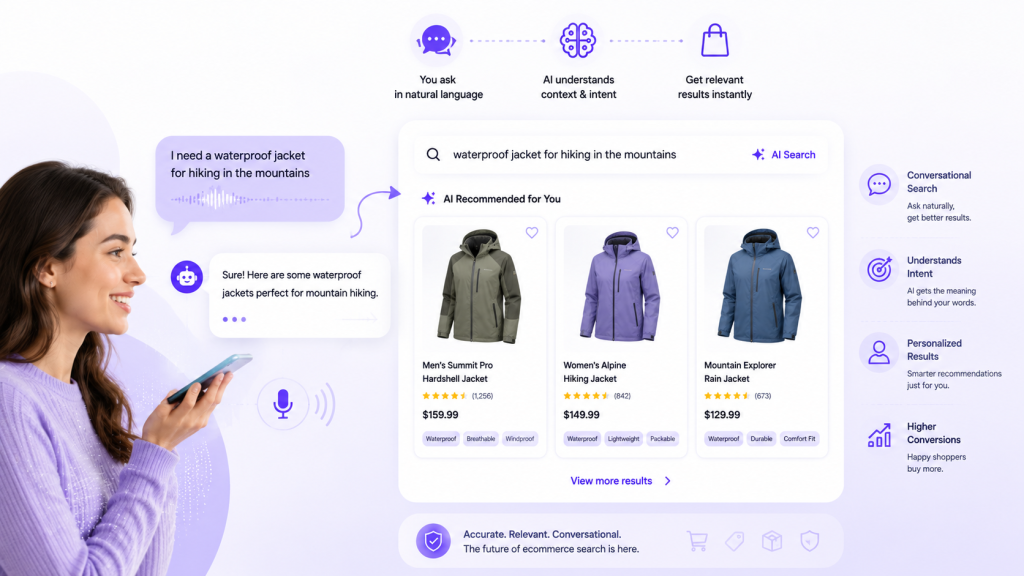
Shoppers search the way they talk: “a gift for my dad who likes camping, under $100.” Conversational search interprets long phrasing, handles follow-ups, and can return generative answers with product citations. bCloud AI delivers this through IntentAI conversational search that keeps context across a session.
Personalization & behavioral ranking
Two shoppers can type the same query and want very different things. AI learns from clicks, add-to-cart behavior, and purchase history to deliver personalized product rankings tuned to each visitor — improving continuously without manual tuning.
7 proven fixes to improve your ecommerce site search
You don’t need a year-long project to fix site search. These seven moves deliver measurable wins fast.
Ecommerce site search software: how to choose
The right software depends on your catalog size, platform, team, and growth goals. Rather than chasing feature lists, score vendors on outcomes. The best combines semantic and conversational AI, personalization, sub-200ms speed at scale, broad platform integrations, and AI-visibility features.
| Criterion | What to ask |
|---|---|
| Relevance | Does it truly understand intent and natural language? |
| Speed & scale | Can it stay sub-200ms under real traffic? |
| Personalization | Does it rank results per shopper? |
| Integrations | Does it connect to Shopify, BigCommerce, Magento, WooCommerce, or custom? |
| AI visibility | Does it help you appear in AI Overviews and assistants? |
| Time to value | Weeks, not quarters? |
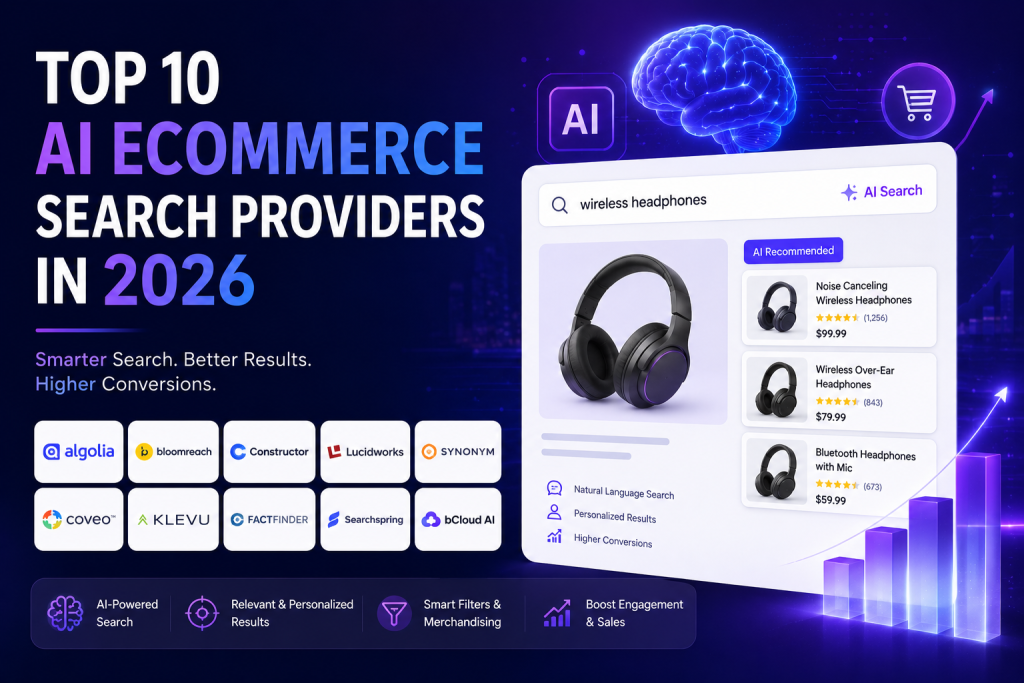
To see how the leading platforms stack up on these criteria, compare the best AI ecommerce search platforms side by side. If product discovery specifically is your bottleneck, our product search engine page goes deeper on catalog-level relevance.
The best ecommerce site search is not a set-and-forget feature — it should continuously improve as shoppers interact with your store. Search queries, clicks, product views, add-to-cart actions, purchases, and zero-result searches reveal exactly where customers are finding what they need and where they are encountering friction. By combining these signals with semantic AI, personalization, intelligent ranking, and search analytics, retailers can continuously improve relevance and product discovery. Over time, this creates a search experience that becomes smarter with every interaction, helping shoppers find the right products faster while reducing dead ends, increasing conversions, and turning high-intent searches into measurable revenue.
How bCloud AI powers ecommerce site search
<200ms
Response time
Even at millions of queries per minute.
99.99%
Uptime
Enterprise-grade reliability.
Up to 40%
Conversion lift
What customers consistently see.
~4 weeks
Time to live
No complex migration.
The Customer Search Journey: From Query to Purchase
Every search begins with intent. Understanding how shoppers move from entering a query to completing a purchase helps retailers identify where revenue is won—and where it’s lost. A modern AI-powered ecommerce search engine improves every stage of this journey.
1. Search
The shopper enters a keyword, question, or natural language query.
2. Understand
AI interprets intent, recognizes synonyms, and understands product context.
3. Discover
Relevant products, filters, and recommendations appear instantly.
4. Convert
The shopper finds the right product faster and completes the purchase with confidence.
Every delay, irrelevant result, or zero-result page creates friction in this journey. AI-powered ecommerce site search removes these obstacles by understanding customer intent instead of relying on exact keyword matches, helping shoppers reach the checkout faster while increasing conversions and average order value.
Frequently asked questions about ecommerce site search
What is ecommerce site search?
Ecommerce site search is the search functionality on an online store that lets shoppers find products by typing queries directly on your website. Modern site search uses AI and natural language processing to understand shopper intent and rank the most relevant products in milliseconds, even when the query doesn’t match product titles exactly.
How is ecommerce site search different from Google search?
Google is an external (offsite) engine that helps shoppers discover your store. Ecommerce site search is the internal (onsite) search on your own website that helps visitors who are already there find and buy products. Onsite search is bottom-of-funnel and has the most direct impact on conversion.
Why is ecommerce site search important?
Visitors who use site search convert at much higher rates than those who only browse, because searching signals strong purchase intent. Meanwhile, about 31% of searches on the average site return zero results, so poor site search silently drains revenue. Improving it lifts conversions, average order value, and satisfaction at once.
What is the best ecommerce site search software?
The best ecommerce site search software combines semantic and conversational AI, personalization, sub-200ms speed at scale, broad platform integrations, and AI-visibility features. Leading options include bCloud AI, Algolia, Coveo, and Klevu; the right fit depends on your catalog size, platform, and growth goals.
How does AI improve ecommerce site search?
AI uses semantic and vector search to understand the meaning behind queries, natural language processing to interpret conversational phrasing, and behavioral learning to personalize rankings. This eliminates most zero-result failures and returns relevant products even for queries the engine has never seen.
How much can ecommerce site search increase conversions?
Stores that upgrade from keyword search to AI-powered site search commonly see conversion improvements of up to 40%, along with higher average order value and lower bounce rates, because shoppers find relevant products faster and hit fewer dead ends.
How do I add site search to my ecommerce website?
The fastest path is an AI-native platform like bCloud AI, which connects to Shopify, BigCommerce, Magento, WooCommerce, or a custom stack. It goes live in about four weeks with no internal ML expertise required.
Does ecommerce site search work on mobile?
Yes. Modern ecommerce site search is designed mobile-first, with predictive autocomplete, collapsible faceted filters, and conversational input optimized for the more than half of ecommerce traffic that now comes from mobile devices.
Turn your site search into a growth engine.
Your ecommerce site search is already collecting your highest-intent shoppers. The only question is whether it’s converting them or losing them. See what AI-powered site search can do for your store — and watch your zero-results shrink and your conversions climb.
bcloud.ai
Related resources: AI E-Commerce Search Guide · Best Ecommerce Search Engine: Top 10 for 2026 · Ecommerce Search Resources & Guides