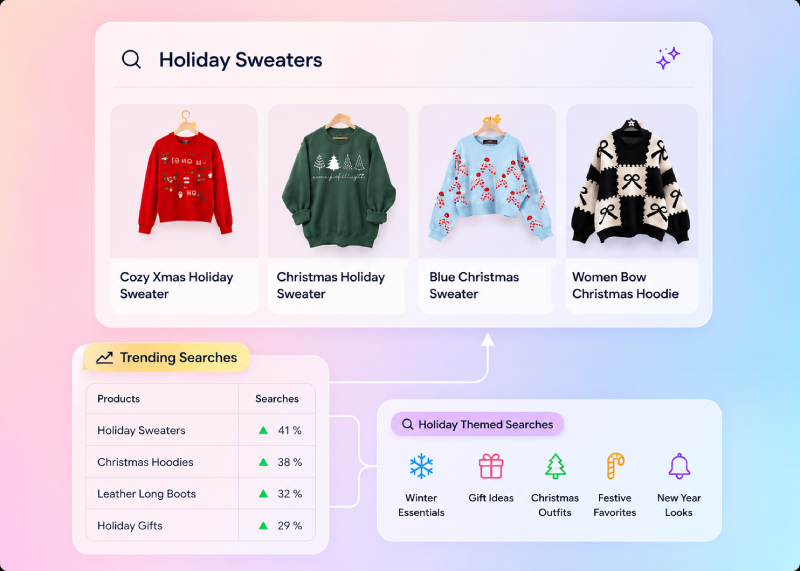


Shoppers now search like they’re talking to a person:
“Comfortable waterproof hiking shoes for rainy trails.”
“Best laptop for graphic design under $1,500.”
“Black dress for a summer wedding.”
That’s why ecommerce search software has become one of the most important technologies for online retailers in 2026. The right platform helps customers discover products faster, improves conversion rates, increases average order value, and creates a better shopping experience from the very first interaction.
What is ecommerce search software?
Why traditional ecommerce search fails
Many ecommerce businesses still use search built around exact keyword matching. It worked reasonably well in the past, but struggles to meet modern expectations. If a customer searches for “comfortable waterproof trekking shoes” but your catalog lists “water-resistant hiking boots,” a traditional engine may return nothing — despite offering exactly what the shopper needs. These limitations often lead to:
Zero-result searches
Customer frustration
Higher bounce rates
Lost revenue opportunities
The problem isn’t your products. It’s the inability of legacy search technology to understand customer intent.
How modern ecommerce search works
Natural language processing
Interprets conversational, full-sentence queries.
Semantic search
Understands meaning rather than exact wording.
Vector search
Connects customer intent with the most relevant products.
AI ranking
Continuously learns from shopper behavior to improve future results.
Together, these technologies create a search experience that feels less like a search box and more like a knowledgeable sales associate.
AI Search Grader by bCloud AI
Grade your ecommerce search in 10 quick questions
31% of ecommerce searches return zero results — and most shoppers who hit a dead end leave for a competitor. How does your store's search stack up?
Answer 10 short questions and get your AI search score, plus a personalized report to fix the gaps. Free, takes about 2 minutes.
No signup needed to take the quiz.
Understanding intent…
Scoring your answers across relevance, AI, experience, and insights.
Your AI search score is ready
Tell us where to send your personalized report. You'll see your score and recommendations right away.
Your score by pillar
Personalized recommendations
Fix the gaps in weeks, not quarters
bCloud AI replaces keyword-only search with hybrid AI retrieval — sub-200ms responses, 99.99% uptime, and conversion lifts of up to 40% across 50+ implementations.
AI-powered semantic search
Semantic search focuses on meaning rather than exact keywords.
When a shopper searches for “comfortable travel backpack,” the engine understands concepts like travel, comfort, storage, portability, and product relevance — surfacing products that satisfy those needs even when the exact terms don’t appear in the catalog. This dramatically improves relevance while reducing frustration from missed matches.
Natural language search
Customers increasingly search using complete sentences instead of isolated keywords. Queries like these have become common shopping behavior:
“Show me waterproof hiking boots under $150”
“Comfortable office chair for back pain”
Natural language search lets customers communicate naturally while the engine interprets intent, constraints, and preferences automatically.
Personalized product discovery
No two customers are exactly alike. Modern ecommerce search software personalizes results based on browsing history, purchase behavior, product affinity, engagement patterns, and customer preferences.
Rather than showing identical results to every shopper, AI-driven personalization surfaces the products most likely to match individual interests and buying intent — creating more relevant experiences and increasing conversion rates over time.
Modern Ecommerce Search Software helps online retailers deliver faster, more relevant, and more personalized product discovery experiences. Instead of relying only on exact keyword matching, advanced search platforms use AI, semantic search, natural language processing, vector search, personalization, and intelligent ranking to understand what shoppers actually mean. By helping customers find the right products with less effort, ecommerce search software can reduce zero-result searches, improve engagement, increase conversions, and create a more seamless shopping experience across growing online stores.
Intelligent autocomplete
Autocomplete is often the first interaction customers have with your search experience. Modern autocomplete does far more than suggest keywords:
Predicts shopper intent in real time
Handles spelling mistakes automatically
Recommends products, not just terms
Displays product imagery inline
Personalizes suggestions for each shopper
The result is faster product discovery and shorter purchase journeys.
AI ranking and merchandising
Traditional search engines require constant manual tuning and rule management. Modern AI ranking systems learn automatically — every click, add-to-cart action, purchase, and engagement signal helps improve result quality over time.
AI-powered merchandising also lets brands prioritize inventory, boost promotional products, support campaigns, and align search results with business goals — without sacrificing relevance.
Conversational commerce
Search is evolving into conversation. Instead of repeatedly entering new search queries, shoppers can hold a natural dialogue:
“I need a gift for my dad under $100.”
“Show me something more premium.”
“What about outdoor products?”
The system remembers context, understands follow-up questions, and continuously refines recommendations — a shopping experience remarkably like interacting with a knowledgeable sales associate.
Why ecommerce search directly impacts revenue
Search isn’t just a convenience feature — it’s one of the strongest drivers of ecommerce revenue. When customers quickly find relevant products:
Bounce rates decrease
Average order value improves
Customer satisfaction grows
Retention rates increase
Conversely, poor search creates friction at the exact moment shoppers are expressing purchase intent. Every failed search represents a potential lost sale.
Enterprise features to look for
As catalogs grow, search complexity increases dramatically. Enterprise brands need platforms that scale without sacrificing performance. Important capabilities include:
Natural language processing
AI ranking and merchandising
Vector search technology
Real-time personalization
Multi-language support
Headless commerce compatibility
API-first architecture
Real-time analytics
Large catalog scalability
The best ecommerce search software combines all of these capabilities into a unified platform.
Common mistakes when choosing ecommerce search software
Many businesses focus solely on pricing when evaluating vendors. Cost matters, but search quality has a direct impact on revenue. Other common mistakes include:
Choosing keyword-based technology over AI-powered search
Ignoring personalization capabilities
Overlooking analytics and reporting
Underestimating scalability requirements
Selecting platforms that require excessive manual maintenance
The most successful ecommerce brands evaluate search software based on long-term business impact rather than short-term implementation costs.
The future of ecommerce search
Search is rapidly becoming more intelligent, conversational, and personalized. Future innovations include:
Voice-powered commerce
Visual product search
Generative AI recommendations
Predictive search experiences
Hyper-personalized discovery
Multimodal search experiences
As AI continues to evolve, ecommerce search will become one of the most important competitive advantages available to online retailers.
How to Measure the Success of Your Ecommerce Search Software
Implementing AI-powered ecommerce search is only the first step. To maximize its value, you should continuously monitor how shoppers interact with search and identify opportunities to improve product discovery. Modern search platforms provide detailed analytics that reveal where customers succeed—and where they encounter friction.
Search Usage
Track how many visitors use search compared to browsing navigation. High search usage often indicates strong purchase intent.
Search Conversion Rate
Measure the percentage of search users who complete a purchase. This is one of the most important indicators of search effectiveness.
Zero-Result Searches
Identify queries that return no products. These reveal missing products, poor synonyms, or catalog optimization opportunities.
Search Response Time
Customers expect search results almost instantly. Faster response times improve engagement and reduce abandonment.
Add-to-Cart Rate
Measure how often products discovered through search are added to the cart. High rates indicate relevant search results.
Popular Search Queries
Analyze the products customers search for most frequently to improve merchandising, inventory planning, and marketing campaigns.
Turn Search Data into Business Growth
The best ecommerce search software doesn’t just return relevant products—it provides actionable insights into customer behavior. By monitoring search analytics, businesses can reduce zero-result searches, improve product relevance, optimize merchandising strategies, and continuously increase conversions through data-driven improvements.
Frequently asked questions
What is ecommerce search software?
Ecommerce search software helps customers discover products on online stores using technologies such as semantic search, AI ranking, personalization, and natural language understanding.
How is AI search different from keyword search?
AI search understands intent and meaning, while keyword search relies primarily on exact word matching.
Does ecommerce search affect conversion rates?
Yes. Better search relevance improves product discovery, reduces friction, and increases purchase likelihood.
What is semantic search?
Semantic search focuses on understanding the meaning behind a query rather than matching exact keywords.
Why is personalization important?
Personalization tailors search results to individual shoppers, creating more relevant experiences and improving conversions.
Turn search into a competitive advantage.
Today’s shoppers expect search that understands intent, context, and conversation — keyword search is no longer enough. bCloud AI combines semantic search, natural language understanding, conversational commerce, personalization, vector search, and AI-powered ranking to deliver faster product discovery and higher conversion rates.
bcloud.ai