
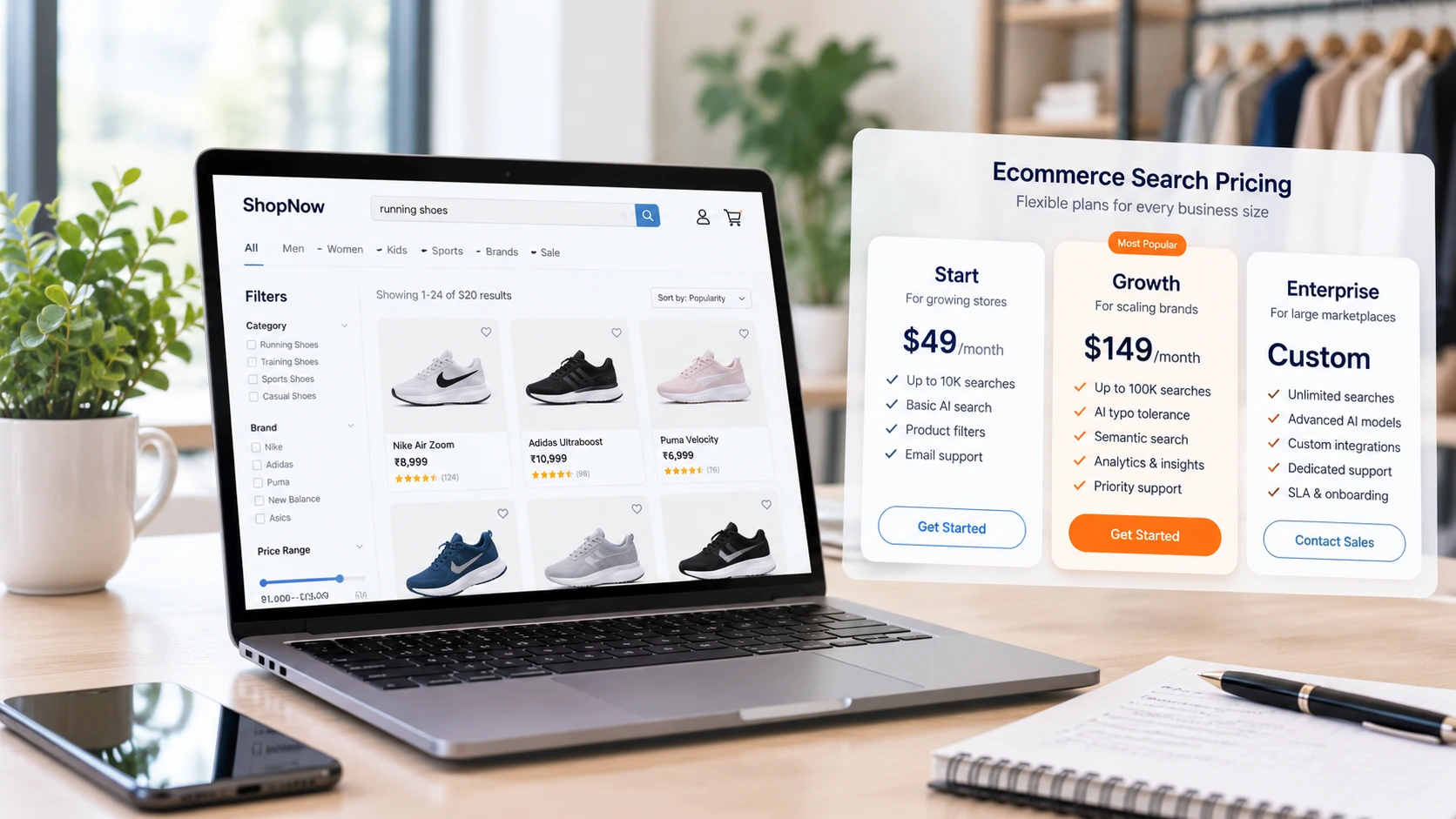
Why search pricing is hard to compare
The unit.
Searches, API requests, product records, compute hours or a flat fee.
What is included.
AI ranking, personalization, recommendations and analytics may be bundled or sold separately.
How it scales.
Some prices stay flat as traffic grows, while others rise with every extra search.
The fine print.
Overage charges, minimum commitments and annual price increases.
So the cheapest quote on paper is not always the cheapest search over three years.
AI Search Grader by bCloud AI
Grade your ecommerce search in 10 quick questions
31% of ecommerce searches return zero results — and most shoppers who hit a dead end leave for a competitor. How does your store's search stack up?
Answer 10 short questions and get your AI search score, plus a personalized report to fix the gaps. Free, takes about 2 minutes.
No signup needed to take the quiz.
Understanding intent…
Scoring your answers across relevance, AI, experience, and insights.
Your AI search score is ready
Tell us where to send your personalized report. You'll see your score and recommendations right away.
Your score by pillar
Personalized recommendations
Fix the gaps in weeks, not quarters
bCloud AI replaces keyword-only search with hybrid AI retrieval — sub-200ms responses, 99.99% uptime, and conversion lifts of up to 40% across 50+ implementations.
The four common search pricing models
Infrastructure-based pricing is common when you run search on a cloud service yourself. For example, Amazon OpenSearch Service bills managed clusters for instance hours, storage and data transfer, with no separate per-query fee (AWS). Your costs then depend on how much capacity you need, plus the team that runs it.
Many vendors combine models, such as a base platform fee plus usage. Map every quote back to these four building blocks before you compare search pricing.
What counts as a “search”?
Under usage-based search pricing, this question matters more than the unit price.
A single shopper visit can trigger many requests:
Autocomplete.
Many setups send a request as the shopper types, so one query can create several requests.
Filters and sorting.
Each filter tap or sort change may count as a new search.
Pagination.
Loading page two of results may count again.
Recommendations.
Some vendors bill recommendation calls separately.
Bots.
Crawlers and scrapers can trigger searches you pay for.
Here is the math. If each search session triggers six autocomplete requests, one results request and two filter changes, that is nine billable requests. At 100,000 sessions a month, you pay for 900,000 requests, not 100,000 searches. Always ask vendors exactly what they count.
Hidden costs beyond the price tag
The license fee is rarely the full cost of site search. Budget for these too:
Implementation and integration.
Connecting your catalog, storefront and analytics takes time, whether it is your team or the vendor’s.
Data preparation.
Messy product data limits any search engine. Cleaning and enriching attributes is often the biggest hidden job. See ecommerce search enrichment.
AI add-ons.
Semantic search, personalization and recommendations may be priced separately.
Ongoing tuning.
Rules, synonyms and relevance tuning need people, every week.
Support level.
Faster response times and dedicated help often cost more.
Migration and exit.
Switching later costs time and money, so check how easily you can leave.
How search pricing changes as you grow
Search pricing that looks fine today can surprise you next year. Three things drive the change.
Traffic growth.
Under usage-based pricing, every successful marketing campaign raises your search bill.
Peak seasons.
November and December traffic can multiply search volume. Ask how pricing handles a peak month, not just an average one.
Catalog growth.
Under per-record pricing, adding product lines, variants or new markets raises costs even if traffic stays flat. See AI search for large catalogs.
Model your costs at today’s volume, at two to three times today’s volume and at your peak month. That shows how each option behaves as you succeed.
7 smart ways to compare search pricing
1. Model your real request volume
Pull a month of real traffic, including autocomplete, filters and pagination. Use that, not a vendor’s estimate, to price each option.
2. Price three scenarios
Compare every vendor at current volume, at growth volume and at peak-month volume. The ranking often changes between scenarios.
3. List every add-on you need
Write down the features you actually need, such as semantic search, personalization, recommendations and analytics. Price each vendor with all of them included.
4. Ask about overage
Find out exactly what happens when you exceed your plan: automatic charges, throttling or a forced upgrade.
5. Calculate total cost over three years
Add license fees, implementation, data work, team time and expected price increases. Three-year total cost of ownership is a fairer comparison than a monthly fee.
6. Compare value, not only cost
A cheaper search that converts worse can cost more in lost revenue. Run a short proof of concept on your own catalog and compare conversion, not just invoices. See A/B testing ecommerce search.
7. Read the contract terms
Check term length, renewal increases, data ownership and what happens to your data and configuration if you leave.
Questions to ask every vendor about search pricing
What exactly counts as a billable search or request?
Are autocomplete, filter and pagination requests billed?
What does the price include, and which features cost extra?
What happens if we exceed our plan in a peak month?
How does pricing change if our catalog doubles?
Are there implementation, onboarding or support fees?
How much can the price rise at renewal?
Who owns our data and configuration if we leave?
Get the answers in writing. They often matter more than the headline price.
Weigh the cost against the revenue
Search pricing only makes sense next to what search earns. A simple model helps.
Take your monthly search sessions, multiply by the expected lift in search conversion and by your average order value. Compare that monthly revenue gain with the monthly cost of each option. If a slightly more expensive search lifts conversion meaningfully, it may still be the cheaper choice overall. For a quick estimate, try the bCloud pricing estimator.
A simple example
Picture a mid-market home goods store on a usage-based plan. Most of the year, the search bill is predictable.
Then November arrives. Traffic triples, autocomplete fires on every keystroke and a holiday campaign drives a burst of filter-heavy browsing. The search bill for the month jumps well past budget, right when margins are tight from discounts.
Under a flat-rate plan, the same month costs the same as any other. The team can focus on selling instead of watching request counts.
Search pricing for B2B and large catalogs
B2B stores and large catalogs face their own pricing traps. Per-record models can get expensive when every size, color or pack quantity counts as a separate record. Customer-specific price lists and catalogs may also add complexity.
Ask how variants and price lists are counted before you compare quotes. See B2B ecommerce search.
Search pricing by business size
Different stores feel search pricing differently.
Small and growing stores.
Traffic is modest but growing fast. Predictable search pricing protects you from bills that rise with every successful campaign. Built-in platform search may be enough at first, but watch zero results and search conversion as you grow.
Mid-market retailers.
Traffic is significant and peaks are sharp. This is where usage-based search pricing can swing the most between average and peak months, so model both before you sign.
Enterprise and large catalogs.
Volume is high and catalogs are complex. Total cost depends heavily on implementation, data work and support, so compare three-year totals, not monthly list prices.
Whatever your size, the right search pricing model is the one whose cost you can predict and whose value you can measure.
Build vs buy: what in-house search really costs
Some teams consider building search themselves on open-source engines or cloud services. The software may be free or billed by infrastructure, but true search pricing includes people.
You will need engineers to build and maintain indexing, relevance tuning, autocomplete, analytics and AI features. You will also need to run infrastructure, plan for peaks and handle upgrades. Those salaries often outweigh any license savings.
Building can make sense for companies with large search teams and unusual needs. For most retailers, a managed platform delivers better relevance sooner, with search pricing that is easier to forecast. See search as a service.
When to revisit your search pricing
Review your search costs at least once a year, and sooner if something big changes. Good triggers include a contract renewal, a jump in traffic, a large catalog expansion, a replatforming project or a move into new markets. Each one can change which pricing model suits you best.
Before renewal, pull the last 12 months of usage and invoices, including peak months. Then compare what you paid with what search earned. That gives you real numbers to negotiate with, or a clear case to switch.
Common search pricing mistakes
Comparing headline prices only.
Add-ons, overage and team time change the real total.
Ignoring autocomplete requests.
They can multiply usage-based bills.
Pricing an average month.
Your peak month is the one that hurts.
Choosing on cost alone.
Lost conversions often cost more than the license.
Skipping the exit terms.
Leaving a vendor later can be slow and expensive.
Where bCloud AI fits
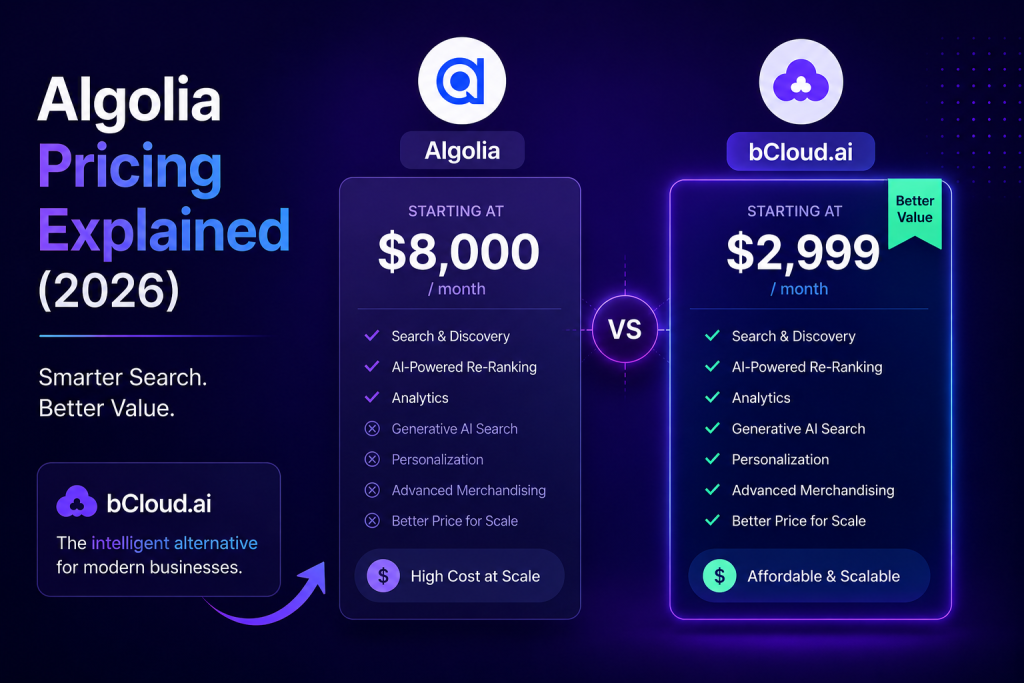
bCloud AI charges one flat monthly fee that covers unlimited searches, so your cost does not increase as search volume grows. That makes search pricing predictable through peak seasons and growth. AI search, search analytics and merchandising controls work together on one platform. See pricing for current plans, or estimate your savings with the pricing estimator.
The bottom line on ecommerce search pricing
Search pricing is not just a number on a quote. It is a model that behaves differently as your traffic, catalog and business grow.
Map every quote to its pricing model, count requests the way vendors do, price your peak month, list every add-on and compare three-year costs. Then weigh cost against revenue, because the best value is the search that sells the most for a predictable price.
Frequently asked questions
How much does ecommerce site search cost?
It varies widely by pricing model, traffic, catalog size and features. Compare total cost over three years, including add-ons, implementation and team time, rather than the headline fee.
What are the main ecommerce search pricing models?
The four common models are usage-based pricing per search or request, per-record pricing, infrastructure-based pricing and flat-rate pricing. Many vendors combine them.
What counts as a search in usage-based pricing?
It depends on the vendor. Autocomplete keystrokes, filter changes, pagination and recommendation calls may all count as billable requests, so always ask.
Is flat-rate search pricing better than per-search pricing?
Flat-rate pricing is more predictable, especially during peak seasons and growth. Usage-based pricing can be cheaper at very low volume but rises with traffic.
What hidden costs should I expect with site search?
Common hidden costs include implementation, data preparation, AI add-ons, ongoing tuning, premium support and migration if you switch later.
How do peak seasons affect search pricing?
Under usage-based pricing, peak months such as November and December can multiply your bill. Flat-rate plans keep the cost the same within the plan.
How should I compare search vendors on price?
Model real request volume, price current, growth and peak scenarios, include every add-on, calculate three-year total cost and test conversion on your own catalog.
Does cheaper search cost less overall?
Not always. A search that converts worse can lose more revenue than it saves, so compare value as well as price.
How is bCloud AI priced?
bCloud AI charges one flat monthly fee that covers unlimited searches, so cost does not rise with search volume. Current plans are on the bCloud pricing page.
Search pricing you can plan around.
bCloud AI covers unlimited searches for one flat monthly fee, so peak season never brings a surprise bill. See it on your own catalog.
bcloud.ai