
What is B2B ecommerce search?
Why B2B search is harder than B2C
The challenges that make a consumer search box “good enough” fall apart in B2B:
Massive catalogs
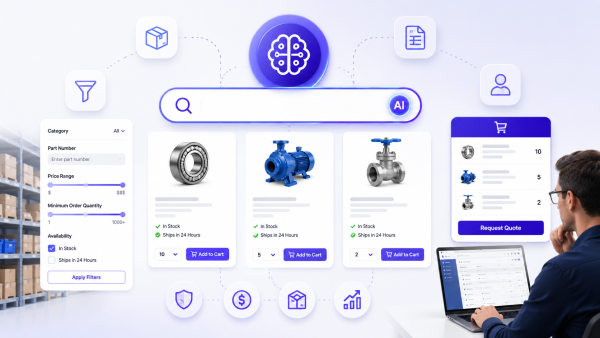
Distributors routinely carry hundreds of thousands of SKUs, with deep variant trees and overlapping attributes.
Part numbers & SKUs
Buyers search exact codes — and a single transposed character on a basic search engine returns nothing.
Technical specifications
Queries combine multiple attributes (“316 stainless, 2-inch, NPT thread”) that demand precise, multi-facet filtering.
Industry language & synonyms
The same component has five names across manufacturers; buyers expect the store to know them all.
Account-specific relevance
Different customers see different catalogs, pricing tiers, and contract items — results should respect that context.
Repeat & bulk ordering
B2B is reorder-heavy; the faster a buyer finds and re-adds known items, the more they buy.
AI Search Grader by bCloud AI
Grade your ecommerce search in 10 quick questions
31% of ecommerce searches return zero results — and most shoppers who hit a dead end leave for a competitor. How does your store's search stack up?
Answer 10 short questions and get your AI search score, plus a personalized report to fix the gaps. Free, takes about 2 minutes.
No signup needed to take the quiz.
Understanding intent…
Scoring your answers across relevance, AI, experience, and insights.
Your AI search score is ready
Tell us where to send your personalized report. You'll see your score and recommendations right away.
Your score by pillar
Personalized recommendations
Fix the gaps in weeks, not quarters
bCloud AI replaces keyword-only search with hybrid AI retrieval — sub-200ms responses, 99.99% uptime, and conversion lifts of up to 40% across 50+ implementations.
How AI solves B2B search
A genuine AI B2B search engine addresses each of those challenges directly:
Semantic & synonym understanding
Maps industry terms and alternate names to the right products, so a buyer never has to guess your exact naming.
Typo & fuzzy matching
Catches transposed SKUs and part numbers instead of dead-ending on a “no results” page.
Deep faceted filtering
Lets buyers narrow by spec after spec without ever losing the thread of their search.
Account-aware personalization
Surfaces the items and variants a given customer actually orders, respecting their catalog and contract.
Hybrid speed at scale
Keyword precision plus vector search, in well under a second — fast even across enormous catalogs where legacy search crawls.
Conversational layer
For complex requirements, buyers describe what they need in plain language and refine from there.
The business case for B2B search
In B2B, search quality is a direct lever on revenue and cost. Professional buyers value speed above almost everything — a store that lets them find and reorder in seconds wins more of their spend.
↑ Self-service
Higher self-service rates
Fewer sales and support calls for routine orders.
↑ AOV
Larger orders
Related and bulk items surface alongside the search.
↑ Reorder speed
Faster reordering
Quick re-adds of known items deepen account loyalty.
↓ Abandonment
Fewer dead ends
Zero-result frustration stops sending carts away.
For distributors, shifting even routine reorders from phone to self-serve search frees your team to focus on high-value accounts.
What to look for in a B2B search platform
When you evaluate a B2B search engine, weight these heavily:
| Look for | Why it matters in B2B |
|---|---|
| Scale | Proven performance across hundreds of thousands of SKUs without latency creep |
| Exact + fuzzy SKU / part-number matching | Catches precise codes and transposed characters alike |
| Deep faceted filtering | Buyers narrow by many technical specs at once |
| Semantic + synonym understanding | Maps industry terminology and alternate names to the right products |
| Account-aware personalization | Respects customer-specific catalogs, contract items, and reorder history |
| Native integrations | Connects to your B2B commerce platform (e.g., Adobe Commerce/Magento, BigCommerce, custom/headless via API) |
| Reliability | Enterprise uptime (99.99%) and security — your catalog and data stay protected |
| Analytics | Zero-result and query reporting to find gaps in catalog coverage |
A useful demo test: search a real part number with a deliberate typo, then layer three technical filters. If the right product still surfaces quickly, the engine is built for B2B. If it isn’t, your buyers will find out the hard way.
AI-powered B2B search improves the buying experience by bringing precision, context, and speed together in one search journey. A professional buyer can enter an exact part number, search using an industry synonym, correct a typo, or combine several technical specifications without having to understand how the catalog is structured. The system can then use account context, product attributes, previous orders, and real-time catalog information to surface the most relevant items. This reduces the time buyers spend searching and makes complex purchasing tasks easier to complete, especially when large catalogs and repeat orders are involved.
B2B search and AI visibility
Common B2B search mistakes to avoid
Industries That Benefit Most from AI-Powered B2B Ecommerce Search
Although every B2B business depends on fast product discovery, some industries rely on search more than others. Large catalogs, technical specifications, part numbers, and repeat purchasing make AI-powered search a competitive advantage rather than a convenience.
Manufacturing
Manufacturers manage thousands of technical components, replacement parts, and industrial equipment. AI search helps buyers locate the correct products using specifications, dimensions, or part numbers.
Wholesale Distribution
Distributors often maintain catalogs containing hundreds of thousands of SKUs. Intelligent search enables procurement teams to find products quickly while simplifying bulk reorders.
Electrical & Industrial Supplies
Buyers search using manufacturer codes, voltage ratings, sizes, and certifications. AI search understands these technical queries and delivers accurate results instantly.
Medical & Healthcare Suppliers
Hospitals and healthcare providers need fast access to compliant medical products. AI search minimizes ordering errors while improving procurement efficiency.
Automotive & Heavy Equipment
Dealers and service centers frequently search using OEM numbers and compatibility information. Intelligent search dramatically reduces the time needed to identify replacement parts.
Technology & IT Hardware
Complex product catalogs containing servers, networking devices, and accessories benefit from AI-driven filtering, semantic search, and personalized recommendations.
One Common Challenge Across Every Industry
Whether you’re selling industrial machinery, medical equipment, electrical components, or wholesale products, professional buyers expect to find exactly what they need within seconds. AI-powered B2B ecommerce search eliminates the friction caused by large catalogs, technical terminology, and complex purchasing requirements, creating faster buying experiences while reducing support costs and increasing revenue.
Frequently asked questions
What is B2B ecommerce search?
B2B ecommerce search is site-search built for professional buyers on wholesale, distribution, and manufacturer stores. It handles large, technical catalogs — part numbers, SKUs, specifications, and industry terminology — and returns precise results fast so buyers can self-serve instead of calling.
How is B2B search different from B2C search?
B2B catalogs are larger and more technical, buyers search by exact part numbers and multiple specs, the same product has many industry names, and results often need to respect account-specific catalogs and pricing. B2B search prioritizes speed and precision over discovery and inspiration.
Can AI search handle exact part numbers and SKUs?
Yes. A strong AI B2B search engine matches exact codes and tolerates transposed characters, while semantic understanding maps industry synonyms and technical terms to the right products.
Does AI B2B search work with platforms like Adobe Commerce/Magento and BigCommerce?
Yes. Leading platforms integrate with major B2B commerce systems and offer a REST API for custom or headless storefronts.
How does better B2B search affect revenue?
It raises self-service rates, increases average and bulk order sizes, speeds reordering, and reduces zero-result abandonment — while freeing your sales team from routine order-taking.
Give B2B buyers search that keeps up.
bCloud AI delivers semantic, SKU-precise, account-aware search across catalogs of any size — fast enough for professional buyers, accurate enough to cut the support calls. See it on your catalog.
bcloud.ai
Go deeper
Start with our complete guide to AI search for ecommerce, which breaks down how semantic search, vector embeddings, and LLMs turn shopper intent into relevant results in milliseconds. From there, see the AI ecommerce search engine that powers it — bCloud AI’s hybrid keyword-and-vector platform built to lift conversions in under 200ms. And because buyers increasingly discover products through ChatGPT, Gemini, and Google AI Overviews, it’s worth understanding AI visibility for ecommerce and how a clean, structured catalog gets your store recommended by AI. If you’re weighing your options, our roundup of the best AI ecommerce search platforms for 2026 stacks the leading providers side by side.