
Why semantics and personalization share one foundation
The mechanism is worth understanding, because it explains why some AI ecommerce search platforms for retail deliver both cheaply and others charge separately for each.
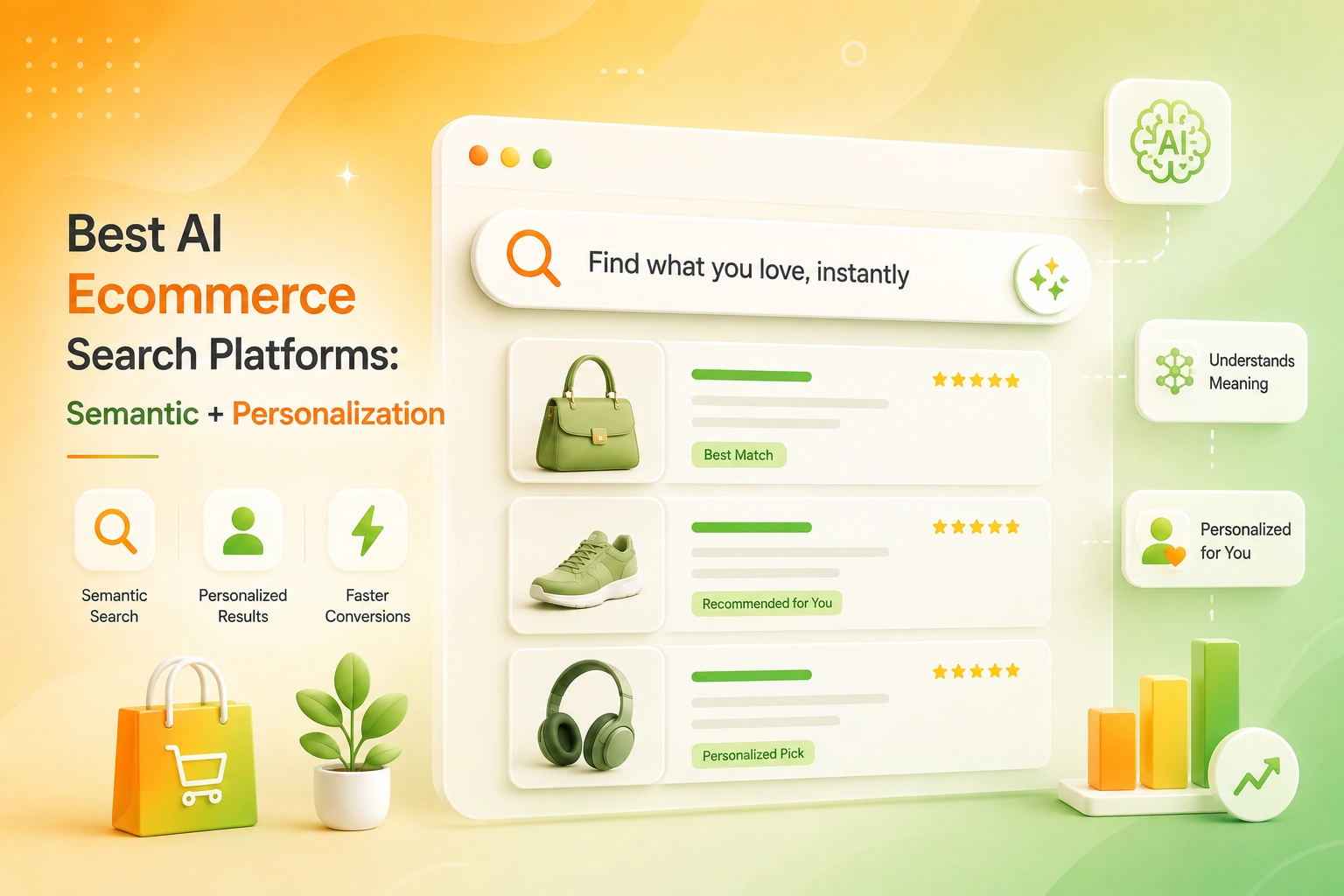
Semantic search converts products and queries into vectors that capture meaning, then retrieves the closest matches. Personalization converts shoppers into vectors — built from browsing history, purchases, and the current session — in the same vector space. Once both exist, “products this person will like” becomes the same mathematical operation as “products matching this query.”
That’s the architectural insight. A platform with genuine vector infrastructure gets personalization almost for free, because the machinery already exists. A platform that layered semantics onto a keyword engine has to build personalization separately, which is why it often arrives later, works worse, and costs extra. The underlying model family is well documented in Wikipedia’s recommender system entry, and our guide to vector search personalization covers the ecommerce implementation in depth.
For a wider view across relevance approaches, our roundup of the top semantic search solutions for e-commerce compares the field on understanding quality specifically.
The 7 best AI ecommerce search platforms for semantic search and personalization
1. bCloud AI — best integrated semantic and personalization
Hybrid BM25 + vector retrieval with personalization running on the same vector foundation, plus conversational search and AI recommendations on one stack. Sub-200ms cached responses, models retraining weekly on real clicks and purchases, 40+ languages. The commercial differentiator: semantic capability and personalization are included at every tier rather than sold as enterprise add-ons, with catalog-based pricing that stays flat through traffic spikes. Free tier covers 20,000 searches and 100,000 records with free implementation. Best for: mid-market retailers who want both capabilities without an enterprise contract.
2. Constructor — best of the behavioral AI ecommerce search platforms
Built to optimize toward conversion and revenue using clickstream and purchase behavior, which makes personalization the core of the product rather than a feature. Genuinely strong in high-SKU fashion and marketplace environments where the long tail is the business. Custom, sales-led pricing with a 30-day trial. Best for: enterprise retailers measuring search on revenue outcomes.
3. Algolia (NeuralSearch) — best developer control
Excellent tooling, 200+ integrations, and a free 10,000-request tier. Both halves exist — NeuralSearch for semantics, personalization as a separate capability — but NeuralSearch sits on the top-tier Elevate plan, so mid-market buyers frequently find the semantic layer they’re evaluating isn’t in the plan they’re quoted. Per-query pricing scales with traffic. Best for: engineering-led teams with enterprise budget.
4. Coveo — best enterprise AI ecommerce search platforms option
Mature machine-learning ranking with hybrid retrieval and personalization spanning commerce and support surfaces. Among the most sophisticated personalization on this list, with a correspondingly heavier implementation and enterprise pricing. Best for: large organizations personalizing across multiple properties.
5. Bloomreach Discovery — best suite-level personalization
Combines AI search with customer-data and content modules, which enables personalization informed by more than on-site behavior. The structural caveat: real-time personalized search requires both the Discovery and Engagement modules, so the capability you want may need two purchases. Commonly $50K+ annually with 3–6 month implementations. Best for: enterprises consolidating CDP and search.
6. Klevu — best mid-market balance among AI ecommerce search platforms
Strong NLP-driven semantic discovery with personalization and mature merchandising automation, long established among Shopify and Magento retailers. Quote-based annual pricing, 14-day trial, no permanent free plan. Best for: catalog retailers wanting proven merchandising alongside semantics.
7. Weaviate / Typesense — best open-source foundation
Both provide genuine vector infrastructure with hybrid retrieval, which means personalization is buildable on the same foundation — but buildable is the operative word, since neither ships commerce personalization out of the box. Best for: engineering teams constructing custom discovery.
AI Search Grader by bCloud AI
Grade your ecommerce search in 10 quick questions
31% of ecommerce searches return zero results — and most shoppers who hit a dead end leave for a competitor. How does your store's search stack up?
Answer 10 short questions and get your AI search score, plus a personalized report to fix the gaps. Free, takes about 2 minutes.
No signup needed to take the quiz.
Understanding intent…
Scoring your answers across relevance, AI, experience, and insights.
Your AI search score is ready
Tell us where to send your personalized report. You'll see your score and recommendations right away.
Your score by pillar
Personalized recommendations
Fix the gaps in weeks, not quarters
bCloud AI replaces keyword-only search with hybrid AI retrieval — sub-200ms responses, 99.99% uptime, and conversion lifts of up to 40% across 50+ implementations.
What “personalization” actually means in AI ecommerce search platforms
Across AI ecommerce search platforms the word covers three quite different capabilities, and vendors rarely distinguish them. Ask which you’re getting.
Session personalization.
The current visit shapes results — products viewed, filters applied, queries typed. This needs no history, works for anonymous first-time visitors, and resolves ambiguity immediately. Someone who viewed three pairs of trail shoes gets trail-weighted results for “running shoes.” Highest value per unit of effort, and the safest to deploy.
Historical personalization.
Long-term taste built from past purchases and browsing, aggregated into a vector. Powerful for returning shoppers and reorder-heavy catalogs, and useless for new visitors — which is why it must degrade gracefully rather than being the only mode.
Learned personalization.
Trained models — commonly two-tower architectures — that place shoppers near products they’ll engage with, capturing brand affinity and price sensitivity that simple averaging misses. The most sophisticated option, and the one requiring the most behavioral data to work.
The best AI ecommerce search platforms blend all three and, critically, keep the query dominant. Personalization should reorder among genuinely relevant results, never override what the shopper asked for. A system that shows sneakers to someone searching “formal dress shoes” because they usually buy sneakers has over-personalized, and that failure erodes trust faster than generic results ever would.
How much personalization to apply, and when
Personalization is not one dial set once. The right strength varies by query.
Some searches carry clear intent, so personal signals should barely touch them. Others are wide open, and that is where personal weighting earns its place. Good AI ecommerce search platforms let you express that difference. Here is how the three cases split.
Specific queries: almost none.
A SKU or exact product name leaves nothing to interpret. Therefore personalization should only break ties, such as which seller or variant appears first. Anything more is noise.
Broad category queries: the sweet spot.
“Running shoes” returns hundreds of valid results. Personal signals decide the order without contradicting anyone. This is where most of your measured lift will come from.
Gift and occasion queries: dial it down.
Shoppers buying for someone else want results unlike their own taste. However, most systems cannot tell the difference. Watch these queries closely after launch.
In short, tie personalization strength to how ambiguous the query is. Ask vendors whether that weighting is configurable or fixed, since a single global setting forces one compromise across all three cases. Our vector search personalization guide covers how the weighting works.
How to evaluate the combination
Five tests for AI ecommerce search platforms, run on your own catalog.
Semantic understanding.
Pull a hundred real queries from your logs — typos, long descriptions, problem-framed searches. Score which platform surfaces the right product on the first screen. Baymard Institute’s research consistently finds these query types break site search, which is exactly why they’re the useful test.
The exact-match floor.
Semantics must not compromise precision. Type SKUs and model numbers; they must resolve literally. This is why hybrid retrieval matters — our hybrid search guide covers the mechanics.
Personalization without override.
Search something that contradicts a test profile’s history — “formal shoes” on a profile full of athletic purchases. Relevance must win. Platforms failing this test are weighting the user vector too heavily.
Cold-start behavior.
Check what a brand-new anonymous visitor sees. It should be strong unpersonalized relevance, with session signals engaging within two or three interactions.
Provable lift.
Can the platform roll out against a permanent control group and report search conversion, revenue per search, and zero-result rate by segment? Personalization is exactly the feature that demos well and needs measurement — our search relevance metrics and A/B testing guides cover the methodology.
The pricing question that catches mid-market buyers
Among AI ecommerce search platforms for retail, semantic search and personalization are the two capabilities most often gated behind higher tiers — and they’re gated independently, which compounds.
Ask three questions before any quote is meaningful. Which tier includes semantic or vector search? Which tier includes real-time personalization? And does personalization require a second module or product? Bloomreach’s Discovery-plus-Engagement requirement is the clearest example, but variations exist across the category.
Then model your total at three times current traffic and twice your catalog, on the tier that actually includes both capabilities. That number — not the entry rate — is the comparison. Teams routinely discover the platform that looked cheapest is the most expensive once configured to do what they’re buying it for.
Where the two capabilities are gated differently
A practical warning drawn from real evaluations: among AI ecommerce search platforms, semantic search and personalization are frequently sold on different axes, and the combinations catch buyers out.
Some platforms include semantics broadly but reserve real-time personalization for higher tiers. Others do the reverse — basic personalization everywhere, vector search only at enterprise level. A third pattern, common in suite vendors, requires a second product entirely: Bloomreach’s real-time personalized search needing both Discovery and Engagement is the clearest published example, and variations exist elsewhere.
Three questions resolve it before any quote means anything. Which tier includes semantic or vector retrieval? Which tier includes real-time personalization? Does either require an additional module or SKU? Get the answers in writing, because “our platform supports personalization” and “the plan we quoted you includes personalization” are different statements that sound identical in a demo.
Then model your total on the tier that includes both, at three times current traffic and twice your catalog. Teams routinely find the platform that looked cheapest at the entry tier is the most expensive once configured to do the job they’re buying it for — and that inversion is worth discovering before signing rather than at renewal.
What changed in 2026
Both capabilities became baseline claims across AI ecommerce search platforms. Nearly every vendor now advertises semantic search and personalization, so the useful questions moved to implementation quality and tier placement rather than presence.
Measurement became the differentiator. Buyers increasingly expect control-group proof rather than case studies, and platforms that can’t produce it are screened out earlier.
The shared foundation inside AI ecommerce search platforms became visible externally. The same structured, semantically indexed catalog powering on-site search is what external AI assistants read when recommending products. Investing in AI ecommerce search platforms with genuine vector foundations improves discovery on your site and your representation inside AI-generated answers.
Common mistakes
- Buying personalization from AI ecommerce search platforms before relevance works. Personalization multiplies good search and merely rearranges bad search. Fix baseline relevance first.
- Letting the user vector outweigh the query. The most common over-personalization failure, and the most damaging to trust.
- Ignoring cold start when comparing AI ecommerce search platforms. Most traffic on many stores is new or anonymous. If personalization degrades poorly, you’ve optimized for your minority.
- Skipping the permanent holdout when deploying AI ecommerce search platforms. Personalization quality drifts as models and catalogs change. A launch-only test tells you nothing a year later.
- Thin product data underneath AI ecommerce search platforms. Semantic understanding is capped by what your catalog expresses. Enrichment before platform selection moves results more than configuration afterward.
Frequently asked questions
What are the best AI ecommerce search platforms for semantic search and personalization?
The 2026 leaders are bCloud AI (both included at every tier on a shared vector foundation), Constructor (behavioral personalization at its core), Algolia (strong tooling, semantics on the top tier), Coveo (enterprise ML across properties), Bloomreach Discovery (suite-level, requires two modules), Klevu (mid-market balance), and Weaviate or Typesense as open-source foundations.
Why do semantic search and personalization work better together?
Because they share one mechanism. Semantic search represents products and queries as vectors; personalization represents shoppers in the same space. Once both exist, tailoring results is the same operation as matching them — which is why platforms with genuine vector infrastructure deliver both efficiently while bolt-on architectures charge separately.
Does personalization override what I searched for?
It shouldn’t. Well-built AI ecommerce search platforms keep the query dominant and use personal signals only to reorder among genuinely relevant results. Test this explicitly by searching something that contradicts a profile’s history — relevance must win.
How does personalization work for new visitors?
Through session signals rather than history. A visitor’s first few product views and filter choices build a session vector within a couple of interactions. Before that, results fall back to strong unpersonalized relevance — personalization should be a layer on good search, never a substitute for it.
Is personalization worth it for smaller stores?
Usually yes, at the session level, provided baseline relevance is solid. Session personalization needs no long histories and immediately helps with ambiguous queries. Measure it with a held-out control so the lift is proven on your own traffic.
How do I know if personalization is actually working?
Run a permanent holdout and compare search conversion and revenue per search between personalized and control groups, segmented by new versus returning visitors. Expect near-zero effect on first-time traffic and clear lift on repeat traffic; any other pattern means the weighting or fallback is miscalibrated.
Semantic understanding and personalization on one foundation.
bCloud AI runs both on the same vector engine — included at every tier, measured against a live control, priced on your catalog.
bcloud.ai