
What SaaS semantic search actually means
SaaS semantic search is hosted, managed semantic search delivered through an API and connectors: the vendor operates the embedding models, vector index, fusion logic, ranking, and infrastructure, while you send your catalog and call their endpoints. It’s the software-as-a-service model applied to product discovery — capability as a subscription, infrastructure as somebody else’s problem.
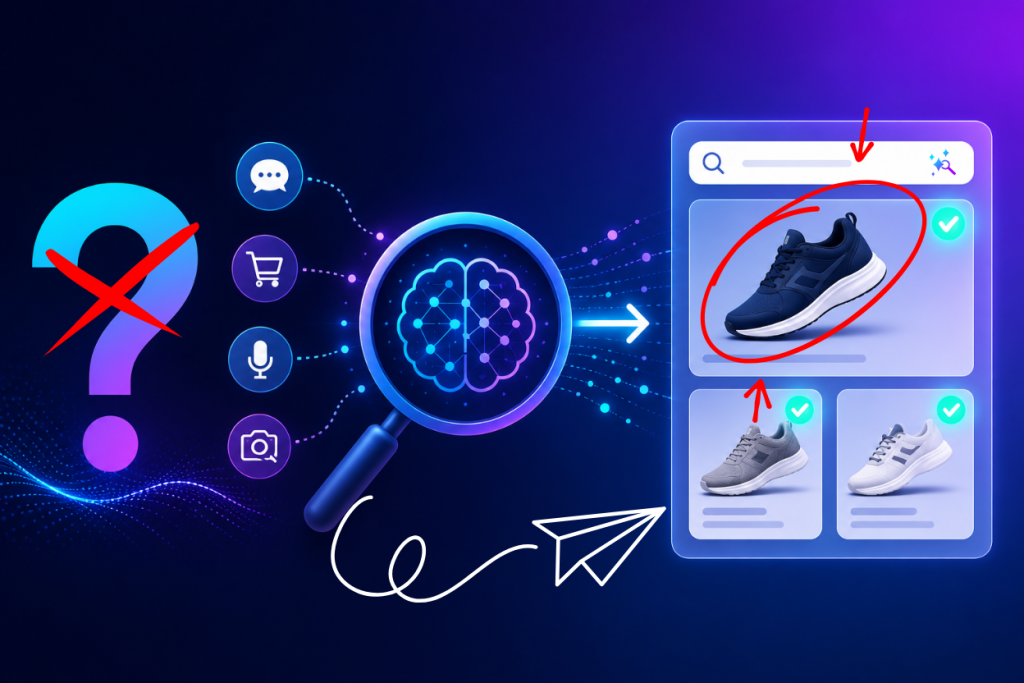
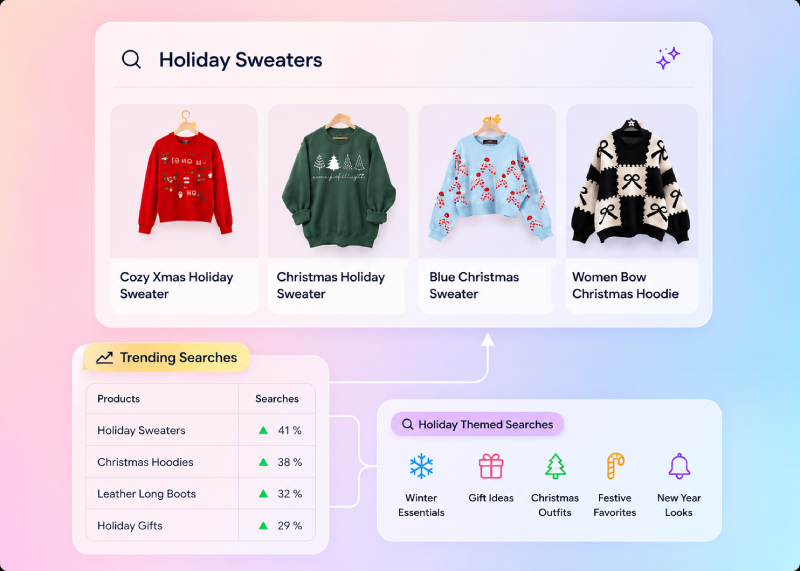
The capability itself is unchanged by the delivery model. Semantic search converts products and queries into vectors that capture meaning, so “warm jacket for a rainy commute” returns rain shells with no exact match required. What SaaS changes is who runs it.
The contrast is self-hosting: standing up Elasticsearch, Typesense, Weaviate, or a vector database plus your own embedding pipeline, then owning cluster sizing, index lifecycle, model migrations, relevance tuning, and uptime permanently. For vendor-by-vendor comparison across both models, see our roundup of the top semantic search solutions for e-commerce; this guide focuses on the delivery decision underneath it.
What SaaS semantic search solutions include
The value is in the surface area you don’t have to build. A mature SaaS semantic search platform ships:
The embedding pipeline.
Model selection, catalog embedding, incremental updates as products change, and — critically — re-embedding when the vendor upgrades models. That last item is a genuine migration project when you own it, and invisible when you don’t.
The vector index and retrieval layer.
Approximate nearest-neighbor indexing, memory management, quantization strategy, and recall tuning, all operated at scale the vendor has already reached.
Hybrid fusion.
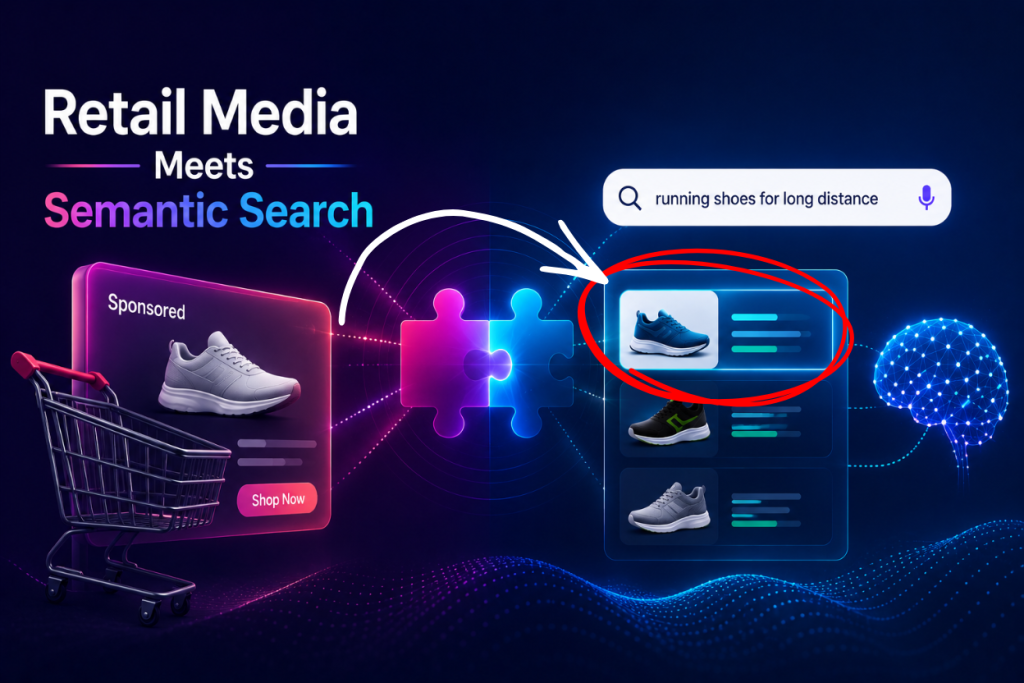
Keyword and semantic retrieval blended so exact SKUs resolve literally while descriptive queries resolve by meaning. Our hybrid search guide covers why semantic-only fails in production.
Business ranking and merchandising.
Stock, margin, and conversion signals layered onto relevance, with no-code controls so merchandisers work without engineering tickets.
Real-time indexing.
Price and stock changes searchable in seconds rather than on tonight’s batch — the mechanics are in our real-time indexing guide.
Analytics and measurement.
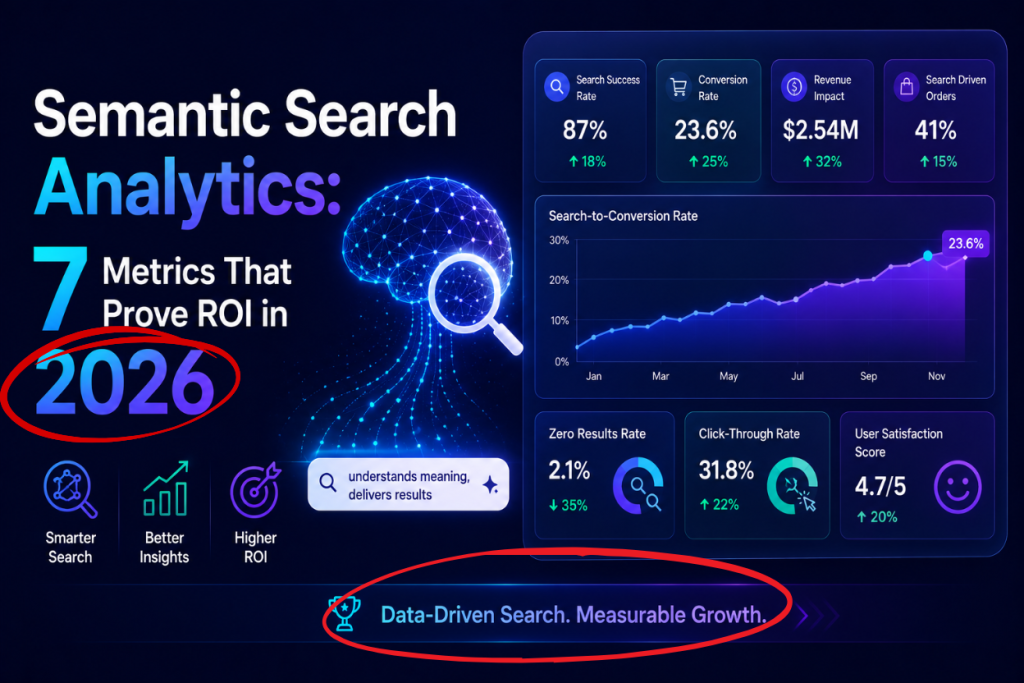
Zero-result reporting, conversion attribution, and ideally control-group rollout so lift is a number rather than a hope.
Assembling that stack yourself is realistically a multi-quarter program. Consuming it as SaaS semantic search is typically a four-to-six-week integration.
AI Search Grader by bCloud AI
Grade your ecommerce search in 10 quick questions
31% of ecommerce searches return zero results — and most shoppers who hit a dead end leave for a competitor. How does your store's search stack up?
Answer 10 short questions and get your AI search score, plus a personalized report to fix the gaps. Free, takes about 2 minutes.
No signup needed to take the quiz.
Understanding intent…
Scoring your answers across relevance, AI, experience, and insights.
Your AI search score is ready
Tell us where to send your personalized report. You'll see your score and recommendations right away.
Your score by pillar
Personalized recommendations
Fix the gaps in weeks, not quarters
bCloud AI replaces keyword-only search with hybrid AI retrieval — sub-200ms responses, 99.99% uptime, and conversion lifts of up to 40% across 50+ implementations.
What stays your responsibility
SaaS removes infrastructure, not accountability. Three things remain yours regardless of vendor, and teams that ignore them blame the platform for their own gaps.
Product data quality.
SaaS semantic search can only understand meaning your catalog expresses. Three-word titles, missing attributes, and inherited supplier copy cap every platform’s ceiling on day one. Audits routinely find a meaningful share of catalogs in exactly that state — and those are the long-tail products semantic retrieval was supposed to rescue. Enrichment before selection moves results more than any configuration afterward.
The synchronization pipeline.
The vendor indexes what you send. Building reliable, event-driven feeds for price, stock, and catalog changes is your side of the line, and stale data undoes any relevance gain.
Schema and indexing decisions.
What gets indexed, at product or variant level, which attributes are filterable — these are business decisions no vendor makes for you, and they materially affect both cost and result quality.
Measurement discipline.
Capture baselines before launch and keep a holdout after. SaaS semantic search vendors provide the dashboards; deciding what “working” means is yours. Our search relevance metrics guide covers the metric set.
The real economics of SaaS semantic search
Pricing comparisons in this category mislead because vendors meter different units. Four shapes exist.
Per-query billing
charges per search request, often with indexed records metered separately. Attractive at low volume, punishing above it — and the two meters compound, so traffic growth and catalog growth stack. Your best sales month becomes your largest invoice.
Catalog and feature-based billing
scales with product count and enabled capabilities, staying flat through traffic spikes. Forecastable against a number you already know.
Resource-based billing
charges for the memory and compute your index consumes, common with open-source clouds. Predictable, but you’re sizing infrastructure rather than buying an outcome.
Enterprise contracts
negotiate annually, sometimes with interlocking modules where the capability you assumed was included requires a second purchase.
Two questions cut through it. Ask where semantic capability sits in the tier structure — several vendors reserve vector search for their top plan, meaning the SaaS semantic search you’re evaluating may not be in the plan you’re quoted. Then model your total at three times current traffic and twice your catalog. That figure is the comparison, not the entry rate.
And when comparing SaaS semantic search against building, price the full picture: infrastructure, embedding inference, and the engineering salaries that self-hosting requires permanently. That last line usually decides it.
When self-hosting wins instead
Being honest here makes the rest of the guide more useful. Self-hosted semantic search is the better call in four situations.
You need architectural control SaaS won’t give.
Custom embedding models, bespoke ranking logic, research-grade experimentation at the index level. Managed platforms will eventually constrain you, and if discovery genuinely differentiates your business, that constraint is expensive.
Data residency or compliance rules exclude available vendors.
Regulated industries and certain jurisdictions narrow the field quickly. Verify certifications and processing regions before a pilot, not after.
You’re at genuine mega-scale.
At extreme volumes, usage-based pricing can exceed the fully loaded cost of a dedicated search team. The math genuinely flips for a small number of companies — and if you’re one of them, you’ll have the data to prove it rather than the suspicion.
You already have search engineers.
If relevance engineering capacity exists and is underused, self-hosting converts a subscription into salary you’re already paying. Our nearest neighbor search guide covers what that team would own.
For everyone else — which is most e-commerce companies — SaaS semantic search wins because relevance engineering is a specialized, never-finished discipline, and search is rarely where a retail business differentiates.
What a SaaS semantic search rollout looks like
Four phases, and the sequence matters more than the vendor.
Weeks 1–2: catalog readiness.
Export your catalog, audit it honestly, and fix what the audit finds — missing attributes, three-word titles, inconsistent categorization. This is the phase teams most want to skip and most regret skipping, because the semantic layer inherits whatever you feed it. Several SaaS semantic search vendors offer AI-assisted enrichment during onboarding, which is worth using.
Weeks 2–3: indexing and relevance review.
The vendor indexes your real catalog, and you review results against a judged query set drawn from your own logs. Verify both extremes here: exact SKUs resolving literally, and full descriptive sentences returning sensible products.
Weeks 3–4: business ranking and merchandising.
Layer stock, margin, and conversion signals onto relevance, then configure the no-code controls your merchandising team will actually use day to day.
Week 4+: measured rollout.
Route a small traffic percentage, watch search conversion, zero-result rate, and tail latency against the control, and ramp in steps as the numbers hold.
The phase most correlated with success is the first one, and the phase most correlated with disappointment is skipping it.
Evaluating SaaS semantic search solutions
Five tests, run on your own catalog rather than a demo index.
The messy-query benchmark.
A hundred real queries from your logs: typos, long descriptions, problem-framed searches. Score which platform surfaces the right product first. This is where semantic quality separates.
The exact-match floor.
SKUs and model numbers must resolve literally. Any SaaS semantic search offering that drifts here lacks a proper lexical layer.
Filtered latency at your scale.
Sub-200ms at p95 and p99 with your real facets applied, under concurrent indexing load. Unfiltered demo numbers predict nothing.
Provable lift.
Can the vendor roll out against a control and report conversion, revenue per search, and zero-result rate? Our A/B testing guide covers the methodology.
Exit terms.
Configuration export, data portability, and contract terms that don’t punish leaving are easiest to secure before signing. A confident vendor won’t resist; resistance is itself information.
Migrating to SaaS semantic search without breaking search
The pattern that protects you is a parallel run. Index your full catalog on the new platform while the existing system keeps serving traffic, then score both against a judged query set — the new platform should beat the old on your metrics before a single shopper sees it. Then ramp: route five percent of searches, watch conversion, zero-results, and latency against the control, and increase in steps.
Migrate the accumulated tuning too, not just the catalog. Synonym lists, ranking rules, and merchandising configuration represent years of work, and the catalog migrates in hours while the institutional knowledge is what gets forgotten. Inventory it first, map what transfers, rebuild what doesn’t.
Done this way, a SaaS semantic search migration is a two-to-four-week overlap with essentially no shopper-visible risk.
Who owns SaaS semantic search after launch
Most teams plan the rollout carefully. Far fewer decide who runs the thing afterwards.
That gap matters, because SaaS semantic search is not a set-and-forget purchase. Vocabulary shifts, catalogs grow, and new categories launch. Meanwhile the system rarely fails loudly, so nobody notices until conversion sags. A light ongoing routine prevents it.
Name one owner.
Usually someone in merchandising rather than engineering. They need the authority to change ranking rules without filing a ticket. Shared ownership means nobody looks.
Read failed queries monthly.
Pull the top hundred searches that returned nothing or converted poorly. They sort themselves into gaps you can fix. This is the highest-value hour in the whole routine.
Re-score the judged set quarterly.
Keep the query set you built during evaluation. Run it again each quarter against the same scoring. Consequently drift shows up as a number rather than a hunch.
Re-index after big catalog changes.
New categories and bulk imports change what your data expresses. Check relevance afterwards rather than assuming the feed handled it. Seasonal ranges are the usual culprit.
In short, budget a few hours a month rather than a headcount. That is still far less than self-hosting demands, and it is what keeps the lift you paid for. Our search relevance metrics guide covers what to score against.
Common mistakes with SaaS semantic search
Five errors account for most disappointing deployments, and every one sits on the buyer’s side of the line.
- Treating it as upload-and-forget. SaaS semantic search removes infrastructure, not ownership. Teams that hand over a catalog and expect magic get mediocre results and blame the vendor; teams that treat the feed as a product get the outcomes the demo promised.
- Skipping the exact-match test. Natural-language demos are seductive, and it’s easy to forget to type a SKU until after launch — when B2B and parts buyers find it first.
- Comparing entry tiers across vendors. If semantic capability sits at different tiers, comparing entry prices compares different products. Price only plans that include what you’re buying.
- No baseline before launch. Without pre-launch zero-result rate, search conversion, and revenue per search, you can never prove the switch worked. Capture them first and keep a holdout after.
- Assuming quality is static. Vocabulary shifts, catalogs grow, and embeddings age. The teams who keep their advantage score quality monthly and act when the trend bends; the ones who treat launch as completion lose ground within two quarters.
Frequently asked questions
What are SaaS semantic search solutions for e-commerce?
SaaS semantic search solutions are hosted, managed semantic search delivered via API and connectors. The vendor operates the embedding models, vector index, hybrid fusion, ranking, and infrastructure while you send your catalog and integrate — typically going live in weeks with no machine-learning staffing required.
How is SaaS semantic search different from self-hosting?
Self-hosting means running your own stack — cluster sizing, index lifecycle, model migrations, relevance tuning, uptime — with maximum control and permanent operational cost. SaaS transfers that infrastructure and much of the relevance engineering to the vendor, turning a multi-quarter build into a four-to-six-week integration.
What stays my responsibility with SaaS semantic search?
Product data quality, the synchronization pipeline for price and stock changes, schema and indexing decisions, and measurement discipline. The vendor indexes what you send, so feed quality and catalog completeness remain yours.
How much do SaaS semantic search solutions cost?
It depends on pricing shape: per-query billing scales with traffic and records, catalog-based pricing stays flat through spikes, resource-based plans price on memory and compute, and enterprise contracts are negotiated annually. Free tiers exist. Model your total at three times traffic before signing, and confirm which tier includes semantic capability.
When is self-hosting better than SaaS semantic search?
When you need architectural control a platform won’t give, when data residency or compliance rules exclude available vendors, at genuine mega-scale where usage pricing exceeds a dedicated team’s cost, or when you already have underused search engineering capacity.
How long does it take to implement?
Four to six weeks is typical for SaaS semantic search including catalog indexing, relevance review on your real data, and a measured traffic-split rollout. Building the equivalent stack yourself is realistically a multi-quarter program.
Semantic search without the infrastructure.
bCloud AI delivers hybrid semantic retrieval, real-time indexing, merchandising, and measurement as managed SaaS — live in about four weeks, priced on your catalog.
bcloud.ai