
What cart abandonment research actually says
Read that list again. Not one of those causes is a search problem. Better retrieval will not make your shipping cheaper or your checkout shorter.
That is the honest boundary, and we are going to hold to it. Anyone selling you search on the promise of fixing cart abandonment is selling you something the research does not support.
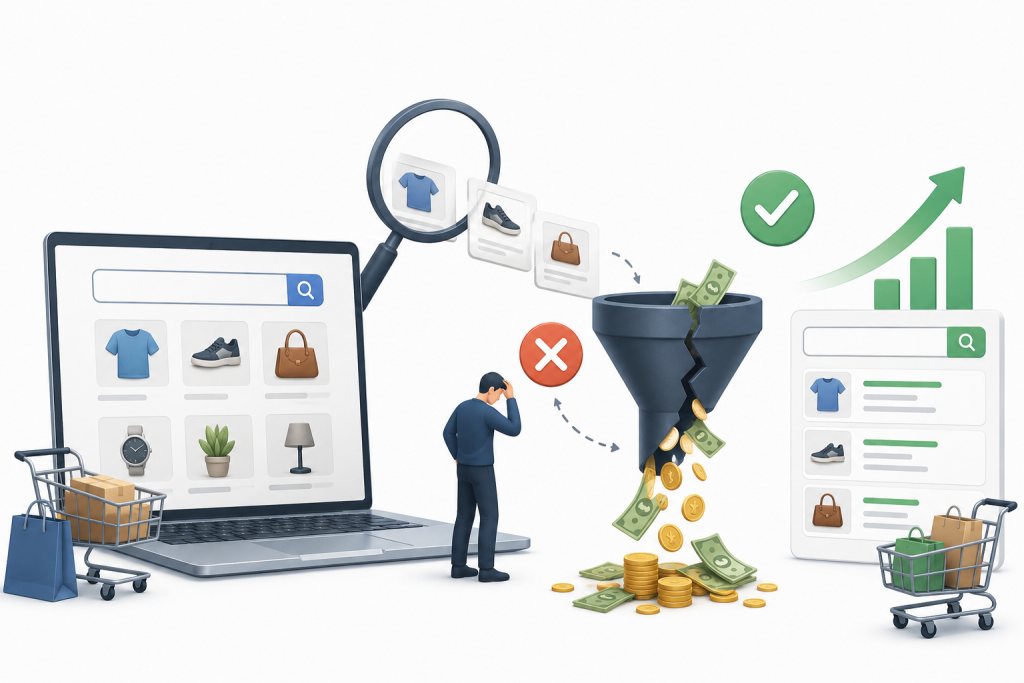
The cart abandonment leak nobody counts
So what does search own? The stage before the cart — and it is a larger population than the cart abandonment stage, because it sits upstream of it.
Consider the arithmetic.
Every abandoned cart
is a shopper who found a product, liked it enough to add it, and then hesitated. That is a shopper who got quite far.
A failed search
is a shopper who told you exactly what they wanted, in their own words, and received nothing they could act on. They did not hesitate. They left with no record of having tried.
Industry usability research has documented for years that site search frequently underperforms badly, with success rates on many sites far below what they could be (Baymard Institute). Those failures do not show up in your cart abandonment rate. They do not show up anywhere unless you look in your search logs.
Call it pre-cart abandonment. It is the leak you can fix with retrieval, and almost nobody has a number for it.
AI Search Grader by bCloud AI
Grade your ecommerce search in 10 quick questions
31% of ecommerce searches return zero results — and most shoppers who hit a dead end leave for a competitor. How does your store's search stack up?
Answer 10 short questions and get your AI search score, plus a personalized report to fix the gaps. Free, takes about 2 minutes.
No signup needed to take the quiz.
Understanding intent…
Scoring your answers across relevance, AI, experience, and insights.
Your AI search score is ready
Tell us where to send your personalized report. You'll see your score and recommendations right away.
Your score by pillar
Personalized recommendations
Fix the gaps in weeks, not quarters
bCloud AI replaces keyword-only search with hybrid AI retrieval — sub-200ms responses, 99.99% uptime, and conversion lifts of up to 40% across 50+ implementations.
How to size pre-cart abandonment this week
This takes about an hour and needs no new tooling.
Multiply step 4 by steps 5 and you have a ceiling on recoverable revenue. It is a ceiling, not a forecast — some of those shoppers would never have bought, exactly as 42 percent of cart abandonment is simply browsing behavior. Apply a conservative recovery assumption, somewhere between a quarter and a half, and you have a defensible number.
In our experience the zero-click count is the one that surprises people. Zero-result searches are visible and often already monitored. Searches that returned twenty irrelevant products and got no click are invisible, and there are usually far more of them. Our guide on covers the diagnosis, and ecommerce search analytics covers the reporting setup.
Why searches fail before cart abandonment is even possible
Five causes account for most of it, and they are fixable in a predictable order.
Vocabulary mismatch.
The shopper uses a word your catalog does not. “Couch” against a catalog of “sofas,” “sneakers” against “trainers,” a trade name against a generic one. This is the single most common cause and the cheapest to fix.
Typos and transpositions.
One wrong character on a part number returns nothing from an exact-match system. For B2B catalogs this is a daily occurrence — see B2B SKU search.
Descriptive queries.
“Something waterproof for a toddler” has no keyword overlap with any product title. Keyword retrieval has nothing to match on. This is what semantic search and hybrid search exist for, and query understanding explains the mechanics.
Attributes trapped outside the index.
The specification the shopper is filtering on lives in a PDF or an image, not a field. No retrieval system can match on data it cannot read.
Stale inventory data.
Results that look right until the shopper clicks through to an out-of-stock page. Functionally a failure, and arguably worse than returning nothing. Real-time indexing is the fix.
What AI search genuinely recovers, and what it does not
Keeping the two columns honest is the whole point of this piece.
If your abandonment problem is concentrated in the right column, fix checkout first. If you have never measured the left column, you are almost certainly leaving more on the table there, because it is unmeasured and therefore untouched.
The cart abandonment sequencing that pays fastest
Four quarters, in this order, because each stage makes the next one measurable and because fixing cart abandonment last is deliberate.
1. Instrument search properly.
Zero-result rate, zero-click rate, search exit rate. You cannot recover what you cannot see.
2. Fix vocabulary.
Build synonyms from your own failed queries, not from a generic dictionary. Fastest payback of anything on this list.
3. Add typo tolerance and hybrid retrieval.
This addresses descriptive queries and exact-identifier errors in one change. See the best hybrid search systems for ecommerce.
4. Enrich the catalog.
Pull trapped attributes into fields. Unglamorous, and it raises the ceiling on everything else.
5. Then work on checkout.
With discovery fixed, more shoppers reach the cart, which makes checkout improvements worth more per point.
Run each stage with a control group so you can attribute the result — A/B testing for ecommerce search and search relevance metrics cover the method. The revenue arithmetic sits in AI search revenue, and the basket-side gains in average order value.
Reporting the two leaks side by side
Most retailers report cart abandonment weekly and search performance never. Putting them on the same page changes the conversation, because it makes the comparison unavoidable.
A simple monthly view does the job. Show cart abandonment rate and recovered revenue from abandonment emails in one row. Directly beneath it, show zero-result rate, zero-click rate and estimated recoverable search revenue. Same period, same units, same slide.
Two things tend to happen when teams start doing this. The search numbers get an owner, because an unowned metric next to an owned one looks conspicuous. And the budget conversation becomes comparative rather than theoretical: a team that knows cart abandonment recovery earns a given amount per month can judge whether the search leak is worth more or less than that.
It also protects you from the opposite error. If your search numbers are already healthy and cart abandonment is where the losses sit, the same report tells you to leave search alone and go fix checkout. Reporting both is how you find out which is true rather than assuming.
The forecast: pre-cart abandonment gets worse before it gets better
Two trends push this leak wider over the next two years, which is why we would not leave it unmeasured while cart abandonment gets all the attention.
The first is query complexity.
Shoppers who have learned to ask assistants full questions bring that habit to your search box. Those longer, more conditional queries are precisely the ones keyword retrieval fails, so the share of failed searches rises even if your catalog and engine do not change. The future of ecommerce forecast covers this shift in detail.
The second is expectation.
A shopper who gets a competent answer from an assistant and then a dead end on your site does not conclude that your search is average. They conclude you do not stock it. That is a worse outcome than a visible failure, because it is silent and it is wrong.
The counter-trend is that the fixes are cheap and well understood. Synonym work, typo tolerance and hybrid retrieval are not research problems. They are configuration and data work, and the retailers who do them in the next year will quietly capture demand from the ones who do not.
What to take away about cart abandonment
Cart abandonment at 70.22 percent is real, well-researched and mostly a checkout problem. Treat it as one.
But run the hour-long exercise above before you assume checkout is your biggest leak. The pre-cart population is usually larger, almost always unmeasured, and responds to fixes that cost less than a checkout redesign. Measuring it is free. Not measuring it is a decision, whether or not anyone made it deliberately.
Frequently asked questions
What is the average cart abandonment rate?
The documented average is 70.22 percent, based on 50 separate studies compiled by Baymard Institute. It has been remarkably stable over time, which is one reason checkout optimization remains a standing priority for most retailers.
What causes cart abandonment?
Excluding shoppers who were simply browsing, the leading documented causes are extra costs such as shipping and fees at 40 percent, slow delivery at 20 percent, distrust of entering card details at 19 percent, forced account creation at 18 percent, and a checkout that is too long or complicated at 17 percent.
Can AI search reduce cart abandonment?
Not directly, and any vendor claiming otherwise is overstating. The documented causes of cart abandonment are checkout and fulfilment issues that retrieval does not touch. What AI search addresses is the stage before the cart, where shoppers fail to find a product at all.
What is pre-cart abandonment?
It is the population that searched, received nothing useful, and left without ever adding an item. There is no abandoned cart to recover and no email trigger, so these losses are invisible unless you examine your internal search logs.
How do I measure search abandonment?
Pull 30 days of internal search queries with result counts, count the queries returning zero results and the queries where nothing was clicked, identify the sessions affected, and multiply by your searcher conversion rate and average order value. Then apply a conservative recovery assumption.
Which is bigger, cart abandonment or search abandonment?
It varies by store, but search abandonment is usually larger because it sits further upstream. An abandoned cart represents a shopper who got most of the way through; a failed search represents one who never got started.
Why are zero-click searches more important than zero-result searches?
Zero-result searches are visible and often already monitored. Zero-click searches returned products but none that the shopper found relevant, which means the failure is silent, typically far more common, and a direct signal of poor ranking or thin product data.
Should we fix checkout or search first?
Measure both, then fix the larger leak. If search has never been instrumented, start there, because discovery failures are cheaper to fix and improving discovery raises the value of every later checkout improvement.
Do abandoned cart emails help?
They recover a portion of carts and are worth running. They simply cannot address the shoppers who never created a cart, which is why pre-cart measurement belongs alongside them rather than instead of them.
Find the leak nobody is counting.
Send bCloud AI 30 days of your internal search queries. We will show you the zero-result and zero-click volume, what it is worth at your conversion rate, and which fixes recover it first. No obligation, your data only.
bcloud.ai