
Why the B2B customer journey runs through search

Why the B2B customer journey runs through search
The buyer arrives knowing what they need.
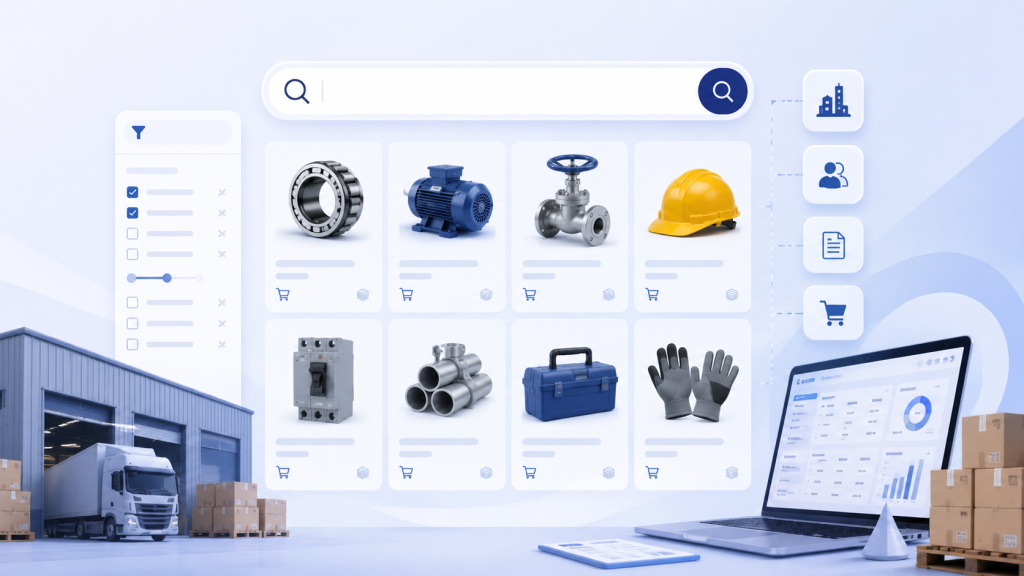
B2C shoppers browse; B2B buyers specify. They come holding a part number, a spec sheet, a compatibility requirement, or a problem statement from an internal ticket. Their first move is almost never the navigation menu — it’s the search bar, with intent already fully formed.
The committee multiplies the journeys.
A typical B2B purchase involves multiple stakeholders — engineers, procurement, finance, end users — each running their own research loop. The classic buyer decision process plays out several times in parallel inside one account, and each participant meets your search experience separately. One journey on the whiteboard is five journeys in the logs.
Most of the revenue is repeat.
Unlike consumer retail, the bulk of B2B revenue flows through reorders and contract purchasing — the least glamorous, most search-dependent stretch of the entire B2B customer journey. A buyer who can’t find their own reorder in under a minute is a churn risk wearing a loyal customer’s login.
Get search right across the journey and every stage accelerates. Get it wrong and the funnel leaks at six different places at once.
AI Search Grader by bCloud AI
Grade your ecommerce search in 10 quick questions
31% of ecommerce searches return zero results — and most shoppers who hit a dead end leave for a competitor. How does your store's search stack up?
Answer 10 short questions and get your AI search score, plus a personalized report to fix the gaps. Free, takes about 2 minutes.
No signup needed to take the quiz.
Understanding intent…
Scoring your answers across relevance, AI, experience, and insights.
Your AI search score is ready
Tell us where to send your personalized report. You'll see your score and recommendations right away.
Your score by pillar
Personalized recommendations
Fix the gaps in weeks, not quarters
bCloud AI replaces keyword-only search with hybrid AI retrieval — sub-200ms responses, 99.99% uptime, and conversion lifts of up to 40% across 50+ implementations.
Touchpoint 1: Problem-framed research
The B2B customer journey usually begins before anyone knows a product name. An engineer searches “reduce vibration on conveyor motor mounts” or “corrosion-resistant fastener for coastal installs” — a problem, not a SKU. Keyword search collapses here, because no product title contains those words.
This is where semantic understanding earns its keep: interpreting the problem, mapping it to solution categories, and returning products that solve it — plus the guides and spec sheets that build confidence. Stores that answer problem-framed queries enter the consideration set before competitors even register the visit. Stores that return zero results send the researcher — and the deal — to whoever understands them. The mechanics live in our guides to what is semantic search and query understanding.
Touchpoint 2: Specification matching
Next, the B2B customer journey narrows: from “solutions to my problem” to “products meeting these exact parameters.” Searches turn dense with attributes — “M8 stainless hex bolt 40mm A4 marine grade,” “24V DC relay 10A DIN rail.” Two capabilities decide this touchpoint.
First, attribute extraction: parsing dimensions, materials, ratings, and standards out of the query and applying them as filters automatically, instead of forcing the buyer to re-enter everything into facet menus. Second, filter performance at depth: B2B catalogs are enormous and every spec query is a multi-facet query, which is exactly where search infrastructure diverges — the scale mechanics in our large catalogs guide apply doubly to industrial assortments. A buyer who specifies precisely and receives precision trusts the catalog; one who specifies precisely and receives noise concludes the site can’t be trusted with an order.
Touchpoint 3: The exact-match moment
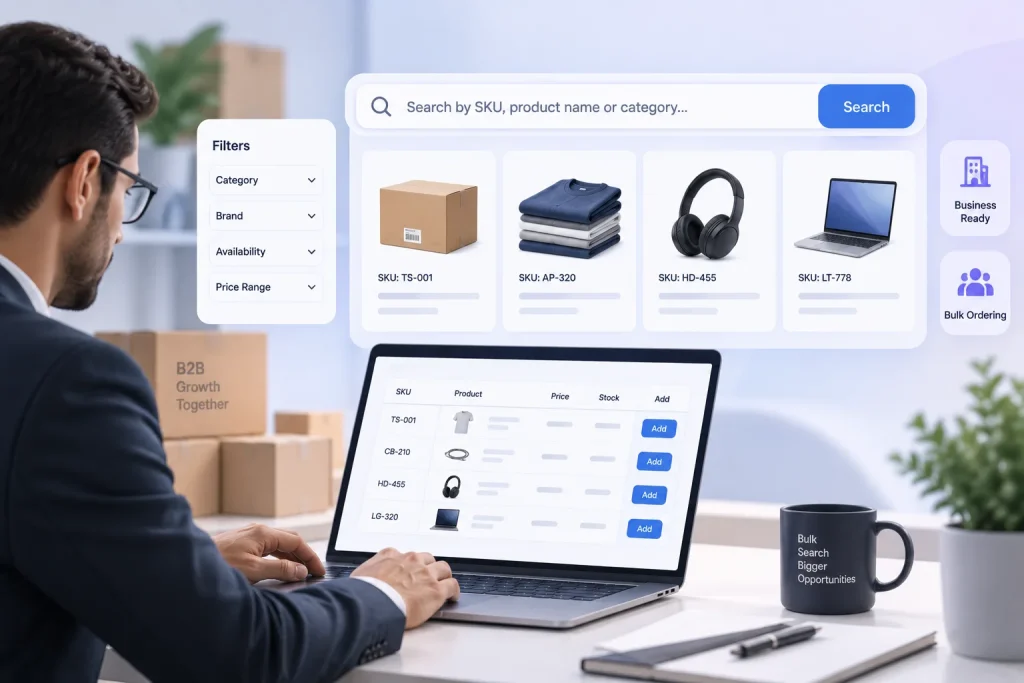
At some point in nearly every B2B customer journey, someone types an identifier: your SKU, a manufacturer part number, a competitor’s cross-reference, or a customer’s own internal code. This looks like the easiest search in the world and is where an alarming number of B2B sites fail — because pure semantic engines “approximate” when they should match literally, and pure keyword engines miss the cross-reference entirely.
The requirements are strict: exact identifiers must resolve exactly (hybrid retrieval’s lexical side, covered in what is hybrid search); known equivalences — competitor and superseded part numbers — should cross-reference; and unknown codes should fail helpfully, with a “we couldn’t find this exact part, closest matches below” rather than a dead end. Procurement lives at this touchpoint, and procurement’s patience is measured in seconds.
Touchpoint 4: Comparison and shortlisting
With candidates found, the B2B customer journey turns evaluative — and multi-stakeholder. The engineer shortlists on specs; finance weighs cost and terms; operations checks lead times. Discovery’s job here is keeping every stakeholder inside your experience instead of exporting the comparison to a spreadsheet (where your competitors get added to the tabs).
What works: side-by-side comparison from search results, complete and consistent attribute data (the spreadsheet migration usually happens because the site’s data was too thin to compare), visible stock and lead-time signals, and account-specific context where it applies. Every gap in your product data at this stage is a reason to leave; enrichment quietly wins deals here.
Touchpoint 5: Approval-ready validation
Before the order, the B2B customer journey passes through validation: someone — often not the original researcher — confirms the selection against requirements and budget. Their searches are re-finding searches: “that relay Marco shortlisted,” pasted part numbers, half-remembered product names. Speed and consistency matter more than discovery breadth. If the validator’s search returns different results than the researcher saw — because ranking shifted or personalization overcorrected — confidence wobbles at the worst moment. This is a place where search personalization must be tuned conservatively: helpful for individuals, never so aggressive that two colleagues can’t see the same product the same way.
Touchpoint 6: Reorder and replenishment
The longest, most valuable stretch of the B2B customer journey is everything after the first order — and it’s almost pure search. Buyers reorder by fragment (“the blue nitrile gloves, large, the ones from March”), by pasted PO history, by their own internal codes. The winning experience recognizes the account, surfaces purchase history in results, resolves “my usual” queries, respects contract pricing and entitlements, and — critically — reflects real-time stock so nobody reorders into a backorder surprise. Freshness is a revenue feature here, which is why real-time indexing sits underneath every serious B2B deployment. A reorder flow that takes ninety seconds instead of fifteen minutes is retention you can measure.
Who is actually searching in the B2B customer journey
The six touchpoints describe stages. However, different people run them.
Each role searches in a distinct language, so one search experience has to serve four very different habits. Knowing which role is typing explains most of your query log.
The engineer searches in specs.
Long attribute strings, tolerances, standards. They need filters that respect every condition. A near miss is a wrong answer to them.
Procurement searches in codes.
Part numbers pasted straight from a requisition. They want one exact result and nothing else. Consequently approximation here reads as an error.
The end user searches in descriptions.
“The blue ones we use on the packing line.” No codes, no specs, just recall. Therefore semantic understanding and order history matter most for them.
Finance searches in totals.
They arrive last and check price against budget. Contract pricing must show correctly for their account. Otherwise the approval stalls at the final step.
In short, segment your query log by role rather than treating it as one stream. A failure that looks small overall may be blocking one role entirely. Our ecommerce search analytics guide covers how to cut the data.
Measuring the B2B customer journey through search
Because the journey runs through search, it can be instrumented through search. The metrics that matter, by touchpoint: problem-query success rate (touchpoint 1), spec-query zero-and-poor-result rate (2), exact-match resolution rate including cross-references (3), comparison engagement and exit rate (4), re-find consistency (5), and time-to-reorder plus reorder search success (6). Add the account dimension — journey health per customer, not just per session — and search analytics becomes an early-warning system: an account whose reorder searches start failing is an account about to call a competitor. The measurement foundations are in our search relevance metrics and ecommerce search analytics guides — and Baymard Institute’s research documents how consistently sites underperform on exactly the query types B2B buyers use most.
Fixing the journey: where to start
If the six touchpoints reveal gaps — and honest measurement usually reveals several — sequence the fixes by revenue proximity. Start at reorder (touchpoint 6), because it protects existing revenue and improves fastest. Move to exact match (3), because identifier failures burn procurement trust daily. Then spec matching (2), problem research (1), and the evaluative middle (4–5).
Infrastructure-wise, the whole B2B customer journey benefits from the same foundation: hybrid retrieval so identifiers and natural language both resolve, attribute-aware query understanding, filter-fast indexing at catalog scale, account context, and real-time freshness. That’s buildable, or it’s a platform decision — bCloud AI’s AI search engine ships the stack with B2B realities (account pricing, huge catalogs, sub-200ms filtered queries) as first-class citizens rather than customizations. Either way, the principle holds: the B2B customer journey is won at the search bar, one touchpoint at a time.
The next shift: the B2B customer journey goes agentic
One more touchpoint is forming right now, and it changes who — or what — is doing the searching. Procurement teams are beginning to delegate the early stretch of the B2B customer journey to AI agents: software that takes a requirement (“source 500 units of X meeting spec Y under budget Z”), searches supplier catalogs, shortlists candidates, and drafts the comparison before a human ever opens a browser tab.
For sellers, this has a blunt implication: your next buyer may be an API call. Agents don’t squint at hero banners or forgive vague product data — they parse structured attributes, query search endpoints, and drop suppliers whose catalogs they can’t read. Every investment already described in this guide compounds here: clean attribute data, exact identifier resolution, semantic understanding of requirement language, and an accessible search API become the difference between being in the agent’s shortlist and being invisible to it. The stores winning the human B2B customer journey and the ones ready for the agentic version turn out to be the same stores, for the same reasons.
Quick wins in the first 30 days
If the six touchpoints feel like a year of roadmap, start with the week-one moves. Pull last month’s zero-result queries and read the top hundred — they’ll sort themselves into identifier failures, spec-language gaps, and problem-phrased questions, telling you which touchpoint bleeds most. Add cross-references for your top fifty competitor and superseded part numbers; it’s an afternoon of data work that repairs the most trust per hour invested. Turn on purchase-history surfacing in search for logged-in accounts if your platform supports it — the reorder touchpoint improves overnight. And instrument time-to-reorder for your top twenty accounts as a standing metric, because the B2B customer journey is easiest to defend where it’s most valuable, and nothing focuses a team like watching that number per account.
Warning Signs Your B2B Customer Journey Is Breaking
Many B2B companies assume their customer journey is working because orders are still coming in. In reality, buyers often work around poor search experiences long before they decide to switch suppliers. If you notice several of the signs below, it’s time to review your search and product discovery strategy.
Watch for these signals:
Frequent searches for the same products
Returning customers repeatedly search for identical items instead of finding them quickly through recent orders or personalized suggestions.
High search activity but low conversion rates
Buyers are searching with clear intent but leaving without requesting a quote or completing a purchase.
Support teams answering product-finding questions
If sales or customer support regularly helps customers locate products or specifications, your search experience is creating unnecessary friction.
Buyers relying on external search engines
Customers searching Google for products already available on your website often indicate a lack of confidence in your on-site search.
Longer purchasing cycles for repeat customers
Existing accounts should complete repeat purchases faster. If reorder times are increasing, search and discovery may be slowing the buying process.
Growing zero-result or low-relevance searches
Empty or irrelevant search results are often the earliest indicator that your catalog, indexing, or search configuration needs attention.
Why These Signals Matter
Every one of these warning signs represents friction somewhere in the B2B customer journey. Addressing them early improves buyer confidence, reduces support overhead, and creates a smoother purchasing experience for every stakeholder—from engineers and procurement teams to repeat buyers managing long-term accounts.
Frequently asked questions
What is the B2B customer journey?
The B2B customer journey is the full path a business buyer — usually a committee of them — takes from recognizing a problem through researching, specifying, comparing, validating, purchasing, and reordering. Unlike consumer journeys, it involves multiple stakeholders, spec-driven evaluation, and a long post-purchase reorder phase that carries most of the revenue.
Why is search so important in the B2B customer journey?
Because B2B buyers arrive with formed intent — problems, specs, and part numbers — their first move at nearly every stage is the search bar. Problem research, specification matching, exact-part lookup, validation, and reordering are all search interactions, so search quality directly shapes how the journey progresses.
What are the main search touchpoints in a B2B journey?
Six: problem-framed research, specification matching, exact identifier lookup (including cross-references), comparison and shortlisting, approval-time re-finding, and reorder or replenishment. Each has distinct requirements, from semantic understanding at the start to account-aware speed at the end.
How do I measure the B2B customer journey through search?
Instrument each touchpoint: problem-query success, spec-query zero-result rate, exact-match resolution, comparison exits, re-find consistency, and time-to-reorder — then track them per account, not just per session, so a deteriorating account journey surfaces early.
What breaks most often in B2B search journeys?
Exact identifiers that fail to resolve, spec queries that ignore extracted attributes, thin product data that pushes comparisons into spreadsheets, and reorder flows that don’t recognize the account or reflect real-time stock. Most B2B sites leak at several touchpoints simultaneously.
Where should a B2B company start improving?
At reorder, then exact match: they sit closest to existing revenue and daily buyer trust. Then work backward through spec matching and problem research. Underneath all of it, hybrid retrieval, attribute-aware understanding, and real-time indexing are the shared foundation.
Win the journey where it actually happens: the search bar.
bCloud AI resolves part numbers exactly, understands problem queries semantically, and keeps reorders account-aware and real-time — the whole B2B journey, one engine.
bcloud.ai