

What is hybrid search?
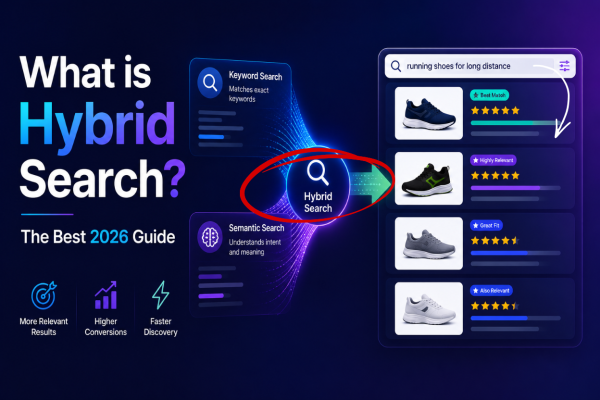
So when someone asks what is hybrid search, the shortest accurate answer is: it’s search that refuses to choose. A query for “waterproof jacket” gets the exact lexical matches and the semantically related items — rain shells, storm coats — and the fusion step decides how to order them.
This matters because each method fails in a predictable, opposite way. Keyword retrieval nails exact strings and collapses on synonyms and natural language. Vector retrieval understands meaning beautifully and drifts on precise identifiers. Run them together and each covers the other’s blind spot. That complementary failure pattern is the entire reason hybrid search exists.
How does hybrid search work?
Understanding what is hybrid search means following a query through four steps.
Step 1: The query fans out.
One incoming query goes to two retrievers simultaneously. The lexical side uses an algorithm like BM25 — the ranking function documented in Wikipedia’s Okapi BM25 entry — which scores documents on term frequency and rarity. The semantic side embeds the query into a vector and searches for nearby vectors.
Step 2: Two candidate lists come back.
Each retriever returns its own ranked candidates, typically the top 50 to 200. These lists overlap partially and disagree meaningfully, which is the point.
Step 3: The lists get fused.
This is the heart of hybrid search. The two rankings must become one, and there are two dominant approaches, covered in the next section.
Step 4: A reranker makes the final call.
A cross-encoder or learning-to-rank model reorders the merged candidates using richer signals — conversion history, margin, stock, freshness. Our guide to search reranking covers this stage in depth.
The whole sequence completes in well under a second on a well-built system, which is why hybrid search is practical rather than theoretical.
AI Search Grader by bCloud AI
Grade your ecommerce search in 10 quick questions
31% of ecommerce searches return zero results — and most shoppers who hit a dead end leave for a competitor. How does your store's search stack up?
Answer 10 short questions and get your AI search score, plus a personalized report to fix the gaps. Free, takes about 2 minutes.
No signup needed to take the quiz.
Understanding intent…
Scoring your answers across relevance, AI, experience, and insights.
Your AI search score is ready
Tell us where to send your personalized report. You'll see your score and recommendations right away.
Your score by pillar
Personalized recommendations
Fix the gaps in weeks, not quarters
bCloud AI replaces keyword-only search with hybrid AI retrieval — sub-200ms responses, 99.99% uptime, and conversion lifts of up to 40% across 50+ implementations.
The fusion step: RRF vs weighted scoring
Here’s where implementations genuinely differ, and where you should push vendors during evaluation.
Reciprocal Rank Fusion (RRF) ignores the raw scores entirely and works only with positions. Each document gets a score based on where it ranked in each list, and those are summed. RRF’s advantage is that it sidesteps a nasty problem: BM25 scores and cosine similarity scores live on completely different scales, so comparing them directly is meaningless. RRF needs no tuning and works well out of the box, which is why it’s the default in most hybrid search systems.
Weighted score fusion normalizes both score types onto a common scale, then blends them with a weight — a 60/40 split favoring semantic, for example. This gives you control that RRF doesn’t: you can tune the balance for your catalog and even shift it per query type. The cost is that normalization is fiddly and the weights need maintenance.
A practical rule: start with RRF, move to weighted fusion only when you have relevance data proving a specific blend does better. And be suspicious of any hybrid search vendor who can’t tell you which method they use.
Hybrid search vs vector search
This comparison comes up constantly, so let’s be precise. Vector search is one component of hybrid search. The hybrid search vs vector search question isn’t really a competition — it’s asking whether you want one retrieval method or two.
The hybrid search vs vector search trade-off is real but lopsided: you pay somewhat more compute and configuration for materially better coverage. For most production catalogs that’s an easy call. If you want the deeper background on each half, see our guides to what is vector search and what is semantic search.
One underrated advantage: the lexical half handles words your embedding model has never encountered. New brand names, model numbers released last month, internal product codes — embeddings trained months ago don’t know them, but BM25 doesn’t need to. That resilience alone justifies hybrid search for fast-moving catalogs.
How to tell if a system is really hybrid search
Plenty of platforms claim hybrid retrieval. Fewer actually run both halves properly.
You do not need access to the code to find out. Four queries typed into any demo will tell you. Run them in this order.
Type a full SKU.
The exact product must come first. If similar items rank above it, the lexical half is weak or missing entirely.
Type a describing sentence.
Use a use case with no product name in it. Sensible results mean the semantic half is working. Nothing useful means it is keyword search with better marketing.
Type a brand launched last month.
Embeddings will not know it, so only the lexical side can catch it. Consequently this is the cleanest single test that both halves are live.
Misspell a common product.
Both halves should recover it, one through typo tolerance and one through meaning. A dead end here means neither is doing much.
In short, four queries beat any feature list. Then ask which fusion method sits underneath, since a confident answer usually signals a confident implementation. Our search relevance metrics guide covers scoring this at scale.
Why hybrid search wins on zero-result rate
The most concrete benefit is the metric that maps most directly to lost revenue. Zero-result searches happen when a query returns nothing, and they’re overwhelmingly caused by vocabulary mismatch — the shopper’s words and your catalog’s words didn’t line up.
Keyword-only systems produce zero results constantly. Vector-only systems almost never return literally nothing, but they sometimes return confidently wrong things, which is arguably worse. Hybrid search reduces both failure modes: the semantic side rescues queries the lexical side would drop, and the lexical side anchors results when the semantic side wanders.
Measure it properly on your own data. Track zero-result rate, search conversion rate, and revenue per search before and after, using the methodology in our guides to search relevance metrics and A/B testing ecommerce search.
What hybrid search costs you
Being honest about the downsides matters, because “run both” isn’t free.
- Latency. Two retrievers plus fusion plus reranking is more work per query. Well-engineered hybrid search still lands under 200 milliseconds, but you must benchmark p95 and p99 under real peak load, not on a demo index.
- Infrastructure. You’re maintaining a lexical index and a vector index, which means more memory, more storage, and more to keep in sync.
- Configuration surface. Embedding model, fusion method, weights, candidate depth, reranker — more knobs mean more ways to misconfigure things.
- Reindexing. Change your embedding model and you re-embed everything. The lexical side is unaffected, which is a small mercy.
None of these are dealbreakers, but they explain why managed platforms are popular: they absorb this complexity. If you’re building it yourself, our vector database comparison and embedding models guide cover two of the biggest decisions.
Tuning hybrid search without breaking it
Once hybrid search is running, most of the remaining gains come from four dials. Turn them one at a time and measure, because they interact in ways that are hard to predict on paper.
Candidate depth.
How many results each retriever returns before fusion — often 50, 100, or 200. Too shallow and good matches never reach the fusion stage; too deep and you add latency while feeding the reranker noise. Depth is usually the first thing to raise when relevance feels shallow, and the first thing to lower when latency creeps.
The semantic-lexical balance.
If you use weighted fusion rather than RRF, this weighting is your strongest lever. Catalogs full of technical part numbers usually want more lexical weight; fashion and home goods, where shoppers describe things rather than name them, want more semantic. Some teams go further and shift the balance per query type, letting a short alphanumeric string lean lexical while a full sentence leans semantic.
The embedding model.
The semantic half of hybrid search is only as good as the vectors feeding it, and swapping models can move relevance more than any amount of fusion tuning. The catch is that changing models means re-embedding the entire catalog, so treat it as a planned migration.
Index parameters.
The vector index has its own settings governing how thoroughly each query explores the graph — the structure described in the HNSW paper that underpins most implementations. Exploring more improves accuracy and costs milliseconds. Our guide to nearest neighbor search covers this layer properly.
A word of caution on methodology: tune against a judged query set drawn from your real search logs, not against queries you invent. Teams consistently pick clean, well-formed examples when testing by hand, which is precisely the traffic hybrid search was never needed for. The gains live in the messy queries — the typos, the vague descriptions, the half-remembered brand names.
Hybrid search in RAG pipelines
Ecommerce isn’t the only place this matters. Retrieval-augmented generation — grounding an AI’s answer in real documents — depends entirely on retrieving the right passages, and hybrid search has become the default there for the same reason it won in commerce. A user asking about “error code 0x8007” needs exact matching; a user asking “why does my sync keep failing” needs meaning. Both arrive at the same endpoint.
The failure mode in RAG is unusually visible, too. Retrieve the wrong passage and the model confidently generates a wrong answer, with no signal that retrieval was the problem. That makes the coverage hybrid search provides more valuable than raw speed, which is a different calculus from ecommerce, where latency is a conversion lever.
Where hybrid search is used
Hybrid retrieval has become the default in serious systems:
- Ecommerce product search, where exact SKUs and vague descriptive queries arrive in the same traffic stream.
- RAG pipelines, where retrieving the right document chunk determines whether an AI answers correctly.
- Enterprise and document search, mixing precise identifiers with conceptual questions.
- Support and knowledge bases, where error codes need exact matching but problem descriptions need meaning.
The pattern holds anywhere queries are heterogeneous — some precise, some conversational. That’s most real-world search.
Hybrid search and AI visibility
Worth noting for retailers: the AI assistants shoppers now ask for recommendations run retrieval pipelines of their own, and increasingly hybrid ones. A catalog that’s well-structured for hybrid search — clean attributes, meaningful descriptions, accurate identifiers — is also the catalog those external engines can parse and recommend confidently. The investment compounds beyond your own site.
How to add hybrid search
Three paths, in ascending order of effort.
Managed platform.
An AI-native search platform ships hybrid retrieval, fusion, and reranking configured and tuned. Fastest route, typically live in weeks. bCloud AI’s AI search engine works this way, blending keyword precision with vector meaning by default rather than gating it behind an enterprise tier.
Add vectors to existing search.
If you run Elasticsearch or OpenSearch, both support kNN vector fields alongside BM25 and native fusion. You keep your lexical setup and layer semantics on top.
Build from components.
A vector database, an embedding pipeline, your existing lexical index, custom fusion, and a reranker. Maximum control, realistically a multi-month project.
Whichever route, evaluate on your own catalog with messy, human queries. For vendor selection specifically, our roundup of the best hybrid search systems compares the options, and the AI ecommerce search guide covers the wider architecture.
Common mistakes when implementing hybrid search
Hybrid search delivers excellent relevance only when both retrieval methods work together correctly. Many teams enable vector search, add BM25, and assume the job is finished. In reality, the biggest improvements usually come from avoiding a handful of common implementation mistakes.
Using only default settings
Default fusion parameters work well for demonstrations but rarely for production catalogs. Every catalog has different search behavior, requiring tuning based on real customer queries.
Ignoring search analytics
Search logs reveal where customers struggle. Without monitoring zero-result searches, refinements, and abandoned searches, it’s impossible to improve relevance consistently.
Using poor product data
Even the best retrieval models cannot compensate for incomplete product titles, weak descriptions, or missing attributes. High-quality catalog data directly improves both lexical and semantic retrieval.
Skipping relevance testing
Changes should always be validated with A/B testing and real search metrics. Measuring click-through rate, search conversion, and revenue per search prevents tuning decisions based on assumptions.
Best practice: Treat hybrid search as an ongoing optimization project rather than a one-time implementation. Regularly review search analytics, retrain embeddings when product data changes, and validate every major adjustment using real customer queries. Continuous tuning is what separates good search experiences from exceptional ones.
Frequently asked questions
What is hybrid search?
Hybrid search is a retrieval approach that runs keyword matching and vector semantic matching in parallel for the same query, then fuses the two result sets into one ranked list. It delivers the literal precision of keyword search and the meaning-awareness of vector search together.
How does hybrid search work?
A query is sent to two retrievers at once — a lexical one using an algorithm like BM25, and a semantic one using vector embeddings. Each returns ranked candidates, the lists are fused using Reciprocal Rank Fusion or weighted score blending, and a reranking model orders the final results.
Hybrid search vs vector search — which is better?
Vector search is one component of hybrid search, so it isn’t a true competition. Hybrid adds a lexical retriever alongside the vector one, which improves exact SKU matching and handles brand-new terms the embedding model has never seen. It costs more compute and configuration.
What is Reciprocal Rank Fusion?
Reciprocal Rank Fusion merges two ranked lists using each document’s position rather than its raw score. This avoids the problem that BM25 scores and cosine similarity scores use incompatible scales. It requires no tuning, which makes it the common default.
Does hybrid search slow down my site?
It does more work per query than either method alone, but well-engineered systems still return results in under 200 milliseconds. Benchmark p95 and p99 latency under your real peak traffic before committing.
Do I need to build hybrid search myself?
No. Managed AI search platforms provide it out of the box, and engines like Elasticsearch and OpenSearch support vector fields alongside keyword indexes with native fusion. Building from components gives the most control but takes months.
See hybrid search on your own catalog.
bCloud AI blends keyword precision with vector meaning in one sub-200ms engine — fusion and reranking included, no enterprise tier required.
bcloud.ai