
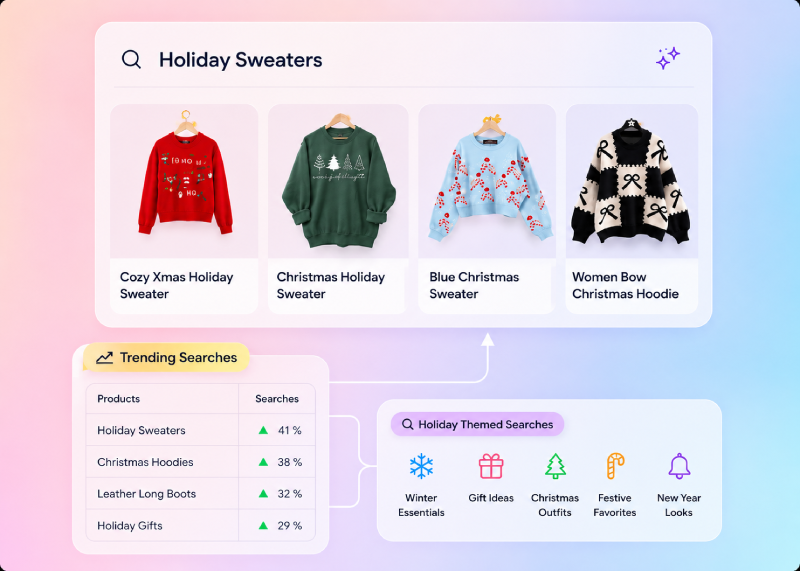

What is seasonal merchandising?
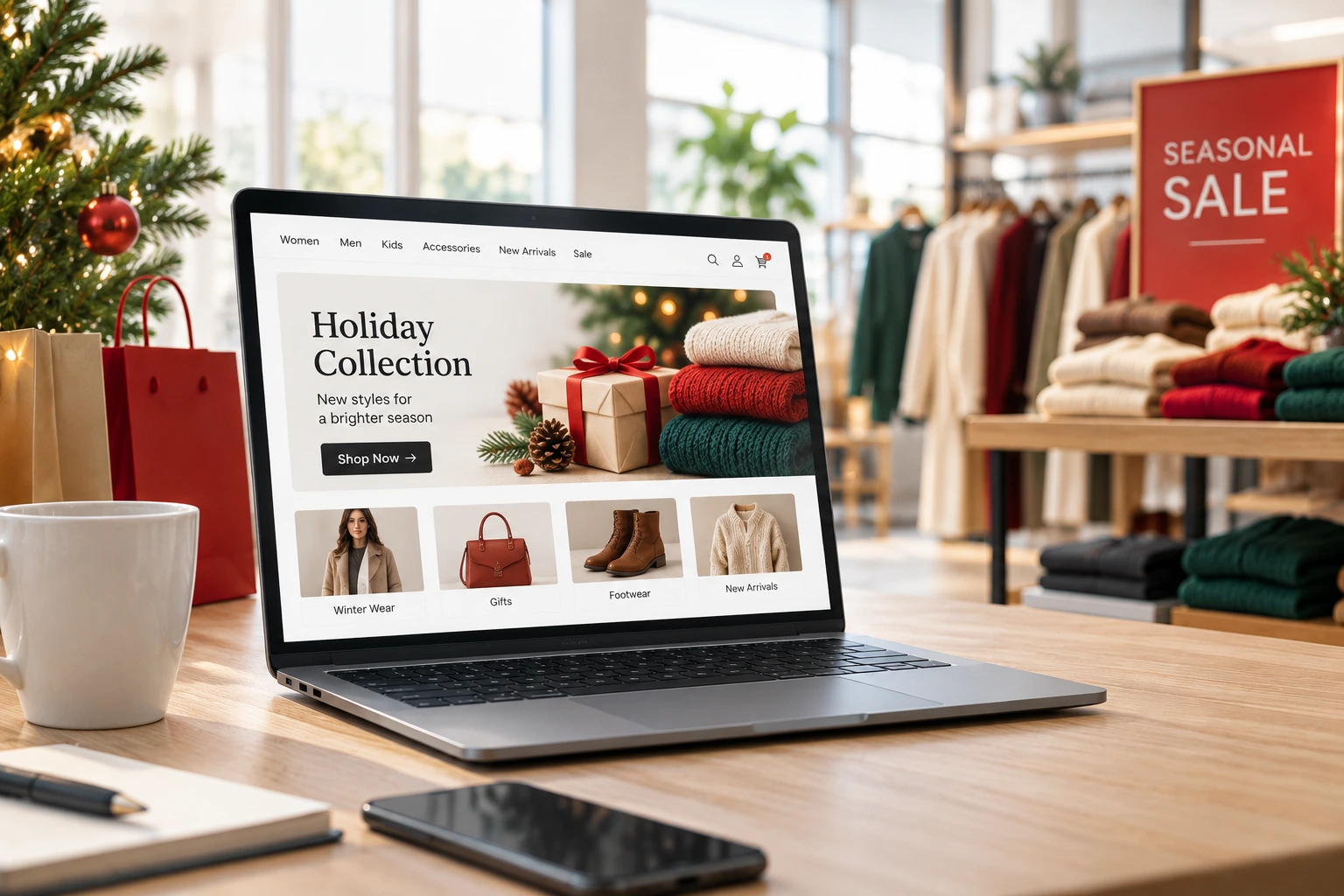
Online, it touches more surfaces than most teams expect:
Collections and landing pages
for occasions such as gifts, back-to-school or summer travel.
Search results
that favor seasonal products when the query calls for them.
Autocomplete suggestions
that reflect what shoppers are searching for this month.
Filters
such as gift price bands, recipient or “arrives by” dates.
Recommendations
that suggest seasonal add-ons and bundles.
Homepage and category banners
that set the seasonal tone.
The best seasonal merchandising treats these as one plan rather than six separate projects. See ecommerce merchandising for the broader discipline.
AI Search Grader by bCloud AI
Grade your ecommerce search in 10 quick questions
31% of ecommerce searches return zero results — and most shoppers who hit a dead end leave for a competitor. How does your store's search stack up?
Answer 10 short questions and get your AI search score, plus a personalized report to fix the gaps. Free, takes about 2 minutes.
No signup needed to take the quiz.
Understanding intent…
Scoring your answers across relevance, AI, experience, and insights.
Your AI search score is ready
Tell us where to send your personalized report. You'll see your score and recommendations right away.
Your score by pillar
Personalized recommendations
Fix the gaps in weeks, not quarters
bCloud AI replaces keyword-only search with hybrid AI retrieval — sub-200ms responses, 99.99% uptime, and conversion lifts of up to 40% across 50+ implementations.
Why seasonal merchandising matters more online
Online, shoppers tell you their seasonal intent directly. They type “gifts for dad,” “Halloween costume for toddler” or “beach bag” into your search box. If your store has not been prepared for those queries, they get generic results and leave.
Peak days are also concentrated. Adobe forecasts US online holiday spending of $275.1 billion for November and December 2026, up 6.7 percent year over year, with Cyber Monday expected to be the biggest online shopping day at $15.1 billion (Adobe). When that much spending lands in a few days, there is no time to fix merchandising on the fly.
Finally, seasonal demand shifts quickly. A product that is perfect on December 15 may be useless on December 27. Seasonal merchandising has to plan the exit as carefully as the entry.
Build a seasonal merchandising calendar
Start with a calendar that covers the full year. For most US retailers, it looks something like this.
Add your own events, such as product launches, anniversary sales or trade show seasons for B2B. Then set prep deadlines for each, usually six to eight weeks ahead of a major peak.
9 smart seasonal merchandising tactics
1. Start from last year’s search data
Your search log shows what shoppers wanted last season, in their own words, and when interest started rising. Use it to decide which collections to build, which queries to prepare for and when to launch. See ecommerce search analytics.
2. Teach search the season’s language
Seasonal queries use words your catalog may not contain: “stocking stuffers,” “ugly sweater,” “teacher gifts,” “dorm essentials.” Map these to the right products with synonyms or curated results before the season starts. See search synonyms.
3. Boost seasonal products without burying bestsellers
When someone searches “sweater” in December, festive sweaters deserve a lift. However, do not push every evergreen bestseller off the first page. Boost moderately and check the results for your top queries by hand.
4. Schedule changes ahead of time
Plan when each boost, banner and collection goes live and when it ends. Adobe’s 2026 forecast expects peak discounts to vary by category, with toys, TVs and apparel peaking on Black Friday and electronics and computers on Cyber Monday. Your seasonal merchandising should follow the same timing.
5. Build gift and occasion collections
Many seasonal shoppers do not have a product in mind. Gift collections by recipient, interest and price give them a starting point. Short buying guides help even more. See guided selling tools.
6. Add seasonal filters
Filters such as “under $50,” “gifts for him” or “arrives by December 24” match how seasonal shoppers think. Remove them when the season ends so they do not clutter the page. See ecommerce search filters.
7. Keep inventory in sync
Seasonal items sell out fast. Make sure search and collections reflect stock in near real time and suggest alternatives when popular items run out. See out of stock products.
8. Refresh autocomplete for the season
Autocomplete should suggest “Halloween costumes for kids” in October, not in March. Review suggestions for your top prefixes at the start of each season. See search autocomplete.
9. Plan the wind-down
Remove seasonal boosts, banners and filters the day the season ends. After the holidays, shift to returns, exchanges, gift card shoppers and clearance. Stale seasonal merchandising makes a store look neglected.
What changes in search during a season
Seasonal search behavior differs from the rest of the year in three ways.
Queries get vaguer.
Gift shoppers type “gift for mom who loves gardening” or “something for a 10 year old boy.” Keyword search struggles with these, while semantic search handles them far better. See natural language search.
Query volume spikes.
Traffic can multiply on peak days, so search must stay fast under load. See search latency.
New words appear.
Trends, viral products and seasonal slang show up in search before they appear in your catalog. Watch for them daily during peak weeks.
Seasonal merchandising by category
Different categories peak at different times, and seasonal merchandising should reflect that. Adobe’s 2026 holiday forecast lists the expected peak discounts by category.
Use this as a guide for when to raise boosts and feature deals in each category. If you sell across several categories, your seasonal merchandising calendar may need a different peak day for each.
Seasonal merchandising on mobile
Adobe expects mobile to account for 57.4 percent of US online holiday spending in 2026. So check every seasonal collection, filter and banner on a phone before launch.
Keep seasonal banners short so they do not push products below the fold. Make gift filters easy to tap. Above all, make sure search works well on mobile, since many shoppers skip menus and type what they want. See mobile ecommerce search.
Seasonal peaks outside the holidays
Not every store peaks in December. A pool supply retailer peaks in early summer, a school uniform store in August and a B2B distributor may peak around budget cycles or trade shows. Seasonal merchandising works the same way for all of them.
Look at your own sales and search data to find your real peaks rather than copying a generic retail calendar. Then apply the same steps: prepare search vocabulary, build collections, schedule boosts, check inventory and plan the wind-down. For B2B buyers, seasonal demand often shows up as reorder spikes for specific parts, so make reordering fast. See B2B ecommerce search.
A simple example
Picture a home goods store preparing for the holidays.
In a weak setup, a shopper searches “hostess gift” in early December and gets zero results, because no product uses that phrase. She tries “gift,” and the top results are summer patio items that happen to mention gifting.
In a strong setup, the team reviewed last year’s searches in October. “Hostess gift” was mapped to a curated set of candles, serving boards and cocktail kits. Seasonal products get a moderate boost, a “gifts under $50” filter is live and autocomplete suggests “hostess gift ideas” after three letters. She finds a candle set in seconds and adds a matching gift bag from the recommendations.
How to measure seasonal merchandising
Compare each metric with the same period last year and note what you would change. Those notes become next year’s plan.
Common seasonal merchandising mistakes
Starting too late.
Collections built the week before a peak rarely get the testing they need.
Over-boosting.
Pushing every seasonal item to the top can bury the products shoppers actually want.
Forgetting search.
Beautiful landing pages do not help shoppers who type their query into the search box.
Leaving seasonal content up too long.
Christmas banners in mid-January signal a neglected store.
Ignoring last year’s data.
The best seasonal merchandising plans start from what shoppers searched for and bought last time.
Who should own seasonal merchandising
Seasonal merchandising works best with one owner and a shared calendar. Merchandising owns collections, boosts and messaging. Marketing aligns campaigns and emails. Engineering handles peak readiness and code freezes. Buying and planning make sure stock matches the plan.
Agree on freeze dates before major peaks, and hold a short review after each season. For peak-week preparation, see our Black Friday search checklist.
Where bCloud AI fits
bCloud AI gives merchandisers control of ranking rules, boost-and-bury logic, curated collections and promotional slots through a single console, unified with search, browse and recommendations. Search analytics trends queries daily, weekly and seasonally, so you can plan from real demand. AI Browse brings the same intelligence to collection pages, and Generative Experiences can create buying guides for gift shoppers.
The bottom line on seasonal merchandising
Seasonal merchandising is about timing and preparation. Shoppers bring seasonal intent to your store, often through the search box, and the stores that prepare for it win the peak.
Build a full-year calendar, start from last year’s search data, teach search the season’s language, schedule changes ahead, keep inventory in sync and plan the wind-down. Then measure, take notes and do it better next season.
Frequently asked questions
What is seasonal merchandising?
Seasonal merchandising is planning which products, collections and messages to promote at each point in the year, then updating your store, including search, collections and recommendations, to match.
When should I start planning seasonal merchandising?
Start six to eight weeks before a major peak such as the holidays, and earlier if you need new collections, content or inventory.
How big is the 2026 holiday season?
NRF forecasts US holiday retail sales of $1.013 trillion for November and December 2026, up 4.2 percent. Adobe forecasts $275.1 billion in US online holiday spending, up 6.7 percent.
What is the biggest online shopping day of the 2026 holiday season?
Adobe expects Cyber Monday to be the biggest online shopping day, with $15.1 billion in US online spending.
How does seasonal merchandising affect site search?
Seasonal shoppers use new words and vaguer queries, such as gift searches. Search needs seasonal synonyms, moderate boosts for seasonal products and refreshed autocomplete.
Should I boost seasonal products in search results?
Yes, moderately. Boost seasonal products for relevant queries, but avoid pushing evergreen bestsellers off the first page.
What should happen after the holiday season ends?
Remove seasonal boosts, banners and filters promptly, then shift merchandising to returns, gift card shoppers and clearance.
How do I measure seasonal merchandising success?
Track revenue from seasonal collections, search conversion for seasonal queries, zero-result rate, sell-through and leftover stock, and compare each with last year.
How does bCloud AI support seasonal merchandising?
bCloud AI provides ranking rules, boost-and-bury logic, curated collections and promotional slots in a single console, with analytics that trend search demand by season.
Get search ready for your next peak.
bCloud AI lets merchandisers shape search, collections and recommendations for every season from one console. See it on your catalog before the holidays.
bcloud.ai