
What Is a Product Search Engine?
What a Failing Product Search Engine Costs You
AI Search Grader by bCloud AI
Grade your ecommerce search in 10 quick questions
31% of ecommerce searches return zero results — and most shoppers who hit a dead end leave for a competitor. How does your store's search stack up?
Answer 10 short questions and get your AI search score, plus a personalized report to fix the gaps. Free, takes about 2 minutes.
No signup needed to take the quiz.
Understanding intent…
Scoring your answers across relevance, AI, experience, and insights.
Your AI search score is ready
Tell us where to send your personalized report. You'll see your score and recommendations right away.
Your score by pillar
Personalized recommendations
Fix the gaps in weeks, not quarters
bCloud AI replaces keyword-only search with hybrid AI retrieval — sub-200ms responses, 99.99% uptime, and conversion lifts of up to 40% across 50+ implementations.
How a Modern Product Search Engine Works
Behind the search box, a modern engine combines five technologies that traditional platforms simply do not have.
Natural Language Understanding
Using GPT-4-class models, the engine interprets queries the way humans think. “Something to help me sleep better” returns weighted blankets, sound machines, blackout curtains, and supplements — products that solve the problem, not just match keywords.
Semantic Vector Search
Every product is encoded as a 1536-dimensional vector that captures its meaning. When a customer searches, the engine finds products with similar meaning vectors, not just similar words — so “couch” and “sofa” map to nearly identical vectors and are treated as synonyms automatically.
Hybrid Keyword + Vector Ranking
Pure semantic search sometimes misses exact matches like SKUs and model numbers, so the best engines blend keyword precision (BM25) with vector understanding. This hybrid approach delivers both exact accuracy and meaning-based relevance in under 200 milliseconds.
Behavioral Reranking
Every search, click, and purchase trains the engine. If shoppers searching “running shoes” consistently choose trail runners over track spikes, the engine adapts its rankings automatically — no manual tuning required, with weekly retraining built in.
Personalization
Two shoppers, one query, different intentions. The engine layers in real-time personalization, surfacing the brands and price points each visitor is most likely to buy. Our pillar AI e-commerce search guide explains the full stack.
Ecommerce Product Search Engine Features That Drive Revenue
When you evaluate any option, these capabilities separate a true revenue engine from a basic search box: smart autocomplete with product images, faceted filtering by price, brand, size, and availability, automatic typo correction and synonyms, a zero-results experience that surfaces related products instead of a dead end, no-code merchandising rules to boost high-margin or in-stock items, and a real-time analytics dashboard that reveals exactly where searches fail. With most ecommerce traffic now on mobile, every one of these must work flawlessly on small screens.
Product Search Engine vs. Traditional Search
| Capability | Traditional search | AI product search engine |
|---|---|---|
| Matching | Exact keywords only | Meaning + keywords (hybrid) |
| Synonyms / typos | Manual dictionaries | Automatic |
| Natural language | Fails | Understands full sentences |
| Zero-results | Blank page | Related products surfaced |
| Ranking | Static rules | Learns from behavior |
| Personalization | None | Per-shopper |
How to Choose the Best Product Search Engine
Score every option on relevance (does it understand intent and natural language), speed and scale (sub-200ms under real traffic), personalization, integrations (Shopify, BigCommerce, Magento, WooCommerce, or custom), AI-visibility readiness for ChatGPT and Google AI Overviews, and time to value. For a side-by-side ranking, see our roundup of the best ecommerce search engines for 2026, and to understand the broader category, read what makes a complete ecommerce search platform and how a search engine in ecommerce works end to end.
Implementing a New Product Search Engine Without the Risk
Transparent Pricing
Most ecommerce search vendors charge by search volume — the more successful you become, the more you pay, which is backwards. A better model prices on catalog size and features, never per search, so your costs do not spike during Black Friday or holiday peaks. bCloud AI offers a free tier so you can index a subset of products and measure the lift before committing; see current plans on the pricing page.
How AI Product Search Improves the Shopper Journey
An AI-powered product search engine improves the shopper journey by helping customers move from a broad idea to the right product with fewer searches. Instead of requiring shoppers to use the exact words found in product titles, it can understand natural language, recognize related concepts, correct common mistakes, and combine keyword precision with semantic relevance. Personalized ranking can then prioritize products based on shopper behavior and preferences, while filters and merchandising tools make it easier to refine the results. By reducing zero-result searches and shortening the path from search to product discovery, an intelligent search engine creates a smoother experience that can increase engagement, conversions, and average order value.
Which Industries Gain Most From an AI Product Search Engine?
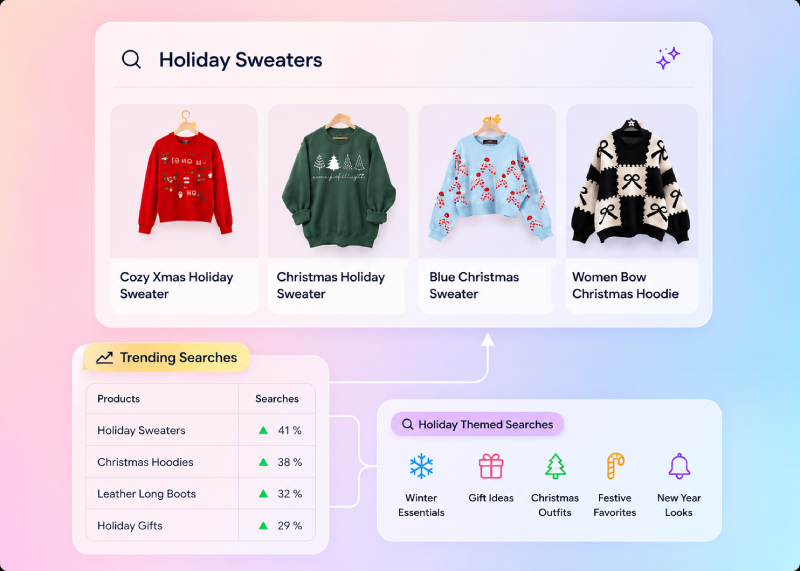
Every catalog benefits, but the impact is largest where products are numerous, technical, or described in many different ways. Fashion and apparel shoppers search by style, occasion, and vibe (“summer wedding guest dress”) rather than SKU. Electronics buyers mix model numbers with vague needs (“quiet laptop for video editing”). Home, furniture, and DIY catalogs are full of synonyms — “couch” versus “sofa,” “faucet” versus “tap.” Grocery and pharmacy stores have enormous, fast-changing inventories. And B2B distributors deal in part numbers, technical specs, and bulk reordering where a single failed search sends a buyer to a competitor. In all of these, meaning-based search dramatically outperforms keyword matching, because shoppers rarely use the exact words in your catalog. High-traffic stores benefit most of all, since even a small lift in search conversion compounds into substantial revenue at scale.
Built for Headless and API-First Stores
Modern catalogs increasingly run on headless and composable architectures, so the search layer must be API-first. A capable engine exposes a clean REST API and SDKs for React, Vue, and Next.js, syncs with Shopify Plus, BigCommerce, Magento, and WooCommerce, and indexes structured and unstructured content alike — titles, descriptions, attributes, and images. That flexibility lets engineering teams embed intelligent search anywhere shoppers discover products, from the main storefront to mobile apps and in-store kiosks, without rebuilding the front end.
The Cost of Doing Nothing
It is tempting to leave search alone because it “works well enough.” But the gap between legacy and AI search widens every month as customer expectations rise. Shoppers now compare every search box to Google and ChatGPT, and they abandon stores that feel clunky. Meanwhile your zero-results queries quietly pile up, each one a customer who was ready to buy. The compounding works against you: weaker search leads to lower conversion, which means less revenue to reinvest, while competitors who upgraded pull further ahead with more data and better results. The longer you wait, the larger the recovery opportunity you leave on the table — and the more market share you cede.
Signs It’s Time to Upgrade
Watch for these signals: a rising zero-results rate, shoppers repeatedly rephrasing the same query, a search conversion rate below your site average, support tickets asking whether you stock products you actually carry, and an inability to merchandise or personalize results without a developer. Any two together usually mean your current search is costing you more than a modern replacement would — and that an AI upgrade will pay for itself quickly.
How bCloud AI Delivers an Intelligent Product Search Engine
bCloud AI is an AI-native product search engine built specifically for ecommerce. It fuses GPT-4-class natural language understanding, 1536-dimensional vector search, hybrid ranking, and weekly behavioral learning, processes millions of queries per minute at sub-200ms with 99.99% uptime, and gives teams no-code control over relevance and merchandising — with AI-visibility optimization built in. The outcome our customers see is consistent: the 31% of searches that once failed start converting, discovery gets faster, and conversions climb up to 40%. It is a complete product discovery engine, not a bolt-on search box.
How to Measure the Success of Your Product Search Engine
Deploying an AI-powered product search engine is only the first step. To maximize its impact, monitor performance regularly and optimize based on real shopper behavior. These metrics reveal whether your search experience is helping customers discover products and complete purchases.
Search Conversion Rate
Track how many shoppers complete a purchase after using search. Higher conversion usually indicates better relevance.
Zero-Result Searches
Monitor searches that return no products. Reducing zero-result queries directly improves revenue opportunities.
Click-Through Rate
Measure how often shoppers click a product after searching. Strong click-through rates indicate relevant search results.
Average Order Value
AI search often increases basket size by exposing complementary and higher-value products.
Remember: The best product search engine is one that continuously improves. By reviewing search analytics and shopper behavior, businesses can refine relevance, reduce abandoned searches, and deliver a faster product discovery experience that drives long-term growth.
Frequently Asked Questions About a Product Search Engine
What is a product search engine?
A product search engine is the software that powers product discovery on an online store. It indexes the catalog, interprets shopper queries, and ranks the most relevant products instantly. Modern AI product search uses large language models, semantic vector search, and behavioral learning to understand intent rather than just matching keywords.
What is an ecommerce product search engine?
An ecommerce product search engine is a product search engine built specifically for online stores. It connects to your catalog and ecommerce platform, understands shopper intent, personalizes results, and is designed to drive conversions and reduce zero-result searches.
How does a product search engine work?
It works in steps: it indexes your catalog, interprets the query (using natural language and semantic vector search in AI engines), blends keyword and meaning-based matching, and ranks results — often reranked by behavior and personalized to each shopper, all in under 200 milliseconds.
How much does a product search engine cost?
Pricing varies by provider. The best model charges based on catalog size and features rather than per search, so costs stay predictable during traffic spikes. bCloud AI offers a free tier so you can test the lift on a subset of products before committing.
How does a product search engine increase sales?
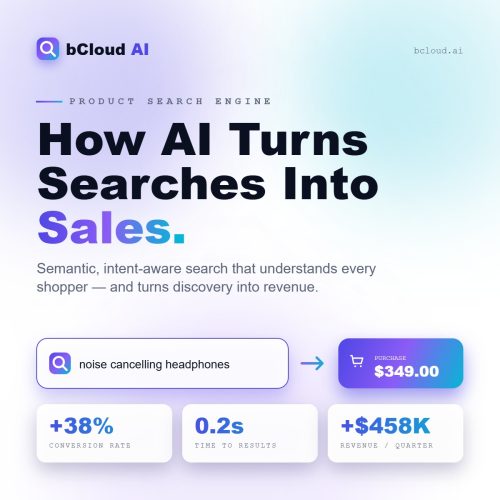
By understanding intent, eliminating most zero-result searches, personalizing results, and surfacing relevant products faster, AI product search commonly lifts conversions by up to 40%, along with higher average order value and lower bounce rates.
What is the best product search engine in 2026?
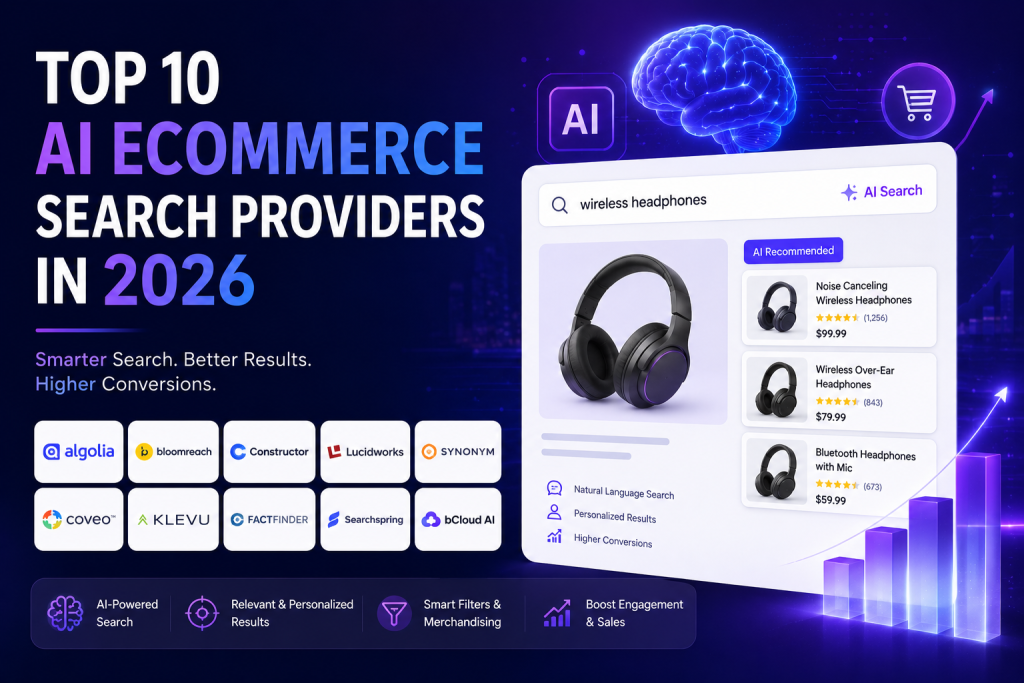
The best product search engine combines semantic and natural language understanding, hybrid ranking, personalization, fast performance at scale, and broad integrations. Leading options include bCloud AI, Algolia, Coveo, and Klevu, with the right fit depending on your catalog and platform.
How long does it take to implement a product search engine?
With a modern platform like bCloud AI, implementation typically takes about four weeks, including catalog import, AI data enrichment, relevance tuning, and a phased rollout — with no internal machine-learning expertise required.
Does a product search engine work on mobile?
Yes. A modern product search experience is mobile-first, with fast autocomplete, one-tap filters, typo correction, and support for voice and conversational input, optimized for the majority of ecommerce traffic that now comes from phones.
See an Intelligent Product Search Engine in Action
Stop losing sales to zero-results. See what an AI-powered product search engine can recover for your store: Start for free or book a demo and watch your conversions climb.