How Does a Search Engine in Ecommerce Work?
What Is a Search Engine in Ecommerce?
How Does a Search Engine in Ecommerce Work?
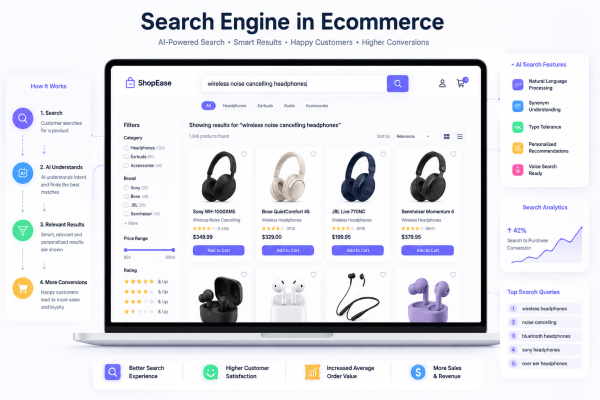
Behind the simple search box, the engine runs three core steps every time a shopper types a query.
Step 1 — Indexing the Product Catalog
First, the search engine reads and organizes your entire product catalog — titles, descriptions, attributes, categories, and images — into a fast, searchable index. The richer and cleaner this data, the better the results, which is why catalog quality matters as much as the algorithm.
Step 2 — Understanding the Query
Next, the engine interprets what the shopper typed. A basic engine matches literal keywords; an AI-powered engine uses semantic search and natural language processing to understand meaning, handle synonyms and typos, and grasp conversational phrasing like “warm waterproof jacket for hiking.” Our pillar AI e-commerce search guide explains this layer in depth.
Step 3 — Ranking and Personalization
Finally, the engine ranks matching products by relevance — and the best systems personalize that ranking for each shopper based on behavior, surfacing the brands and price points an individual is most likely to buy. bCloud delivers this through AI Search and AI recommendations.
Types of Search Engines in Ecommerce
Not every search engine works the same way. There are three broad types, and the difference shows up directly in your conversion rate.
Keyword-Based Search
Traditional engines match the literal text a shopper types against your product data. They work until a customer uses a synonym, a misspelling, or a descriptive phrase — then they fail silently, returning nothing.
Semantic and Vector Search
Modern engines understand meaning. Using vector embeddings, a semantic engine maps products and queries into a shared space so “ANC headset” and “noise-cancelling headphones” match even with no shared keywords.
Conversational and AI Search
The newest generation lets shoppers search the way they talk and even ask follow-up questions, returning generative answers with product citations. bCloud powers this with IntentAI conversational search — the experience customers now expect after using ChatGPT.
7 Vital Benefits of a Search Engine in Ecommerce
A strong search engine is not a convenience feature — it is one of the highest-leverage tools in your store. Here are seven vital benefits:
| # | Benefit | Why it matters |
|---|---|---|
| 1 | Higher conversions | Searchers convert at far higher rates than browsers; AI search can lift conversions up to 40%. |
| 2 | Fewer zero-results | Semantic understanding rescues the ~31% of searches that otherwise return nothing. |
| 3 | Higher average order value | Relevant results and recommendations increase basket size. |
| 4 | Better customer experience | Fast, accurate discovery reduces frustration and bounce. |
| 5 | Personalized shopping | Results adapt to each shopper’s behavior and intent. |
| 6 | Actionable insights | Search data reveals demand, trends, and gaps in your catalog. |
| 7 | AI visibility | Structured, AI-ready search helps you appear in ChatGPT and AI Overviews. |
We quantify the revenue impact in our breakdown of why your ecommerce search engine is costing you millions, and the onsite conversion mechanics in our ecommerce site search guide.
Onsite Search vs. External Search Engines in Ecommerce
It helps to separate two worlds. A general search engine like Google — and AI assistants like ChatGPT, Gemini, and Perplexity — help shoppers discover your store from the outside. A search engine in ecommerce is the internal, onsite search on your own website that turns those visitors into buyers. Both matter in 2026, and they reinforce each other: external discovery brings shoppers in, while your onsite search engine converts them. Google’s own guidance on generative AI features in Search confirms that strong fundamentals power both.
Common Problems With a Search Engine in Ecommerce (and How to Fix Them)
How to Improve Your Search Engine in Ecommerce
Real-World Impact: A Quick Example
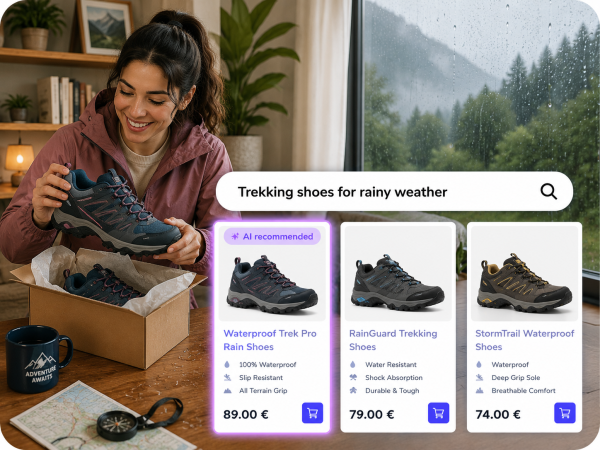
Consider a mid-sized retailer whose shoppers searched for “wireless earbuds for running.” A keyword-only engine returned zero results because the catalog listed the product as a “sport Bluetooth earphone.” Shoppers assumed the item was out of stock and left. After switching to a semantic engine that understood the two phrases meant the same thing, those once-empty searches began converting — recovering sales that were previously invisible in every report. Multiply that across thousands of queries a month, and the revenue impact is substantial. This is the everyday difference between a basic engine and an AI-driven one: the products were always there; only the engine changed.
Don’t Forget Mobile and Voice
More than half of ecommerce traffic now comes from phones, and a growing share of shoppers search by voice or in conversational, ChatGPT-style language. A modern engine must handle predictive autocomplete, collapsible filters, and natural phrasing on small screens. If your search works well on desktop but frustrates mobile shoppers, you are losing the majority of your traffic at the most important moment — so test the mobile search experience as rigorously as the desktop one.
Which Stores Need It Most
Every online store benefits, but the gains are largest for catalogs where shoppers use varied, descriptive language — fashion, electronics, home goods, beauty, grocery, and B2B distributors with deep technical catalogs. High-traffic stores benefit most of all, because even a small lift in search conversion compounds into significant revenue at scale.
How bCloud AI Powers a Smarter Search Engine in Ecommerce

Key Features of a Modern Ecommerce Search Engine
Today’s shoppers expect far more than a simple keyword search. A modern ecommerce search engine combines artificial intelligence, personalization, and real-time analytics to help customers discover products faster while increasing conversions. Here are the essential capabilities every ecommerce business should look for.
AI-Powered Semantic Search
Understands customer intent instead of matching exact keywords, delivering relevant products even when shoppers use different wording.
Instant Autocomplete
Displays product suggestions, categories, and popular searches in real time as customers type, reducing search effort.
Personalized Results
Ranks products based on browsing history, previous purchases, location, and customer preferences to improve conversions.
Typo & Synonym Handling
Recognizes spelling mistakes, abbreviations, and alternative product names so customers always receive relevant results.
Search Analytics
Tracks popular searches, zero-result queries, click-through rates, and conversions, helping merchants continuously improve search performance.
Mobile & Voice Ready
Optimized for mobile devices and conversational voice queries, ensuring a seamless shopping experience across every device.
Why These Features Matter
The more accurately your search engine understands customer intent and delivers relevant products instantly, the higher your conversion rate, average order value, and customer satisfaction. Investing in these capabilities ensures your ecommerce store remains competitive as shopper expectations continue to evolve.
Frequently Asked Questions: Search Engine in Ecommerce
What is a search engine in ecommerce?
A search engine in ecommerce is the software that powers product search on an online store. It indexes the catalog, interprets shopper queries, and ranks the most relevant products in milliseconds. Modern engines use AI, semantic search, and natural language processing to understand intent rather than just matching keywords.
How does a search engine in ecommerce work?
It works in three steps: it indexes your product catalog into a searchable format, interprets each shopper’s query (using semantic and natural language understanding in AI-powered engines), and ranks the most relevant products — often personalized to the individual shopper.
What is the difference between a search engine in ecommerce and Google?
Google is a general web search engine that helps shoppers discover stores from the outside. A search engine in ecommerce is the internal, onsite search on your own website, focused entirely on your products and built to drive purchases once a shopper arrives.
What are the types of search engines in ecommerce?
The three main types are keyword-based search (literal text matching), semantic or vector search (meaning-based matching), and conversational or AI search (natural-language, ChatGPT-style discovery). AI-powered semantic and conversational engines deliver the best relevance.
Why is a search engine in ecommerce important?
Shoppers who search show strong purchase intent and convert at far higher rates than browsers. A good search engine reduces the roughly 31% of searches that return zero results, lifting conversions, average order value, and customer satisfaction at once.
How does AI improve a search engine in ecommerce?
AI adds semantic understanding, natural language processing, typo and synonym handling, and behavioral personalization, so the engine returns relevant products even for queries it has never seen and tailors results to each shopper.
Can a search engine in ecommerce help with AI visibility?
Yes. An AI-ready search engine structures product data and content so engines like ChatGPT, Gemini, and Google AI Overviews can read and recommend your store, turning AI-driven discovery into onsite traffic.
What is the best search engine for an ecommerce website?
The best search engine for an ecommerce website combines semantic and conversational AI, personalization, fast performance at scale, and broad integrations. Leading options include bCloud AI, Algolia, Coveo, and Klevu, with the right fit depending on your catalog and platform.
Give Your Store a Smarter Search Engine
A modern search engine in ecommerce is the fastest way to convert more of the shoppers you already have. Start for free or book a demo to see AI-powered, intent-based product search in action.