
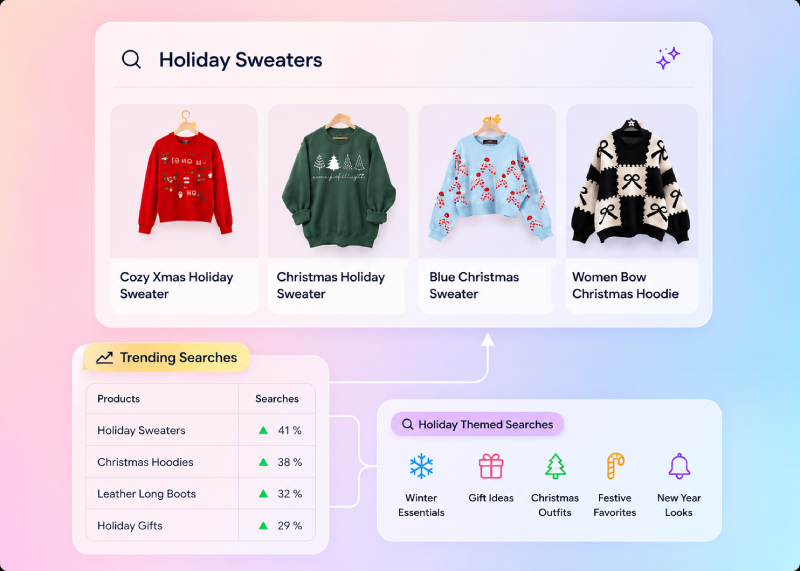

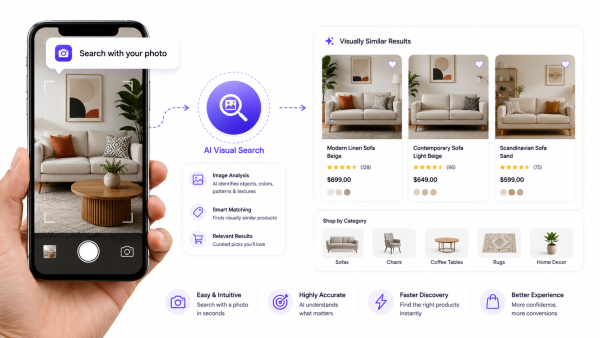
What is visual search for ecommerce?
Why visual search matters now
Visual search has moved from novelty to expectation, driven by a few forces at once. Shoppers — especially younger ones — already search visually on social platforms and with their phone cameras, and they bring that habit to retail. Whole categories live or die on how something looks: fashion, home décor, furniture, beauty, and accessories are full of purchases where a description never captures what a picture does. And as discovery shifts toward AI that understands images as fluently as text, stores that can be searched visually are simply more findable.
The growth of visual search is reshaping how consumers interact with products online.
The business reason is just as direct. Every “I can’t describe it, so I’ll give up” moment is a lost sale — and those moments cluster around your most visual, often highest-margin products. Visual search captures intent that text leaves on the table, turning a frustrated browser into a buyer. It’s the same logic behind replacing a basic product search engine with an intelligent one: meet shoppers where their intent actually is.
AI Search Grader by bCloud AI
Grade your ecommerce search in 10 quick questions
31% of ecommerce searches return zero results — and most shoppers who hit a dead end leave for a competitor. How does your store's search stack up?
Answer 10 short questions and get your AI search score, plus a personalized report to fix the gaps. Free, takes about 2 minutes.
No signup needed to take the quiz.
Understanding intent…
Scoring your answers across relevance, AI, experience, and insights.
Your AI search score is ready
Tell us where to send your personalized report. You'll see your score and recommendations right away.
Your score by pillar
Personalized recommendations
Fix the gaps in weeks, not quarters
bCloud AI replaces keyword-only search with hybrid AI retrieval — sub-200ms responses, 99.99% uptime, and conversion lifts of up to 40% across 50+ implementations.
How visual search works
Behind the scenes, visual search runs on computer vision and the same vector technology that powers semantic text search. Understanding the flow makes it clear what separates a genuine visual search engine from a glorified image filter.
The most capable platforms go a step further with multimodal AI — models that understand text and images together. A shopper can combine the two (“find me this jacket, but in black”) and the system understands both the picture and the modifier. bCloud AI’s multimodal AI-powered search is built around exactly this idea: understanding text, images, intent, and context from a single query, so discovery feels effortless no matter how a shopper expresses what they want.
Where visual search shows up on your store
Visual search isn’t one button — it’s a capability that appears across the journey:
Camera & upload search
A search bar that accepts an image, so shoppers can snap or upload to find a match.
“Shop the look”
Tap any product in a lifestyle photo and surface that item — or its closest equivalents — instantly.
Visually similar items
“More like this” recommendations on product pages, powered by image similarity rather than manual tagging.
Image-based discovery
Shoppers explore your catalog by visual style, not just category labels.
Incorporating visual search across these touchpoints can significantly improve customer satisfaction.
Each of these turns a picture into a path to purchase — and removes the guesswork that text-only search forces on visual products.
Visual search also changes how shoppers move from inspiration to evaluation and purchase. A customer may discover a product in a social post, save an image from another website, or photograph something they see in the real world and then use that image as the starting point for their shopping journey. Instead of beginning with a category page or trying to guess the right keywords, they can immediately explore products that match the visual reference. When this experience is connected with relevant filters, product information, recommendations, and availability, visual discovery becomes a natural part of the buying journey rather than a separate search feature.
The business case for visual search
Visual search moves the metrics that matter — and for visual-first categories, it’s often the single highest-impact upgrade to product discovery.
The ROI of implementing visual search can be substantial, with a direct, positive impact on sales.
↑ Conversion
Higher conversion rates
By capturing intent that words simply can’t express.
↑ Engagement
Deeper engagement
As shoppers explore and discover your catalog by image.
↑ AOV
Higher average order value
Through visual recommendations and “shop the look” discovery.
↓ Dead ends
Fewer failed searches
When a shopper can show you what they want, they rarely bounce.
It also reduces the silent revenue leak of failed searches — and it compounds with the rest of your AI search stack rather than replacing it.
How to add visual search to your store
The good news: adding visual search doesn’t require a custom computer-vision team. With a modern, AI-native platform, the path is straightforward.
Because visual search rides the same infrastructure as your text search, you’re extending one system, not bolting on a second. For a deeper look at how these next-generation capabilities fit together, bCloud’s guide to advanced ecommerce search walks through the modern discovery stack end to end.
Visual search and AI visibility
Common visual search mistakes to avoid
Industries That Benefit Most from Visual Search
Visual search delivers the greatest impact in categories where appearance plays a major role in purchasing decisions. Instead of describing products with keywords, shoppers can simply upload an image and discover visually similar items within seconds.
Fashion & Apparel
Help shoppers find clothing with similar colors, patterns, cuts, and styles from a single photo.
Furniture & Home Décor
Match sofas, tables, lighting, and décor items based on design, materials, and overall aesthetic.
Beauty & Cosmetics
Recommend products with similar shades, packaging, or styles that shoppers discover online or on social media.
Jewelry & Accessories
Enable customers to locate rings, watches, handbags, or accessories that closely resemble an uploaded image.
While visual search is valuable across ecommerce, it provides the biggest competitive advantage for businesses where shoppers buy based on appearance, design, and style rather than technical specifications alone.
Frequently asked questions
What is visual search for ecommerce?
Visual search for ecommerce lets shoppers find products using an image instead of text. AI analyzes the photo’s shape, color, pattern, and style, then returns the most visually similar products from your catalog — so customers can find exactly what they’re looking at even when they can’t describe it in words.
How does visual search work?
AI converts each image — the shopper’s photo and every product image in your catalog — into a mathematical “embedding” that captures its visual features. The system then finds the products whose embeddings are most similar to the shopper’s image. Multimodal platforms can combine image and text in a single query.
Which products benefit most from visual search?
Visual-first categories see the biggest impact: fashion and apparel, home décor, furniture, beauty, jewelry, and accessories — anywhere the look of a product matters more than a text description can convey.
Do I need a computer-vision team to add visual search?
No. A modern AI-native search platform handles the computer vision for you, automatically embedding your catalog images. You add a lightweight search experience and provide good product imagery.
Does visual search help with AI visibility?
Yes, indirectly. As AI engines and tools like Google Lens make image-based discovery mainstream, the structured, image-complete catalog that powers on-site visual search is the same data those systems use to recognize and recommend your products.