
The thing most people get wrong

This matters enormously for retailers, because it relocates the question. You’re not trying to get into a model’s training data — that ship sailed and wasn’t steerable anyway. You’re trying to be retrievable and readable at the moment someone asks. That’s a solvable problem.
The four stages of LLM product search
Stage one: interpreting the request.
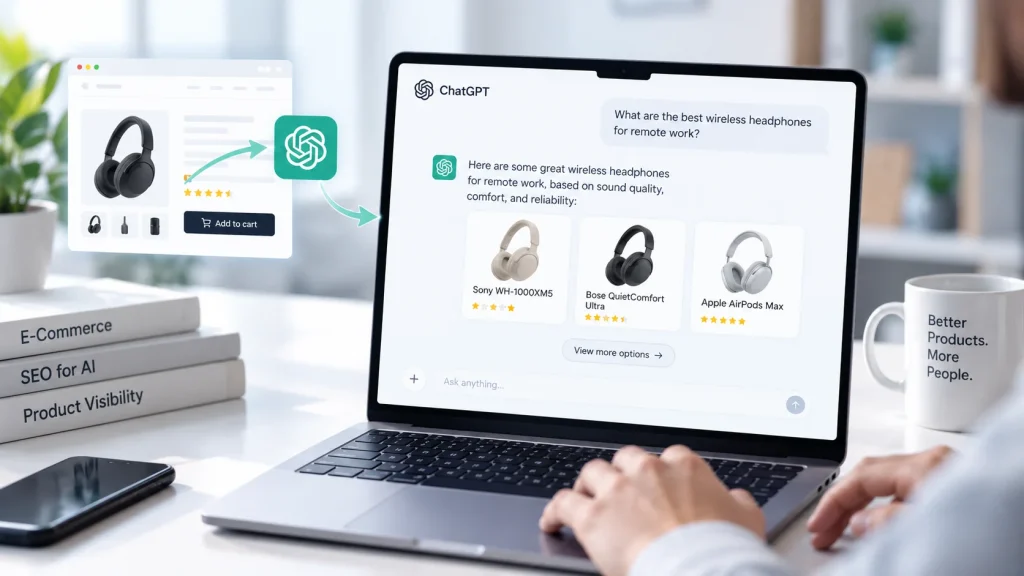
LLM product search starts here. The model parses what was asked into structured requirements. “Waterproof jacket under $150 for bike commuting” becomes category, a waterproofing requirement, a price ceiling, and implied needs — visibility, packability, breathability under exertion — that the shopper never stated. This decomposition is why LLM product search handles vague requests that break keyword systems, and it’s covered in our query understanding guide.
Stage two: retrieval — where LLM product search really happens.
The system searches for relevant products, typically across a web index, sometimes through direct integrations or merchant feeds. Retrieval is usually semantic — matching meaning rather than keywords — often blended with keyword matching for precision, as covered in our hybrid search guide.
Stage three: reading and filtering.
The model reads retrieved pages and extracts what it needs: price, availability, materials, specifications, ratings. This is where most catalogs fail. If your product page doesn’t state the waterproof rating anywhere a machine can find it, you’re filtered out — not because your jacket isn’t waterproof, but because nothing said so in a readable way.
Stage four: composing the answer.
The model synthesizes a recommendation from what survived, usually with citations. Products that made it into the grounding set get considered; everything else was never in the running.
The whole sequence runs in seconds, and the retailer has no visibility into any of it.
AI Search Grader by bCloud AI
Grade your ecommerce search in 10 quick questions
31% of ecommerce searches return zero results — and most shoppers who hit a dead end leave for a competitor. How does your store's search stack up?
Answer 10 short questions and get your AI search score, plus a personalized report to fix the gaps. Free, takes about 2 minutes.
No signup needed to take the quiz.
Understanding intent…
Scoring your answers across relevance, AI, experience, and insights.
Your AI search score is ready
Tell us where to send your personalized report. You'll see your score and recommendations right away.
Your score by pillar
Personalized recommendations
Fix the gaps in weeks, not quarters
bCloud AI replaces keyword-only search with hybrid AI retrieval — sub-200ms responses, 99.99% uptime, and conversion lifts of up to 40% across 50+ implementations.
What makes a catalog findable by LLMs
Six factors determine whether your products enter the LLM product search grounding set. None is exotic.
Crawlability.
If AI crawlers can’t reach your pages, nothing else matters. GPTBot, Bingbot, PerplexityBot, ClaudeBot, and Google-Extended each need access, and each is controlled separately — blocking one doesn’t block the others, and a security plugin or CDN rule can block them regardless of your robots.txt. Our AI crawlers guide covers the diagnostics.
Server-side rendering.
Many crawlers execute limited or no JavaScript. If prices and descriptions only appear after client-side rendering, they see an empty shell. This single technical detail excludes a lot of otherwise good stores from LLM product search entirely.
Structured data.
Product schema markup stating name, price, availability, brand, and attributes turns your page from prose into data. It’s the difference between hoping a model infers your price and telling it explicitly.
Attribute completeness.
The determining factor for whether you match specific requests. A model can only filter on attributes your page states. Waterproof rating, weight, materials, dimensions, compatibility, care instructions — every missing attribute is a query you silently lose.
Use-case language.
Shoppers ask by situation, not category. A product description mentioning “bike commuting,” “packs into its own pocket,” or “wears over a suit” gives the model something to match against. Pure spec sheets match spec queries and nothing else.
Freshness.
A model reading stale prices recommends products at wrong prices, which erodes trust in both the assistant and your brand. Keep your public pages current — the discipline in our real-time indexing guide applies to the pages crawlers read, not just your search index.
Why LLM product search rewards thin-tail products unusually well
Here’s a genuinely interesting asymmetry in LLM product search.
Traditional search ranking heavily favors popularity — pages with authority and links outrank pages without. That systematically buries long-tail products, however well they match a query.
LLM product search behaves differently. When someone asks for “a waterproof jacket that packs down small for bike commuting under $150,” the model is looking for fit, and a well-described niche product can beat a famous one that matches less precisely. Specificity becomes an advantage rather than a handicap.
The practical implication: enriching descriptions on your long-tail products has outsized return in this channel. Those are the items that were invisible in traditional search and can be genuinely competitive in LLM product search — provided the data exists for a model to read. Our product findability guide covers the merchandising side of this.
What you cannot control, and what that means
Being clear-eyed here prevents wasted effort.
You can’t optimize the model behind LLM product search.
There’s no ranking algorithm to reverse-engineer, no keyword density that helps. Attempts to game LLM product search with keyword stuffing or hidden text tend to backfire, since models read for meaning and the systems retrieving pages apply their own quality judgments.
Retrieval is opaque.
You don’t know which of your pages were considered or why one was chosen. Bing Webmaster Tools’ AI Performance report is currently the most direct visibility available, and even that is sampled and lagged by two to three days.
Results vary by assistant and by phrasing.
The same question asked slightly differently returns different products. There’s no stable “rank” to track.
Volatility is normal.
Grounding indexes get rebuilt, and sites have seen citations collapse for one to three weeks before recovering with nothing changed on their end. Watch trends over weeks, not days.
What you can control is whether your catalog is crawlable, complete, structured, and current. That’s not a small list, and it’s entirely within reach.
How to measure LLM product search visibility
Four instruments for LLM product search visibility, none perfect, useful together.
Bing Webmaster Tools AI Performance.
Citations and cited pages from Copilot and partners. Sampled, lagged two to three days, and currently the closest thing to a direct measurement.
AI referral traffic.
Filter analytics for chat.openai.com, copilot.microsoft.com, perplexity.ai, and gemini.google.com. Volumes are modest but these visitors arrive with a recommendation rather than a hypothesis, so they convert unusually well.
Manual spot-checks.
Ask each assistant the questions your customers would ask. Crude, but it tells you how you’re described, which no dashboard reveals.
Crawler logs.
Whether AI crawlers are arriving and what status codes they receive. This is the leading indicator — crawl problems precede citation problems by days or weeks.
Our semantic search analytics guide covers the measurement discipline more broadly.
The overlap with your own site search
The most useful thing to understand about LLM product search remains that the work required is the same work that fixes on-site search.
Both need complete structured product data. Both need accurate current prices and availability. Both need descriptions expressing what a product is for, not just what it’s called. Both benefit from consistent categorization and clean attributes.
That’s a genuine two-for-one, and it reframes catalog enrichment from housekeeping into infrastructure with compounding returns. A store investing in product data improves internal discovery — covered in our AI site search and top semantic search solutions for e-commerce guides — and improves external AI visibility simultaneously.
It also means the reverse is true: a store with thin product data is invisible twice.
What this changes about product content
The practical consequence of LLM product search working through retrieval is that your product pages stopped being purely persuasive documents and became machine-readable data sources — and most catalogs were written for neither.
Specifications need to be explicit, not implied.
A photograph showing a jacket’s hood doesn’t tell a model the hood is adjustable. A spec table does. Anything a shopper might filter on needs stating in text a machine can parse.
Use cases belong in the description.
Models match requests to products, and requests are phrased as situations. A description mentioning what the product is for — commuting, coastal environments, small apartments, wide feet — creates matchable surface that a spec sheet alone doesn’t.
Comparison context helps.
Content explaining how a product differs from alternatives gives a model something to say when a shopper asks for a comparison. Stores that publish honest comparison content get cited in comparison answers; stores that only publish product pages get cited less.
Structured and unstructured should agree.
If your schema says one price and your page text says another, you’ve introduced ambiguity at exactly the wrong moment.
Reviews and Q&A add retrievable substance.
User-generated content frequently contains the use-case language your marketing copy omits, and it’s often what a model quotes when explaining why a product fits.
None of this is gaming anything. It’s making true information about your products legible — which is the only durable strategy in LLM product search, since there’s no algorithm to exploit.
Week 1 — verify access.
Check robots.txt, then check your WAF and CDN separately, since that’s where blocks hide. Pull crawler logs for 403s and 503s. Fetch a product page with a plain HTTP request and confirm the price and description appear in the raw HTML.
Week 2 — add structured data.
Product schema on every product page: name, price, availability, brand, and as many attributes as you can populate.
Weeks 3–4 — enrich the tail.
Sample fifty products from your catalog’s long tail and read them as a shopper would. If you can’t tell what several are or when you’d use them, neither can a model. Fix those first — they have the most to gain.
Ongoing — spot-check and measure.
Monthly assistant queries plus the Bing report, tracked as a trend.
Frequently asked questions
How do LLMs find products in online stores?
Through retrieval, not memory. The model interprets the request into structured requirements, searches for current product information across a web index or feed, reads what comes back to extract price and attributes, then composes a recommendation grounded in that material. Training data plays little role because it’s stale.
Can I optimize my products for LLM product search?
Not by gaming a ranking algorithm — there isn’t one to reverse-engineer. You optimize by being retrievable and readable: allow AI crawlers, render content server-side, add product structured data, complete your attributes, and write descriptions covering use cases rather than only specifications.
Why don’t LLMs recommend my products?
Usually one of three reasons: AI crawlers can’t reach your pages, your content requires JavaScript to render so crawlers see an empty shell, or your product data lacks the attributes needed to match specific requests. Check crawl access first — it’s the most common and most fixable.
Do LLMs use training data to recommend products?
Minimally, and unreliably. Product information changes constantly — prices, stock, discontinuations — so models retrieve current information rather than depending on training. That’s good news for retailers, because it means being findable now matters more than having been famous earlier.
Does structured data help with LLM product search?
Yes. Product schema markup states your price, availability, brand, and attributes explicitly rather than leaving a model to infer them from prose. It doesn’t guarantee recommendation, but it removes ambiguity at the stage where products get filtered out.
How do I measure whether LLMs are recommending my products?
Use Bing Webmaster Tools’ AI Performance report for citation data, filter analytics for referrals from AI assistant domains, spot-check manually by asking assistants your customers’ questions, and monitor crawler logs for access problems, which are the leading indicator.
Be readable to the systems doing the recommending.
The catalog structure that makes AI assistants recommend your products is the same structure that powers great on-site search. bCloud AI helps you build both.
bcloud.ai