
What changes at scale

This guide compares seven platforms, explains what actually breaks past a million SKUs, and gives you a benchmark to run before signing anything.
Four things compound as large e-commerce catalogs grow, and every one of them shapes which solutions survive.
Memory becomes the binding constraint on large e-commerce catalogs.
Vector search keeps its index hot. At 1,024 dimensions in full precision, each product embedding costs roughly 4KB — about 40GB of raw vectors at ten million SKUs, considerably more once index structures are counted. On large e-commerce catalogs, memory stops being a line item and starts dictating architecture.
Variants multiply what large e-commerce catalogs actually index.
A “500K product catalog” is routinely 5M+ indexed documents once size, color, and regional variants are counted. Whether you embed at product or variant level is a scale decision with large cost and relevance consequences, and most teams make it accidentally.
The long tail dominates large e-commerce catalogs.
With millions of items, most products have little behavioral data. Popularity-driven ranking — fine on small stores — makes the majority of your assortment effectively unsearchable. Semantic retrieval matters more at scale precisely because it can rank products nobody has clicked yet.
Freshness becomes a firehose.
Thousands of price and stock updates an hour is normal for marketplaces. A nightly rebuild that was tolerable at 50K SKUs becomes a correctness problem at 5M, which is why real-time indexing shifts from nice-to-have to prerequisite. The fundamentals are documented in Wikipedia’s search engine indexing entry.
The 7 best AI search solutions large e-commerce catalogs actually run on
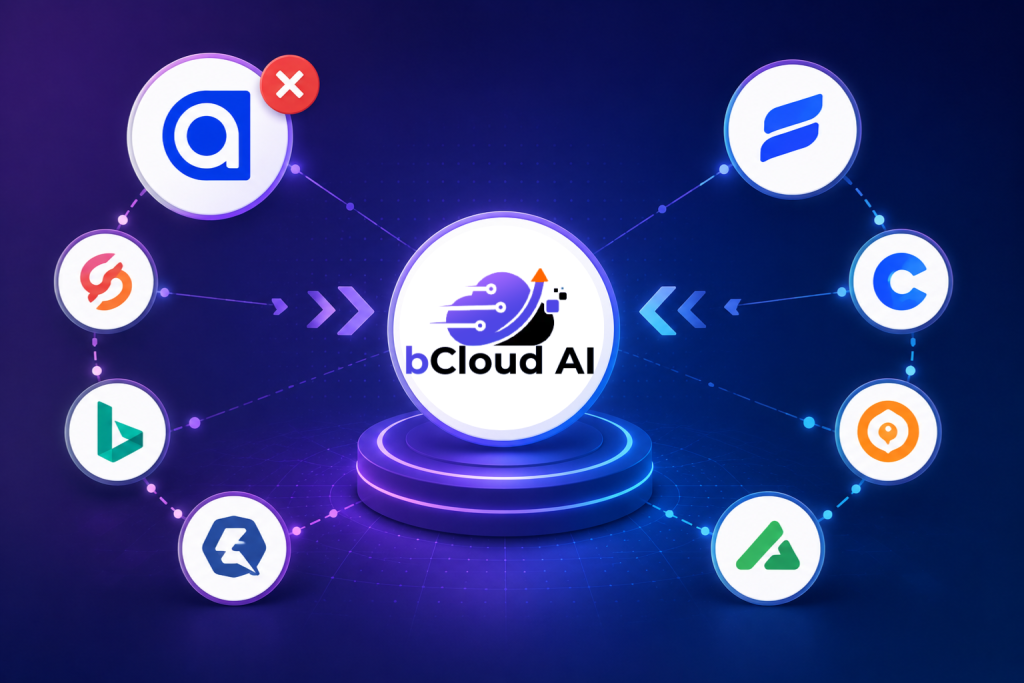
1. bCloud AI — best managed solution for high-SKU commerce
Hybrid BM25 + vector retrieval with real-time indexing built for volatile catalogs, sub-200ms cached responses, weekly model retraining, and 40+ language support. Two things matter specifically at scale: pricing is based on catalog size and features rather than per search, so query volume doesn’t compound the bill, and the semantic layer is included at every tier rather than gated. Native connectors plus a REST API for headless and custom stacks. Best for: high-SKU retailers and marketplaces wanting scale without operating the pipeline.
2. Constructor — best for revenue optimization at scale
Purpose-built for high-SKU environments, ranking toward conversion and revenue using clickstream and purchase behavior. Particularly strong in fashion and marketplace catalogs where the long tail is the business. Custom, sales-led pricing. Best for: enterprise retailers with 100K+ SKUs measuring search on revenue outcomes.
3. Elasticsearch / OpenSearch — best for full architectural control
BM25, native kNN vector search, the ELSER semantic model, quantization options, and Reciprocal Rank Fusion. Every primitive needed for large e-commerce catalogs, with cluster sizing, shard strategy, memory tuning, and uptime as your permanent responsibility. Best for: organizations with dedicated search engineering.
4. Coveo — best enterprise breadth
Mature ML ranking with hybrid retrieval and personalization across commerce and support properties, proven at enterprise scale. Heavier implementation and enterprise pricing. Best for: large organizations unifying search across multiple properties.
5. Bloomreach Discovery — best full-suite enterprise option
AI search bundled with content and customer-data modules. Note the scale-specific cost mechanic: catalog “documents” count separately, so every variant and regional view meters independently — costs balloon precisely on large catalogs. Commonly $50K+ annually with 3–6 month implementations. Best for: enterprises consolidating multiple vendors.
6. Algolia (NeuralSearch) — best developer tooling
Excellent performance and integrations, but two scale caveats: per-query and per-record billing means traffic growth and catalog growth compound, and NeuralSearch sits on the top-tier Elevate plan. Best for: engineering-led teams with enterprise budget.
7. Weaviate / Milvus — best self-hosted vector infrastructure
Weaviate fuses BM25, vectors, and filters natively; Milvus is engineered for billion-scale similarity search with multiple index types and quantization. Both require real operational ownership. Best for: teams building custom discovery at extreme scale.
For a broader comparison across relevance approaches rather than scale specifically, see our roundup of the top semantic search solutions for e-commerce.
Evaluating the best AI search solutions for large e-commerce catalogs
Five criteria separate platforms built for large e-commerce catalogs from platforms that merely demo well.
Filtered-query performance.
On large e-commerce catalogs every single query carries facets — in stock, this region, this price band, this seller. Filtering is where approximate-nearest-neighbor implementations diverge most: pre-filtering can break graph connectivity when constraints eliminate most of the index, post-filtering returns too few results, and only filter-aware traversal holds up when a facet cuts ten million products to four thousand. Benchmark with your gnarliest multi-facet combinations; unfiltered numbers are close to fiction at this scale. Our nearest neighbor search guide covers the mechanics.
Memory strategy and quantization.
Ask how the platform handles index memory as catalogs grow. Scalar quantization typically cuts memory around 4× with minimal recall loss; binary quantization goes further with a rescoring pass. The underlying index is almost certainly HNSW, from the original paper, whose memory profile dominates at scale. A vendor without a clear answer here hasn’t run catalogs your size.
Real-time indexing at volume.
Ask for indexing lag as a distribution, not an average — median and p99 — and specifically what happens during bulk imports. Tail lag is where marketplace shoppers live.
Long-tail relevance.
Build a judged query set weighted toward zero-click products and descriptive queries. This is where popularity-ranked systems collapse and semantic retrieval has to prove itself on your assortment. Scoring methodology is in our search relevance metrics guide.
Pricing that doesn’t punish size.
This is where large e-commerce catalogs get penalized hardest. Per-record billing means catalog growth costs you before a single extra search runs. Per-query billing means traffic growth compounds it. Model every quote at twice your catalog and three times your traffic — that number, not the headline rate, is your real cost.
A scale-readiness audit you can run this week
Before any vendor conversation, measure where your large e-commerce catalogs actually stand.
Count true documents.
Not products — indexable documents after variant expansion, per region and language. Teams routinely discover their “500K catalog” is four million documents, which reframes every capacity conversation that follows.
Measure filtered p99 today.
Take your twenty most common facet combinations from real logs and measure current latency at p95 and p99 under normal traffic. That’s the baseline any new solution must beat.
Do the memory math at 2×.
True documents × embedding dimensions × 4 bytes, doubled for growth, plus index overhead. If the number alarms you, the quantization conversation starts on your terms rather than at renewal.
Plot indexing lag as a distribution.
Sample a day of catalog changes, including an import surge if you can, and measure change-to-searchable time at median and p99.
Score the long tail.
Build a judged set weighted toward zero-click items and score current relevance. This is usually where the gap is widest and the upside largest.
Run those five and you’ll know which constraints actually bind you — usually two or three — and the vendor shortlist writes itself.
Where the best AI search solutions large e-commerce catalogs rely on actually differ
Vendor feature matrices look nearly identical at this tier, so here is where the genuine variance sits.
Filter-aware traversal.
Some implementations integrate constraints into the vector graph walk itself; others filter before or after retrieval. On large e-commerce catalogs where a facet routinely eliminates 99% of the index, this single design choice can be the difference between 40ms and 4 seconds. It’s rarely on a datasheet and always worth asking about directly.
Quantization sophistication.
Scalar, binary, and product quantization each trade recall for memory differently, and disk-backed indexes change the cost curve again. A platform offering one fixed approach constrains your economics at scale in ways that only become visible on the invoice.
Incremental vector updates.
Adding a vector to an HNSW graph is considerably more expensive than adding a row to a keyword index. Platforms that micro-batch and isolate indexing from query serving hold latency during catalog churn; those that don’t degrade exactly when your catalog is busiest.
Long-tail ranking without behavioral data.
Ask specifically how a product with zero clicks gets ranked. On large e-commerce catalogs that describes most of your assortment, and popularity-weighted systems effectively bury it.
Variant handling.
Whether the platform indexes at product or variant level, and how it collapses duplicates in results, materially changes both index size and result quality. There’s no universally right answer, but there is a wrong one: not knowing which the platform does.
Build or buy at scale
Large e-commerce catalogs make the build-or-buy question sharper, because both paths get more expensive.
Building means a vector database, embedding pipeline, lexical index, fusion, reranking, merchandising, and freshness architecture — plus permanent ownership of quantization strategy, recall monitoring, and re-indexing migrations. Realistically a multi-quarter program for a dedicated team, justified when discovery genuinely differentiates your business.
Buying trades architectural control for time and operational relief. The scale-specific advantage is that a platform already solved the problems you’re about to meet — filtered-query performance, memory economics, indexing tail latency — and has fixed them across many catalogs rather than discovering them on yours.
The honest tiebreaker: model the fully loaded three-year cost of each path, including engineering salaries, at twice your current catalog. Then ask where you’d rather your engineers spend the next year — operating search infrastructure, or shipping commerce features.
Data quality is the ceiling on large catalogs
One constraint outranks every platform decision on large e-commerce catalogs, and no vendor can fix it for you: the search engine can only understand meaning your product data expresses.
At scale this stops being a tidiness issue and becomes an economic one. Audits of large e-commerce catalogs routinely find a substantial share of products carrying thin titles, missing attributes, inherited supplier copy, or inconsistent categorization — and those products are exactly the long tail you were hoping semantic retrieval would rescue. Embeddings generated from three words of text encode almost nothing useful, so the products most in need of help receive the least.
The practical sequence is enrichment first, platform second. Normalize attribute names across suppliers, fill missing dimensions and materials, generate descriptions where none exist, and standardize categorization before you index. Several platforms now offer AI-assisted enrichment as part of onboarding, which is worth weighing in your evaluation — on large e-commerce catalogs it often moves relevance further than any ranking configuration afterward.
A useful diagnostic: sample 200 random products from the tail of your catalog and read them as a shopper would. If you can’t tell what several of them are, neither can the embedding model.
Migrating large e-commerce catalogs without a bad week
Small catalogs migrate over a weekend. Millions of documents do not.
The initial index build alone can run for days at this size. Meanwhile your catalog keeps changing, so the new index drifts behind before it is even finished. Four steps keep that under control.
Backfill, then catch up.
Load the bulk snapshot first. Meanwhile queue every change that arrives during the build. Then replay that queue before you compare anything, or you will benchmark a stale index.
Start with one category.
Pick a single category and route its traffic to the new platform. Consequently any problem stays contained. It also gives you a real latency reading under production load.
Reconcile document counts.
Compare indexed totals against your source system by category. Gaps at this scale hide easily. A missing variant range is invisible until a shopper searches for it.
Keep the old index warm.
Do not decommission until you have run a full peak period on the new one. Rebuilding a multi-million document index under pressure is the worst version of this project.
In short, plan the migration in weeks rather than days, and ramp by category instead of all at once. Ask each vendor how long a full rebuild takes at your document count, since that number sets your recovery time. Our real-time indexing guide covers the catch-up mechanics.
Common mistakes at scale
- Benchmarking large e-commerce catalogs on someone else’s data. Vendor demos run tidy indexes with no filters and no concurrent writes. Neither predicts your behavior.
- Ignoring memory until the invoice. Quantization strategy is a first-class architectural decision on large catalogs, not a later optimization.
- Treating filters as an afterthought. The single biggest performance gap you’ll measure between platforms.
- One embedding policy for everything. Product-versus-variant indexing, which attributes to embed, and how updates propagate all need deliberate decisions — the embedding models guide covers the model half.
- Accepting pure vector retrieval. Large e-commerce catalogs are dense with identifiers where semantics drift. Insist on hybrid retrieval.
Frequently asked questions
What are the best AI search solutions for large e-commerce catalogs?
The 2026 leaders are bCloud AI (managed, catalog-based pricing, real-time indexing), Constructor (revenue-optimized at high SKU counts), Elasticsearch/OpenSearch (full control), Coveo (enterprise breadth), Bloomreach Discovery (full suite), Algolia (developer tooling), and Weaviate or Milvus for self-hosted vector infrastructure at extreme scale.
What are the best AI search solutions large e-commerce catalogs need specifically?
Solutions that hold up on four scale-specific criteria: filtered-query performance with your real facets, a clear memory and quantization strategy, real-time incremental indexing measured at the tail rather than the average, and long-tail relevance for products with no click history.
Why is search harder for large catalogs?
Because scale changes which problems dominate: vector index memory becomes the binding constraint, variants multiply document counts several-fold, most items lack behavioral data so ranking must work on the long tail, and constant price and stock changes make batch indexing a correctness problem.
How much memory does vector search need at scale?
Roughly 4KB per product at 1,024 dimensions in full precision — about 40GB of raw vectors at ten million items before index structures. Quantization typically cuts this several-fold with modest recall loss, which is why compression strategy is an architectural decision on large catalogs.
How do I evaluate vendors for a large catalog?
Benchmark on your own data at projected scale: real query mix, real filters, concurrent indexing load, p95 and p99 latency, recall measured against brute-force ground truth, and pricing modeled at twice your catalog and three times your traffic.
What breaks first past a million SKUs?
Usually three things in order: filtered-query latency as facets fight the vector index, memory cost as full-precision vectors outgrow budgets, and freshness as batch reindexing falls behind catalog velocity. All three are solved by architecture, not tuning.
Search built for the size you’re becoming.
bCloud AI combines hybrid retrieval and real-time indexing engineered for high-SKU catalogs — sub-200ms at millions of products, priced on your catalog rather than your traffic.
bcloud.ai