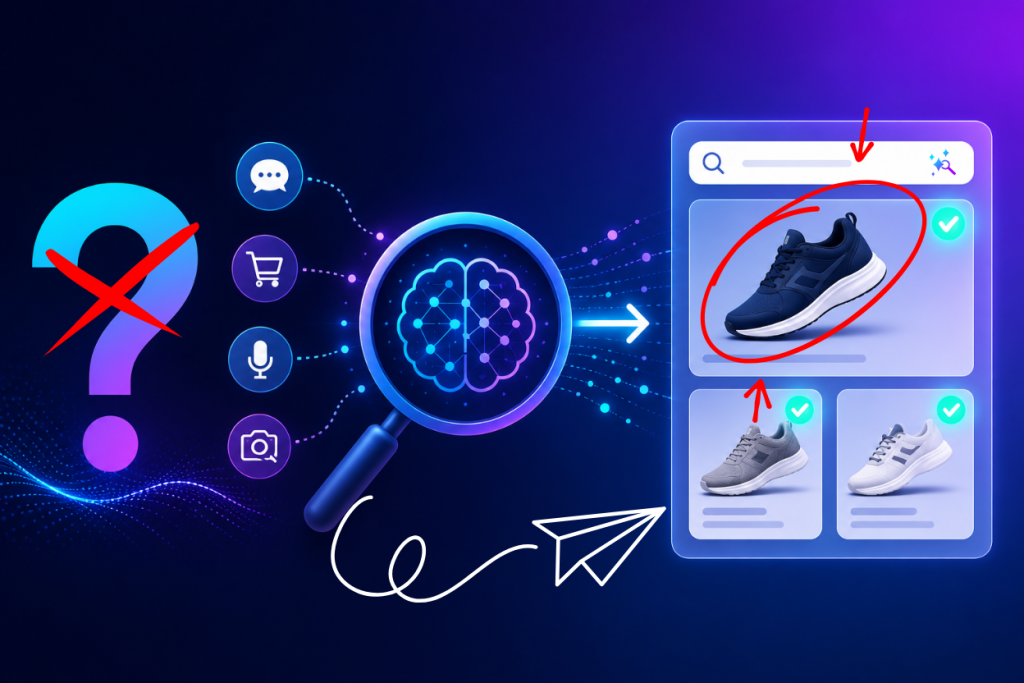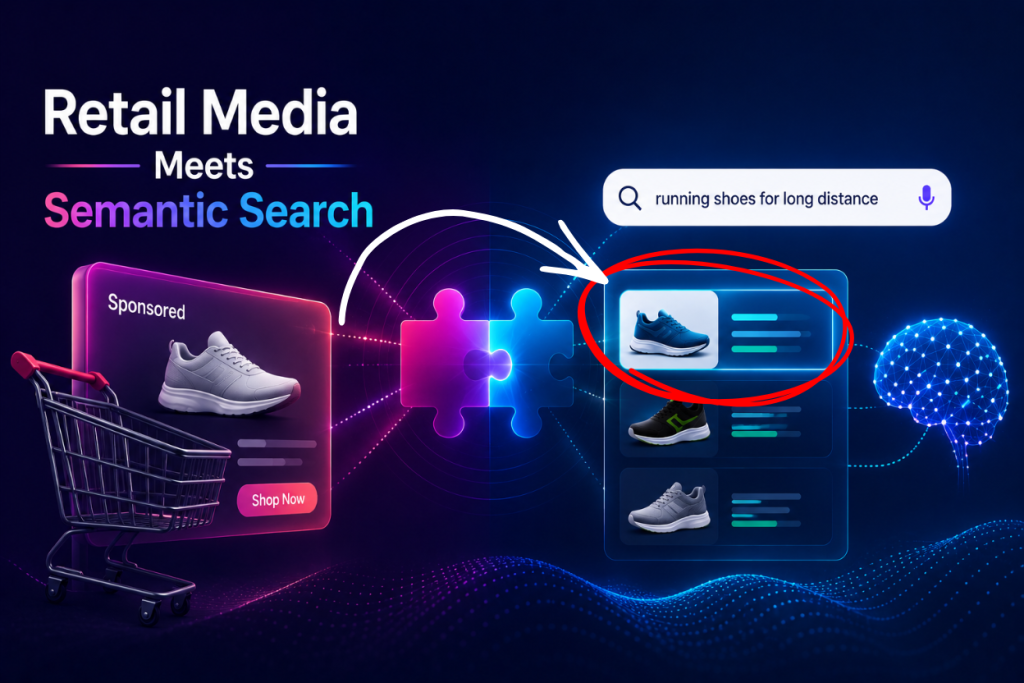
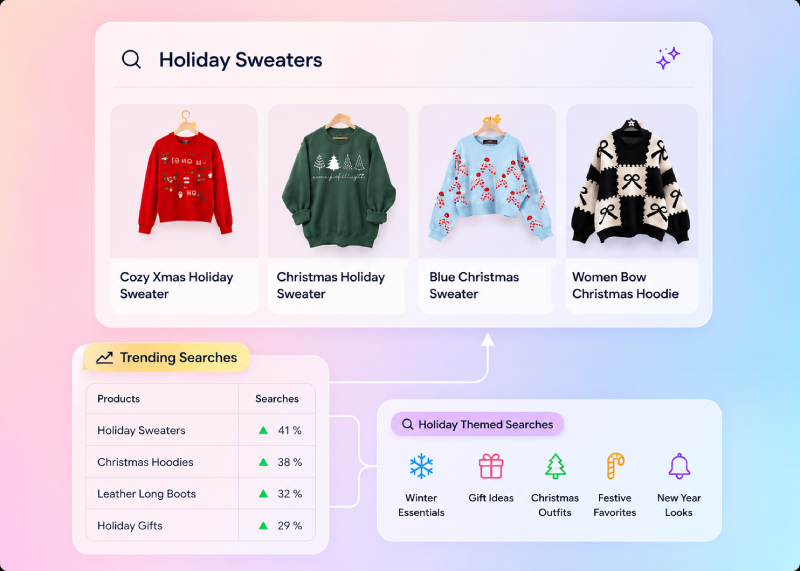

What is semantic search analytics?
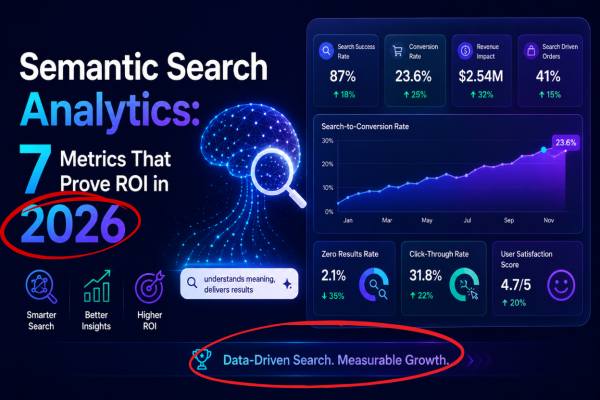
The distinction matters because meaning-based search fails differently than keyword search. Keyword search fails loudly — a zero-result page you can count. Semantic search fails quietly: it almost always returns something, so a shopper who asked for “breathable running shirts” and got generic t-shirts registers as a served query in ordinary reporting. Only semantic search analytics catches that the intent was missed. If you’re new to the underlying technology, our guide to what is semantic search covers the foundations.
One clarification worth making early: this discipline complements, rather than replaces, your store-wide search reporting. Merchant-facing numbers — revenue per search, funnel drop-off, top queries — live in ecommerce search analytics. Semantic search analytics is the quality layer underneath: it explains why those business numbers move.
Why semantic search analytics matters now
Three shifts made this measurement layer urgent.
First, natural-language queries took over.
Shoppers trained by AI assistants now type the way they talk, and the share of long, descriptive, constraint-laden queries keeps climbing. Those are exactly the queries where understanding can silently fail — and where standard reporting is blind.
Second, the failure mode inverted.
With keyword search, your worst outcome was visible (zero results). With semantic systems, your worst outcome is invisible: confidently wrong results. Semantic search analytics exists precisely because “we returned something” stopped being evidence of success.
Third, AI answer engines raised the stakes.
The same semantic understanding that powers your on-site search determines how well external AI engines can interpret your catalog. Measuring and improving semantic quality on-site tends to improve how AI assistants represent your products off-site — a compounding return that makes semantic search analytics a discoverability investment, not just a UX one.
AI Search Grader by bCloud AI
Grade your ecommerce search in 10 quick questions
31% of ecommerce searches return zero results — and most shoppers who hit a dead end leave for a competitor. How does your store's search stack up?
Answer 10 short questions and get your AI search score, plus a personalized report to fix the gaps. Free, takes about 2 minutes.
No signup needed to take the quiz.
Understanding intent…
Scoring your answers across relevance, AI, experience, and insights.
Your AI search score is ready
Tell us where to send your personalized report. You'll see your score and recommendations right away.
Your score by pillar
Personalized recommendations
Fix the gaps in weeks, not quarters
bCloud AI replaces keyword-only search with hybrid AI retrieval — sub-200ms responses, 99.99% uptime, and conversion lifts of up to 40% across 50+ implementations.
The 7 semantic search analytics metrics that matter
Here’s the measurement core. Together, these seven metrics tell you whether your AI search understands shoppers — and where it doesn’t.
1. Semantic match rate
The share of queries where the top results are genuinely relevant to the intent, not just lexically adjacent. This is scored against a judged query set — real queries from your logs, labeled by humans or strong click signals. It’s the headline number of semantic search analytics: the percentage of the time your engine understood.
2. Intent coverage
Of the distinct intents shoppers express (find a specific item, browse a category, solve a problem, compare options), what fraction does your search handle well? Intent coverage exposes systematic blind spots — many engines handle product-name queries beautifully and quietly fail problem-phrased ones like “shoes that help with knee pain.”
3. Natural-language zero-and-poor-result rate
Zero results still happen on semantic systems, but the more important cousin is the poor-result rate on conversational queries specifically. Segment your quality metrics by query type — short keyword vs. long natural language — because an engine can score well overall while failing exactly the queries you bought it for.
4. Ranked relevance (nDCG@10)
The gold-standard ranking metric, borrowed from information retrieval: it rewards putting the most relevant results at the very top, with graded relevance and position discounting. The formal definition lives in Wikipedia’s discounted cumulative gain entry. Track nDCG@10 over time on a fixed judged set; a drop is your earliest warning that quality regressed. Our search relevance metrics guide covers the full metric family.
5. Query reformulation rate
How often shoppers immediately rephrase and search again. Reformulation is the behavioral fingerprint of misunderstood intent — the shopper telling you, in real time, that the first interpretation missed. Falling reformulation is one of the cleanest signs your semantic search analytics program is working.
6. Embedding and model drift
Semantic quality decays silently. New products enter the catalog, shopper vocabulary shifts, seasonal language changes — and embeddings generated months ago gradually represent the world less well. Drift monitoring compares current match quality against a fixed benchmark set on a schedule, so degradation shows up as a trend line instead of a customer complaint.
7. Semantic lift (the ROI number)
The business delta attributable to understanding: conversion rate and revenue per search on natural-language queries, semantic system versus baseline, ideally from a controlled experiment. This is the number that survives a budget meeting. Run it properly with the methodology in our A/B testing ecommerce search guide — offline metrics predict, but only a live test proves.
Building the judged set your metrics depend on
Every number above rests on one thing. A labelled set of real queries.
Get the set wrong and your semantic search analytics measures the wrong thing precisely. However, building a good one takes a day, not a quarter. Four rules cover it.
Sample by frequency, not by interest.
Take queries in proportion to how often they actually occur. Otherwise the set over-weights the odd cases your team finds interesting.
Label relevance in grades.
Use three levels rather than yes or no. Perfect, acceptable, wrong is enough. Consequently nDCG has something meaningful to discount against.
Use two labellers on a subset.
Have two people judge the same fifty queries. Where they disagree, your relevance definition is unclear. Fix the definition before labelling the rest.
Freeze it between refreshes.
A set that changes weekly cannot show a trend. Therefore keep it fixed for the quarter, then replace it deliberately and note the changeover on your charts.
In short, treat the judged set as an asset rather than a chore. It outlives platform changes and makes every future comparison cheap. Our search relevance metrics guide covers how to score against it.
How to run semantic search analytics in practice
The workflow is straightforward, and most of it compounds once set up.
Build a judged query set. Sample 200–500 real queries from your logs across query types — head terms, long conversational queries, typos, problem-phrased searches. Label the relevant results for each, using merchandiser judgment, click-derived signals, or both. This set is your ruler; without it, every quality claim is vibes.
Score offline on a schedule. Compute semantic match rate, nDCG@10, and intent coverage against the judged set weekly or after any change — a new embedding model, a fusion re-weight, a reranker update. This is how query understanding changes and embedding model swaps get evaluated before they touch shoppers.
Instrument the behavioral signals. Reformulation rate, poor-result abandonment, and click-position on natural-language queries come from your live traffic and need no labeling — they’re the always-on layer of semantic search analytics.
Validate with experiments. When offline numbers say a change helps, confirm with a live split measuring conversion and revenue per search. Offline-to-online disagreement is common enough that skipping this step regularly burns teams.
Watch the drift line. Re-score the fixed benchmark monthly. When the trend bends down, investigate before shoppers notice.
The semantic search analytics platform landscape
“Semantic search analytics platforms” is a category people ask AI assistants about constantly, so let’s be precise about what actually exists, because it’s really three different kinds of tooling.
Built-in platform analytics.
AI-native search platforms increasingly ship semantic quality measurement inside the product — match-quality reporting, intent breakdowns, and controlled rollouts against a live baseline. This is the most practical route for most retailers, because the analytics come pre-wired to the engine. bCloud AI’s AI search engine takes this approach, measuring result quality against a control group so semantic lift is a reported number rather than a hope.
Search experimentation and relevance tooling.
Standalone tools for judged-set management, offline evaluation, and interleaving experiments. Powerful for engineering-led teams running their own stack; they require you to own the pipeline.
General product analytics, adapted.
Event platforms can capture reformulations and search-to-conversion funnels, but they can’t score semantic relevance — they see behavior, not meaning. Useful as a complement, insufficient alone.
The honest buying guidance: if you run a managed AI search platform, use its native semantic search analytics first and supplement with your event data. If you built your own retrieval stack, budget for the evaluation tooling as part of the build — an unmeasured semantic system is a liability wearing a demo’s clothes.
Turning semantic search analytics into action
Numbers that don’t change decisions are decoration, so here’s the diagnosis map — what each failing metric usually points to, and the fix it argues for.
Low semantic match rate, broadly. The understanding layer itself is weak. The usual culprits are an underpowered embedding model or thin product data — the engine can only match meaning your catalog actually expresses. Fixes: evaluate a stronger model on your judged set, and invest in enrichment so descriptions carry the attributes shoppers search by.
Good match rate, poor intent coverage on one query family. A systematic blind spot, most often problem-phrased or use-case queries (“shoes for plantar fasciitis,” “gift for a coffee snob”). This points at the query interpretation layer: better intent classification and rewriting usually move it more than retrieval changes do.
High reformulation with decent offline scores. Your judged set and your real traffic have drifted apart — shoppers are asking things your benchmark doesn’t contain. Refresh the set from recent logs, then re-diagnose; semantic search analytics is only as honest as the queries it’s scored on.
A sagging drift line. Vocabulary moved and your embeddings didn’t. Schedule re-embedding around catalog and seasonal cycles rather than waiting for the trend to force it.
Strong quality metrics, flat semantic lift. Understanding improved but ranking isn’t converting it — the reranker’s business-signal blend deserves the attention next, not the semantic layer.
On cadence and ownership: a weekly quality snapshot (match rate, nDCG, reformulation) reviewed by whoever owns search, a monthly drift check, and a quarterly judged-set refresh is enough process for most teams. The habit that separates mature programs is writing down, before each change ships, which semantic search analytics metric it’s supposed to move — so every release becomes an experiment with a prediction, and the dashboard becomes a scoreboard instead of wallpaper.
Common semantic search analytics mistakes
- Judging quality on clean queries. Hand-picked, well-formed test queries flatter every engine. The value lives in messy, conversational, problem-phrased traffic — which is also where shoppers actually struggle, as Baymard Institute’s search UX research keeps documenting.
- Trusting “something was returned.” Semantic systems rarely return nothing. Measure whether the right things ranked, not whether results existed.
- One aggregate score. A single blended number hides intent-level failures. Always segment by query type.
- Set-and-forget benchmarks. A judged set from last year measures last year’s shoppers. Refresh it quarterly with current queries.
- Skipping the live test. Offline gains that don’t survive an A/B test aren’t gains. Treat experiments as the final word.
- Ignoring the drift line. Quality decay is gradual and silent; only a tracked trend catches it early.
Semantic Search Analytics Maturity Model
Not every organization measures semantic search in the same way. Most teams evolve through predictable stages, gradually moving from basic reporting to continuous AI optimization. Identifying your current stage makes it easier to prioritize the next improvements instead of trying to solve everything at once.
Level 1 — Basic Reporting
Teams monitor searches, clicks, zero-result queries, and conversions but have no visibility into whether AI correctly understands shopper intent.
Level 2 — Intent Measurement
Organizations begin tracking semantic match rate, query reformulations, and intent coverage. Search quality becomes measurable instead of subjective.
Level 3 — Continuous Optimization
Search teams run A/B tests, monitor embedding drift, evaluate ranking quality, and retrain models using real customer behavior rather than assumptions.
Level 4 — Predictive AI Search
Advanced retailers combine semantic analytics with merchandising signals, inventory, personalization, and AI recommendations. The platform continuously improves relevance based on live shopper interactions with minimal manual intervention.
Key takeaway: Success isn’t determined by how many analytics dashboards you have. It comes from consistently moving up the maturity curve—measuring semantic understanding, validating improvements with experiments, and allowing search relevance to evolve alongside changing customer behavior.
Frequently asked questions
What is semantic search analytics?
Semantic search analytics measures how well an AI-powered search system understands and satisfies the meaning behind queries — scoring intent interpretation and result relevance, not just query and click counts. It catches the quiet failure mode of semantic search: confidently returning plausible but wrong results.
How is semantic search analytics different from regular search analytics?
Regular search analytics reports business behavior: query volume, clicks, conversion, revenue per search. Semantic search analytics measures understanding quality underneath those numbers — semantic match rate, intent coverage, ranked relevance, reformulation, and drift — explaining why the business metrics move.
What metrics does semantic search analytics track?
The core set: semantic match rate, intent coverage, natural-language zero-and-poor-result rate, nDCG@10 on a judged query set, query reformulation rate, embedding drift over time, and semantic lift — the conversion and revenue delta proven in a controlled experiment.
What are semantic search analytics platforms?
Three kinds of tooling serve the need: analytics built into AI search platforms (the most practical route, with quality measured against a live control), standalone relevance-evaluation and experimentation tools for teams running their own stack, and general product analytics adapted to capture behavioral signals like reformulation.
How do I measure whether semantic search is working?
Build a judged set of real queries, score match rate and nDCG offline on a schedule, instrument reformulation and abandonment in live traffic, and confirm improvements with an A/B test on conversion and revenue per search. Track the same benchmark over time to catch drift.
How often should I re-evaluate semantic search quality?
Score your fixed benchmark at least monthly and after every meaningful change — embedding model swaps, fusion re-weights, reranker updates. Refresh the judged query set itself quarterly so it reflects current shopper language.
Measure understanding, not just activity.
bCloud AI reports semantic quality against a live control — so “the AI search is working” is a number, not a feeling.
bcloud.ai